AFGHANISTAN: Judicial and school CP
In its present state, Afghanistan is not fully under the rule of law.
Judicial CP was prevalent in the Taliban era, and it seems it still is in some regions.
In schools, formal CP is banned but there have been reports of general brutality.
 ANGUILLA: Judicial and school CP
Anguilla is one of the surviving British Overseas Territories. Formerly part of St Kitts, it became a separate jurisdiction in 1967.
EXTERNAL LINKS: (these will open in a new window) 
As at December 1998, according to this written answer in the UK House of Lords, there was no judicial corporal punishment and no prison CP in Anguilla. (There are no reformatories on the island.) GPTEVAC states that JCP was formally abolished in 1998.
The 1998 parliamentary answer noted that corporal punishment was allowed in schools. GPTEVAC now says that school CP was outlawed in 2012.
 ANTIGUA & BARBUDA: Judicial CP
A 1997 news report claimed that Antigua & Barbuda was one of several Caribbean countries that had stopped imposing JCP under international pressure, but reinstated it in 1990.
The local press describes the punishment as "lashes". For examples of court cases in which teenage boys were ordered to receive lashes, see these Feb 2007 news items.
In 2011 the Attorney-General announced that it was proposed to abolish judicial flogging. This duly took place in 2015, at least as far as juveniles were concerned, according to GPTEVAC.
EXTERNAL LINKS: (these will open in a new window)
Sentencing of children in Antigua and Barbuda [DOC]
According to this Child Rights Information Network document (Dec 2010), females may not be whipped or flogged. Courts could at that time sentence males under 18 to a maximum of 12 strokes with a tamarind rod, applied to the buttocks, for various offences. It is not clear whether or not JCP for adult men was still then on the books.
ANTIGUA & BARBUDA: School CP
GPTEVAC (2022) reports that corporal punishment in schools is lawful and widely used, but that in 2017 the government stated that it would be abolished "in due course".
According to this press report, in June 2004 the Education Ministry decided to retain the use of CP, despite pressure from UNICEF to ban it. A spokesman said they were "not willing to have such punishment abolished in the face of tyrannical behaviour exhibited by some students in schools".
In 2011 the Attorney-General stated that school CP could be administered only by the principal or delegate, and that the government was not going to abolish it, because it had public support.
This Nov 2015 news item reaffirmed that the authorities were not then proposing abolition, and implied that the normal instrument used is the strap.
This Oct 2019 report added that the punishment is to be applied to the student's buttocks, max. six strokes in secondary schools and four strokes in primary schools. The dimensions of the strap are given.
 AUSTRALIA: Domestic CP
Reasonable corporal punishment in the home is lawful in all Australian states, according to anti-CP agitators GPTEVAC.
A March 2010 news item reported that this situation was set to continue, and that the democratically elected Australian authorities had no intention of taking any notice of the (wholly unelected and unaccountable) UN Committee on the Rights of the Child, which constantly tries to mislead sovereign nations into thinking that the UN Convention on the Rights of the Child bans corporal punishment, which is not in fact mentioned in the Convention at all.
At least, that is what the newspaper headline says. A close reading of the text suggests that it was only the New South Wales government that specifically rejected the UNCRC's approach, but perhaps it is taken as read that where NSW goes, the rest of the country will follow.
It was reported in 2011 that a proposal to outlaw parental smacking in the Australian Capital Territory (Canberra) was overwhelmingly rejected by residents.
See also these video clips for brief extracts from Australian TV news about parental smacking.
AUSTRALIA: Judicial and prison CP
Judicial corporal punishment was used in Australia in the 19th century and it lasted, in some states, into the middle of the twentieth. Implements used included the cat, the birch, the strap and the cane. The details varied from state to state.
|
 MAIN ARTICLE: See this separate page (illustrated) for full details of the history, legislation and modus operandi of JCP in each Australian state. MAIN ARTICLE: See this separate page (illustrated) for full details of the history, legislation and modus operandi of JCP in each Australian state.
|
AUSTRALIA: Navy CP
From these May 1919 news items it is evident that the Australian Navy had on its foundation in 1901 adopted the same regulations for the caning of boy seamen as those applicable in the UK. However, in about 1915 the cane was abolished for use on seagoing ships and retained only on the training ship Tingira and at the Royal Naval College at Jervis Bay. The definition of "serious" offences is word-for-word identical with that of the UK regulations. The number of strokes permissible (six, nine or twelve) is likewise the same. However, there was evidently talk even in 1919 of abolishing CP altogether, and it is not clear whether or when this actually happened (in Britain, the caning of boy seamen continued until 1967.)
AUSTRALIA: School CP
The situation varies from State to State. School corporal punishment is now everywhere banned in government schools, either by law or by administrative regulation. Private schools in Queensland may use CP, and a very few have been known to do so in relatively recent times. CP has been removed from all schools in CT, NSW, Northern Territory, South Australia, Tasmania, Victoria and Western Australia. This leaves Queensland as the only holdout.
Following are some details by State:
Australian Capital Territory: According to this 1997 statement by the state government , CP has been banned since 1988 in state schools and was said to have fallen into disuse in Anglican and Catholic schools, but possibly at that time was still used by some other private schools. GPTEVAC says it was outlawed in all ACT schools by the Education Act 2004.
New South Wales: CP was abolished in state schools in 1986 and reintroduced in 1988 before being again outlawed in 1995. NSW was unusual in that all canings in government schools, even of boys, were administered to the hands. Since NSW is the dominant state, and Sydney arguably the media capital of the whole country, this has given rise to a myth that all school CP in Australia was on the hand, which is not the case.
In private schools in NSW (many of which were rather "British" and generally caned boys on the backside), CP was banned in 1997.
Northern Territory: A December 2004 document by the Australian Institute of Family Studies claimed that the NT was by then the only part of Australia where corporal punishment had not been banned in government schools. This remains the case, but an April 2010 news item quoted the NT Education Minister as saying that CP was contrary to official policy and was not used.
In private ("non-government") schools in the Northern Territory, it is now a condition of official registration that CP be explicitly rejected, according to this 2017 document [DOC] . Since it is a legal requirement that all such schools be registered, this amounts to a complete ban on CP.
Queensland: The official implement was the cane, restricted since 1934 to boys only. CP was abolished by regulation in state schools in 1995 (see external links below) but remains available to private schools, one or two of which, especially Christian schools, stated until quite recently that it was still in use. As of June 2012 the state government had no plans to outlaw it.
South Australia: A 1956 news report claimed that CP of girls was banned. CP was reportedly abolished in state schools in 1982, although another report said in 1990 that it was still by then only in the process of being phased out. In government schools it was banned by administrative regulation, not by legislation. In Oct 2008 it was reported that the state government was proposing to ban it by law, but in 2012 there were no plans to forbid private schools from using it. However, GPTEVAC now claims that CP was outlawed in private schools in 2019.
Tasmania: Corporal punishment was abolished in all schools in 1999, not in 1994 as claimed by GPTEVAC.
Victoria: The strap on the hand (boys only; girls were exempt) was the official method in state schools; it was abolished in 1983. The state government was reported in 2006 to be in the process of abolishing CP in private schools, not directly but by making registration of each school conditional upon its absence: see this Dec 2005 news item and these Feb 2006 follows-up. It is assumed that this process has now been completed; at all events there appears to be no evidence that CP is still in use anywhere in Victoria. There have been the usual calls for its return, as in this Apr 2012 news item.
Western Australia: Banned in all government schools since 1987, but was found in 2014 to be still in use in at least two private Christian schools. In mid-2012 it was reported that the state government had no plans to outlaw it, but in July 2014 it said it would be prepared to do so if the public demanded it. GPTEVAC now says this indeed happened in 2016.
EXTERNAL LINKS: (these will open in a new window)
Canning the Cane: The abolition of corporal punishment in ACT Schools
A collection of documents from the Capital Territory (i.e. the Canberra region) government archive.
Discipline in Secondary Schools in Western Australia
Report of a government committee in 1972. Remarkably detailed -- there are 380 pages of it, including a lot of interesting surveys and statistics.
Violence: directions for Australia
1990 document from the Australian Institute of Criminology. Note the assumed polarisation to the extremes: we are told that some authorities regard CP as "essential", while others oppose it as "archaic and excessive". Is it not at least possible that most reasonable people regard it as neither of these things, but somewhere in the large gap between the two?
Anyway, according to this, CP was restored in New South Wales in November 1988 and was evidently still lawful there in 1990.
Corporal punishment
From the Queensland government, a history of school CP in the state, mentioning some relevant legal cases. There is a photograph of a cane broken in two, presumably symbolising the 1995 abolition. The page also contains an extract from a school punishment book in 1936.
Education Regulations 2000
These are the rules for the State of Victoria under which corporal punishment was prohibited in state (but not at that time private) schools.
Other external links for Australia/Schools
 AUSTRIA and AUSTRIA-HUNGARY: Judicial and military CP
Cadogan (1938) states that judicial corporal punishment in Austria had been abolished by the Criminal Code of 1867, the founding year of the Austro-Hungarian Empire (1867-1918), a polity much larger than present-day Austria and Hungary, including what is now Slovakia, Slovenia, the Czech Republic, and parts of Bosnia, Croatia, Italy, Poland, Romania, Serbia and Ukraine.
This 1852 news item reports on sentences of "stripes with a rod" being meted out to male and female dissidents.
Military whipping seems to have been applied throughout Austria-Hungary, despite the claimed absence of official JCP. See these pictures of the equipment used.
 AZERBAIJAN: School CP
Formerly part of the Soviet Union, Azerbaijan became independent in 1991. Its population is Muslim but it has a secular government. Like nearby Russia and Turkey, it is a member of the Council of Europe without really being in Europe.
GPTEVAC claims (2023) that school CP is "considered unlawful" but there is no explicit legislation outlawing it.
This 2012 video clip shows a line of Azeri teenage schoolboys receiving classroom discipline almost British-style, with one stroke each of a rattan cane across the buttocks.
 BAHAMAS, THE: Judicial CP
Judicial corporal punishment in this former British colony in the Caribbean, abolished in 1984, was reintroduced in 1991. It takes two forms, the cat-o'-nine-tails applied to the bare back, and the tamarind rod applied to the bare buttocks. The Privy Council in London, to which the country subscribes as its court of last resort, upheld flogging in 2002 as not contrary to the constitution of The Bahamas (see Pinder v. The Queen in External Links, below).
Calls for the "return" of JCP in 2002 and again in 2005 suggest that the flogging provision was regarded locally as having fallen into disuse.
However, new flogging sentences were handed down in October 2006 and in May 2007. The second of these, involving the cat-o'-nine-tails, was thrown out by the appeal court in Feb 2008.
There was some confusion over the Oct 2006 case: the sentence was initially reported as being of a flogging with the cat, but it later turned out that it was to be eight strokes with the tamarind rod (which as far as can be ascertained is actually a bundle of rods like the Isle of Man birch). Half of this punishment was to be administered at the beginning of the prison sentence and the rest at the end. It has since been revealed that the first four strokes were indeed administered in late 2008.
Meanwhile, though, the Attorney-General announced in Dec 2008 that the law permitting JCP would be repealed in the next legislative term. This appears to have been a policy U-turn following a change of government in 2007. However, no such repeal had been reported as at Dec 2018.
DOCUMENTS:
Annual return 1937 - Juvenile offenders
Statistical return sent by the local government to the Colonial Office, with annotations by "Sir Humphrey" after its arrival in London ("They seem to be rather fond of whipping juveniles in Bahamas"). Lists about 120 cases of whippings of boys with the "tamarind rod", probably a kind of birch. The offenders were aged between 9 and 16 inclusive, and the number of strokes ranged from 2 to 12. These figures would seem to call into question a claim by Benson (1937) that there were only 11 cases in 1930 and none at all in 1935.
Bahamas Penal Code, Chapter 48, s.118
Legislation providing for flogging with cat on back (up to 24 strokes) or "rod" on buttocks (up to 12 strokes) for adult male offenders. The punishment could be given in instalments, and only half those numbers of strokes might be administered on any one occasion. The date of introduction is not known. This section was repealed in 1984. When JCP was brought back in 1991, the identical provisions were re-enacted as Part II of the Criminal Law (Measures) Act 1991. All adult floggings must be inflicted in the prison at New Providence.
However, in a separate clause of the 1991 Act, there is also provision for the whipping of boys under 18 with a "light cane" on the buttocks, not necessarily in New Providence. It seems that these juvenile canings are delivered in police stations, not in the prison. (This would echo pre-1948 UK practice for juvenile JCP.) There are no reports to hand of any actual cases, which could mean either that they never happen in practice, or that juvenile cases don't get reported.
EXTERNAL LINKS: (these will open in a new window)
GPTEVAC previously described CP in The Bahamas as unlawful as a sentence for crime. It has since (Dec 2018) changed its mind, and says that the legal position is unclear; in particular, there are still some circumstances in which juveniles may be ordered to be whipped.
Criminal Law (Measures) Act, 1991
Here is the legislation which reintroduced judicial CP in The Bahamas. It is made explicit that no sentence of flogging or whipping shall be passed on a female of any age. The section on the caning of boys under 18 (maximum two instalments of 6 strokes each) says that the parent or guardian may be present, and may even carry out the whipping, if the court so decides. Otherwise the punishment is to be delivered by "such other person as the court may approve".
Pinder v The Queen
Case in which an armed robber was sentenced in 1997 to a flogging in two instalments of three strokes each. The appeal reached the Privy Council in London (2002), which by 3 votes to 2 upheld the flogging as not unconstitutional, even though the original court had failed to specify with what instrument the strokes were to be inflicted. This law report summarises the Privy Council's decision.
Report of the Special Rapporteur
UN document (ignore the heading about Pakistan) giving names and dates for two flogging sentences in 1995, reportedly the first in The Bahamas since reintroduction in 1991.
US State Department Report on Human Rights Practices 1995
US State Department Report on Human Rights Practices 1996
Judicial corporal punishment was abolished in The Bahamas in 1984 but reintroduced in 1991. The 1995 report said it retained broad public support. The 1996 report curiously failed to mention a case in which a convicted rapist allegedly received his "six strokes of the rod" before his time for appealing had elapsed -- see this Aug 1996 news item.
US State Department Report on Human Rights Practices 2000
The 1997, 1998 and 1999 reports repeat the 1996 wording, but the 2000 document gives more detail. Caning (presumably this means the juvenile canings mentioned earlier) was "permitted at police stations but only if performed by a sergeant or higher ranking official" -- but there is no indication as to how often this was invoked -- while the cat-o'-nine-tails was allowed in prisons but used rarely.
Amnesty International Report 2001
Judicial caning remained on the statute book in The Bahamas in 2000, but no new sentences were imposed or carried out.
US State Department Report on Human Rights Practices 2001
US State Department Report on Human Rights Practices 2002
No JCP was ordered in 2001 or 2002, according to these reports, and the "cat" had not been used for several years. (The 2003, 2004 and 2005 reports do not mention CP at all.)
US State Department Report on Human Rights Practices 2006
Mentions the 2006 flogging sentence referred to above. (The USSD reports for 2007 through 2022 do not mention JCP.)
BAHAMAS, THE: Prison CP
EXTERNAL LINKS: (these will open in a new window)
Prison Rules
Section 243 provides that, for certain specified offences, the chairman plus two members of the committee may order a male prisoner to receive punishment with a tamarind rod. For very serious offences by a prisoner over 18, they may recommend the cat-o'-nine-tails, but that has to be approved by the Governor-General. There is a maximum of 24 strokes for prisoners over 18, and 12 strokes below that age.
BAHAMAS, THE: School CP
Corporal punishment, sometimes referred to locally as "flogging", is lawful in schools in The Bahamas and remains in use.
According to this March 2007 news item, in state schools it is a requirement that CP be recorded in a book. There is some confusion about the implements to be used.
A Junior High School principal was quoted in this June 2008 news item as saying that he uses the cane, but if he does not happen to have a cane to hand he will use his belt. The report states that CP may be administered only by headmaster and senior masters/mistresses, not by ordinary class teachers.
In Dec 2008 the Attorney-General confirmed this rule, adding that the government had no intention of changing the law that permits school CP.
In March 2013 there was a fuss about a mass caning at a junior high school. It was reported that boys had been caned on the buttocks, while girls were caned on the hands.
In March 2019 a video clip surfaced showing six boys being punished with a belt at Patrick J Bethel High School in Abaco.
One or two schools in The Bahamas state online that they use CP, but give few details.
EXTERNAL LINKS: (these will open in a new window)
Teen Pregnancy on the Rise
Item from Radio Abaco (April 2001) summarises the Bahamas Ministry of Education's rules for the application of corporal punishment in schools with "a bamboo cane" (I suspect they really mean rattan; bamboo is too rigid and brittle). This appears to conflict with a Feb 1999 report quoting an Education Minister as saying that caning was no longer authorised, and that only a flat paddle or ruler might be used. The person administering the punishment must be of the same sex as the student.
 BANGLADESH: Judicial CP
Bangladesh was formerly East Pakistan, and before 1947 part of India. Its population is mainly Moslem but it is officially a secular state, with no Islamic law in criminal matters. However, the official judicial system is corrupt and ramshackle, and informal community "justice" is said to be common. Unofficial traditional courts of village elders ("salish") in rural areas have imposed whippings. See this June 1987 news item about a case in which a young man and woman were publicly flogged for adultery. And in October 1995 another young woman was given 101 lashes for similar reasons.
In July 2010 the High Court outlawed punishments handed down by religious edict. This put paid, in theory, to public floggings of women for adultery, but did not prevent two youths being caned the same month by order of village elders, whose legal status is unclear, for harassing a schoolgirl.
This video clip from 2015 shows three boys being caned on the hands for theft at an unofficial outdoors village court hearing.
EXTERNAL LINKS: (these will open in a new window)
GPTEVAC says that, quite apart from the unofficial floggings mentioned above, Bangladesh has not repealed the Indian Code of Criminal Procedure of 1898, under which male offenders under 16 may be ordered to receive up to 15 strokes of the cane. We have no reports of this actually happening, and various "human rights" bodies do not mention it.
Report of the Special Rapporteur (1996)
Mentions public floggings (usually of women) ordered by local village councils.
US State Department Human Rights Practices Report 1998
A 14-year-old girl was given 101 lashes for being raped; a woman and her husband were given 101 lashes and had their heads shaved. These punishments were ordered by "local arbitrators", not the official courts.
US State Department Human Rights Practices Report 2000
US State Department Human Rights Practices Report 2001
US State Department Human Rights Practices Report 2002
US State Department Human Rights Practices Report 2003
US State Department Human Rights Practices Report 2004
US State Department Human Rights Practices Report 2005
The whipping by unofficial rural courts in Bangladesh of women accused of moral offences continued in successive years. Each year's report gives the number of cases reported (usually fewer than 20). The annual reports for 2006 through 2009 do not specifically mention flogging or whipping.
US State Department Human Rights Practices Report 2010
Refers to a couple of cases of unofficial whippings of women for adultery. (Subsequent years' USSD reports through 2015 do not specifically mention JCP.)
BANGLADESH: Reformatory CP
Institutions originally known as correction centres, now renamed development centres or KUKs, are run by the Department of Social Services for juvenile delinquents. Under the Children's Rules, inmates may receive "caning not exceeding ten stripes" for violating any of 30 stipulated rules of conduct.
EXTERNAL LINKS: (these will open in a new window)
Juvenile Crime on the Rise: Correction centres not much of help [sic]
Article in the Daily Star, Dhaka (July 2008) refers to the above-mentioned rules.
GPTEVAC formerly said the upper age limit under these rules was 16. The cane must be applied to either the palm of the hand or the buttocks, and a medical officer should be present. GPTEVAC now (July 2020) no longer mentions these details but says "Legislation governing care institutions reportedly provides for corporal punishment as a disciplinary measure but we have no specific details".
BANGLADESH: School CP
As long ago as 1999, the Prime Minister called for guidelines to end physical punishment. However, CP remained lawful and nothing more was heard until 2010, when it was announced that the government, acting on an order from the High Court, had banned corporal punishment in all schools.
For examples of fairly mild classroom CP being provided to secondary schoolboys in Bangladesh, see these video clips.
In August 2013 it was reported that the government was proposing a law that would provide for the fining and/or imprisonment of teachers who use CP.
EXTERNAL LINKS: (these will open in a new window)
GPTEVAC
The latest version (July 2020) says legislation to confirm the government's ban on school CP has yet to be enacted.
 BARBADOS: Judicial CP
EXTERNAL LINKS: (these will open in a new window)
Report of the National Commission on Law and Order, June 2004
See pages 131 ff., where we learn that adult floggings with the "cat" were ordered up to 1992 but then outlawed by the Court of Appeal. However, GPTEVAC claims that JCP is still in force for boys under 16, as at July 2018.
BARBADOS: School CP 
Corporal punishment, described as "lashing" or "flogging" or "licks", is in use in schools. There is anecdotal evidence that in practice it is usually given only to boys, with a cane across the backside, but CP of girls is legal. A Code of Discipline (link to full text) states that CP is permitted at all levels -- see this Jan 2005 news item. This followed the Minister of Education's acceptance in 2004 of a recommendation by the National Commission on Law and Order that CP be retained (see below).
In July 2005, following a case of injury to a child's buttocks as a result of a "flogging" by a primary school teacher, the Barbados Union of Teachers reminded its members that CP may be administered only by a school principal or senior teacher.
The same organisation's publication Teachers' Handbook: The Scope Of The School's Authority (not currently on line) summarises the corporal punishment provisions of the Education Regulations 1982. It recommends that a cane only be used and says that it is advisable, but apparently not mandatory, to have a witness present.
In July 2008 a suggestion that CP in schools might be abolished was strenuously opposed by several head teachers, one of whom wrote a newspaper column explaining why and pointing out that recommendations by the UN Committee on the Rights of the Child are not binding on any sovereign country.
In Jan 2009 the government confirmed that school corporal punishment would not be abolished.
Controversy continued in Oct 2009 when a local newspaper published pictures of boys being caned for arriving late to school.
In Dec 2014 a local psychologist threw his weight behind the retention of school CP in certain cases if done correctly.
In Jan 2015 a politician and cleric urged that Barbados should resist the global trend against corporal punishment, and two teachers' union leaders supported its retention, pointing out that "corporal punishment works".
In Jan 2016 the head of the teachers' union reiterated that the retention of school CP was necessary to reduce indiscipline.
This pro-caning stance was backed by a local criminologist in this May 2017 news report, in opposition to the Education Minister describing CP as "abuse" and proposing its abolition.
In Nov 2019 the Education Minister said the government was "reluctant" to introduce legislation banning the cane because the public were "very opposed" to abolition, but she confirmed that that was still the regime's long-term intention, according to this news report.
EXTERNAL LINKS: (these will open in a new window)
Report of the National Commission on Law and Order, June 2004
See pages 128 ff. of this large document, which rejects external pressure by UN bodies and so on to abolish CP in schools on the grounds that the local community is strongly in favour of it.
Guidelines for the Administration of Corporal Punishment
Undated document produced by the Ministry of Education. It says that CP is a "last resort" and shall be administered with "a proper instrument" (no details provided) by the principal or his designee. Where possible, female students should be punished by a female member of staff. The student must be informed beforehand of the reason for punishment, and it must be recorded in a punishment book. Parents may exempt their offspring from CP by filing a statement by a medical doctor that it would be detrimental to the child's mental or emotional stability.
Other external links for Barbados/Schools
 BELIZE: Judicial CP
Belize is a very small former British colony in Central America, from which little news is heard.
One might expect that a country with official prison flogging still on its statute book (see below) would also still have judicial CP, but apparently not.
EXTERNAL LINKS: (these will open in a new window)
GPTEVAC says JCP has been unlawful in Belize since 1978.
BELIZE: Prison CP
DOCUMENTS:
Two prisoners tamarind whipped
March 2000 news item describes the carrying-out of sentences of 12 and 6 lashes with a "tamarind whip" respectively on two named prisoners, for attacking fellow-inmates a few weeks earlier. They were reported to be "strapped to a whipping horse" to receive the punishment. These were claimed to be the first floggings since 1975. The article doesn't explain why this type of punishment was suddenly brought back into use after lying dormant for 25 years.
Since the tamarind is actually a tree, it appears that "whip" is a misnomer, and that the implement is really akin to a "birch rod", i.e. a bundle of a few slender branches: cf. Jamaica, where the "tamarind switch" seems to have been more or less identical to the post-1960 version of the Isle of Man birch.
EXTERNAL LINKS: (these will open in a new window)
Government commitments and human rights in Belize
Amnesty International report (July 2000) mentions the above case and adds the detail that the tamarind punishments were applied to the prisoners' buttocks.
US State Department Human Rights Practices Report 2000
A bit more on the above case. It seems the floggings led to a riot the following day, in which one prisoner was killed. Despite this, another flogging took place in the prison five months later (see this Aug 2000 news item). (USSD reports for more recent years make no mention of any further cases.)
Fear of Flogging: Estevan Sho
Yet a fourth prisoner, 23-year-old Estevan Sho, was sentenced to be flogged later in 2000, according to this Amnesty document.
GPTEVAC states that the Prison Rules still (in Dec 2017) permit CP in penal institutions, though it has apparently not been used since 2000.
BELIZE: School CP
EXTERNAL LINKS: (these will open in a new window)
GPTEVAC says that corporal punishment in Belize schools has been against the law since 2011.
Other external links for Belize/Schools
 BERMUDA: Judicial CP
Bermuda is a British Overseas Territory.
Whipping with cat or cane by order of the courts was a regular occurrence in the 1940s. By the 1960s it had become rare (source: annual police and prisons reports in the British Library). In 1985 a 14-year-old boy was sentenced to six strokes of the birch (The Daily Telegraph, London, 20 July 1985), reportedly the first such sentence in over a decade. The case went to appeal and the outcome is not currently to hand.
Judicial corporal punishment was outlawed in Bermuda by the Abolition of Capital and Corporal Punishment Act 1999. This appears to have been part of a deal with the UK in exchange for full British citizenship rights. See this Dec 1999 news item, which also claimed that the "cat" had not been used since 1961.
BERMUDA: Prison CP
Benson (1937) reports two cases in 1935. Corporal punishment in penal institutions was outlawed by the Abolition of Capital and Corporal Punishment Act 1999.
DOCUMENTS:
Prison Rules 1951
Detailed rules for the infliction of the cat, on the bare back, and the cane and the birch, on the bare buttocks.
BERMUDA: School CP
Spare the rod, urges children's advocate
News item quotes 1996 code of practice for using the cane or strap in government schools: a maximum of four strokes on the hand.
This 2002 news item said that the only school using CP at that time was Warwick Academy, but this must mean the only private school.
Three boys aged 10 and 11 were publicly strapped at Northlands Primary School in 1998. That this was apparently thought newsworthy would suggest that it was unusual.
A May 2006 interview with the leader of the teachers' union spelled out that CP could now be administered only by school principals; the union wanted this power restored to ordinary teachers.
EXTERNAL LINKS: (these will open in a new window)
Education Rules 2006
These make clear (para 24, p.11) that school CP is permitted in Bermuda; it must be administered by the principal or deputy principal. A male may not corporally punish a female student, but in exceptional circumstances a female staff member may cane or strap a boy, if authorised by the Chief Education Officer. There is no information about the modus operandi.
GPTEVAC confirms (as at Oct 2017) that school CP remains lawful under the 2006 rules (see previous item), though the government has discouraged schools from using it.
 BHUTAN: Judicial and prison CP
Little is known about this small kingdom in the Himalayas. As far as can be ascertained, there is no provision for corporal punishment in the legal system.
EXTERNAL LINKS: (these will open in a new window)
Amnesty International Report 1998
This says that four people were held at a police station and flogged daily in September 1997. Amnesty reports for subsequent years make no reference to flogging, but they do mention political dissidents being held and "beaten", so we can probably infer that this was illicit torture and not CP.
BHUTAN: School CP
This Apr 2012 news item said that corporal punishment was banned in schools, and replaced by counselling and detention, measures which school principals said were not working. As a result of the ban, schools in urban Bhutan were facing growing indiscipline problems, the article claimed.
EXTERNAL LINKS: (these will open in a new window)
GPTEVAC states that school CP in Bhutan is in fact lawful, but was banned by administrative notice in 1997.
 BOLIVIA: Judicial CP
Native "community justice" in the form of judicial whipping, on the orders of village elders, was making a comeback in Bolivia, according to these Nov 2006 news items.
In Jan 2009 it was reported that a new constitution had been ratified. This would "allow Indians to mete out corporal punishment under their own legal systems".
EXTERNAL LINKS: (these will open in a new window)
US State Department Report on Human Rights Practices 1995
Indigenous communities in areas of Bolivia "with little or no government presence" imposed whippings, contrary to the Constitution. (The same information is repeated in the 1996 USSD report, but not mentioned from 1997 onwards.)
GPTEVAC says JCP is ordered by community elders in indigenous justice systems, even though this is technically illegal.
BOLIVIA: School CP
EXTERNAL LINKS: (these will open in a new window)
US State Department Report on Human Rights Practices 1995
"Corporal punishment" in schools was common in Bolivia, according to this, but it is not clear whether this means proper formal CP. More likely it just refers to casual brutality. The same information is repeated in every year's USSD report up to 2006, but no further details are provided.
GPTEVAC now says school CP in Bolivia was explicitly prohibited by law in 2014.
 BOTSWANA: Judicial CP
Judicial caning is routine, especially at the customary (tribal) court in each village, known as the "Kgotla", a sort of open-air town meeting. Official courts may order males aged 14-40 to be caned across the bare buttocks for almost any crime, often as an alternative to imprisonment. Earlier reports that tribal courts may also cane women appear to be incorrect, and when in 2007 a woman actually was flogged it was said to be illegal. Reports make clear that the punishment is generally inflicted on the spot, immediately the court rises.
In a July 2005 caning case, the punishment was photographed being administered in public, whereupon the authorities ordered that the procedure must henceforth be private. However, this July 2006 news item appears to imply that journalists may witness it if they so wish.
This May 2006 news item reports from one village court where there are at least 50 cases of theft per week, always punished by "three to five lashes on the bare buttocks". See also this Aug 2007 account of the procedure at a customary court.
In Nov 2006 complaints were reported that at one customary court the canings were being administered by a prisoner rather than an official.
Tribal chiefs have from time to time, for instance in January 2009, complained that caning on the buttocks is too lenient, and called for the restoration of what allegedly was the traditional method of whipping, on the upper back. When one considers how extremely non-lenient is (for example) caning on the buttocks in Singapore, this claim seems entirely mysterious.
In January 2010 the Attorney-General clarified that the punishment must be delivered to the buttocks only, with a cane of a type laid down in the regulations. Females, and males over 40, may not be caned. Protection should be placed over the kidneys, and a medical officer is supposed to certify the recipient fit for punishment. A medical officer or magistrate is to be present during the infliction, which is to take place privately in a prison or in a recognised customary court, except for offenders under 18, who may be caned in some other place in the presence of a parent.
Administering canings at local courts used to be the job of the Local Police, a force now disbanded. Instead, it was reported in Feb 2010 that 322 assistant court bailiffs were being recruited to carry out this task, among others. It was clarified in 2011 that even female court bailiffs can be required to cane convicted men.
A May 2012 news item reported that caning sentences were being handed down as a substitute for imprisonment, because the jails were full.
A March 2013 news report of a caning case (five strokes) at a local court included a picture of the 26-year-old recipient's wealed buttocks.
A trickle of reports of canings by local courts has continued over the years, as for instance in 2010 and 2012 and 2013 and on up to 2019. Most of the cases reported involve beneficiaries in their late teens and twenties. However, it is evident that the vast majority of JCP cases in Botswana do not get into the newspapers.
EXTERNAL LINKS: (these will open in a new window)
Culture and Customs of Botswana New!
This book (Greenwood Press, 2006) gives at p.178 some socio-cultural context. "After the caning, the guilty party is often mainstreamed back into society. With overcrowding in prisons, such corporal punishment has come to be more accepted as an alternative to imprisonment for minor crimes. In the view of many Batswana, the cane is preferred because it cheap, involves no lawyers, and affects the guilty party directly. In addition, by avoiding prison, it is seen as a way to prevent petty thieves from becoming more hardened criminals through association with tougher gangsters in prison.
GPTEVAC gives more details about the relevant legislation in Botswana. For boys, the maximum number of cane strokes is six. "Under the Criminal Procedure (Corporal Punishment) Regulations 1969, the implement used for males under 18 must be 0.914m long and 9.525mm diameter (art. 2). The caning
should be administered on the bare buttocks (art. 3)."
Sentencing in Botswana: A comparative analysis of law and practice
Long academic thesis from 2016. Chapter 3 (pages 139 to 246) has everything you could wish to know about judicial CP in Botswana. The author favours abolition but concedes that the population would not accept it.
Combined second and third reports submitted by Botswana under article 44 of the Convention
The democratically elected government of Botswana explains (2017) why it has not abolished JCP as demanded by the entirely unelected and unaccountable UN Committee on the Rights of the Child (see page 16):
(a) [...] The resultant injury [from six strokes of the cane] is less than the type that could result from a rough game of football, body piercing, tattoos, boxing match etc.
(b) The humiliation that results, which appears to be the main objection to corporal punishment, is less than the humiliation a Motswana child would feel if he were sent to a juvenile center or prison;
(c) Juveniles sent to detention centers are removed from the positive influence of their parents and family members and afterwards consider themselves 'government children' and reject guidance from family members;
[...]
(f) For punishment to be potentially reformative, the person receiving the punishment must see it as such. Juveniles accept corporal punishment as intended to reform them and incarceration as punishment intended to take them away from their families;
(g) Juvenile offenders would choose corporal punishment over any other form of punishment. In imposing corporal punishment, children's views on it are often taken into consideration, in line with the principles contained under the UNCRC.
US State Department Human Rights Practices Report 1993
Caning was allowed in Botswana for certain offences for men below age 40. The rules prescribed strokes only across the buttocks. Corporal punishment for children under 14 was outlawed by the High Court, but village headmen "may beat children under rules of traditional punishment". Caning was mandatory for rape.
US State Department Human Rights Practices Report 1996
US State Department Human Rights Practices Report 1998
US State Department Human Rights Practices Report 2003
US State Department Human Rights Practices Report 2004
District customary courts in Botswana continued to sentence village youths to strokes (instrument not specified) on the buttocks for vandalism and the like. The 1996 report quotes the example of nine young men sentenced by a customary court to six strokes each for common nuisance.
The House of Chiefs, an advisory body, thought the strokes should be across the back, but saw its motion to that effect turned down by the Government, which takes the view that the proper place for punishing disobedient boys is their bottoms.
On a more serious note the 1998 report adds that the minimum sentence for rape now includes corporal punishment if the offender is HIV positive. (The 2000, 2001 and 2002 reports merely repeat the same information as the earlier reports.)
The 2003 and 2004 reports add that illegal immigrants from Zimbabwe, too, were judicially caned (see also this Jan 2004 news item and its follows-up).
The USSD reports for 2005 to 2009 inclusive add nothing of significance.
US State Department Human Rights Practices Report 2010
"Tribal judges may issue sentences that include corporal punishment such as lashings on the buttocks." (The 2011, 2012, 2013 and 2014 reports on Botswana add nothing new.)
US State Department Human Rights Practices Report 2015
"Some laws prescribe corporal punishment for offenders. Although some human rights groups viewed these provisions as cruel and degrading, the Court of Appeals ruled these provisions do not violate the constitution's provisions on torture or inhumane treatment." (The 2016, 2017, 2018 and 2019 reports on Botswana add nothing new.)
US State Department Human Rights Practices Report 2020
A transgender woman was sentenced to flogging by a traditional court. "By traditional law women are excluded from flogging in the traditional courts due to modesty concerns over removing a blouse for canings. The transgender person was not afforded this exception but was able to avoid the punishment after a doctor deemed she was too ill for corporal punishment."
US State Department Human Rights Practices Report 2021 New!
"The quality of decisions reached in the customary courts varied considerably, and defendants often lacked a presumption of innocence. Tribal judges applied corporal punishment, such as lashings on the buttocks, more often than did formal courts." (The 2022 report adds nothing new.)
Other external links for Botswana/Judicial
BOTSWANA: School CP
This Aug 2006 news report stated that at that time the government had no intention of abolishing caning in schools.
This 2015 video clip shows senior secondary students receiving mild classroom canings across the seat of the trousers.
EXTERNAL LINKS: (these will open in a new window)
Caning students should be light
Feb 2001 news item (scroll down to third item on page) includes government guidelines under the Education Act 1967. A light cane not more than 1 metre long should be used on palms or buttocks, max. five strokes at secondary and three strokes at primary level. In primary schools it is also permissible to cane the back of the student's legs. Male teachers (other than head teachers) may not cane girls.
GPTEVAC gives more details, from which it is apparent that the rules are more complicated than the above item would suggest. Among other things, in some circumstances a strap may be used instead of a cane. CP is lawful in both government and private schools.
Other external links for Botswana/Schools
 BRAZIL
School and domestic corporal punishment of children is forbidden in Brazil with effect from 2014, according to GPTEVAC. CP has been lawful as a disciplinary measure in penal institutions, but this is no longer the case as far as juveniles are concerned. It is not clear whether the ban also applies to adult prisoners. There is no official JCP.
Flogging is said to have been rife in the Brazilian Navy in the 19th century.
EXTERNAL LINKS: (these will open in a new window)
Revolt of the Lash
There was a mutiny against naval flogging in 1910, shortly after a sailor was given 250 lashes, according to this Wikipedia article. As a result, the practice was dropped.
 BRITISH VIRGIN ISLANDS: Judicial and prison CP
Whipping with a tamarind switch, both as court-ordered penalty and for internal prison discipline, was abolished by the Corporal Punishment (Abolition) Act 2000, according to GPTEVAC.
BRITISH VIRGIN ISLANDS: School CP
Under Article 5 of the BVI Education Act 2004, corporal punishment may be administered in public and private schools "only by the principal or deputy principal and one senior teacher appointed in writing by the principal for that purpose". In June 2014 it was reported that the islands' government was proposing to amend the Act to make CP unlawful.
It is now stated by GPTEVAC(in 2017) that there was indeed a new Education Act passed in 2014. This repealed the provisions for CP, but did not explicitly prohibit it.
 BRUNEI: Judicial CP
Brunei Darussalam, to give it its full name, is a small sultanate on the island of Borneo. It is culturally Malay, but not part of Malaysia, though it is entirely surrounded by two states of Malaysia, with which it shares a British legal heritage. The courts regularly order male offenders to be caned for any of a long list of offences broadly similar to that applying in Malaysia. In the case of adults this is usually, or possibly always, in addition to imprisonment. This is not necessarily true in the case of juveniles, who are sometimes told to report to the prison just for a caning and then dismissed. In this May 2000 example a youth of 15, found guilty by the High Court of repeated gambling, was ordered to present himself at 10am on a specified date to receive "six strokes of the cane on his bare buttocks". If he failed to turn up, a warrant for his arrest would be issued.
In general the procedure is the same as that of Singapore, i.e. the offender is secured to a frame in a bending-over position and caned across the bare seat with a large rattan. Boys aged eight and upwards are punished with a school-type "light rattan". However, unlike in Singapore, the official terminology remains British, and in the legislation the penalty is thus referred to as "whipping".
There are well under 100 judicial canings most years in Brunei, many of them not reported in the press (see USSD country reports linked below for statistics for various years). Most sentences reported are of small numbers of strokes, typically three strokes for foreigners who overstay. Cases such as this Nov 2017 one, in which four gang robbers were each given 12 strokes, which would be fairly unexceptional in Singapore, seem to be unusual in Brunei. Then again, it has less than one-tenth of Singapore's population.
In 2014, much worldwide publicity surrounded a proposal by the Sultan of Brunei to adopt a Syariah (Sharia) penal code, including lashes, for certain offences. To this end, an official delegation visited Saudi Arabia in February 2014 to see how it is done. As of 2016, the CP elements of this new code had not been implemented. Most of the international commentators on this development seemed to be unaware that Brunei already routinely uses judicial caning of a kind considerably more severe, stroke for stroke, than Saudi lashes.
EXTERNAL LINKS: (these will open in a new window)
GPTEVAC quotes Brunei legislation restricting the number of strokes to 18 for a "youthful offender" instead of the 24-stroke maximum for adult men.
In practice, press reports of juvenile JCP are rare. But see this Jan 2013 news report about a 17-year-old sentenced to "two light strokes of the cane", in this case combined with a term of imprisonment.
The Child Rights Information Network [DOC] informs us that the JCP of boys in Brunei is to be administered with a light rattan applied to the bare buttocks, rather oddly referred to in the legislation as a "punishment in the way of school discipline".
US State Department Report on Human Rights Practices 1999
US State Department Report on Human Rights Practices 2000
US State Department Report on Human Rights Practices 2001
Judicial caning became mandatory in Brunei in 1988 for 42 offences. According to this, 80% of criminal convictions result in caning. Each year's report quotes different cases in which canings were ordered for assaults on women and children. The document says many convicts are reported to prefer caning to lengthy incarceration, but cites no source for this claim. (The 2002 and 2003 reports add nothing new.)
US State Department Report on Human Rights Practices 2004
Mentions that caning was extended to cover immigration offences (see also these Feb 2004 news items). (The 2005 and 2006 reports add nothing new.)
US State Department Report on Human Rights Practices 2007
This states that there were 68 caning sentences for immigration violations during the year under review. (The 2008 report adds nothing new.)
US State Department Report on Human Rights Practices 2009
184 offenders received a caning in Brunei between January and October 2009, mostly for drug or immigration offences, according to this.
US State Department Report on Human Rights Practices 2010
Only 53 persons were caned between January and October 2010. There is no explanation for the sharp drop in numbers from the previous year.
US State Department Report on Human Rights Practices 2011
Only 38 persons were caned between January and September 2011.
US State Department Report on Human Rights Practices 2012
75 males were caned between January and September 2012, "most commonly for drug-related offenses, immigration violations, theft, and breaking and entering".
US State Department Report on Human Rights Practices 2013
41 males were judicially caned in Brunei during the year.
US State Department Report on Human Rights Practices 2014
80 males received caning during the year.
US State Department Report on Human Rights Practices 2015
More than three times the number of persons were caned in Brunei between January and September 2015 than in all of 2014. The document does not give the precise figure.
US State Department Report on Human Rights Practices 2016
The first phase of the new Sharia Penal Code began to be implemented in 2014, but not its CP provisions. It applies to everyone, not just Muslims, according to this. Meanwhile, under the existing secular law, judicial caning could be ordered for 95 offences. For the first time in several years, no statistics are given. (The 2017 and 2018 reports add nothing new.)
US State Department Report on Human Rights Practices 2019
The new sharia court had been inaugurated but had not yet handed down any caning sentences. (The report for 2020 adds nothing new.)
BRUNEI: Reformatory CP
EXTERNAL LINKS: (these will open in a new window)
Youthful Offenders (Place of Detention) Rules
See Part XI, section 51, for rules governing "whipping with a light cane" for males only for serious offences against discipline in a reformatory institution. This punishment award is made by the Advisory Board or the Superintendent on a referral from the Warden. The instrument is a light cane and the maximum number of strokes is 10 for an inmate over 14, and six under that age. Unusually for plainly British-derived rules of this kind, the part of the body to which the caning is to be applied is not specified. The Medical Officer must be present, and may stop the punishment.
BRUNEI: School CP
GPTEVAC says that school CP is lawful, for boys only. However, schools have been "directed" by the government not to use it. It is not clear whether this applies to private schools.
 CAMEROON: School CP
This West African country is primarily culturally French, so one would not expect a strong tradition of corporal punishment as a formal ceremony, but see this picture of a high-school whipping under way in 2015 and this one from 2017.
School CP has theoretically been unlawful in Cameroon since 1998, according to GPTEVAC..
 CANADA: Domestic CP
In 2004 the Canadian Supreme Court ruled that parents (and only parents) may spank their children in a "transitory and trifling" manner between the ages of 2 and 12, subject to certain conditions (no implements, no striking on the head).
In 2015 the newly elected Liberal federal government stated that it wanted to outlaw parental CP altogether. In opposition to this idea, a campaign was set up called "Keep 43 Committee of Canada".
See also this June 2003 news item with video clip.
CANADA: Judicial and Prison CP
Corporal punishment for violations of internal prison discipline in Canada was delivered to the prisoner's bare buttocks with a large leather strap. JCP as a court sentence could be either with the same strap, if the court so specified, or otherwise with a cat-o'-nine-tails across the shoulders, in either case usually combined with a jail term and inflicted in prison.
This 1931 court case in Manitoba is an example in which two bank robbers were jailed and given 10 lashes with the cat.
But that does not seem to have been very typical. Much more commonly in that era, we find reports of courts quite routinely ordering the strap, mostly for youths in their teens or twenties and usually combined with a spell in reformatory or jail. Typical sentences were five or ten strokes. Examples are this case in 1927, this one in 1928, this one in 1931 (a report unusually illustrated with pictures of the beneficiaries), and this one in 1937, all in Ontario. Most of these, but not all, were for robbery with violence.
In this Nov 1952 illustrated news item, clearly regarded as somewhat sensational for British Columbia by that time, it is reported that a large gang of young men in their teens and twenties (pictured) were sentenced to jail terms and strappings for peddling illegal drugs.
In a case in Jan 1956, three youths aged 17, 18 and 21 were each sentenced in Alberta to 12 strokes of the "paddle" (an alternative name for the leather strap) plus six years each in jail, for assaulting a girl. The judge ordered that the strappings were to be administered in two instalments, at the beginning and the end of the prison term. A similar procedure was used in some of the earlier Ontario strapping cases mentioned above.
This Sep 1938 court case in Ontario was more unusual in that two 17-year-olds were sentenced to just a strapping (5 strokes each), apparently without prison time.
Prison discipline strappings were likely to become public knowledge only in the case of major riots, resulting in corporal punishment for the ringleaders, as in Sep 1945 and July 1952 and Oct 1952.
It is surprising to discover that, at least in Ontario, women prisoners could still be strapped as recently as 1948, as noted in this July 1948 news item. This had evidently been outlawed by the time of the 1953-1955 parliamentary committee, whose report makes no mention of it.
Benson and Glover (1931) state that in 1929 there were 78 floggings by order of the courts, and 72 strappings for breaches of prison discipline. Benson (1937) updates these figures for 1935 to 40 and 50 respectively.
All the above (and everything in the article linked below) applied only to youths over 16 and adult men, but Cadogan (1938) also noted that courts could order boys under 16 to be "spanked" (no details provided), and that there were 55 such spankings per year on average between 1932 and 1936.
This 1933 news item reported on what was presumably such a case, in which a 15-year-old was sentenced to receive 10 strokes of the strap, without any imprisonment, for extortion.
Judicial and prison CP in Canada was abolished by legislation in 1972.
DOCUMENTS:
Evidence of Ontario Director of Public Prosecutions
Evidence of Warden of Kingston Penitentiary
Evidence of Ontario Deputy Minister for Reform Institutions
Witness statements to the parliamentary committee on corporal punishment, 1953-55.
External links for Canada/Judicial
CANADA: Reformatory CP
EXTERNAL LINKS: (these will open in a new window)
Beadle, Beadle and Beadle v The Queen and Others
British Columbia case about paddlings and spankings (but also much else) in foster homes in the 1960s.
CANADA: School CP
Corporal punishment in all schools was outlawed by a Supreme Court decision in 2004. Most provinces had already abolished it, and the only schools reported as still using it at all frequently in recent years were in Alberta and, to a lesser extent, Manitoba, where (at least in Winnipeg) teachers' authority to use the strap was actually extended in 1958.
In the more urban east, CP was already seen as something from the distant past. In public schools in Quebec it was abandoned as long ago as the 1960s, according to this report. The Board of Education in Toronto banned it in 1971.
In state schools the traditional mode of CP had been the strap across the hands, after the manner of historic Scottish practice except that, at any rate in modern times, the strap used was generally of a rubber/canvas mixture rather than of leather. See these pictures.
It was reported in 2005 that exhibits in a school museum in Alberta suggest that the strap replaced the willow switch as the CP implement of choice in the early 1900s.
That seems to be borne out by this 1919 newspaper advertisement for a "regulation strap, especially prepared to meet school requirements".
This 1931 news report describes the use of a "rubber strap" and notes that, at least at one Ontario school, it was sometimes applied to the student's backside rather than his hands, where parents so requested.
Reports suggest that many private schools were more inclined to use English-style caning or American-style paddling over the posterior. For instance, the three St John's boys' boarding schools, featured in this illustrated article (with video clips), used a US-type paddle, although they called it a "swat stick". A paddle was also in use at De La Salle College in Toronto. Shawnigan Lake School in British Columbia, and Upper Canada College in Toronto, both used the cane, applied to the students' buttocks. At Feller College near Montreal, all three implements -- strap, cane and paddle -- were apparently in use.
DOCUMENTS:
Photographs of school straps
The typical rubber/canvas strap illustrated, with an extract from a 1971 catalogue in which these were sold to schools.
EXTERNAL LINKS: (these will open in a new window)
Bibliography of Reported Corporal Punishment Cases in Canada
From the University of New Brunswick. There has been a surprisingly large number of legal cases over school corporal punishment. Some are fairly recent, others date back to the 19th century. To look these references up, you would need to have access to many different series of Canadian law reports.
Rules and Regulations for the Management and Government of Common Schools
Rules for British Columbia in 1870. These recommended using corporal punishment (no practical details laid down) only where it was "imperatively necessary".
Other external links for Canada/Schools
 CAYMAN ISLANDS: School CP
This tax haven in the Caribbean is a British Overseas Territory. Corporal punishment in its schools has been prohibited since 2016, according to GPTEVAC.
Other external links for Cayman Islands/Schools
 CHILE: Judicial CP
Benson (1937) states that judicial CP in Chile had been abolished in 1928.
 CHINA: Judicial CP
Historically, the idea of corporal punishment seems to have been deeply ingrained in Confucian culture, and school, domestic and judicial CP was widely practised for many centuries. This 2003 article, complete with an engraving of miscreants being flogged on the bare buttocks in front of the Emperor, dates the practice at least back to the 11th century BC, and claims that JCP was formally abolished in 1909. These photographs show judicial floggings taking place around 1900.
Present-day China's official propaganda line has always been that all forms of corporal punishment were swept away by the 1949 communist revolution. In reality, it is clear that Beijing's writ has not always run consistently throughout this vast territory. In March 1991 it was claimed that parents refusing to follow the regime's one-child policy were caned on their bare buttocks.
In January 2013 a member of the National People's Congress suggested that rising crime be tackled by reintroducing judicial caning, citing Singapore as an example to follow.
External links for China/Judicial
CHINA: School CP
Corporal punishment in schools was supposedly banned with effect from the Communist takeover in 1949 along with all other kinds of CP. In practice, there is plenty of evidence that it has continued to be used in some schools and is accepted by students.
A May 2000 report suggested that "beatings" in schools were widespread, and these video clips of students being caned or paddled in class show that some of this is proper formal CP, even if technically illegal. These punishments are mostly delivered to the seat of the trousers, predominantly of boys but sometimes also girls. Other anecdotal evidence shows that the application of a ruler to students' hands is a common minor punishment in some schools.
More recent Chinese school CP videos can be seen on this page.
There is also corporal punishment at private residential martial-arts academies that appear to be attended mainly by young adults, including from overseas. See these video clips.
See also this Jan 2005 news report (illustrated) about an 8-year-old schoolgirl caned for not finishing her homework. The school principal confirmed that corporal punishment was forbidden, and the teacher apologised. The article mentions that CP is illegal in "government schools". It is not clear whether we should infer from this that it might be legal in private schools.
EXTERNAL LINKS: (these will open in a new window)
GPTEVAC cites various surveys suggesting that beatings by teachers are widespread in Chinese schools. How much of this is proper formal CP, as opposed to random brutality, remains unclear.
The government-controlled People's Daily reported in July 2005 that CP was particularly prevalent in rural schools, and that the Ministry of Education had issued strict instructions prohibiting it.
Other external links for China/Schools
 COLOMBIA: Judicial CP
Colombia has no official JCP at national level, but local indigenous communities are permitted to operate their own systems of law and order, and in some areas this includes whipping, as seen in this video clip. See also this June 2000 news item, and this Aug 2012 news item (with a further video clip).
 CYPRUS: Judicial CP
During the political troubles of the middle 1950s (when Greek Cypriots were rioting against the British colonial power and agitating for union with Greece), emergency laws were introduced to enable the courts to order male teenagers to be caned for taking part in unlawful assemblies. This scheme started in December 1955.
From this January 1956 news report it becomes clear that the youths were caned over the seat of their trousers while they bent over a chair. This is unusual in British colonial judicial CP, which has normally involved the baring of buttocks.
This June 1956 follow-up report emphasises that it was a fairly mild schoolboy-style punishment, and not the vicious flogging with a cat that Greek propagandists were claiming.
No references to further caning sentences have been found after the end of 1956, and it may be that the experiment was abandoned as counter-productive in public-relations terms.
However, there had also been JCP in Cyprus for ordinary offences. Benson (1937) records that 8 adults were sentenced to "flogging" (no details provided) in 1935.
EXTERNAL LINKS: (these will open in a new window)
Consideration of reports submitted by states parties
Cyprus became independent in 1960. This UN document from as recently as 1993 notes (at paragraph 105) that the Criminal Code had included provisions for "whipping and caning", which were repealed as unconstitutional; it does not say when this happened.
CYPRUS: School CP
EXTERNAL LINKS: (these will open in a new window)
GPTEVAC states that CP has been unlawful in Cyprus schools since 1967, but cites no source for this information.
 CZECH REPUBLIC: Judicial CP
Benson (1937) states that judicial CP in Bohemia and Moravia-Silesia had been abolished in 1867, when they came under Austrian rule.
CZECH REPUBLIC: School CP
Anecdotal evidence (such as scenes in fictional but apparently reality-based movies) suggests that there is or was a tradition of school caning throughout what used to be Czechoslovakia, and that this may have survived the communist era. More research is needed on this.
The Czech Republic was until quite recently the only other country in Europe apart from France (q.v.) where school CP was not explicitly prohibited, but it has now been outlawed, according to GPTEVAC.
This June 2007 news item (which stated, wrongly as it seems at that time, that CP was banned in schools) reports on a poll showing that 25% of the Czech public wanted schools to be able to spank students.
 DENMARK: Judicial and Prison CP
Cadogan (1938) reported that judicial CP was abolished in Denmark in 1911. Before then, boys aged 10-18 and girls aged 10-12 could be awarded corporal punishment (no details given) by the courts. Adults aged 18 to 55 could be flogged for rape and indecent assault.
CP for internal prison discipline offences was abolished with effect from 1933.
DENMARK: School CP
Caning in Danish schools was abolished in 1967. For more details and a video clip, see this separate page.
 DOMINICA: Judicial CP
EXTERNAL LINKS: (these will open in a new window)
Committee on Rights of Child Reviews Initial Report of Dominica (May 2004)
This tiny Caribbean country still in 2004 had penal legislation providing for the flogging of children aged 12 and above, according to this.
GPTEVAC confirms that boys under 16 may be sentenced by the courts to undergo a whipping of up to 12 strokes on the buttocks with a tamarind rod.
Sentencing of children in Dominica
This Child Rights Information Network document (2018) gives more details. Boys under 14 may be privately whipped by the High Court for any offence with up to 12 strokes of a tamarind rod, straight after the court hearing, in the presence of a police officer and, if desired, a parent or guardian. Boys under 16 but over 14 may be ordered to be caned by lower courts but the High Court must confirm the sentence. Adult males may be given up to 24 strokes on the buttocks with a tamarind rod or, if over 18, flogged, for various sexual offences. There is no indication as to how frequently any of these punishments are actually imposed, if at all.
 ECUADOR: Judicial CP
There is no CP in the Criminal Code in Ecuador but, as in some other Latin American countries, the constitution allows indigenous communities to follow traditional forms of justice, including corporal punishment (whipping) along with public humiliations such as being drenched in cold water, paraded about in underwear, and beaten with nettles. When whipping takes place it often seems to be for robbers and thieves, and is usually, but not always, applied to the offender's buttocks. See these video clips.
 EGYPT: Judicial CP
Only young delinquents aged from 7 to 15 could be ordered CP by the courts; this consisted of up to 24 strokes with a cane. A physician had to be present. This punishment could be applied for any offence. There were 4,045 such canings in 1928-29 (Benson & Glover, 1931) and 7,422 in 1934-35 (Benson, 1937). It is not clear when this provision was abolished.
Also unclear, if the above information is correct, is the basis on which this 1950s flogging of an adult man was imposed. Perhaps it was an illicit punishment (though the equipment used looks "official"), or maybe the law had been changed by then to countenance JCP for adults.
Other external links for Egypt/Judicial
EGYPT: Prison CP
Benson and Glover (1931) recorded 529 floggings for prison discipline reasons (revolt, violence, insubordination) in 1929. Remarkably, this figure had risen to 2,702 in 1935, according to Benson (1937). This punishment was applied with a cat-o'-nine-tails for prisoners over 18, and with a cane for juveniles. The maximum number of strokes in convict prisons was 36, and in local prisons 24 (or 12 for juveniles under 18).
EXTERNAL LINKS: (these will open in a new window)
US State Department Reports on Human Rights Practices: Egypt - 2001
Mentions that flogging as a disciplinary measure in Egyptian prisons, under a law of 1956, was abolished in 2001. See also this Dec 2001 news item.
The Egyptian Organization for Human Rights welcomes the abolishing of the whipping penalty
Further to the previous item, this news release from Dec 2001 describes the implement formerly used, which sounds rather like a cat-o-seven-tails. Prisoners under 17 could be caned instead. It also mentions that a decision to whip 40 prisoners was made as recently as 1996.
 ERITREA: Judicial CP
GPTEVAC says judicial caning for juveniles was definitively outlawed in Eritrea only as recently as 2015.
 ESTONIA: Reformatory CP
Benson (1937) reports that boys and girls could be punished with "a light rod" for misbehaviour in reformatories, with a maximum of six strokes under age 14, and 12 strokes if over that age. There were 23 such canings in the year 1935-36.
This presumably ceased to apply when Estonia was annexed by the Soviet Union from World War II onwards.
 ETHIOPIA: Judicial CP
EXTERNAL LINKS: (these will open in a new window)
Crime and Punishment: The Legal System
This 1991 report on the situation in Ethiopia states that the penal code introduced by Emperor Haile Selassie in 1930 gave the courts power to order flogging (no details given). There is no mention of corporal punishment playing any role after the 1974 revolution.
GPTEVAC states that JCP in Ethiopia was outlawed in 2005.
The Penal Code of Ethiopia 1957
This sets out the now obsolete provisions: "Where a young offender is contumacious the Court may, if it considers corporal punishment is likely to secure his reform, order corporal punishment. Corporal punishment shall be inflicted only with a cane and the number of strokes shall not exceed twelve to be administered on the buttocks. Only young offenders in good health shall be subjected to corporal punishment". It would appear that this applied to male offenders aged between 9 and 18.
 FIJI: Judicial CP
Judicial caning (max. 12 strokes) remains on the statute book in Fiji for males of 17 or over, despite a 2002 High Court ruling that corporal punishment is unconstitutional. In practice, what seems to happen is that magistrates order the punishment, as in this Jan 2008 case, and the High Court then throws it out on appeal.
It was reported in May 2010 that flogging was being considered as a sentencing option in cases where offenders opt to be dealt with by village elders. It is not stated how this would fit with the High Court ruling mentioned above.
In Aug 2010 a village law was introduced in Visoqo to the effect that youths who grow marijuana would henceforth be "spanked" three times. A similar announcement was made in the Bua district in Dec 2010, where the local chief said that spanking worked well as a deterrent for the younger generation. In both cases there is no indication of what exactly is meant here by "spanking".
A report in June 2015 suggested that public floggings by indigenous village chiefs, using "coconut fibre whips", were commonplace in Fiji, particularly for girls who grow their hair too long or stay out late. It stated that this practice was now to be banned by the authorities.
For an example of JCP use in an earlier era, see this Dec 1973 case in which two twentysomethings were sentenced to jail and caning for armed robbery.
EXTERNAL LINKS: (these will open in a new window)
GPTEVAC says that JCP in Fiji for offenders under 17 was abolished under the Juveniles Act 1974.
Waisake Ceacea v. R.
Report of a 1977 Supreme Court hearing in which a sentence of 10 strokes and 8 years for rape was upheld.
US State Department Report on Human Rights Practices 1999
This report stated that judicial corporal punishment was rarely used in Fiji. (The 2000, 2001, 2002 and 2003 reports repeated the same information.)
US State Department Report on Human Rights Practices 2004
JCP was still on the statute book, but no cases had been reported.
US State Department Report on Human Rights Practices 2005
Notes that JCP had been ruled unconstitutional. There was a caning sentence by a magistrate's court in May 2005, but the punishment had not been carried out. (The 2006 report adds no further information. The reports for 2007 to 2011 inclusive do not mention JCP.)
FIJI: School CP
Corporal punishment continues to be applied in schools in Fiji, despite the High Court ruling of 2002 (see judicial CP, above), which was reported at the time as covering school CP also -- see for instance this April 2002 news item.
Various bodies, including the Fijian Teachers Association and the Great Council of Chiefs, as well as the Methodist Church, strongly oppose abolition.
One January 2005 report revealed a state of confusion in the Education Ministry, with the acting chief executive wanting to "reintroduce" it while the Education Minister said she would not condone it.
At all events, the legislation has not yet been changed to impose any explicit ban on school CP, which has traditionally been administered with a leather strap.
The use of CP has perhaps declined sufficiently for many people to think it has actually been outlawed: in Oct 2012 high-school students themselves called for its reintroduction.
EXTERNAL LINKS: (these will open in a new window)
US State Department Human Rights Practices Report 1999
This US State Department document noted (in Section 5) that corporal punishment was administered in some Fijian schools, and refers to reports of beatings in religious schools. It is strange to find a US Government report taking it as read that school CP is a Bad Thing. Perhaps to be even-handed they should produce a report on "Human Rights Practices" in the USA? (The reports for 2000 and 2001 merely repeated the same information.)
US State Department Human Rights Practices Report 2002
The report notes that the High Court had ruled school CP unconstitutional, but the Education Minister had said that it was an effective form of discipline. (The 2003 report adds nothing new. The reports for 2004 and 2005 do not mention school CP.)
US State Department Human Rights Practices Report 2006
According to this, the Education Ministry had issued a policy forbidding the use of corporal punishment in schools in Fiji. Despite this, CP "was common both in homes and in schools". (The reports for 2007 to 2011 inclusive repeat the same information.)
Other external links for Fiji/Schools
 FINLAND: Judicial CP
Adult JCP was abolished in 1889, according to Cadogan (1938).
Benson & Glover (1931) state that courts in Finland could order boys and girls aged 7 to 16 to be birched. This was to be carried out by the parent or guardian at home, with an official witness, but if the parent or guardian refused to do it, a court official would carry out the punishment.
There were 178 of these juvenile birchings in 1927 (167 boys and 11 girls). Cadogan adds that 911 such cases were recorded in the period 1930 to 1934. It is not known when these provisions were rescinded.
FINLAND: Prison CP
Benson & Glover (1931) note, Cadogan (1938) concurring, that adult prisoners in Finland could be given up to 25 strokes with a rattan cane for serious offences against discipline. The prisoner to be caned was medically examined beforehand, and a doctor was usually present at the infliction, during which "the body is protected with a sheet".
There were 9 such prison canings in 1928, and an average of 22 per year over the period 1930 to 1934. This legislation was later repealed (date of abolition not known).
 FRANCE: Domestic CP
British visitors to France have long noted that French children seem much better behaved than British ones. Tougher parental discipline appears to be part of the answer, and a survey in 2007 found that 87% of French parents spanked their offspring. This Mar 2015 article (with cartoon) noted that France was still, at that time, not one of those 30 or so European countries that have attempted to ban parental CP by law.
But that has now changed: GPTEVAC reports (June 2020) that the Civil Code has been amended to prohibit parental spanking. See this July 2019 news item.
FRANCE: Judicial CP
Presumably there must have been judicial flogging in France at some time in the distant past, but no information is to hand.
However, this Sep 1910 news report reveals that whipping or flogging was being suggested by mainstream newspapers at that time as a response to a wave of gun and knife violence by criminals known as "Apaches". Evidently nothing came of this.
FRANCE: School CP
When STOPP began its campaign in the UK in the 1970s to abolish school CP, it made a lot of the fact that such things had (so it claimed) long gone from continental Europe. In particular, Peter Newell's 1972 Penguin book "A Last Resort?" said that corporal punishment had been prohibited in France in the 1870s. All STOPP propaganda repeated this ad nauseam and it became widely quoted in the press: if Britain's nearest neighbour had managed to outlaw it 100 years ago, how could it be allowed to continue here? And so on.
It eventually turned out that this was all a pack of lies, and GPTEVAC (prop. P. Newell) as recently as June 2019 was saying that "There is no explicit prohibition in law of corporal punishment in schools and 'light correction' is tolerated in the same way as it is for parents. A Supreme Court ruling in 1908 allowed a 'right to correction' for teachers".
However, in August 2008 a teacher was fined for slapping a student who had insulted him. The teacher had lost his temper, and quickly apologised, but the court found him guilty of "aggravated violence", a verdict widely regarded as absurd by the local population, according to this report in TIME magazine.
Anyway, GPTEVAC now tells us (June 2020) that school CP is "considered unlawful" and that a government circular in July 2014 described CP in primary schools as "strictly prohibited". The equivalent document for secondary schools "makes no provision for corporal punishment" but apparently does not explicitly outlaw it.
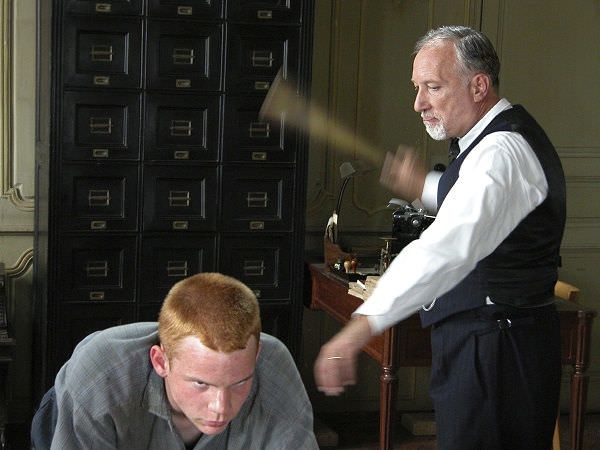
Pascale Mondain (Grégory Gatignol) bends over for a caning from headmaster M. Rachin (François Berléand) in the 2004 French fictional film Les Choristes, set in a grim rural boarding school in 1949.
|
Meanwhile, anecdotal evidence in the form of fictional but apparently reality-inspired films suggests that not only angry clouting of a student's head (Les Quatre Cents Coups) but even formal, bending-over caning ceremonies (Anthracite and Les Choristes) were not unknown in France in the 20th century, at any rate at boarding schools.
Other external links for France/Schools
 GERMANY: Judicial and prison CP
Corporal punishment as a judicial penalty ordered by the courts in Germany seems to have died out in the early 20th century, but the details of this change are not to hand. Benson and Glover (1931) claim there was no JCP at that time, and also say that there was no prison CP either. Benson (1937) repeats this latter claim, which appears by then to be incorrect.
Contrary to some reports, the 1933-1945 Nazi regime never officially had JCP on the statute book (though of course there was plenty of unofficial brutality of a more random kind). It did however have a policy of formal caning on the buttocks (max. 25 strokes, for males and possibly also for females) for internal disciplinary reasons in prisons and youth institutions. This soon came to include, but was certainly not peculiar to, the notorious concentration camps and death camps.
The legislation enabling prison caning was probably something the Nazis inherited -- along with the special equipment used -- rather than introduced themselves, though it might have been a revival of something that had in practice fallen into desuetude before 1933. In earlier times a birch or whip had been used. It is not clear when the change to the cane was made, but there is a reference to a "hazel stick" in Saxony in 1855.
There is also some evidence that, as the rule of law collapsed during WW2, the Nazi hierarchy sometimes "got round" the absence of JCP by sending dissident teenagers to a reformatory with the express instruction that they be caned on arrival, presumably on trumped-up disciplinary charges (letter from Himmler to Heydrich, January 1942).
It is not known whether these provisions fell into immediate disuse at the end of WW2, or when they were formally abolished.
DOCUMENTS:
Flogging in eighteenth- and nineteenth-century Germany
Descriptions of judicial birchings and prison whippings of men and women. According to this, CP for women was abolished in 1870 in Saxony.
GERMANY: School CP
There was a tradition of school corporal punishment in Germany until relatively modern times. The usual instrument was a cane, but the use of straps has also been reported anecdotally.
This 1903 news item summarises the then legal framework for CP in elementary schools: only as a last resort or for gross misconduct, and normally only for boys.
Contrary to myth, the Nazi regime (1933-45) did not reintroduce CP, because it had not been abolished. According to this July 1987 magazine article, what the Nazis did do was to "lift all restrictions" on it.
After WW2, different Länder (regional states) in what became the BRD (West Germany) dealt with the issue in different ways at different times: as time went on, caning was increasingly confined to older students, boys in particular. CP was not completely banned everywhere until 1983. This conflicts slightly with an unsourced claim by GPTEVAC that it has been prohibited since the 1970s.
This 1968 magazine article includes a photograph of a classroom with a boy bending over and being disciplined by the schoolmaster with what looks more like a paddle than a cane. We don't know whether the picture is posed or real. The text says that caning was legal at that time in elementary schools, and describes a case in Baden-Württemberg of a teacher being threatened by the State with dismissal for using CP but being supported by parents.
A July 1970 illustrated newspaper article noted that school caning had then only "recently" been abolished in Bavaria, and showed that state's "last school cane" being installed in a museum.
In the East, the DDR (1945-1989), like most communist states, always claimed there was no CP of any kind. It seems quite likely that this was not true.
EXTERNAL LINKS: (these will open in a new window)
The Rules Established for the Thomasschule
Modern English translation of a document from 1733 giving the internal regulations of the St Thomas School in Leipzig, where J.S. Bach was the Kantor (choirmaster and music director). The students at that time (all male) were aged from 10 to 24. There are references to canings with rods or sticks, but no details of the modus operandi. Boys could be caned for, among other things, being lazy or careless, truancy, stealing, and begging.
 Eric Carle: The very busy illustrator
The creator of "The Very Hungry Caterpillar" says he was caned on both hands at junior school in Nazi Germany.
 GAMBIA: Judicial CP
EXTERNAL LINKS: (these will open in a new window)
Responses of the Government of Gambia
Undated (c.mid-2000s) document, part of a UN study on "Violence against children". It sets out the then-prevailing provisions for the courts to order CP for youngsters, similar to those in many other formerly British territories (max. 12 strokes of the cane for boys under 17).
But in addition, most remarkably, a police officer above the rank of inspector, if aged over 30, could, without reference to the courts, himself summarily cane a boy aged from 7 to 18 for minor offences or "any misbehaviour in any public place". There was a maximum of 10 strokes "with a cane of a pattern approved by the Director of Health Services". This had to be done within 24 hours of the misbehaviour. There was a similar provision for girls, but only if aged over 13 and to be administered by a female officer.
GPTEVAC says JCP was abolished in 2005.
 GHANA: School CP
A 2001 newspaper editorial stated that caning had been gradually phased out. This turned out to be entirely untrue. Several more recent news items have reported parents and opinion leaders calling for the "reintroduction" of corporal punishment, but no evidence is to hand that it was ever legally banned, and there have been many reports of its use.
This November 2005 news item made it clear that corporal punishment was in fact widespread and legal. In theory it was regulated by the Ghana Education Service, which laid down a maximum of six strokes and sought to discourage the use of CP in the classroom by ordinary teachers. Rather, the caning should be given by the headmaster or under his supervision.
"Traditional rulers" (tribal chiefs) called in Oct 2007 for the "reintroduction" of school CP, by which they appear to have meant that classroom teachers should have the power to cane, not just headteachers.
A 2011 opinion poll found that 94% of parents, 92% of students and 64% of teachers favoured the use of corporal punishment.
See also this photograph of a schoolgirl being caned in class. There is also a video clip of a teacher randomly caning girls and boys in a schoolyard, but it is not clear whether it is intended as a punishment or just a game.
A handful of Ghanaian schools say on line that they use the cane.
In Jan 2019 the government announced that caning was now banned in primary and secondary schools, private as well as public.
EXTERNAL LINKS: (these will open in a new window)
GPTEVAC confirms the rules mentioned above. It clarifies that (as at March 2020) school CP is still lawful in Ghana; the government's ban is administrative policy merely, and has not been confirmed in legislation.
Other external links for Ghana/Schools
 GRENADA: Judicial and prison CP
Grenada is a very small former British colony in the Caribbean. Judicial CP is lawful but is due to be outlawed. No details are available beyond what is in the external links below, and no reports of actual cases have come to light.
This 1902 news item sets out the then-new rules for flogging by cat or birch for misconduct in prison.
EXTERNAL LINKS: (these will open in a new window)
According to GPTEVAC, flogging and whipping for adults is still in force in Grenada. Boys aged 7 to 15 may be whipped but not flogged. Girls may not receive JCP. A new law to abolish these provisions was passed in 2012 but had not come into force by Feb 2020.
US State Department Human Rights Report for 1995
This notes that floggings (no details provided), though rare, were ordered for sex crimes and theft cases. (The USSD reports for 1996 to 2004 inclusive repeat the same information.)
US State Department Human Rights Report for 2005
Flogging "was rare but was used as punishment for sex crimes", which accounted for 50% of all court cases, according to this. (The USSD reports for 2006 to 2009 add nothing new.)
US State Department Human Rights Report for 2010
Flogging, described as "rare" for many years previously, suddenly becomes "not uncommon" for sex crimes and assault in the 2010 report, but no specific cases are mentioned and no statistics given.
 GUATEMALA: Judicial CP
Like other Latin American countries, Guatemala has no official judicial CP at national level. However, a 1996 treaty allows local indigenous tribes to apply customary punishments to their own people for certain crimes, even if these would otherwise be contrary to the national law.
An example of where this included CP was seen in April 2006, when four Mayan youths were ordered by local elders to be publicly spanked by their parents, as shown in this video clip.
For another case, see this May 2006 press item (in Spanish with rough English translation), which includes a photo of a young man showing the scars on his back after receiving 75 strokes with peach-tree branches on the orders of local leaders following a public debate among the Kaqchitel people of his village. He was punished for carrying firearms and attempted kidnapping.
A couple of more recent public whippings are seen in these video clips.
 GUYANA: Judicial CP
Guyana used to have judicial whipping on its books both for adults and for juveniles. Here is an adult case in 1946. It is not known what instrument was used.
Judicial whipping for juveniles under 17 (which applied only to males) was outlawed in 2010. JCP for adults remains legal. We have not come across any reports of the penalty having been used in recent times. There is no mention of it in US State Department reports.
EXTERNAL LINKS: (these will open in a new window)
Sentencing of children in Guyana [DOC]
This Child Rights Information Network document confirms that whipping for juveniles and for all females is outlawed, but that JCP is still on the books for males aged 17 and over.
GUYANA: School CP
Under rules issued by the Ministry of Education in 2004, corporal punishment in schools in Guyana is meant for severe or repeated offences only, and should be administered by the head teacher, or in his or her presence by a specifically delegated assistant, who in the case of a girl student must be female. A record is to be kept.
Certain activists have been campaigning for CP to be abolished, but there appears to be strong support in various quarters for its retention as well as some resentment at interference by UN bodies, one correspondent in the local press pointing out (correctly) that the UN Convention on the Rights of the Child does not in fact prohibit school corporal punishment, or even mention it.
In Oct 2008 the Education Minister was quoted as saying that draft legislation was being brought forward to "reintroduce" corporal punishment in schools. It is not clear what was meant by this, since CP was already lawful and had not been abolished.
EXTERNAL LINKS: (these will open in a new window)
GPTEVAC
GPTEVAC (2020) quotes Guyana's 2002 ministerial guidelines: "Corporal punishment must be administered only by the head teacher, deputy head teacher or designated senior teacher and only for certain offences (including fighting and use of indecent language); boys should be punished on their hands or buttocks, girls on their hands; the punishments should be inflicted with a cane or strap no longer than 24 inches and not in the presence of other learners, and all punishments should be recorded in the Misdemeanours Book."
Committee on Rights of Child reviews initial report of Guyana
A government spokesperson maintained in this 2004 UN report that CP was used in schools only "in extreme cases" and "under controlled circumstances in accordance with the Education Act".
 HONG KONG: Judicial CP
Judicial caning was abolished in 1990. Thitherto it had been used by the courts, for relatively serious offences, on juvenile and adult males, usually but not always in addition to a prison term. Caning sentences were frequent in the 1950s but gradually declined to a handful per year in the 1980s.
Benson (1937) claims that there were 191 instances of JCP in Hong Kong in 1930, and only 61 in 1935.
An Associated Press report in The New York Times (24 Aug 1989) said that 476 canings were awarded in 1952. According to this January 1989 news item, there were only 8 cases in 1988.
DOCUMENTS:
Ordinance No 39 of 1954 as amended
Former legislation governing HK caning sentences (max. 18 strokes). The instrument was "a light cane or rattan", to be administered on the breech. If the offender chose to waive his right to appeal, he was to be caned within 24 hours of the sentence. These rules applied to males over 16; younger boys could also be sentenced to a caning, evidently under some other rules not currently to hand.
Public Order Ordinance 1981
Legislation providing for the caning of offenders of 14 years and over found in possession of an offensive weapon.
Patten may appeal for clemency on sentence
Officers hated caning offenders
Anecdotal reminiscences in the local press of Hong Kong judicial canings. According to these reports, the rattan used was over 1 metre long. A leather strap was tied round the recipient's back to protect the spine. His hands were secured by leather straps to a "wooden platform" (the meaning of this is unclear) and he was made to bend over with his trousers down. This earlier report speaks of bending over a "thick leather bar" and states that bleeding sometimes occurred.
The general impression given by these accounts is that the punishment was probably not dissimilar to present-day judicial caning in Singapore, though perhaps not quite so severe.
See also these pictures of the equipment used, now on display in a museum. The cane shown, if it really is the genuine article, appears to be rather more than half an inch thick, hardly the "light cane" mentioned in the legislation. This video clip shows the caning equipment in the museum being used in a dummy demonstration.
EXTERNAL LINKS: (these will open in a new window)
Leung Shing-wong v The Queen
Case in the Court of Appeal (November 1970). The appellant aged 36 had been convicted of robbery and sentenced to 18 months in prison plus 14 strokes of the cane. The appeal court quashed the jail term but upheld the caning sentence. It did not think prison was appropriate in this case. "On the contrary, ... it would be infinitely preferable if after the sentence of corporal punishment has been carried out the appellant should be ejected from the precincts of the prison at the earliest possible opportunity so that any visible discomfort which he may be suffering at the time may be readily apparent to ... the public ... and to any of his friends who may be minded to commit [this] type of offence ...".
Hong Kong: Human Rights, Law and Autonomy -- The Risks of Transition (Alternative link)
Near the end of this long Amnesty document, in an Annex summarising previous concerns about Hong Kong, is a note about a controversy that arose in 1988 after two teenagers were caned for robbery.
HONG KONG: Reformatory CP
Reformatory School Rules, Cap.225 L.N.163/77
1977 regulations for the award of caning to "male detained persons" for certain offences against reformatory discipline. The medical officer was required to be present, from which we may deduce that these canings were a fairly serious business, even though administered "on the clothed buttocks" unlike the judicial ones in HK. Also interestingly different from, for example, British reformatory rules in that they give 48 hours in which to exercise a formal right of appeal to the Director, but the offender may waive this right and elect to undergo his punishment forthwith.
These provisions no longer apply; it is not known when they were repealed.
References:
-- Allott's Judicial and Legal Systems in Africa, 2nd edition, Butterworth, London, 1970
-- Benson, Sir George, Flogging: The law and practice in England, Howard League for Penal Reform, London, 1937 (in particular Appendix I, "The law and practice of other countries").
-- Cadogan Report (Report of the Departmental Committee on Corporal Punishment), London, 1938.
-- Keefe, Eugene K., Countries of the World, Bureau Development Inc., 1991.
-- Kalet Smith, Anna, Juvenile Court laws in foreign countries, Children's Bureau, Social Security Administration, Federal Security Agency, Washington DC, 1949.