AUSTRALIA
Corpun file 26212
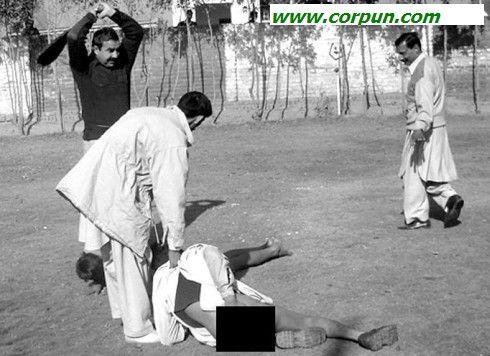
Australiana Pioneer Village

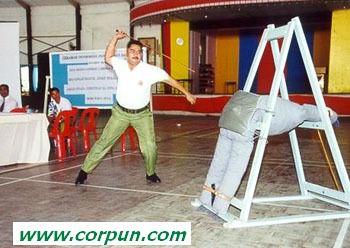
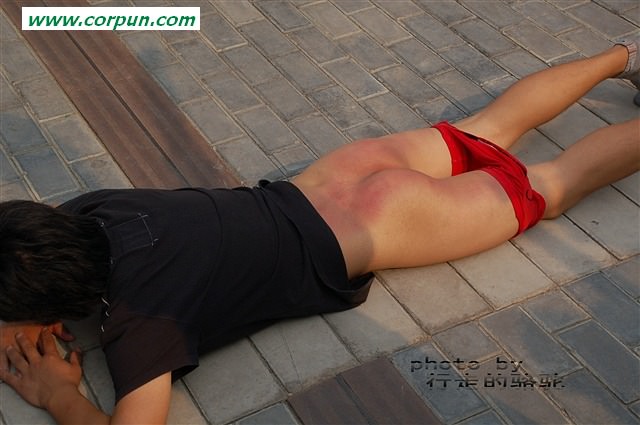
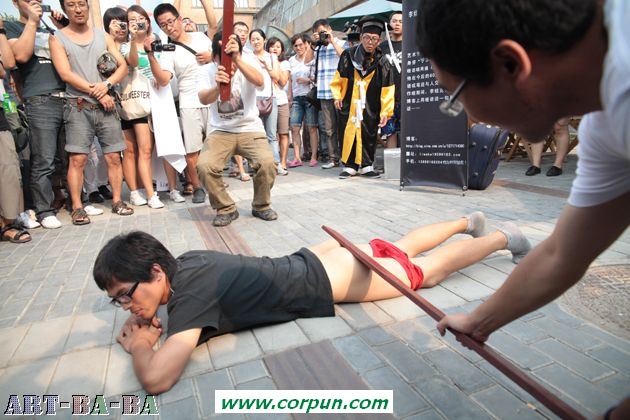
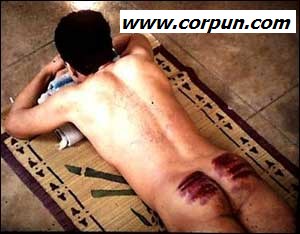
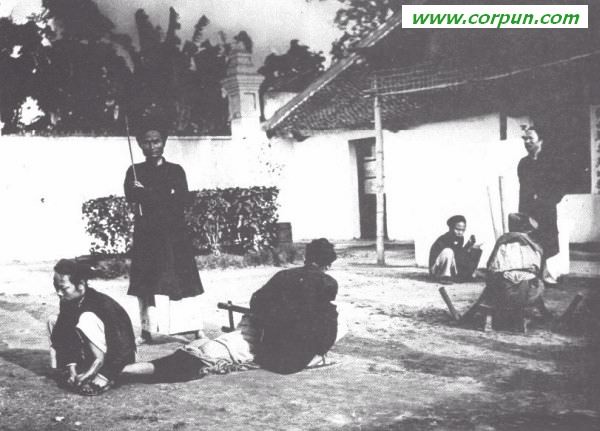
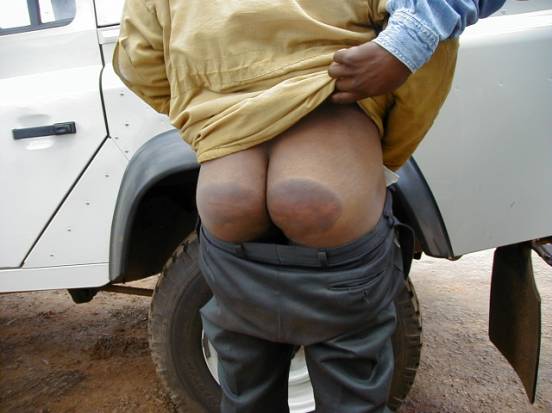
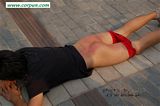
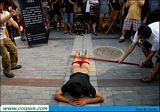
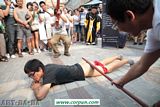
Re-enactment of a whipping with the "cat" at the Australiana Pioneer Village in Wilberforce, just outside Sydney.
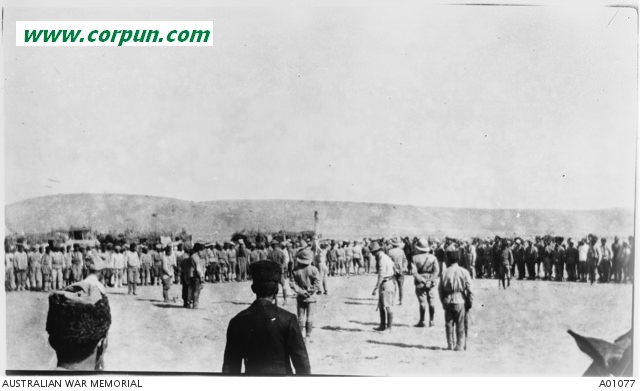
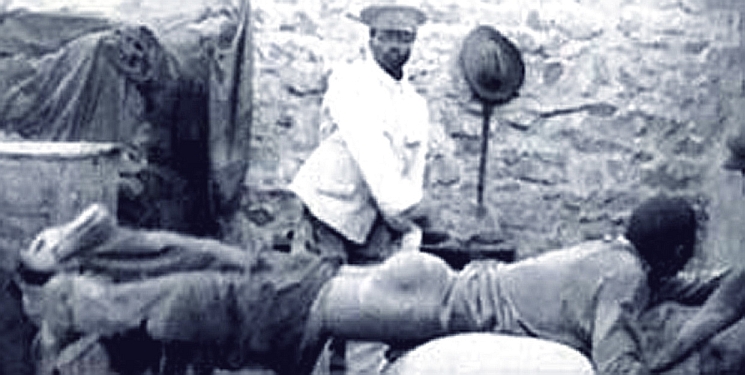
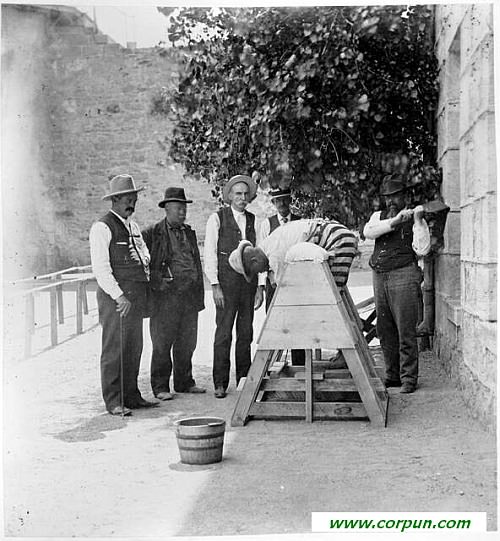
Corpun file 25797a
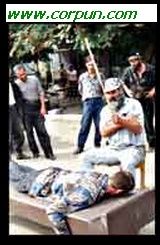
Dunsterforce flogging
Dunsterforce was a company of Australian and other Allied irregulars in 1917-1919 deployed across Greater Persia (now Iran, Iraq and the Caucasus), named after its commander, Gen. Lionel Dunsterville. This picture from c.1918 is captioned "Men gathered around to witness a battalion flogging of Dunsterforce irregulars for an assault on an NCO".
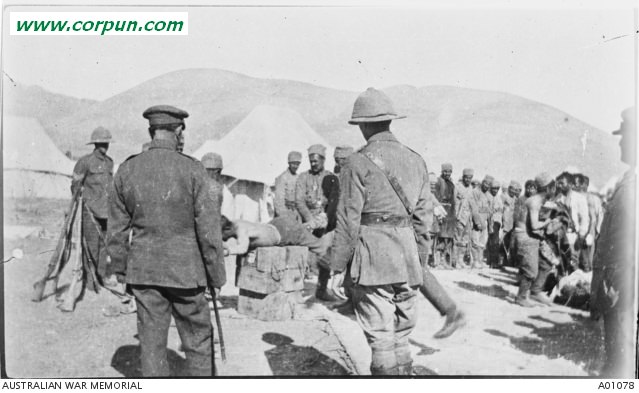
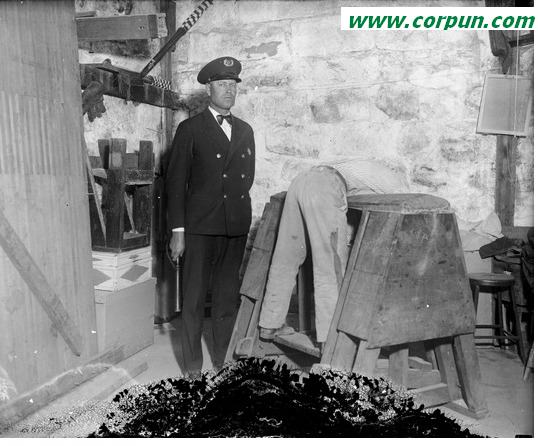
Corpun file 25797b
Another Dunsterforce flogging
"Persia, c.1918. A Dunsterforce company irregular being held over four boxes by his arms and legs in readiness for a flogging for stealing forage." He is stripped to the waist, presumably to be whipped on the bare back.
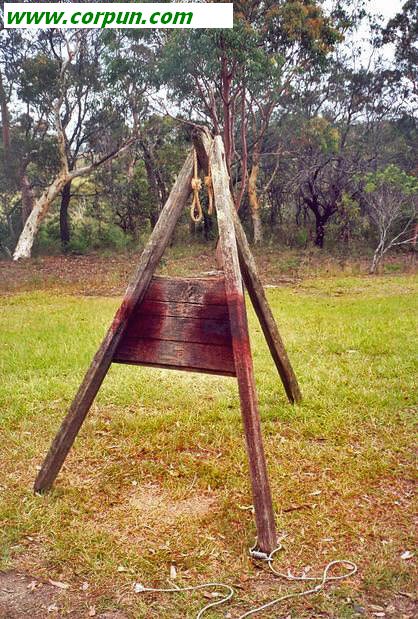
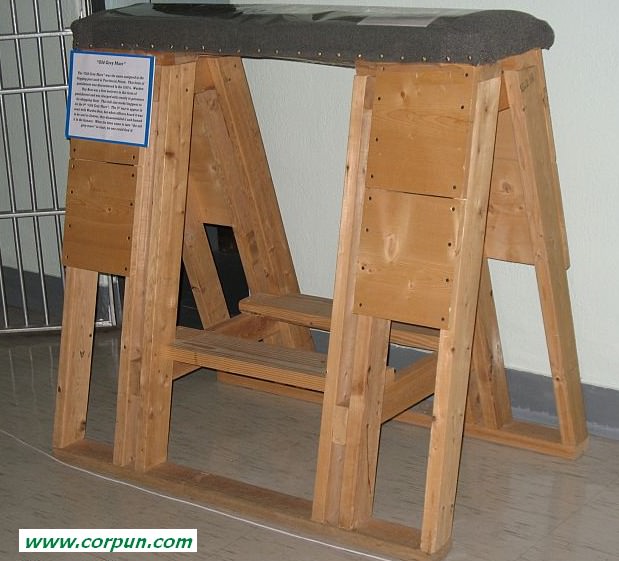
Corpun file 23780a
Flogging triangle
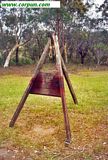
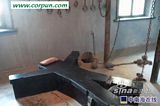
Here is a flogging triangle from Old Sydney Town, Somersby, on display at Gosford, New South Wales. My informant writes: "The wood is old but not the ropes, which might not be authentic in their arrangement. A pulley seems more likely. The top rope appears to be handcuff-like, with slip knots, with the middle hooked over the third leg of the tripod. This arrangement does not provide well for prisoners of differing heights."
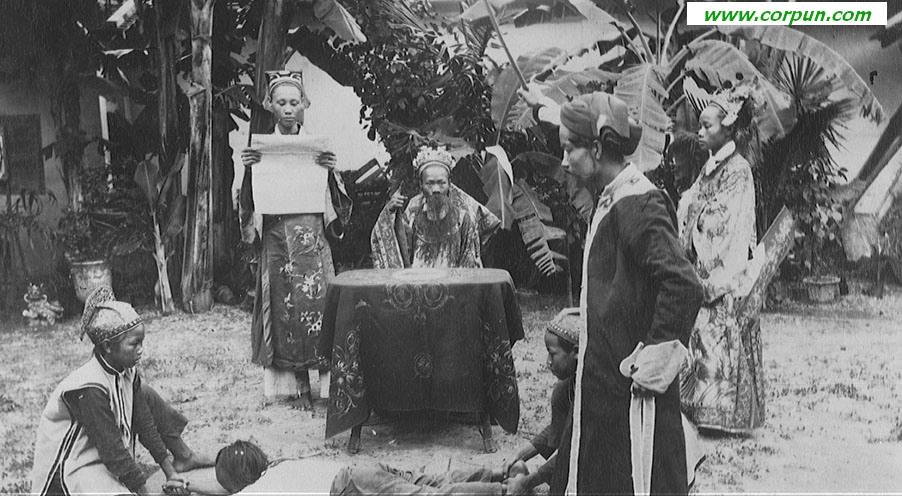
Corpun file 23780b
The above triangle "in use"
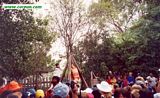
Actor Anthony George plays convict Wilbur Ramsay in this modern re-enactment (April 2010) of a flogging using the equipment at Gosford illustrated above.
 AUSTRIA-HUNGARY
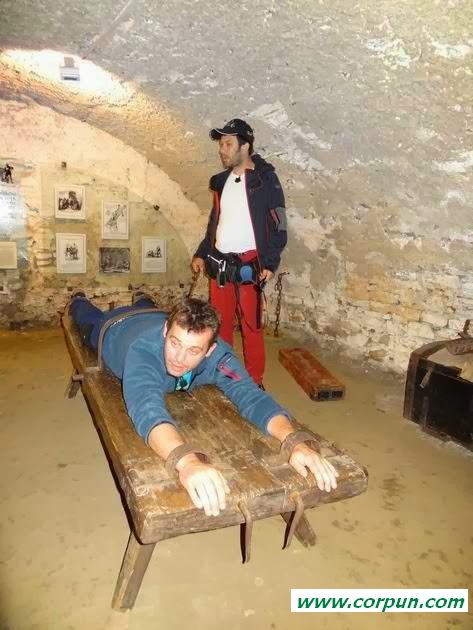
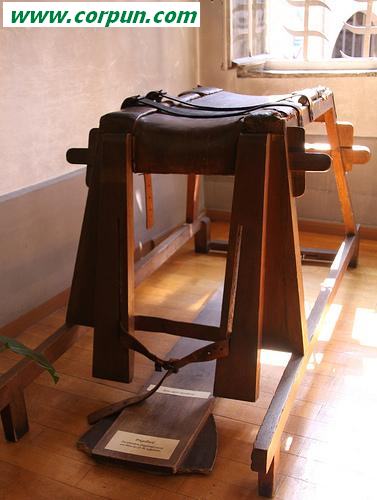
Corpun file 24804
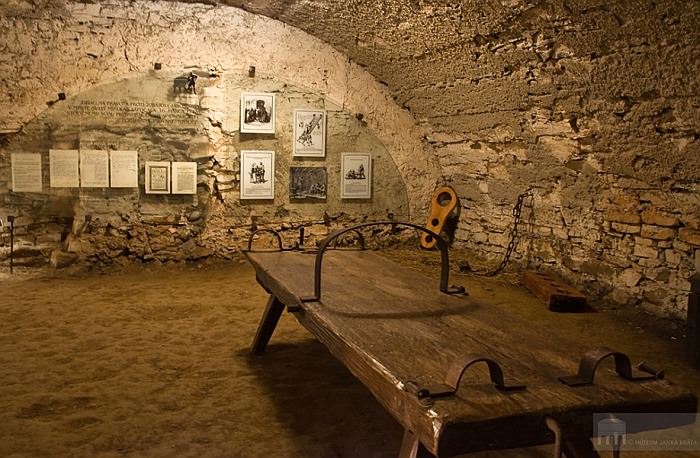
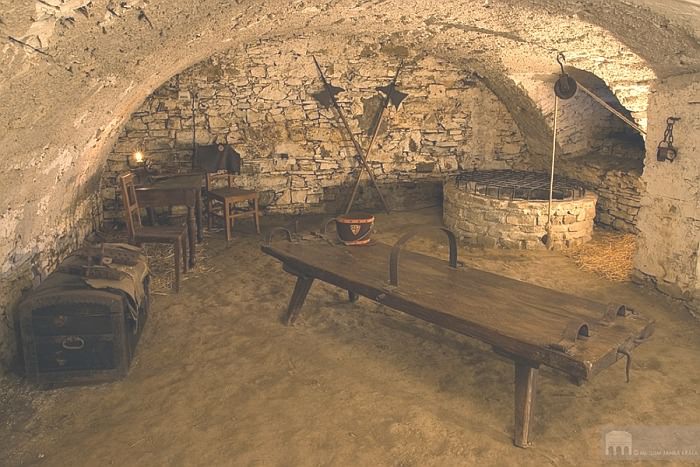
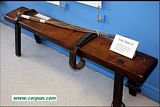
Punishment bench, Museum Janko Kral
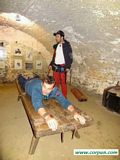
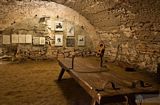

The military in the former Austria-Hungary empire used a flat bench for flogging. This example is at Liptovsky Mikulas in present-day Slovakia. Note iron bands for waist, ankles and wrists.
Corpun file 24803
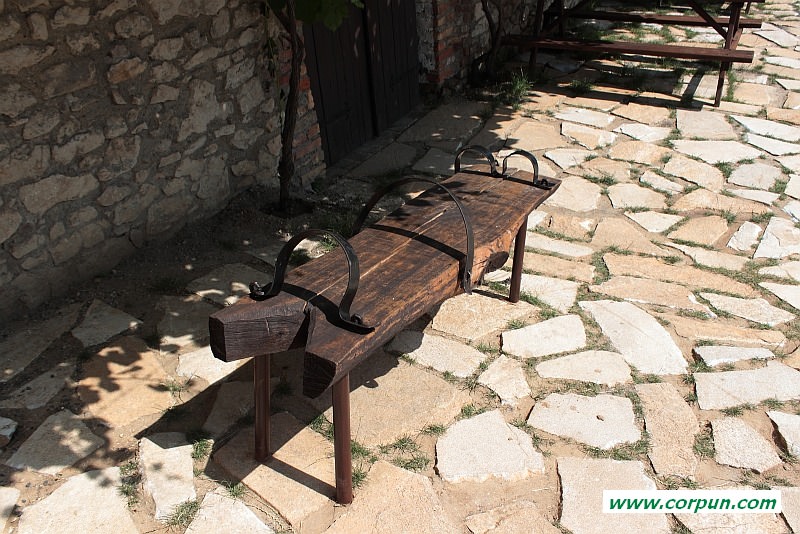
Punishment bench, Sumeg Castle
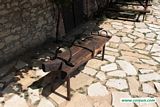
A similar piece of equipment at this tourist site in Hungary.
Corpun file 19927
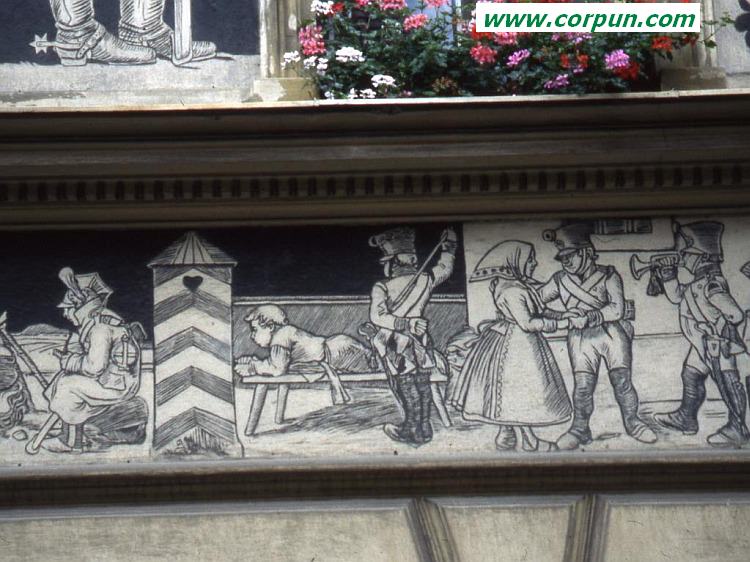
Frieze in Prague
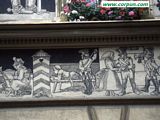
This is part of a frieze on the front of a building of c.1900 in Prague depicting scenes of the period (up to 1918) when the Austro-Hungarian Empire included what is now the Czech Republic. My informant says the design (technically "sgraffito" or etching) represents an Austrian officer caning a young Czech soldier, who is lying flat on a bench with his wrists tied, receiving punishment across the seat of his pants.
Corpun file 19464
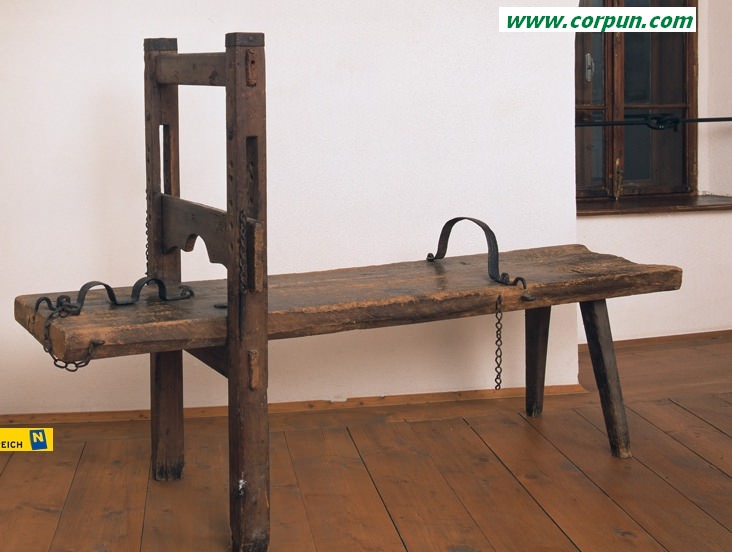
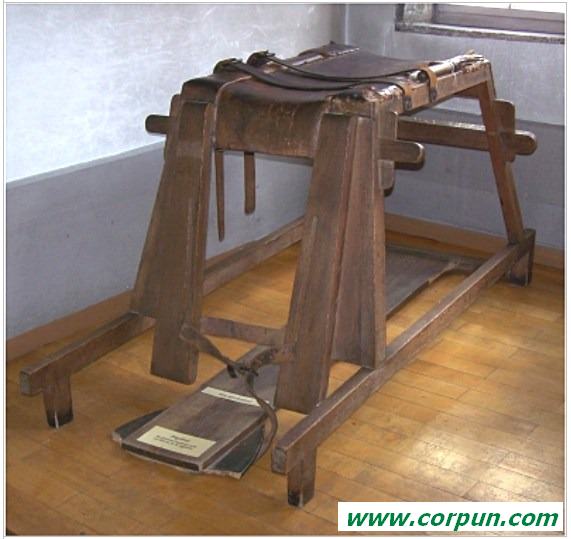
Whipping bench, Zwettl
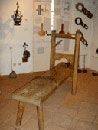
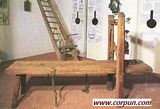
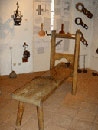
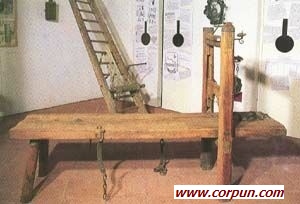
Zwettl is a town in Lower Austria. This machine is in its local museum. It looks at first glance like a guillotine for beheading people, but evidently the device at the head end is just for holding the culprit's head firm during the flogging. Note straps/chains for securing lower body to bench.
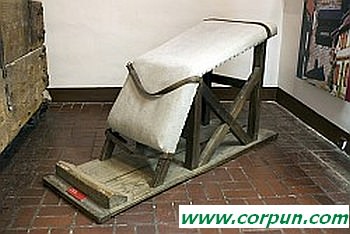
Corpun file 21446
Prügelbank (whipping bench)
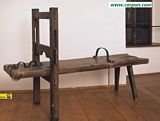
This appears to be essentially the same as the previous item, possibly suggesting that standard equipment was provided centrally. This one is at the Niederösterreich (Lower Austria) regional museum at St Pölten.
 BENIN
BENIN
Corpun file 23871
"Dahomey - Préparation à la bastonnade" (Preparations for whipping)
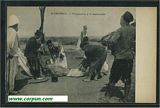
Benin, in West Africa, was known as Dahomey until 1975. This postcard has a look of the early 20th century about it. Since the caption is given in French, we can probably date it to later than 1894, when France established itself as the colonial power.
The offender is held in position lying flat on the ground. We see that his buttocks are being bared for punishment. The implement to be used would appear to be the whip lying on the ground to the left.
One might speculate that this typically African procedure predates the arrival of the French, for whom formal judicial CP would have been an alien concept, and that the new colonial regime just left the local rulers to carry on as before in this regard.
 BRUNEI
Corpun file 8190
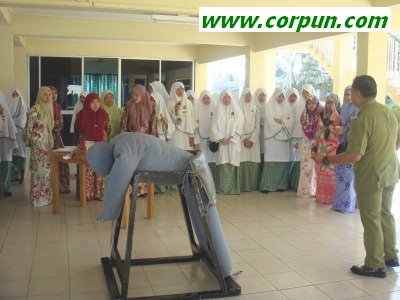
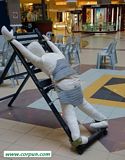
Demonstration on a dummy of judicial caning in Brunei
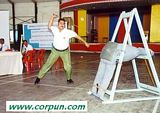
This is clearly what it says it is, and it comes from the now-defunct webpage of the Brunei school at which the demonstration took place, as a live illustration for an anti-drug talk. However, on the same page was also this photograph of pupils passing round a picture, evidently of the wealed and bruised buttocks resulting from such a caning, though we cannot be certain that that picture is itself genuine.
Compare this September 1998 news report of an educational prison visit by another school group. This likewise involved a caning demonstration on a dummy (pictured) and the text states that "many cringed when pictures of lacerated and bleeding behinds were shown..." It seems a little strange that at both events, intended to scare kids off starting on drugs, all the students shown are girls, who cannot be sentenced to caning anyway.
Corpun file 22955
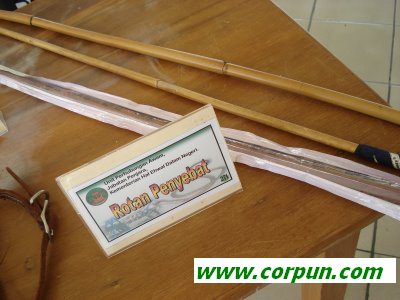
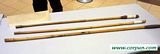
Another dummy demonstration in Brunei, and the canes used
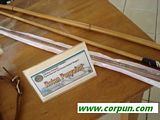
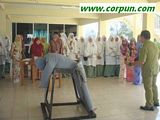
This dummy demonstration, at a student visit to Jerudong Prison in Nov 2008, uses a rather less elaborate kind of trestle. In the second picture are shown the two types of canes, the smaller one being for offenders under 17.
Corpun file 25746
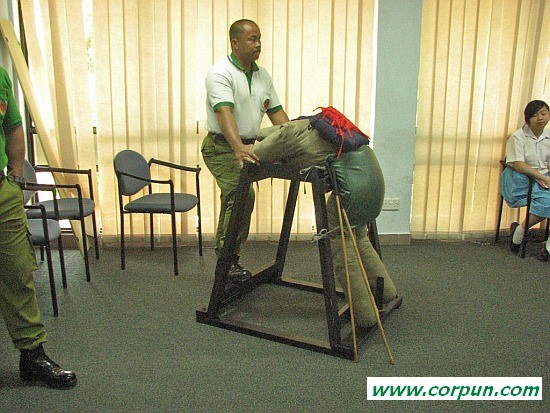
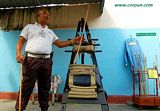
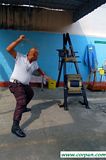
Yet another dummy demonstration in Brunei
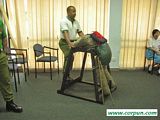
This was a demonstration given at a local school in 2012.
 CANADA
Corpun file 25390
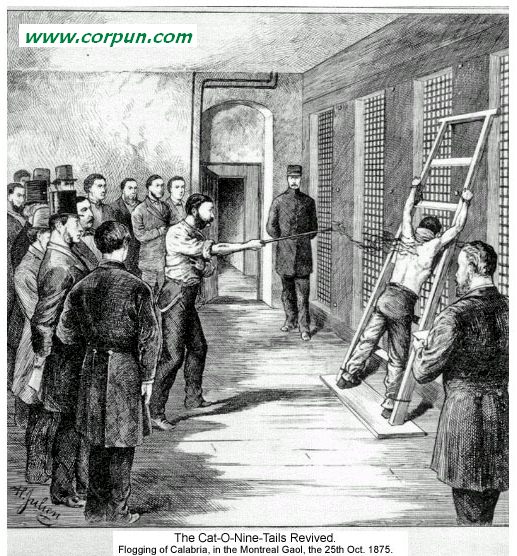
Flogging with the cat-o-nine-tails
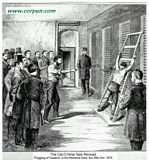
Drawing of a flogging in Montreal Gaol on 25 October 1875. Captioned "The cat-o-nine-tails revived", it was published in the Canadian Illustrated News on 6 November that year.
Corpun file 21844
Straps and cats
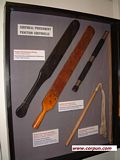
Display in the museum at Kingston Penitentiary, Ontario. At left is the federal penitentiary strap, said to date from c.1903. Next to it is the slightly longer Ontario Provincial Jail strap. At right are two cats-o'-nine-tails, one British and the other Canadian. See this feature article.
Corpun file 23011
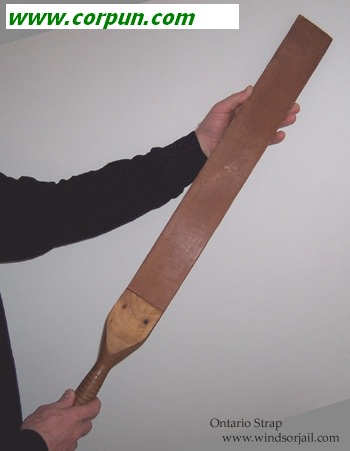
Another strap
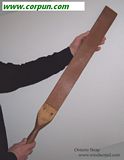
Another picture of the Ontario strap. This one, or at least the picture of it, is at Windsor Jail. It seems to be longer and wider than the ones illustrated in this article.
Corpun file 15761
Whipping post, Newfoundland
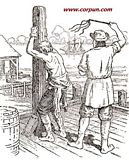
This is supposed to represent a punishment carried out in Newfoundland in the early 1700s by the "fishing admiral". It shows a cat-o'-four-tails, and appears in J.A. Cochrane, The Story of Newfoundland, Montreal, 1938. We should bear in mind that the drawing was probably made in 1938 and not in the 1700s, so may or may not be reliable.
Corpun file 23431
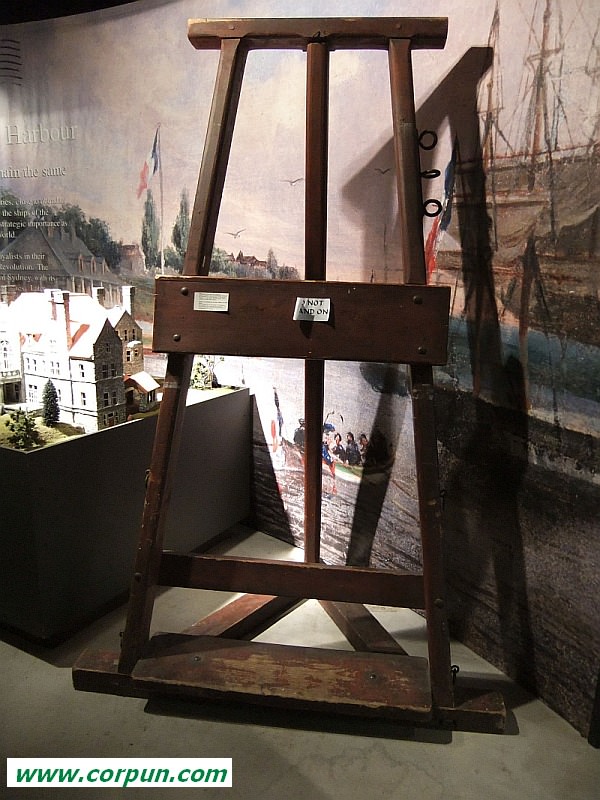
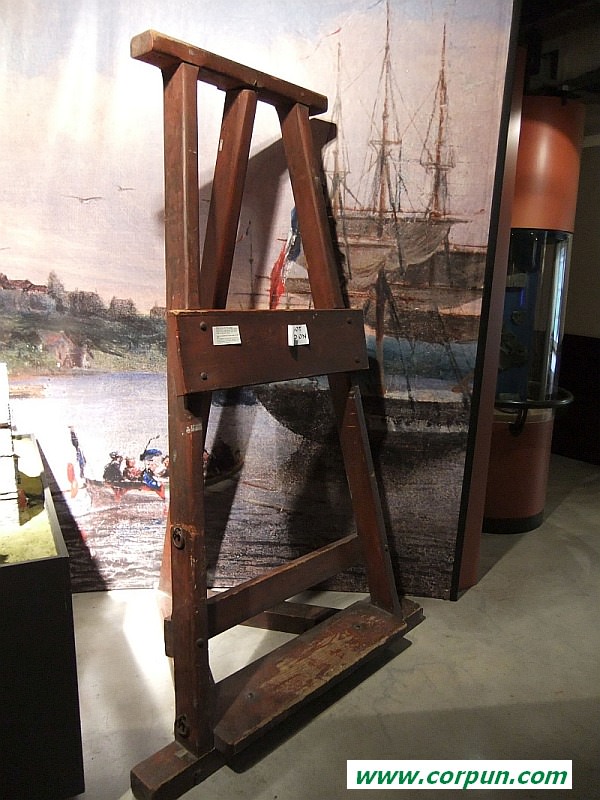
Whipping frame, Nova Scotia
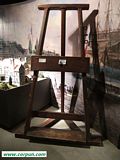
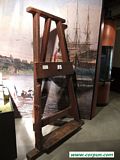
This dates from the mid-19th century and was originally at the courthouse in Sydney, Nova Scotia. It is now part of a display of Cape Breton culture at the Joan Harriss Cruise Pavilion. My informant says that it is about 7 feet high.
Corpun file 24364
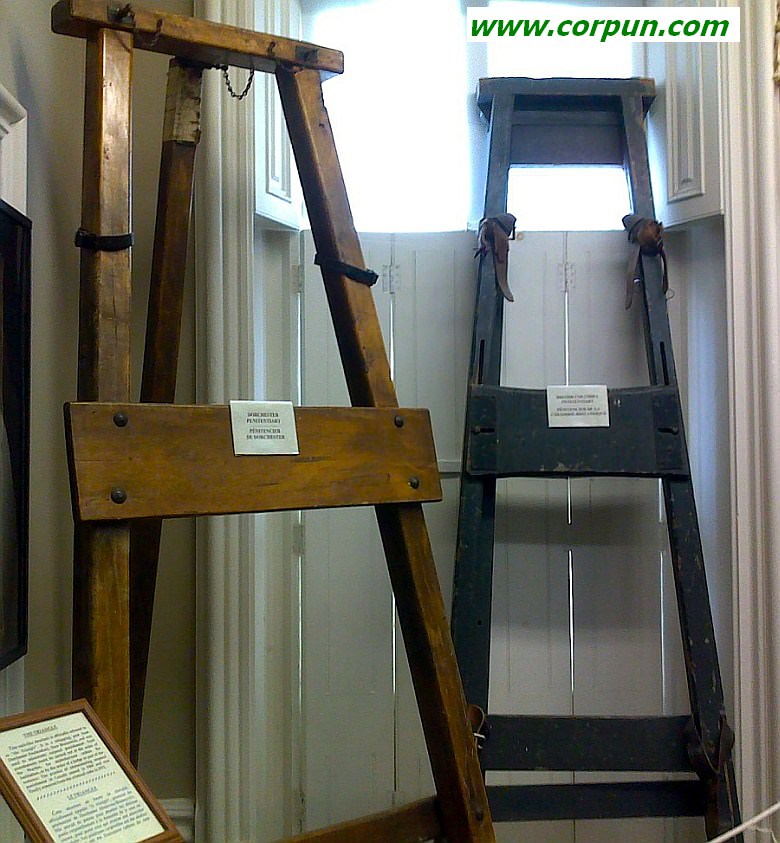
Whipping frame, Dorchester Penitentiary
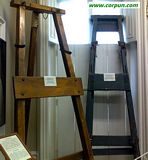
These frames, less elaborate than those above, are on display at Keillor House Museum in Dorchester, New Brunswick.
Corpun file 25387
Strapping bench with straps, Dorchester Penitentiary
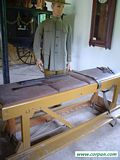
Also at Keillor House Museum, a bench over which prisoners were tied to be strapped on the bare buttocks. Compare with these examples from other prisons.
 CHINA
CHINA
Corpun file 21100
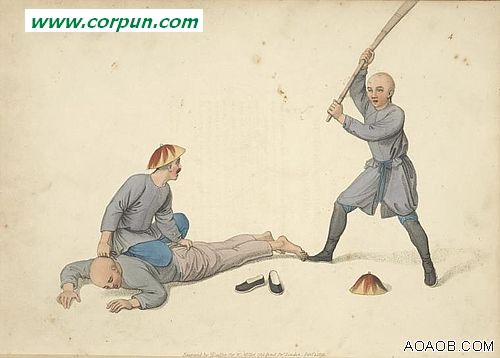
19th-century Chinese punishment
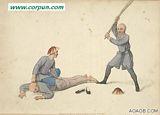
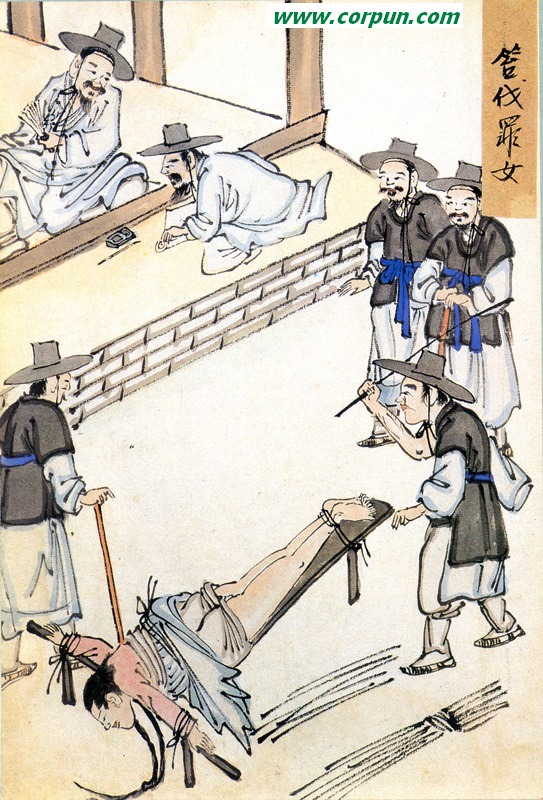
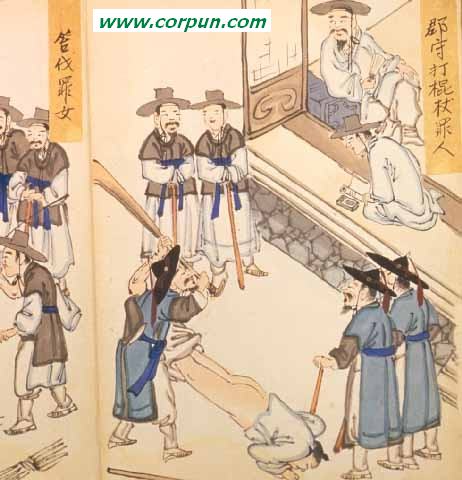
Picture of a criminal being punished with some sort of big paddle. This comes from a Korean site, but is said to represent China in the 19th century. The offender has kept his trousers on, but it looks as if the assistant is pulling them taut across the posterior.
Corpun file 21789
"Bambooing his breeches"
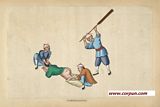
Rather similar to the previous item, except that this undated gouache on rice paper (held in the New York Public Library) shows that the culprit's trousers have been lowered to uncover his buttocks.
Corpun file 26014
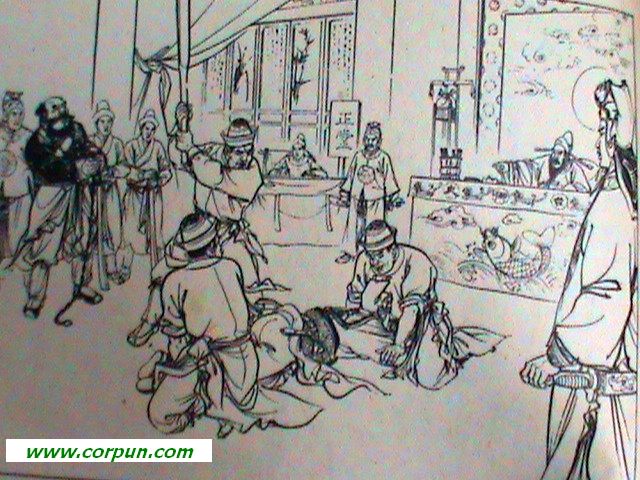
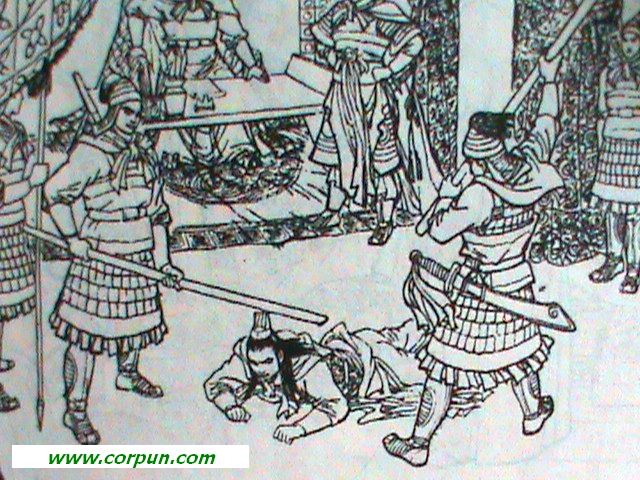
More old drawings of punishment
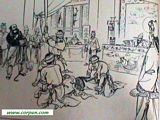
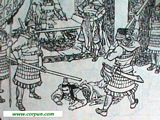
Two representations of ancient imperial China, date unknown. Again, the culprit is shown lying face down on the ground. These appear to be from a fictional comic book, but might perhaps be broadly realistic. The implement is a big long paddle and the setting is possibly a court.
Corpun file 15892
Gyatse Dzong fortress, ancient punishment
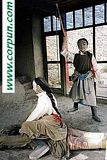
This tableau or model is said to be a representation of a flogging in ancient Tibet. As far as I can make out, one official is sitting on the offender's back while the other beats the back of his thighs with a big stick.
Corpun file 16553
Criminal being punished
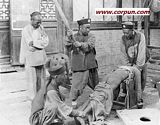
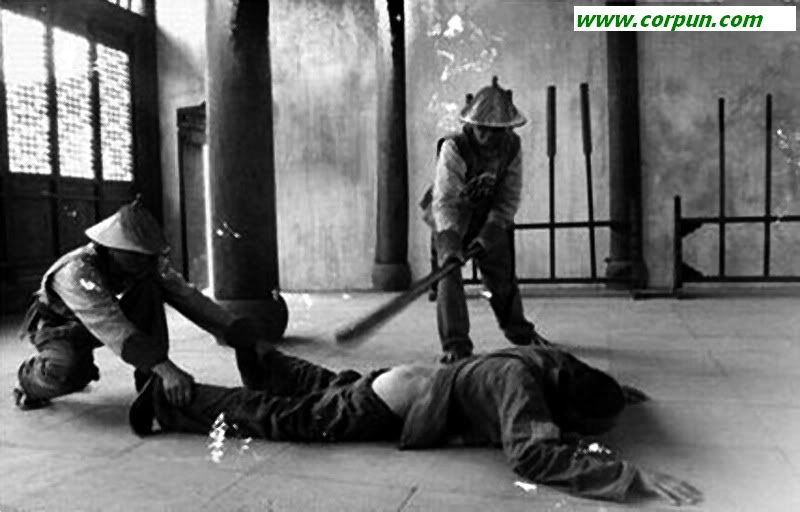
Found in a picture agency's library, this is a contemporary photograph of the real thing, dated "circa 1900", and its caption reads: "Chinese punishment: Whipping a lawbreaker. Even the theft of a few pennies brought about this severe reprisal." Note that the modus operandi is identical to that in "Wei Hai Wei flogging" (see below).
Corpun file 24120
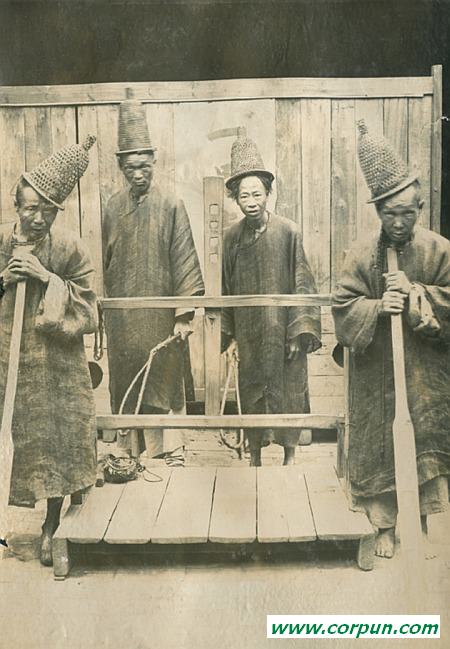
"Stocks for punishment beatings", c.1895
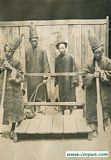
It is not clear how this piece of equipment would have functioned, but note the long paddles as seen in the previous picture.
Corpun file 22424
Another judicial paddling
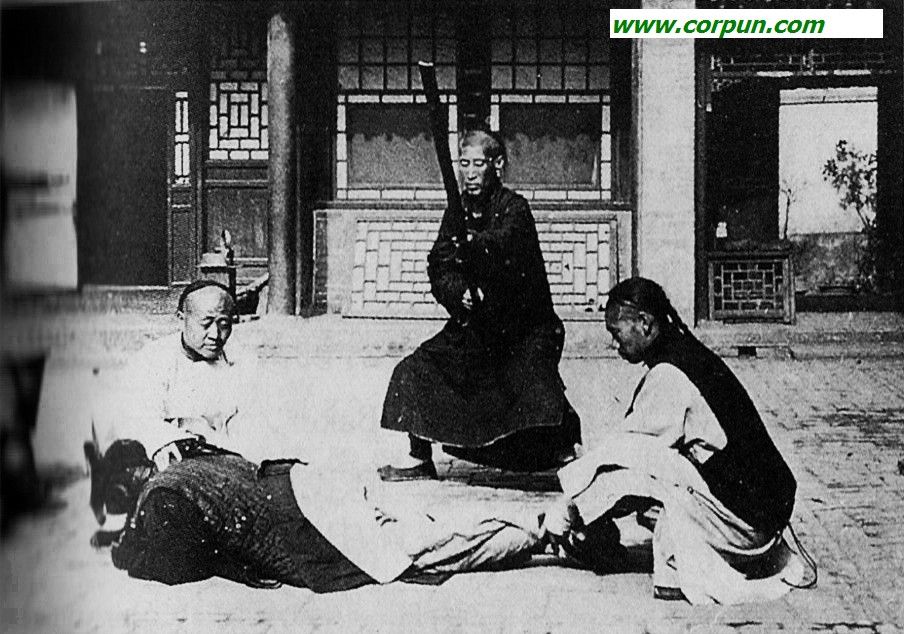
Another real-life photograph, described as "Qing Dynasty", which dates it to before 1912. In this case, the offender is simply lying flat on the ground, as in many of the earlier etchings and paintings. It is a bit unclear, but the buttocks appear to have been uncovered for punishment.
Corpun file 22426
More of the same kind of thing
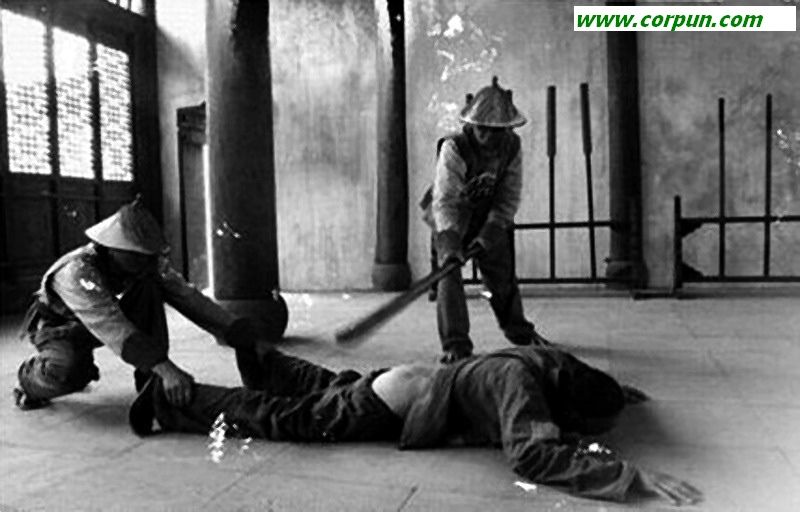
And another one. This is clearly a punishment on the backside.
Corpun file 14695
Punishment of the Bastinado
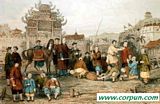
Hand-coloured engraving from a painting by Thomas Allom, published in London around 1843. Most dictionaries define bastinado as a punishment applied to the soles of the feet, but this is clearly a caning on the clothed backside. For a glimpse of the long history of this kind of punishment in China, and a much older illustration, see this 2003 news item.
Corpun file 3930
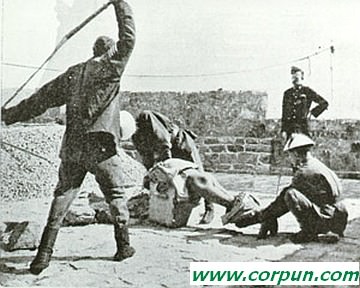
Wei Hai Wei flogging
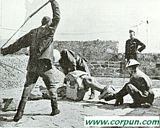
From an undated postcard, which had "punished for stealing" written on the back. Wei Hai Wei is a port and naval base on the north coast of the Shantung Peninsula. It was leased to the British (who called it Port Edward) from 1898 to 1930, hence perhaps the British-looking soldier who is evidently monitoring this infliction. However, the modus operandi shown here is more traditional Chinese than British.
Corpun file 19432
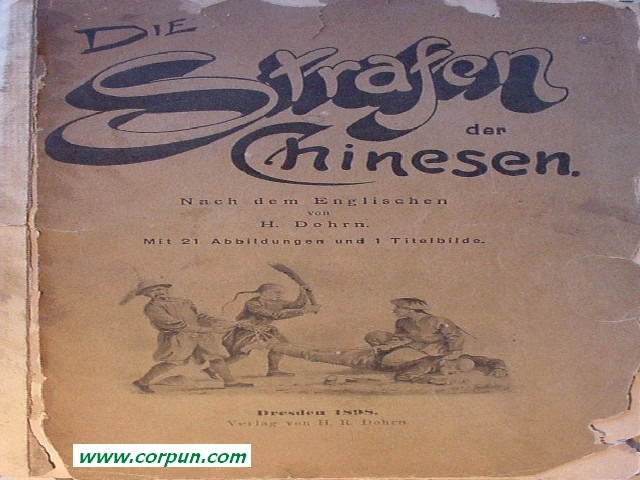
The Punishments of China
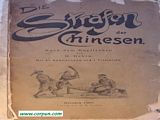
Cover of a book in German, literally "The punishments of the Chinese", published in Dresden in 1898, translated from English, it says. I deduce that this was probably a translation of The Punishments of China, illustrated by twenty-two engravings, attributed to George Henry Mason (London, 1801), which I have not seen but which, according to various catalogues, includes an engraving -- very possibly the one seen here -- captioned "An offender undergoing the bastinade".
Mason was one of few Westerners to visit China in the 18th century, and it is conceivable that he was actually shown some of these events.
Note similarity of modus operandi to that shown in the pictures above.
 CONGO (formerly BELGIAN CONGO)
Corpun file 3298
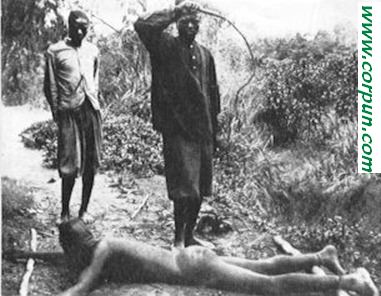
Native flogging
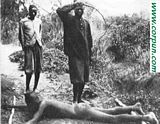
This picture has appeared in various places, most recently in King Leopold's Ghost: A Story of Greed, Terror, and Heroism in Colonial Africa by Adam Hochschild (Boston, 1999). It seems likely to be from the period around 1900 when the King of Belgium was running the Congo as his personal fief with the aid of slave labour. The culprit is completely naked, but the strokes of the whip appear to be landing across the buttocks alone. It seems a bit odd that this is going on in what looks like a country lane. Perhaps other officials are present, but out of shot.
Is the onlooker an assistant to the operation, or -- noting his rather hangdog posture, and the fact that he seems to be holding his own bottom -- another offender waiting his turn? The "lying flat" position is typically African, but note that the ankles and wrists are tied to crossbars on the ground to keep the recipient immobile. Flogging was reserved for Africans (see following item).
Corpun file 15342
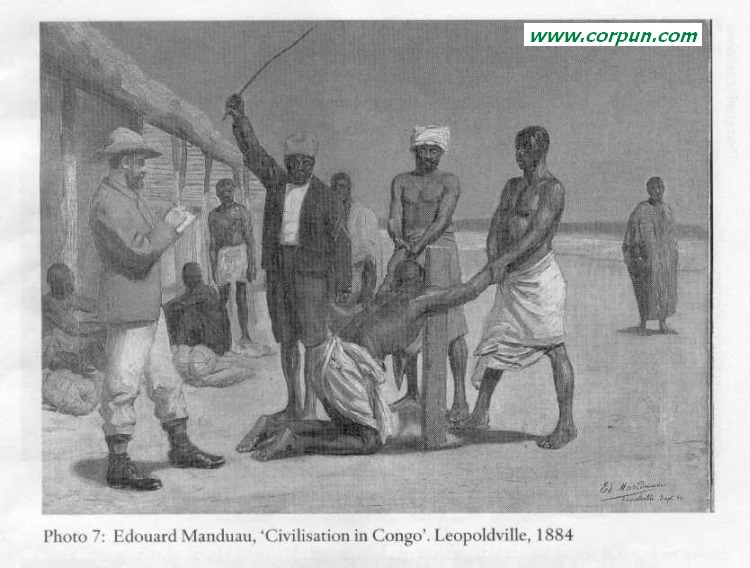
'Civilisation in Congo'
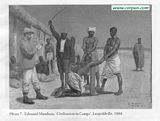
Painting dated 1884, shown at a "Memory of Congo: The Colonial Era" exhibition in Brussels in 2005. The exhibition's caption said: "Flogging by whip or stick, a punishment reserved for Africans, was allowed by penal law until 1940. It was also allowed by army and prison regulations. It could also be used as a form of punishment wherever custom allowed it. Flogging had already been denounced when Stanley was 'founding the Free State'. It was then a vestige of pre-colonial slavery. Thus it is not enough to regard the whip as simply the symbol of colonial oppression."
This punishment is being given on the upper back, in contrast to the previous item, which gives photographic proof of flogging on the bare buttocks. Does this mean that practice varied in an ad hoc manner from one occasion to another? Or could it be that the artist in 1884 was inhibited by the prudery of that era from showing the reality?
 EGYPT
EGYPT
Corpun file 14958
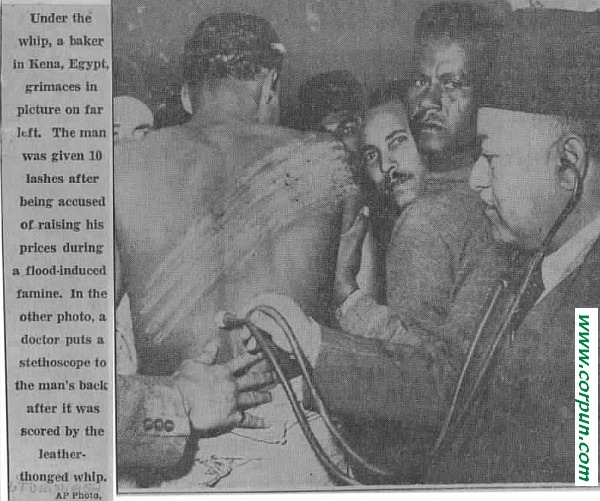
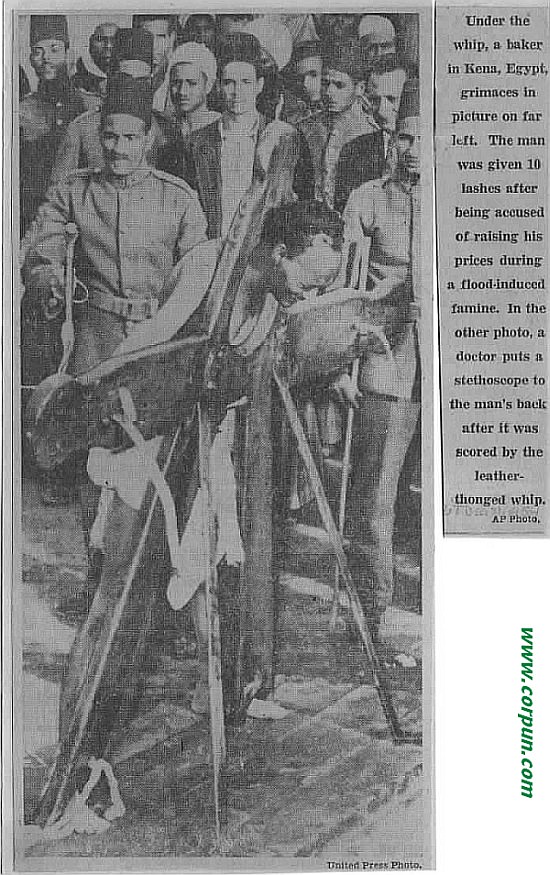
Baker flogged and Back showing resulting weals
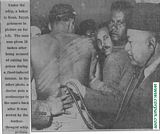
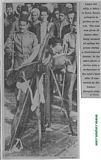
Pictures from 1954. The man is being publicly whipped in the public square of Kena for charging too much for his bread during a famine. Note the curious crucifix-style whipping post with a hole for the offender to put his head through. The second picture shows a doctor attending to him afterwards.
Corpun file 26142
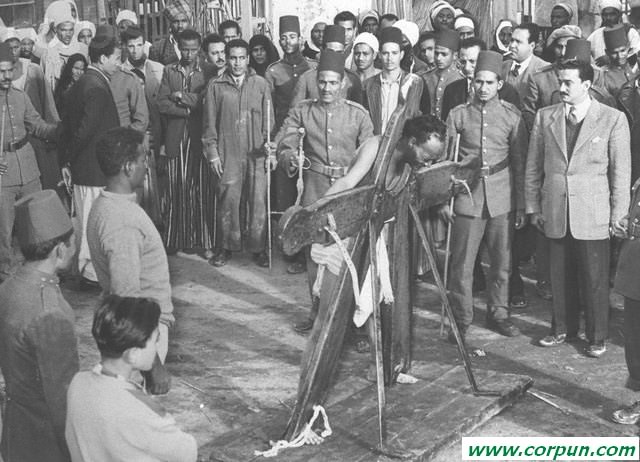
Baker flogged -- clearer picture
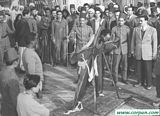
We now have a much better-quality version of the first of the above two pictures. It also gives a wider view of the watching crowd.
 FRANCE
Corpun file 25135
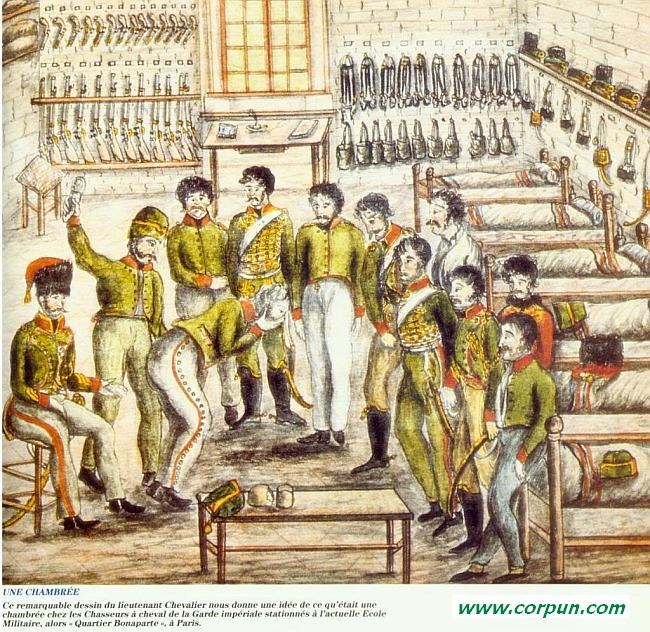
"Une chambrée"
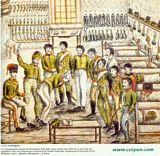
This appears to represent what we might nowadays call an unofficial slippering in the French army. I think the picture may date from around c.1800. The text says "This remarkable drawing by Lieutenant Chevalier gives an impression of an imperial guardsmen's cavalry barrack-room at what is now the Ecole Militaire, then the Quartier Bonaparte, in Paris".
 GERMANY
Corpun file 21948
Prügelbock (Whipping bench)
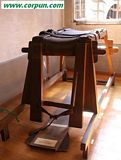
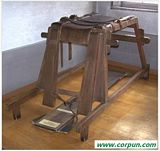
On display at the Naturhistorishes Museum in Schloss Bertholdsburg at Schleusingen, Thuringia, where whipping sentences were carried out publicly in the marketplace, according to the museum caption. A "Siebenstriemer" (cat-o'-seven-tails) was used, consisting of a wooden handle with leather tails. "Der Delinquent war nach vorne gebeugt und lag mit dem Oberkörper auf der mit Leder gepolsterten Fläche auf. Dadurch war sein Gesäß gespannt und zur Aufnahme der Hiebe bereit." (The offender was bent forward and had to lie with his chest on the cushioned leather surface. Thus his buttocks were tensed ready to absorb the strokes.) The museum adds that the contraption is authentic, and worn with use; it was formerly kept in the Town Hall. Public flogging was abolished here in 1848.
Corpun file 20101
Prügelbock, Quedlinburg
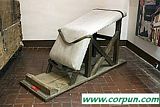
This flogging contraption is to be found at the Schlossmuseum (castle museum) in Quedlinburg, Saxony-Anhalt. It is said to be from the 16th century. I am not quite clear exactly how this would have been used.
Corpun file 19387
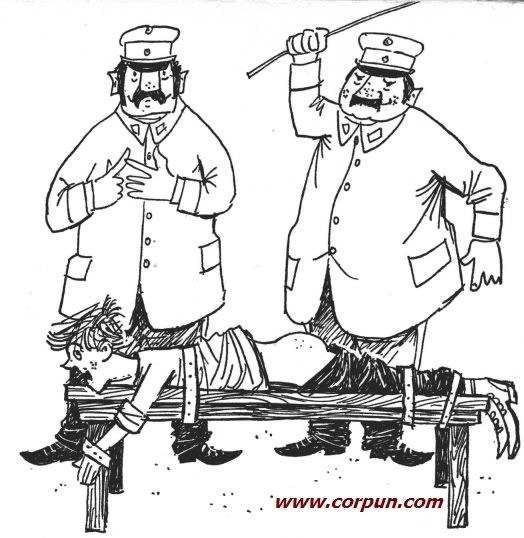
Juvenile caning
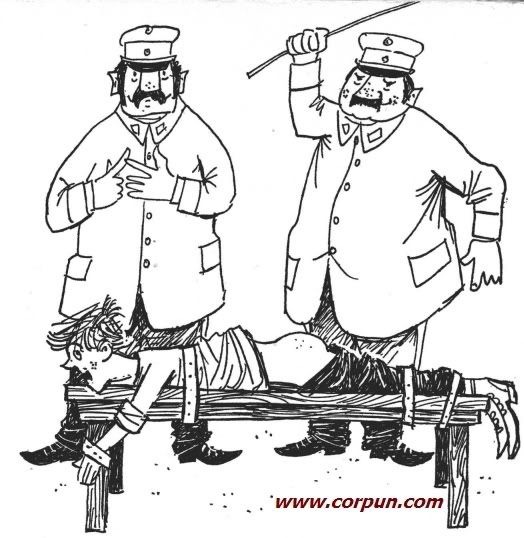
This, I'm told, comes from Germany. The artist is very probably Franz Josef Tripp, who illustrated children's books in the 1960s. A youth is being caned on his bare bottom. The man on the left is presumably counting out the strokes on his fingers. The officials' uniform resembles that of the Kaiserreich (German Empire) era (1871-1918), although the kind of punishment shown could be a bit earlier than that (see pictures below).
Corpun file 19757
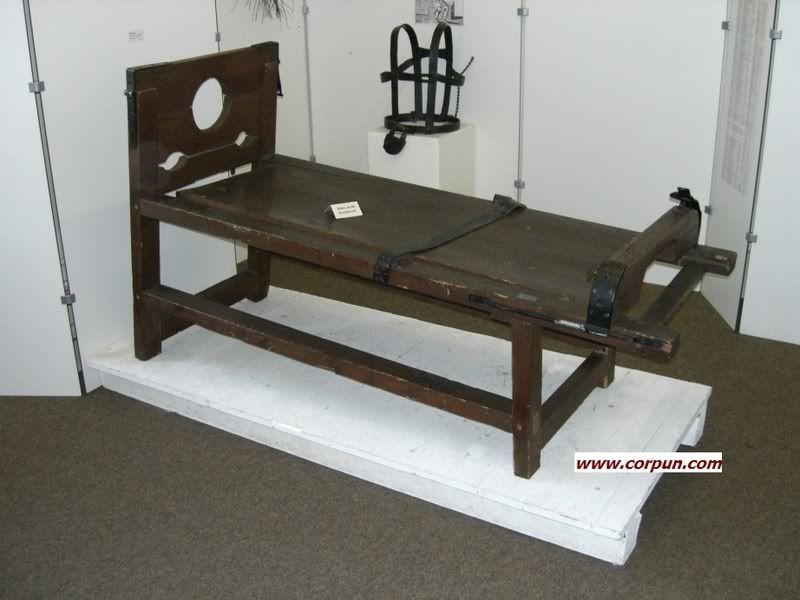
Whipping bench
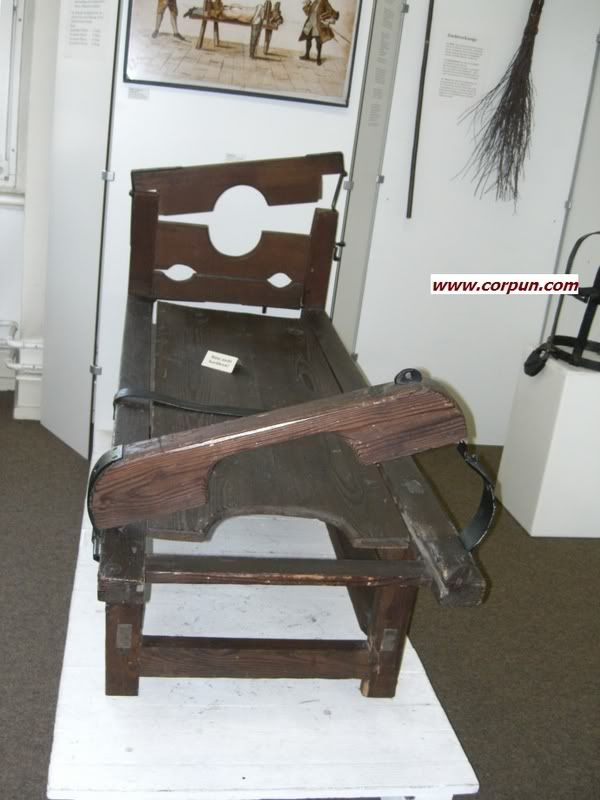
Here is a piece of furniture found in the local museum at Ludwigsburg, near Stuttgart. It is thought to have been used in the 19th century. The person to be whipped lies face down, with head and arms lodged in the holes at the head end and the feet secured at the bottom end. The second picture shows how the ends were designed to open up to secure or release the offender. Note the similarity with the device at Zwettl (see Austria, above).
Corpun file 19759
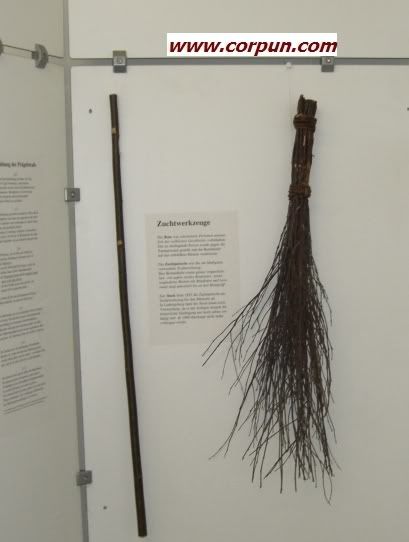
Cane and birch
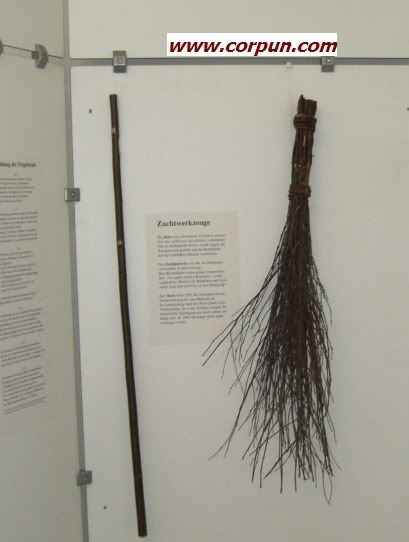
Two whipping instruments also on display at Ludwigsburg (see previous item).
Corpun file 19756
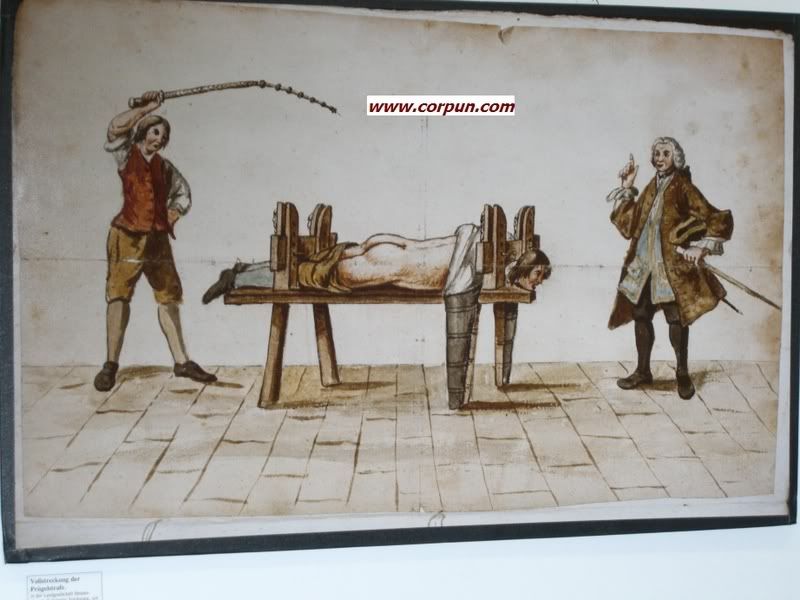
German JCP in ?18th century
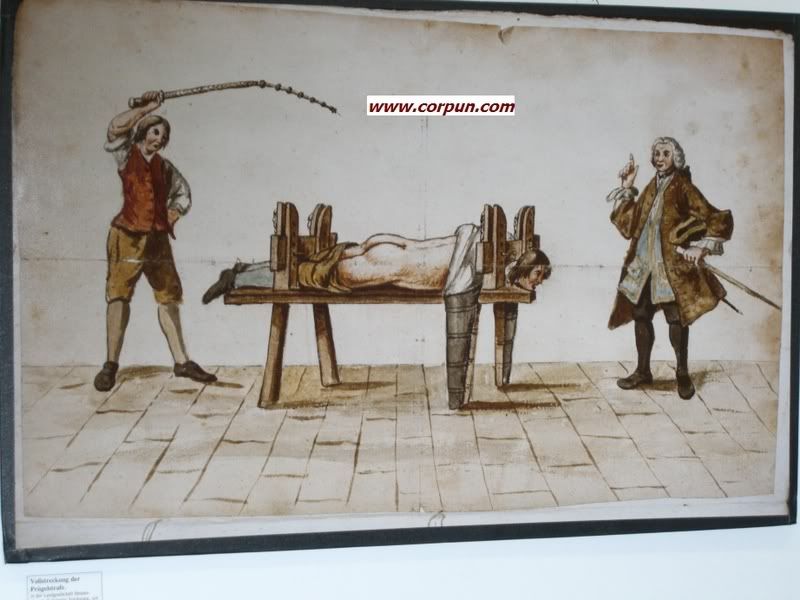
Also at the museum in Ludwigsburg is this old print, showing a not dissimilar machine in use.
Corpun file 13976
Prügelbock
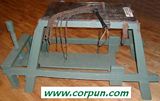
This Prügelbock (whipping trestle) is at the prison museum at Celle, Lower Saxony. On it sits a cat with perhaps six tails. The museum's German-language website says that this particular example was used until 1913. There seem to be no other details. It is hard to work out from the picture what goes where, or what the bits and pieces to the left and underneath are for. Suggestions welcome. Meanwhile, the following tiny and very unclear picture, provenance and date unknown, seems to show the same or similar equipment in actual use:
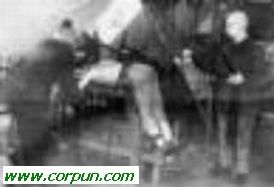
This picture has a blurred and furtive look about it, as though taken secretly, which suggests that it could actually be "the real thing". The prisoner's ankles are apparently tied athwart the vertical pin on the left of the main picture and he bends over the contraption to receive the punishment on his seat. Perhaps in that case the main purpose of the device is simply to raise the buttocks to a convenient height. See this page for a bit of hard information about judicial and prison flogging in Germany.
A reader in Norway writes that he thinks this was used during World War II in Germany and the occupied countries: "A few years ago there was a documentary of the punishments the Germans used, and a Norwegian woman was describing the punishment she got while in a German prison. They showed pictures of this block". However, it is quite different from the flogging block that has been pictured in various places as the standard item used in the Nazi era both in ordinary prisons and in the concentration camps.
Corpun file 25440
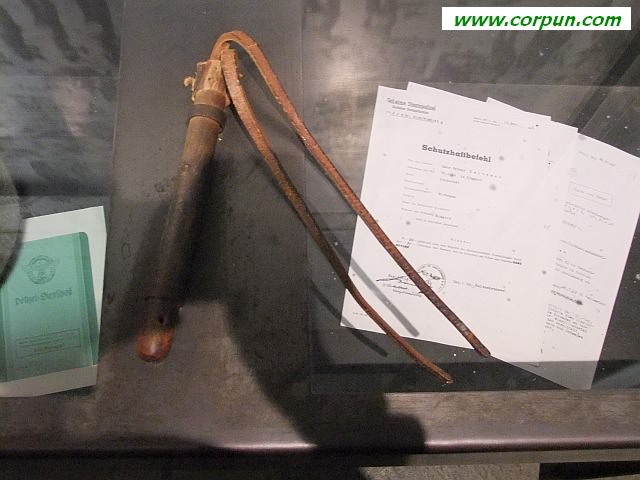
World War II whip

Found in the Norway Resistance Museum at Akershus Fortress in Oslo. The whip may have been used on prisoners during the German occupation of Norway (1940-1945). This example is in very poor condition and has evidently lost most of its "tails".
 GHANA
GHANA
Corpun file 22289
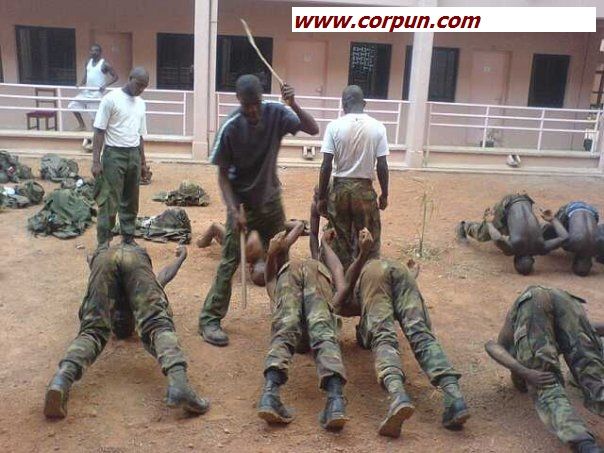
Ghanaian soldiers punished
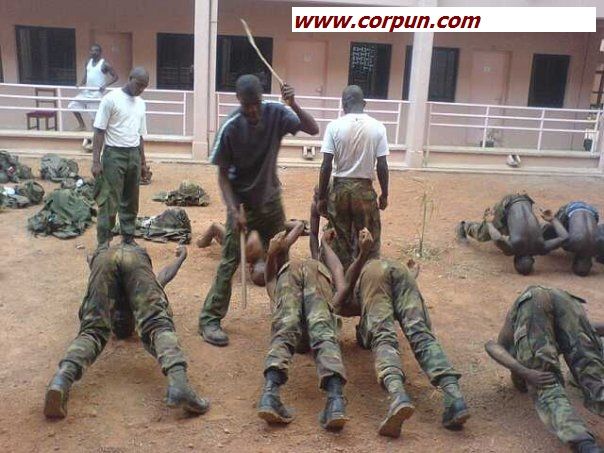
Nothing known about this except what the caption says.
 HONG KONG
Corpun file 17726
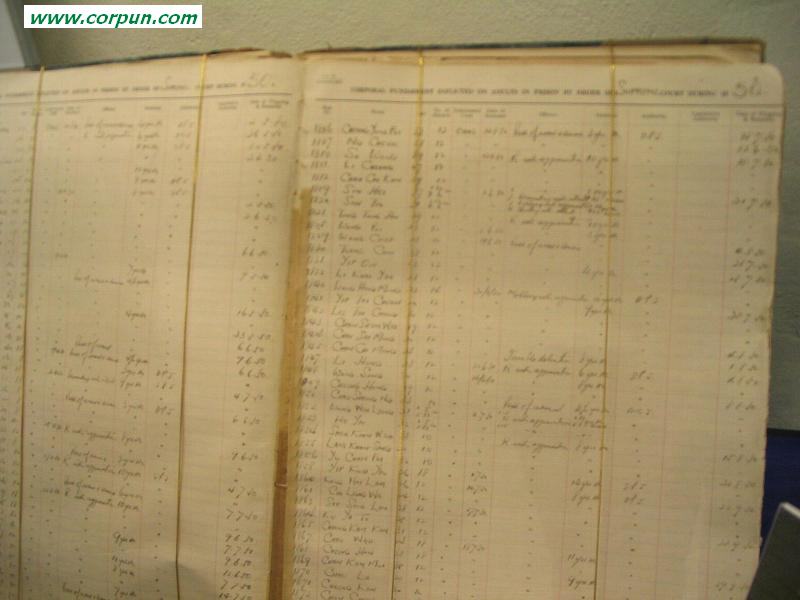
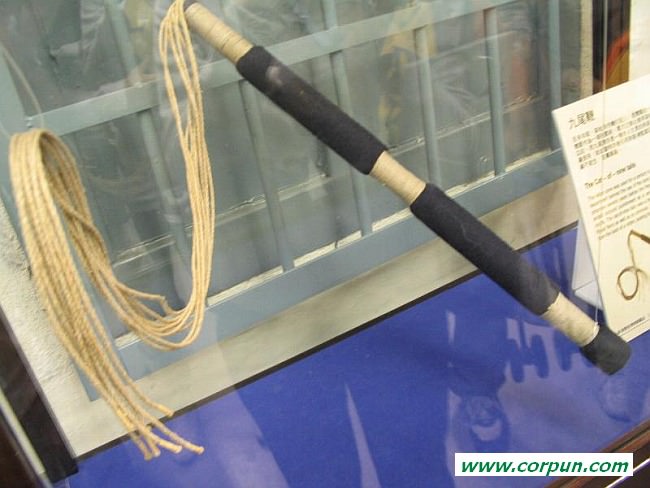
Cat-o-nine-tails and Punishment Register
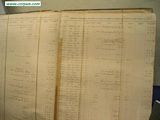
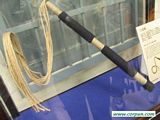
On 19 March 2006 there was an open day at Victoria Prison, and these items were put on show. It is, I think, a very long time since the cat rather than the cane was used in Hong Kong. The punishment book is unfortunately difficult to read in this picture. The pages shown appear to date from 1950.
Corpun file 14631
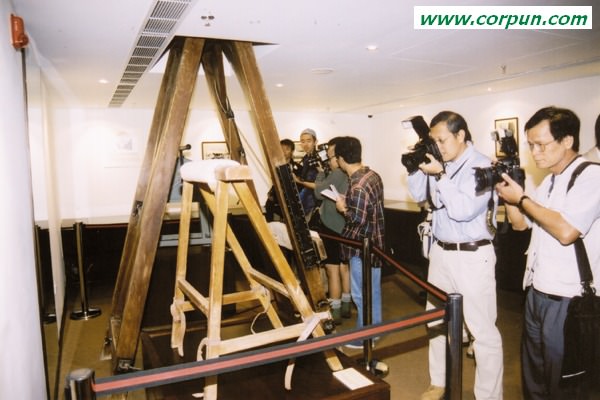
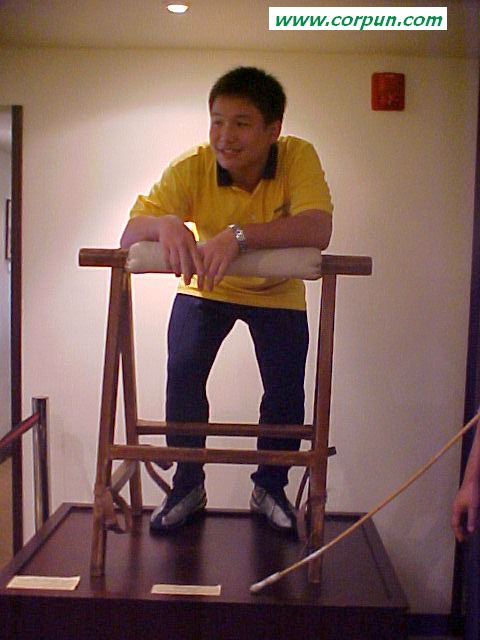
Caning A-frame and trestle
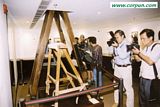
I assume that this is from the press launch in 2002 of the Hong Kong Correctional Services Museum. There are two trestles exhibited side by side, a smaller one and a larger A-frame of the familiar kind (so tall that a recess has to be made for it in the ceiling). The big frame was for judicial punishment; the smaller trestle seems to have been for reformatory canings of juveniles, rather than judicial ones. A description of the judicial caning of a 16-year-old in 1990 says "the boy's hands were secured by leather straps to a wooden platform" as he was made to bend over with his trousers down. (However, in the reformatory case the boy was allowed to keep his trousers on.) In a different article, an officer who formerly supervised these events said the offender had to "lie on a rack" to which he was strapped, and a leather strap was put round his back to protect the spine -- perhaps a reference to bending over the padded bar shown here.
Corpun file 14951
Judicial cane

From the same event as the previous item. The VIPs are standing by the A-frame. The cane looks excessively rigid but perhaps in actual use it would have been soaked in water to make it flexible.
Corpun file 15329
Another picture of the A-frame
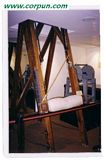
This is a different photo of the same exhibit in the Correctional Services Museum. It shows more clearly the padded bar at the level of the beneficiary's abdomen.
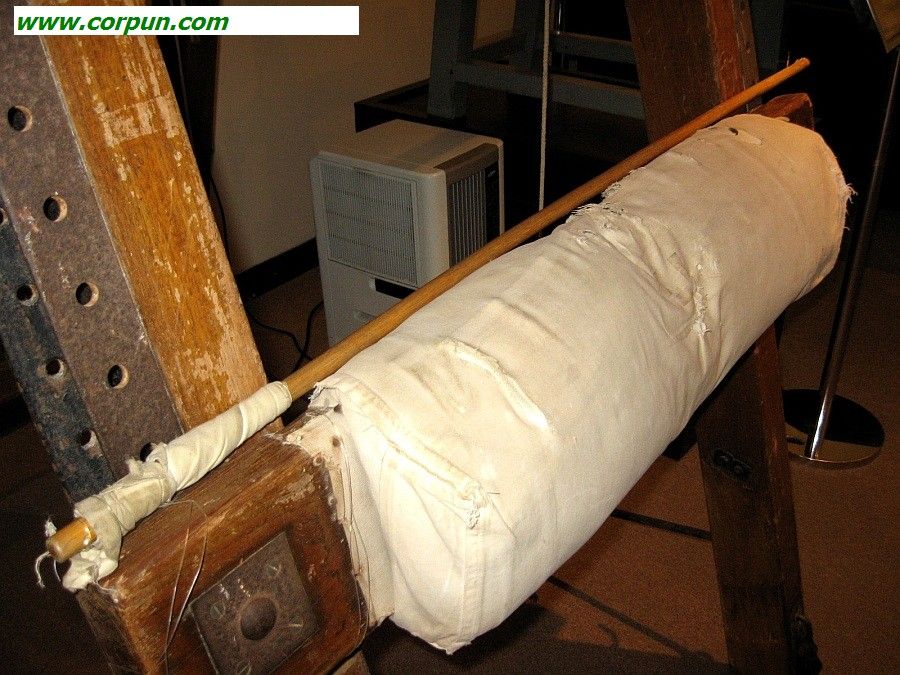
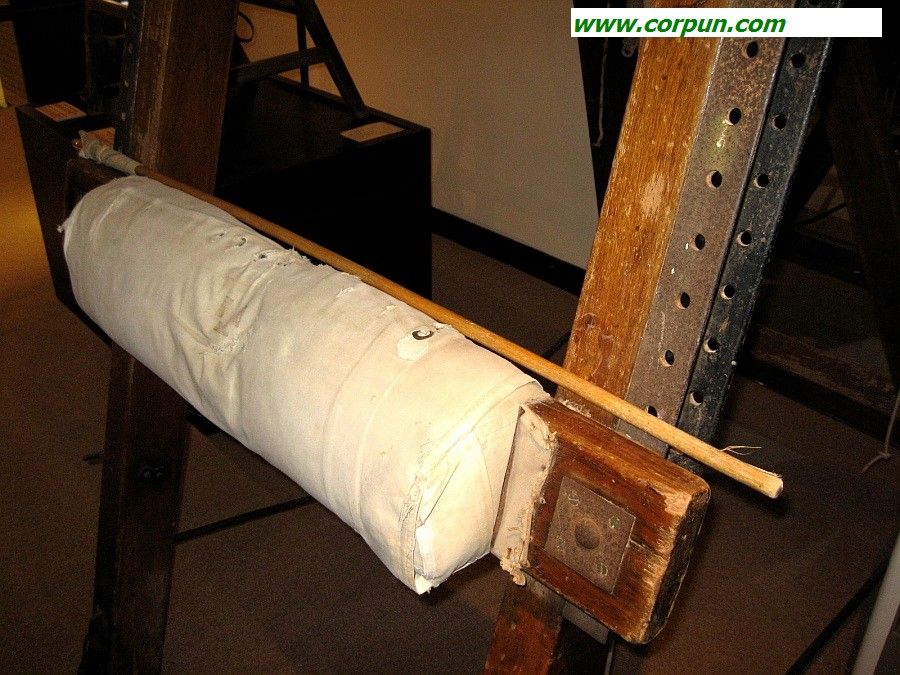
Corpun file 22761a
Close-ups of the padded bar, with cane
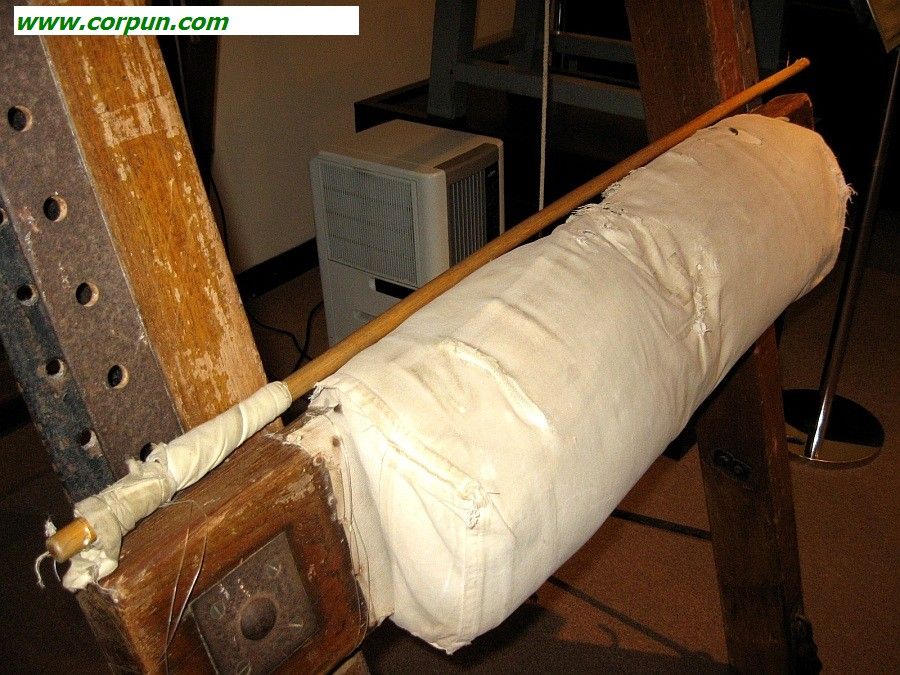
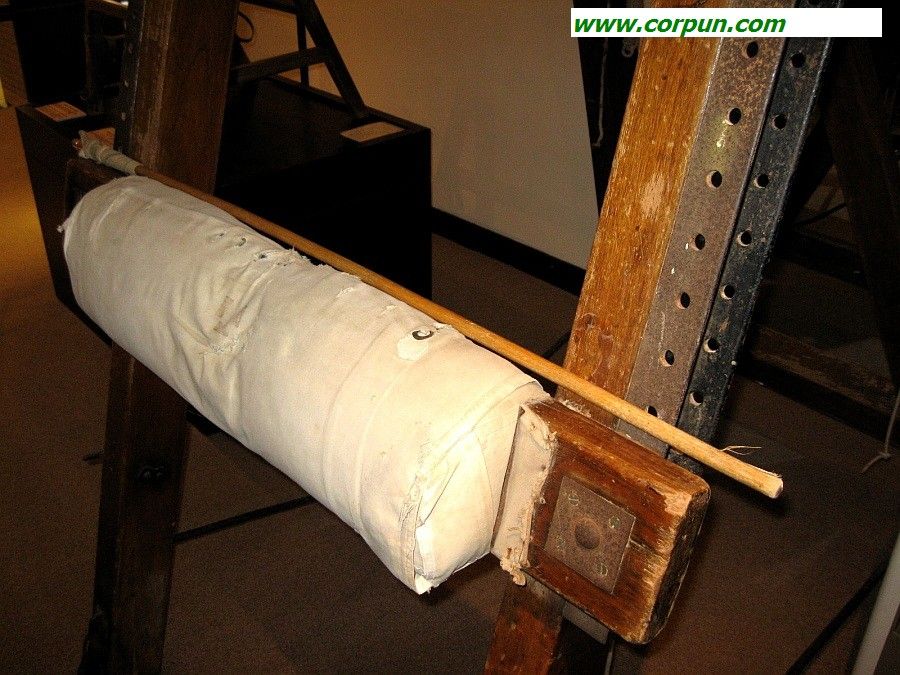
Note that the cane is a bit frayed at the business end, possibly demonstrating that it has been well used. The wrapped handle end would have provided a good grip for the operator. The padding has become noticeably indented in the centre, at the point against which the prisoner's genitals would have pressed, and has evidently been repaired at that point due to wear and tear.
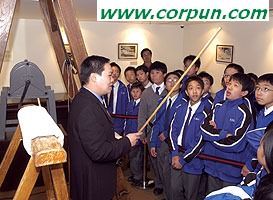
Corpun file 15577
Students learn about corporal punishment

Picture on a Hong Kong government website captioned "Students learn about corporal punishment (abolished by Hong Kong in 1990) at the Correctional Services Museum in Stanley, which has a wide range of exhibits depicting more than 160 years of penal history". It does not perhaps add much to the other pictures, but it's interesting that present-day schoolboys are having these things officially shown to them.
Corpun file 15337
The Detention and Training Centre trestle or horse
This is described in the museum as having been used in the "Detention and Training Centre", possibly a reformatory for youngsters; if so, these rules would presumably have applied, which state that the cane was applied to the youth's clothed buttocks. This makes it sound rather more like a schoolboy caning but, even so, the doctor had to be present, and up to 12 strokes could be given in the case of boys over 14, and there was a right of appeal to the Director. Note padded bar for abdomen, and straps for ankles as well as wrists near the bottom of each of the contraption's four legs. This means the beneficiary would have been bent nearly double, with his legs wide apart, during the punishment. The cane is also in view.
Corpun file 22761c
A clearer picture of the Detention Centre horse, with cane
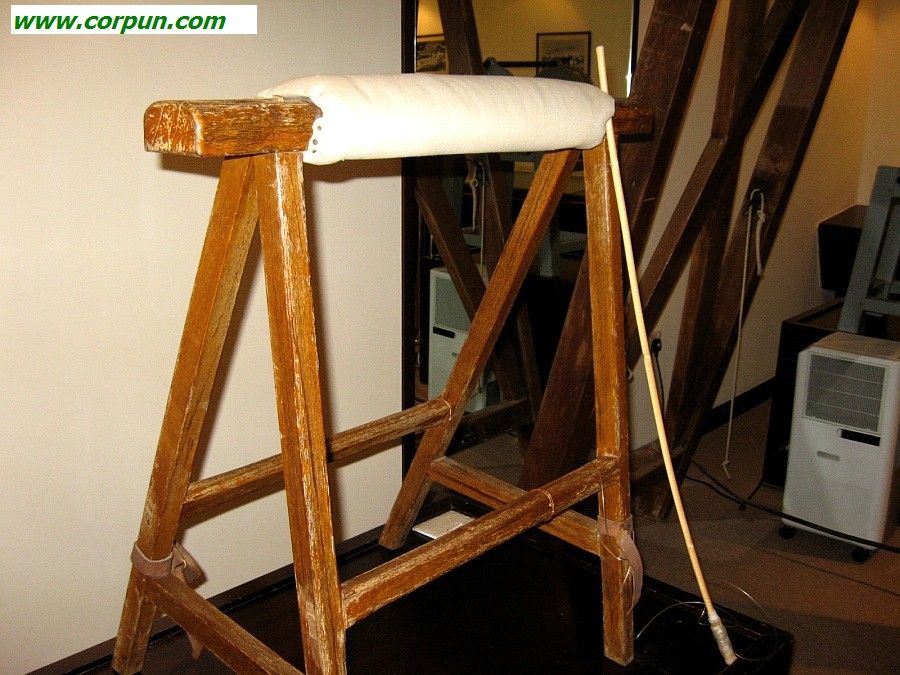
The cane shown, though smaller and thinner than the judicial one, is clearly still a quite formidable implement.
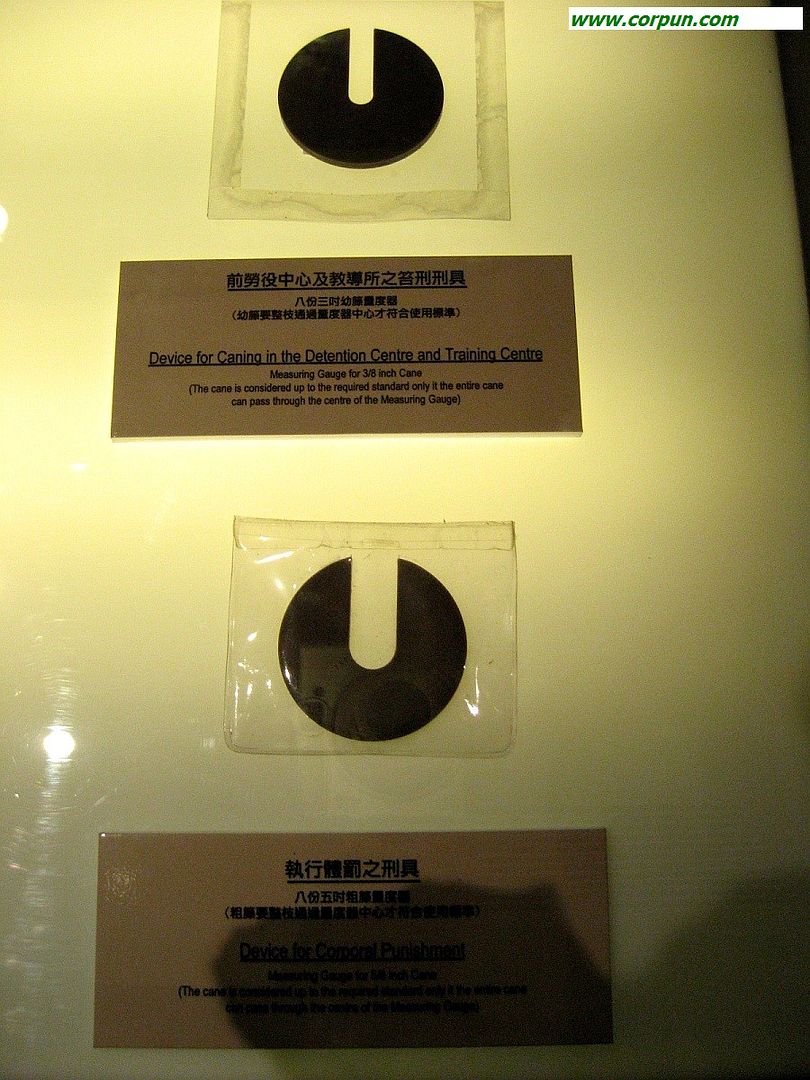
Corpun file 22761d
Gauges for verifying correct thickness of canes
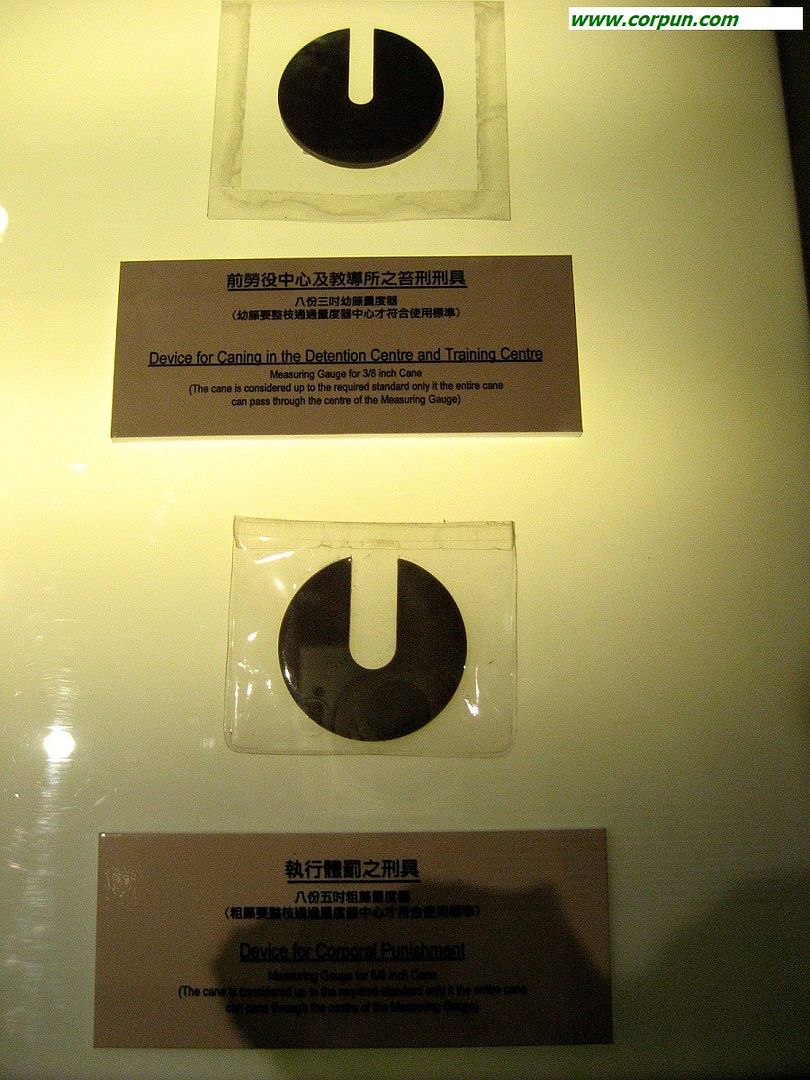
From the same prison museum exhibition. I have not seen anything quite like this before. The smaller one is captioned: "Detention Centre and Training Centre. Measuring Gauge for 3/8 inch Cane. (The cane is considered up to the required standard only if the entire cane can pass through the centre of the Measuring Gauge)". For the larger, clearly the judicial one, the caption says: "Corporal Punishment. Measuring Gauge for 5/8 inch Cane". This is even thicker than the Singapore judicial cane (which is half an inch thick). According to informed sources, such a thick cane would have to have been soaked in water before use to make it springy enough to "bite" effectively, otherwise it would just produce numbness and bruising.
 See also this video clip in which a Hong Kong museum official demonstrates the use of the judicial cane.
 INDIA
INDIA
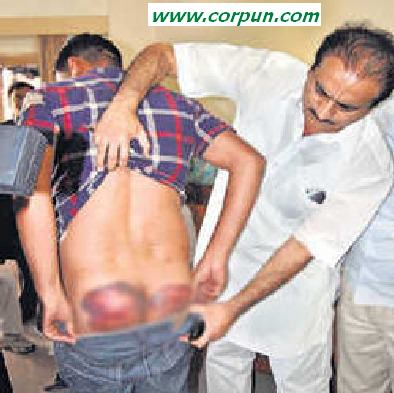
Corpun file 24293
Result of police spanking?
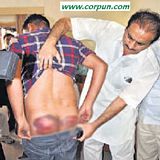
This from 2011 is described as depicting the effects of "police torture" but I suspect it could actually be from one of the quite formal but unofficial spankings with a leather paddle used by the police in parts of both India (especially Punjab) and Pakistan, as seen in this video clip.
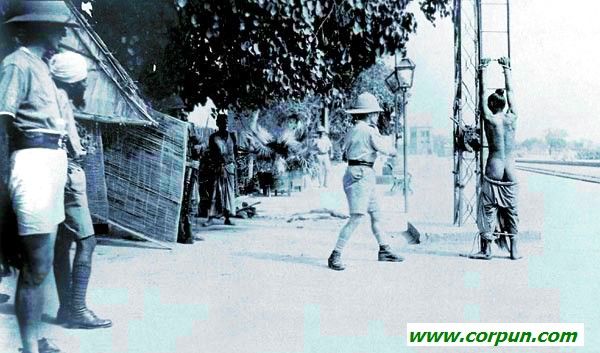
Corpun file 22697
Public flogging, April 1919
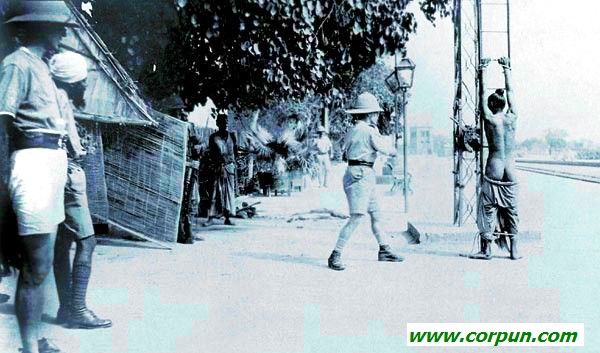
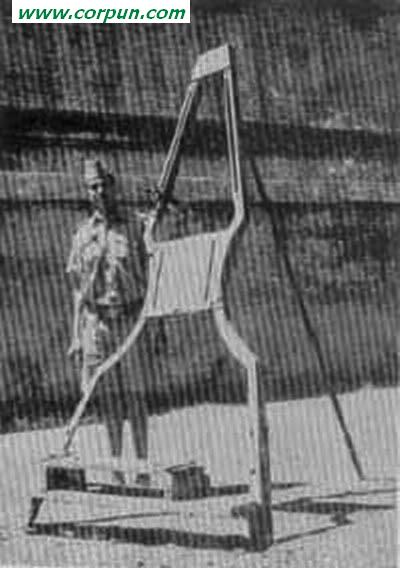
This punishment is being administered by a British colonial official in trademark long baggy shorts and pith helmet. Two other officials, a Brit and a local, look on. Although this is described as a "public flogging", very few of the public appear to be present, unless they are behind the camera. The offender has been tied up to a ladder or gantry of some kind on what looks rather like a railway station platform. His trousers have been lowered just enough to expose his buttocks for punishment. Unfortunately the implement cannot be seen, but I think it would have been a cane. There is another version of this photo, of inferior picture quality but less tightly cropped, showing a policeman or soldier with a rifle standing off to the right.
Corpun file 17139
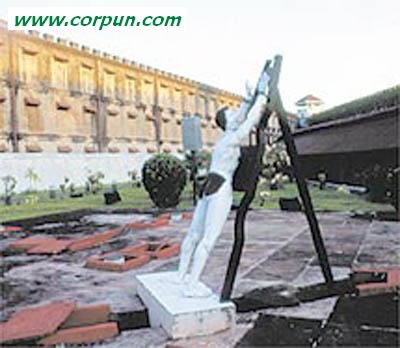
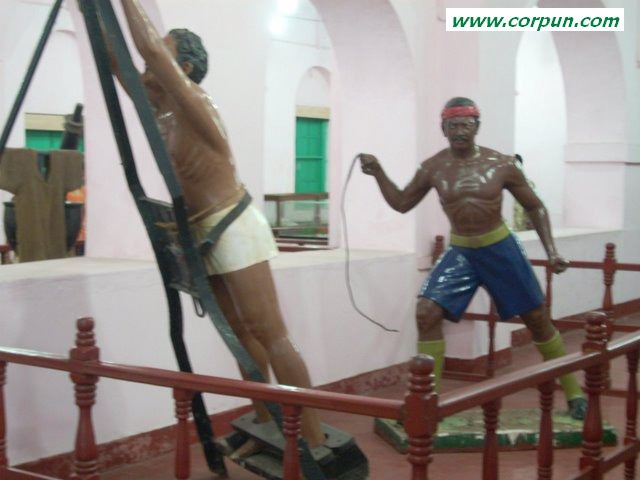
Flogging frames, Andaman Islands
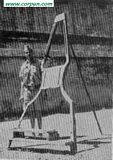
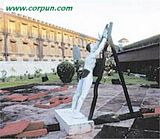
The Andaman Islands lie off the Burma/Thailand coast, but belong to India. A large prison was built at the main town, Port Blair, under British rule, and part of it is now a museum. These two pictures are of two slightly different flogging frames there. The colour picture shows one on display with a model of a prisoner mounted on it, and comes from a tourist web site that has now disappeared. Note that these metal frames are very similar to the one used in this 1978 Pakistan flogging and also in the second picture from the top on this page of miscellaneous Pakistan floggings, all presumably inherited from the days of British India.
Corpun file 18095
Cellular Jail at Andaman
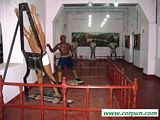
A more recent (2006) view of one of the flogging frames in the museum at Port Blair.
Corpun file 20859
Cellular Jail at Andaman, continued
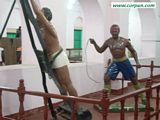
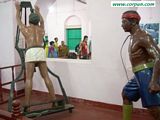
Two more views of the same tableau at Port Blair.
 INDONESIA (formerly DUTCH EAST INDIES)
Corpun file 13933
Rotanslagen in de Gevangenis (Caning in the Prison), c.1900
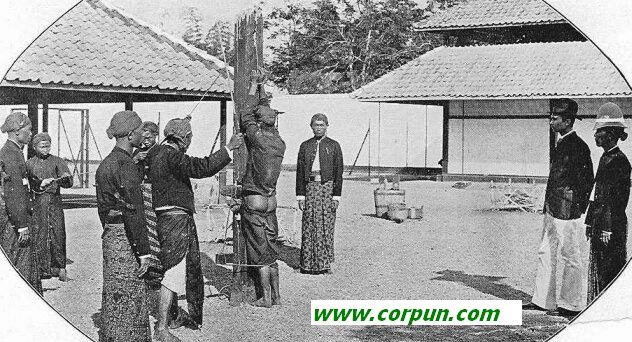
From a Dutch book, Uit onze Koloniën: Uitvoerig reisverhaal (From our colonies: Detailed account of a journey), by Henri Hubert van Kol (Leiden, 1903). I now hear that it was also reproduced as a picture postcard.
The prisoner's buttocks have been bared, though only just. He is tied, rather loosely it would appear, to a post that looks as if it has been installed and fitted out specially for the purpose. Two officials (at left of picture) are pulling on a rope attached to a ring holding his wrists. Everyone looks rather stiff, as if consciously posing for the photographer, and the man with the cane is holding it still in the air and is plainly not in motion, so I think the whole scene is probably staged. Even so, there is no reason to suppose that this isn't an authentic representation of the procedure. The chap towards the right in western clothes is presumably in charge. Apart from the official next to him wearing a policeman's helmet, all the other staff are in Javanese costume with bare feet.
The entire scene is, mutatis mutandis, surprisingly "British"-looking. Britain did have some brief involvement in that part of the Indies before the Dutch took over. As far as I know, back home in Europe the Dutch had no tradition of this sort of thing by the date in question. Today, neither do the Indonesians themselves (except recently in Aceh, see below), unlike their Malaysian, Singaporean and Bruneian neighbours, who have so enthusiastically embraced the CP system bequeathed by their former colonial masters.
Corpun file 25665
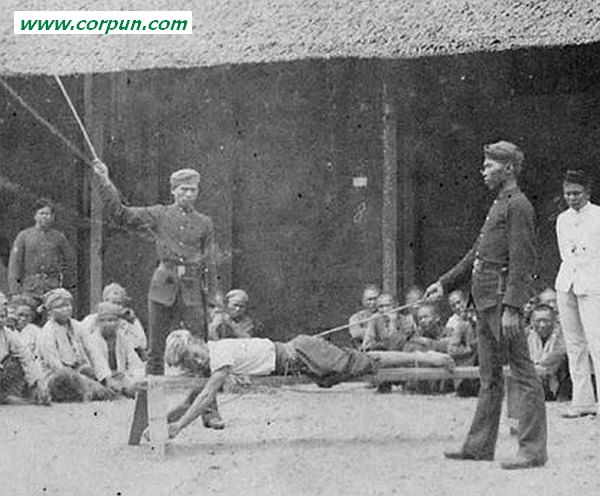
Caning 1880-1895
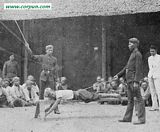
Another caning scene under Dutch colonial rule, with a different modus operandi -- the "tied face down to a bench" method as typically used in Austria-Hungary and Korea. Here the posterior is again the target for discipline, but this time it is clothed. There seems to be quite an audience, so perhaps this is public JCP rather than prison discipline. From a collection of photographs from the Langkat district of North Sumatra, dated 1880 to 1895.
Corpun file 25281
Prison whipping c.1900
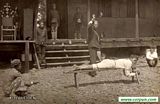
Quite similar to the previous item, but this is said to be from Lahat prison in South Sumatra. Picture held by the Royal Institute in Leiden, Netherlands. The precise nature of the implement being used cannot be discerned.
Corpun file 18302
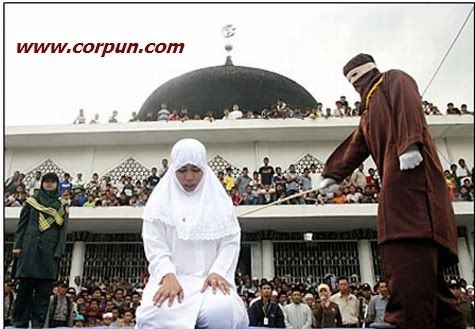
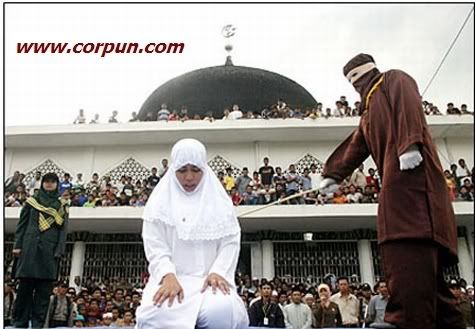
Public caning of young woman, Aceh province, 2006
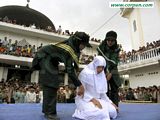
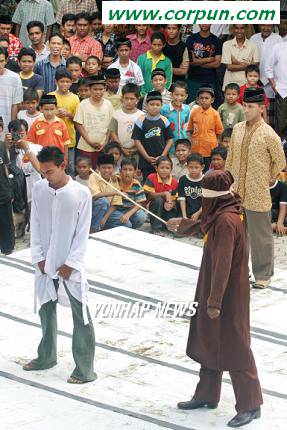
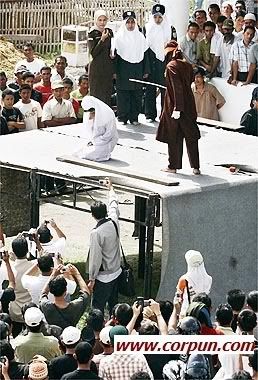
Judicial flogging is now operating in Indonesia, but only in Aceh province, and deriving from a quite separate, Islamic, tradition. These public punishments, for both sexes, are applied to the clothed upper back. In most cases it is done outside the local mosque. This agency photo, dated January 2006, was captioned "Nur Azizah binti Hanafiah, 22, prepares to receive a caning after being found by a citizen having illegal sex with her boyfriend at her house. Aceh Province has practiced Islamic Syriah law since 2001".
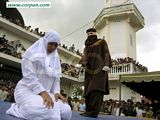
The second picture shows the same occasion with the caning under way, administered by a masked official.
See also these June 2005 news items, one of which includes a photograph of a man at the receiving end. It appears that men must stand to receive the caning, while women are allowed to kneel.
See also these video clips of different but similar events.
Corpun file 17297
Public caning in Aceh (continued)
Another picture of what is clearly the same event.
Corpun file 19520
Another Aceh caning
Same sort of thing, different location, different female offender being punished.
Corpun file 18657
Caning of gambler
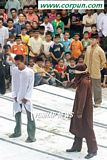
According to the caption of this agency picture, the punishment shown was administered on 2 December 2005 in the provincial capital, Banda Aceh. The offence in this case was gambling. As noted above, men being caned have to stand up on their own two feet.
Corpun file 19814
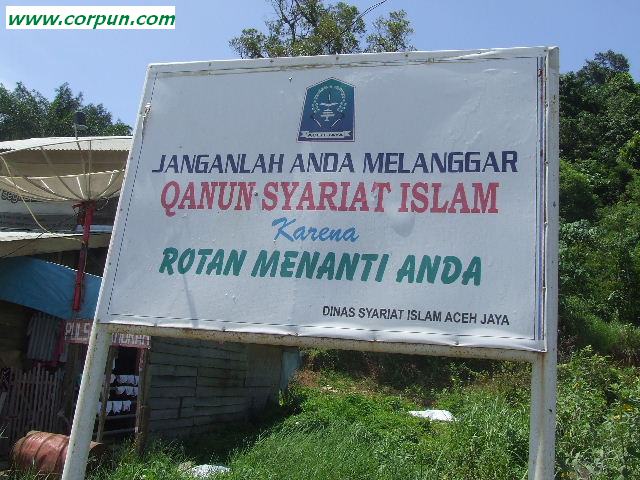
Road sign in Aceh
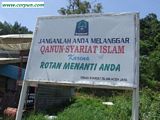
This billboard is in Calang, the capital of Aceh Jaya district. It reads: "Don't break the Islamic Sharia Regulations, because the cane awaits you".
 IRAN (formerly PERSIA)
Corpun file 6765
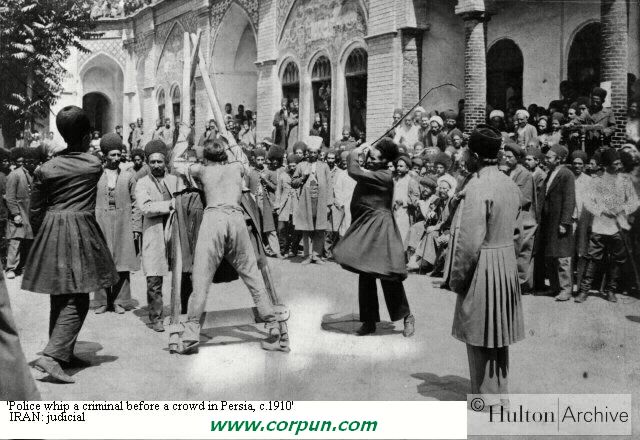
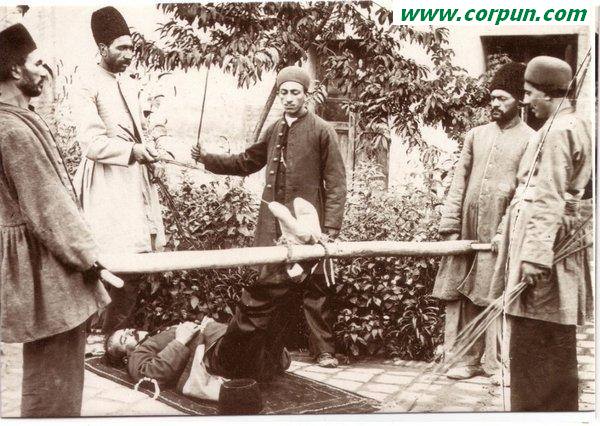
Police whip a criminal before a crowd in Persia, c.1910
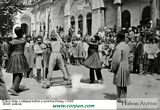
Persia is the country now known as Iran. Note that exactly the same punishment is still applied there to this day, with the offender similarly stripped to the waist, in front of a crowd likewise gathered in the street -- see this February 2001 news photograph. However, in 1910 they used a proper flogging triangle rather than a lamp post, and had two operators inflicting alternate strokes from opposite sides.
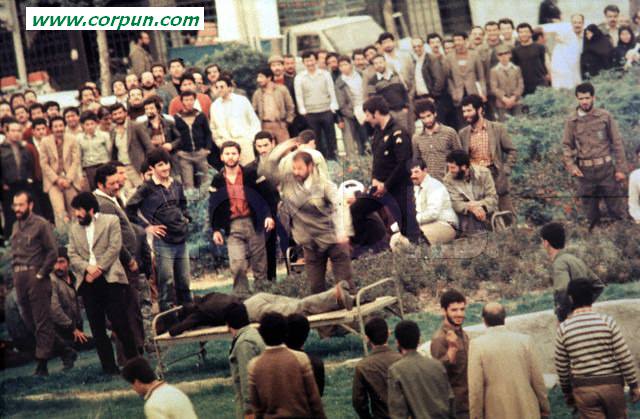
Corpun file 18300
Public flogging in Vanak Square, 1983
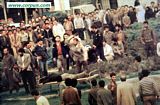
Vanak Square is in Tehran. This agency photograph was captioned "A man attached to a bed is flogged in public in Vanak Square for alcohol consumption, surrounded by Revolutionary Guards and plain clothes security men". It's unclear what implement is being used or whether the culprit is being punished on his back or his bottom, or both, but it's notable that he has been allowed to keep all his clothes on, unlike the 1910 and 2001 pictures. The picture was allegedly taken in January 1983.
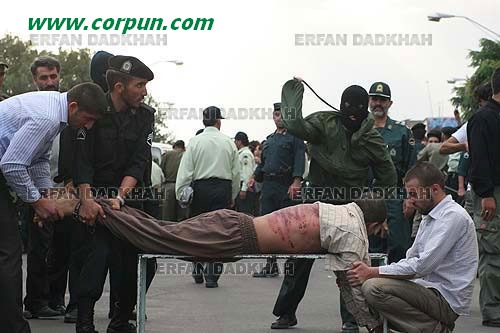
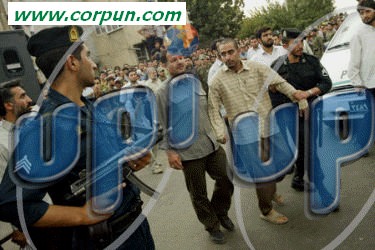
Corpun file 19533
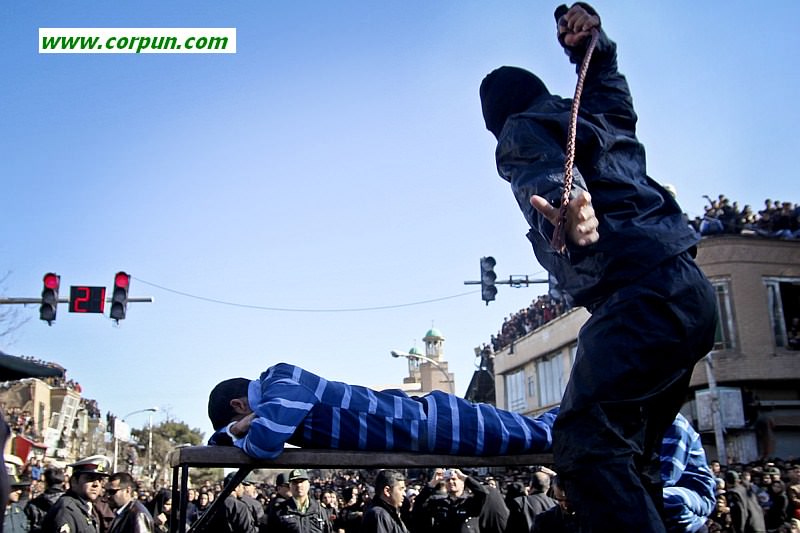
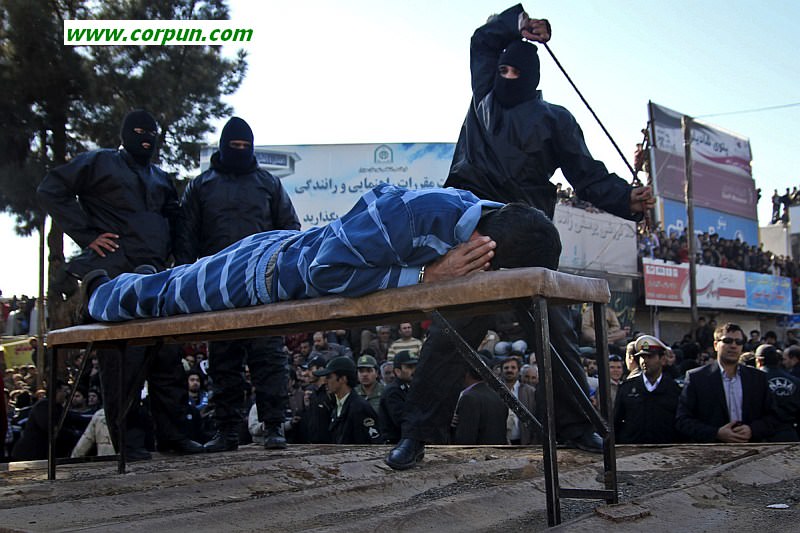
Public flogging in Qazvin, August 2007
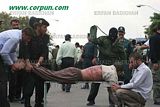

News agency pictures whose captions described this as taking place at Qazvin, 165 km west of Tehran, on 21 August 2007. Saeed Ghanbari is seen being brought to the place of punishment and given 80 lashes for alcohol and adultery.
A better-quality version of the second picture is now available with the related news item.
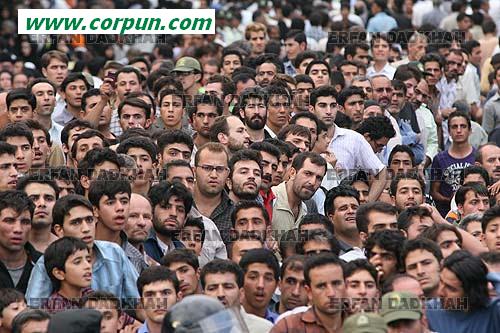
Corpun file 19532
Spectators at the above
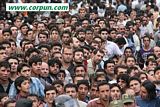
A large crowd -- all male, it would appear -- gathered to watch Saeed Ghanbari's flogging (see previous item), including several quite young children.
Corpun file 24344
Public flogging in Sabzevar, January 2013
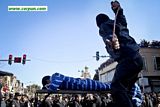
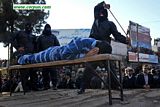
The offender being punished here was reportedly convicted of rape. Unlike in the previous example, he has not been required to bare his back.
Corpun file 20567
Falaka aka bastinado
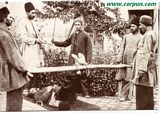
Caning the soles of the feet, a nasty tradition in the Middle East, including (as here) Persia, date unknown.
Corpun file 21827
Supplice des verges à un condamné (Caning of a convict)
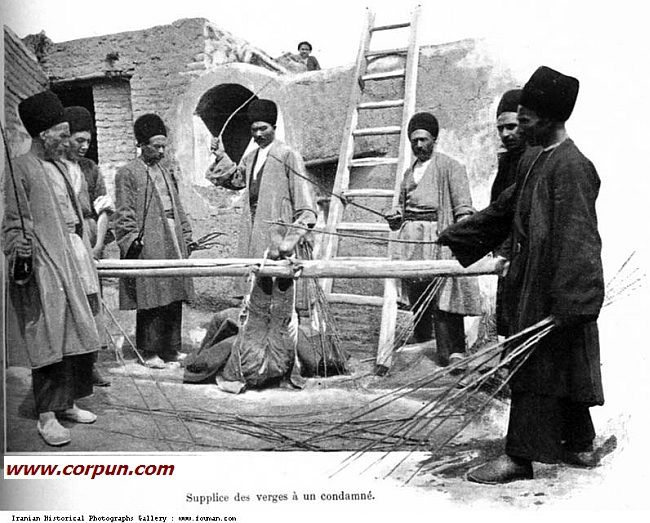
A very similar scene to the above. The officials seem to be taking it in turn to administer the strokes. A remarkably large number of rods is being held in reserve.
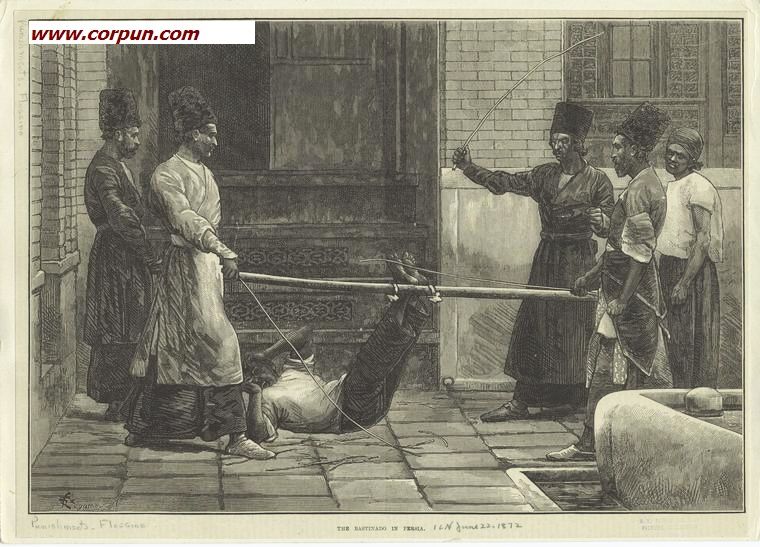
Corpun file 21788
The bastinado in Persia (1872)
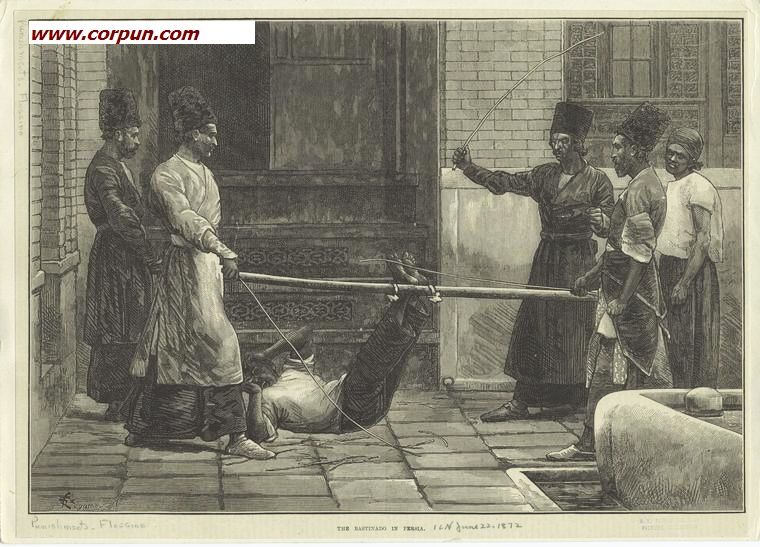
Engraving from the Illustrated London News (22 June 1872) of another very similar scene.
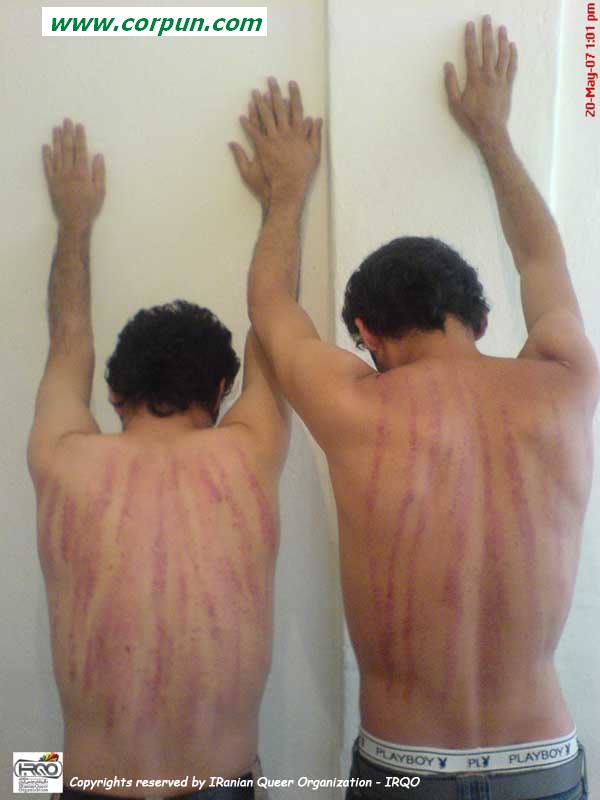
Corpun file 19714
Vertical flogging

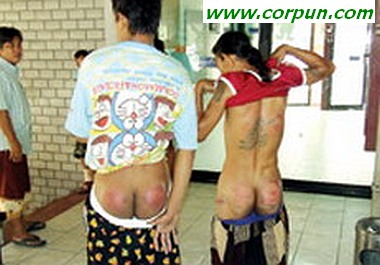
Two twentysomethings show the marks on their backs after being sentenced to 80 lashes for alleged homosexual activities in 2007, according to an Iranian gay rights group. (Relatively speaking they were lucky: other gay people have been publicly hanged by the barbarous Iranian regime.) The technique of flogging lengthwise, rather than horizontally across the back, is odd.
 IRELAND
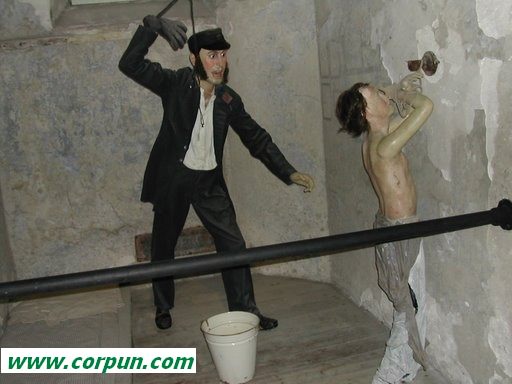
Corpun file 19908
Tableau in Cork jail
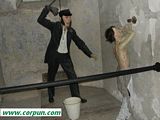
This model is on display in Cork jail. It is supposed to represent a flogging on the bare back. Any such event in real life would very likely have been from the time (pre-1921) when Ireland was still part of the UK, probably indeed in the 19th century.
 ISLE OF MAN
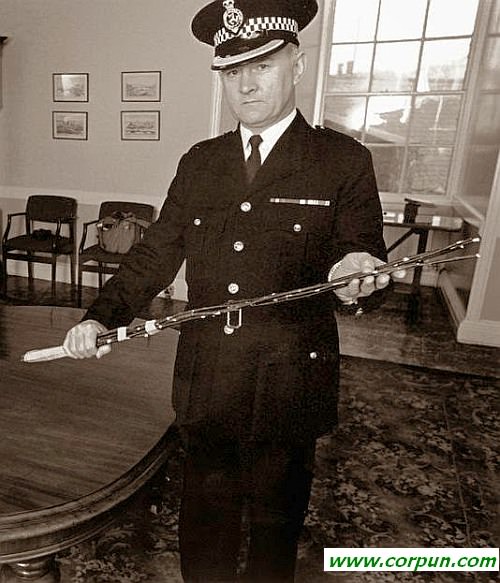
Corpun file 25125
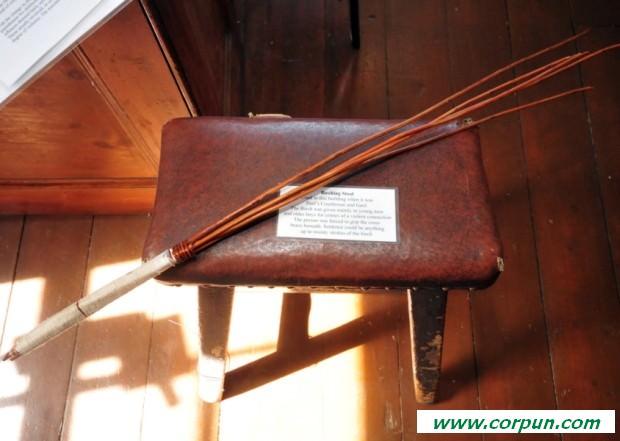
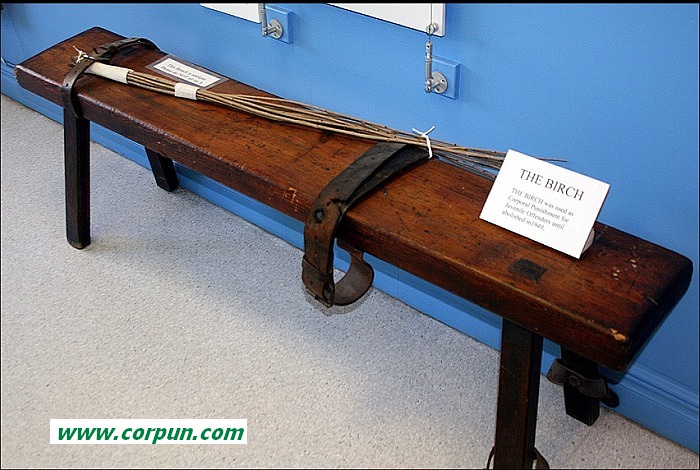
The birch
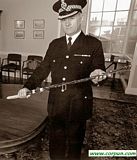
An Isle of Man police officer holds a birch as used on older teenage boys in the 1960s. This was made of about four hazel branches with their twigs and buds removed. Applied across the offender's bare buttocks, this was a much more severe instrument than the mainland UK police juvenile birch of pre-1948. See also this feature article.
Corpun file 26193
Town birch and birching stool
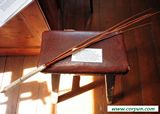
Most Isle of Man birchings took place in Douglas, the capital, but occasionally boys were sentenced and punished in other towns on the island. This is a birch and birching stool at the Leece Museum (in a building that used to be the courthouse) in Peel, on the west coast. The birch is probably a modern reconstruction. The notice says "Sentences could be anything up to twenty strokes" but in practice no more than ten were inflicted in the modern era, and three or six was much more common.
 JAPAN
JAPAN
Corpun file 22308
Flogging penalty in the Edo period
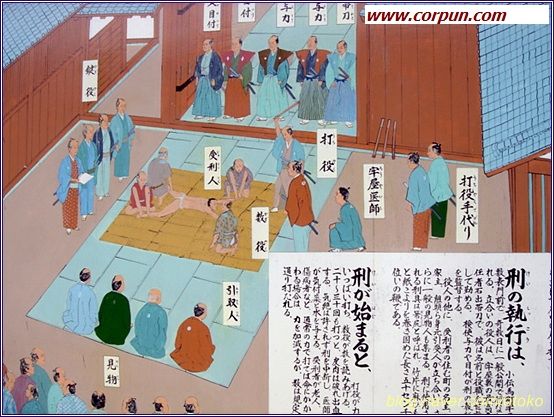
This diagram was captioned "Convict flogged on back and buttocks in Edo Japan" and allegedly represents judicial CP in the Edo period (1603 to 1868). The offender is shown held spreadeagled face down on the ground.
Corpun file 26279
"Ik kreeg er slechts 12" [I only got 12]
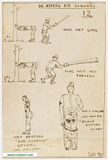
The then Dutch East Indies (now Indonesia) was occupied by Japan from 1942 to 1945. Here we see four remarkable sketches, now in an archive in the Netherlands, made by a Dutch inmate of a Japanese internment or prisoner-of-war camp in 1945. It shows CP being administered by a Japanese soldier to the seat of the inmate's trousers in a surprisingly formal manner, complete with proper bending over, the implement apparently being a big thick stick. The captions read in turn: "How it was", "How it seemed to me", "The familiar Air Cushion feeling afterwards", "After two days: member of the Black Bottom Club". These remarks suggest that this punishment ritual was routine in the camp. We do not know what offence the Dutchman had committed.
 KENYA
KENYA
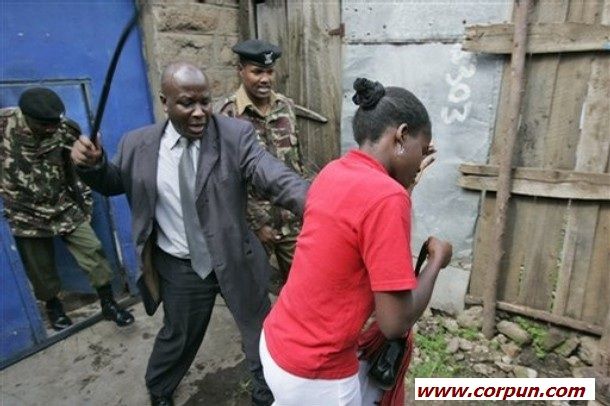
Corpun file 21702
Extrajudicial punishment in Kenya
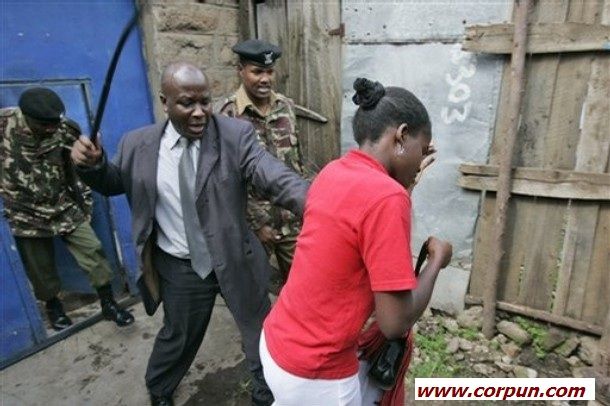
Associated Press picture from April 2008. A plain-clothes police officer beats a woman with a sjambok during protests in Nairobi.
 KOREA
KOREA
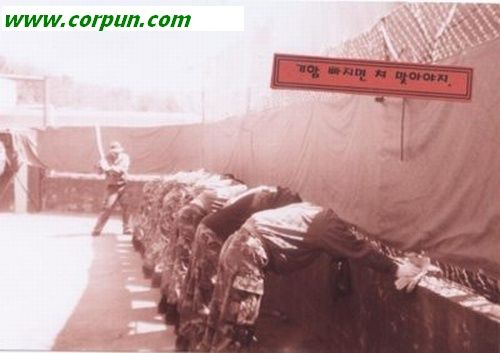
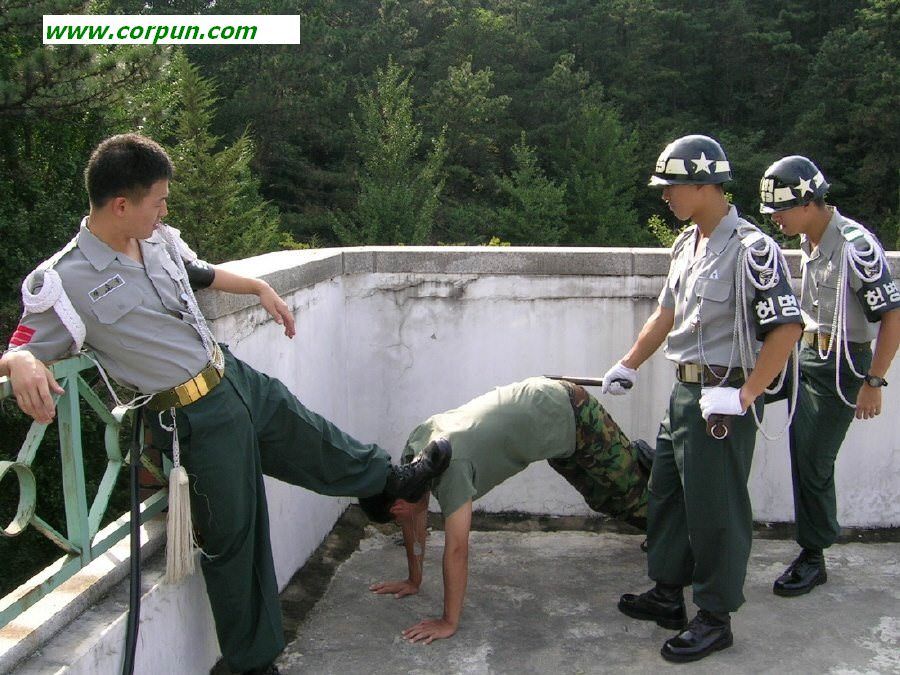
Corpun file 23226
South Korean army caning
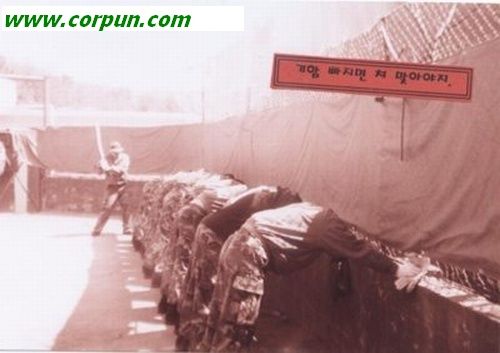
Many soldiers bending over for a caning while an officer advances down the line punishing each in turn. This looks like "the real thing", though possibly unofficial.
Corpun file 23010
Soldiers punished
This is also said to be the South Korean army. It is not certain whether this is "the real thing" or a posed scene, possibly from a movie. But informed sources who have served with South Korean troops say they find it entirely plausible.
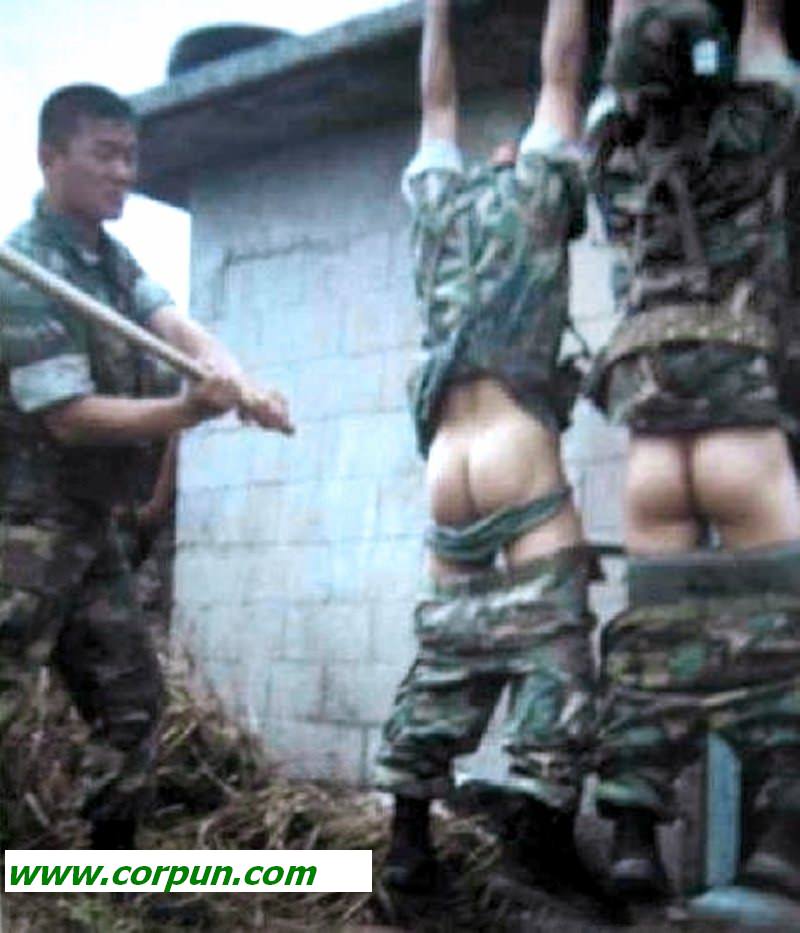
Corpun file 23663
Punishment in the South Korean army
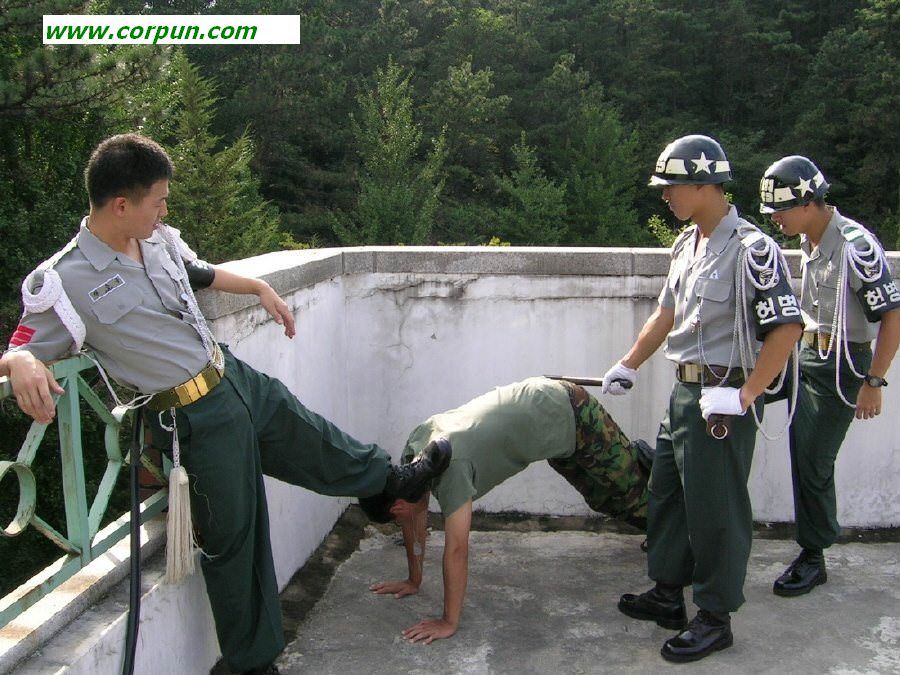
I am not sure how real this is. It might be a scene from a film. I suppose the fellows in the helmets are meant to be the military police. Also unclear: is what it portrays really "punishment", or is it more akin to a hazing or initiation? The position adopted by the beneficiary is familiar to us from pictures of school CP in South Korea. The implement is a stick, too thick and rigid to be called a cane and, I should have thought, too short to have very much effect on impact.
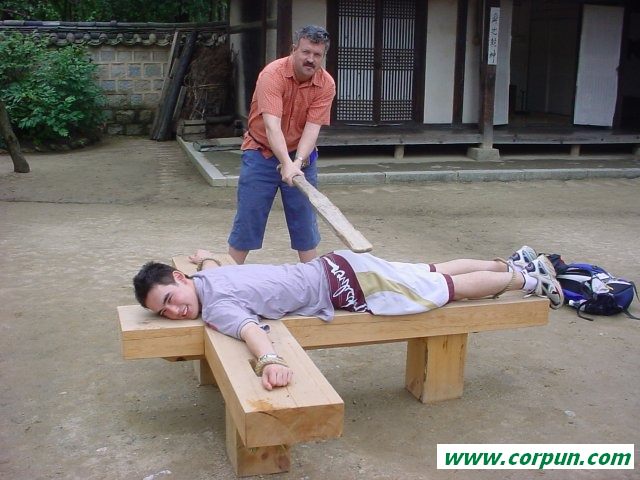
Corpun file 16936
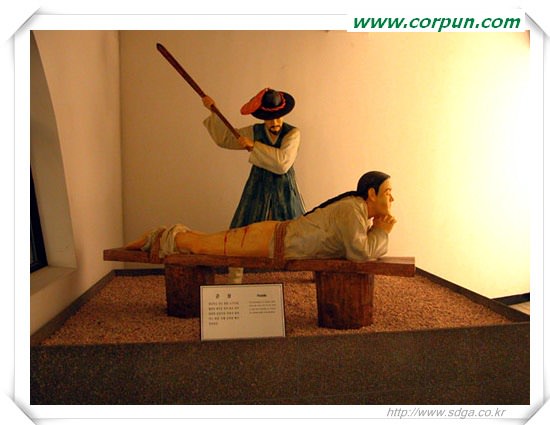
Ancient flogging punishment re-enacted at Seoul Folk Museum
This flogging bench is provided for the enlightenment (and use!) of visitors at the Folk Village Museum in Seoul. Compare with these pictures of the real thing about 100 years ago, which all appear to involve an implement more like a cane or switch than the big "paddle" shown here.
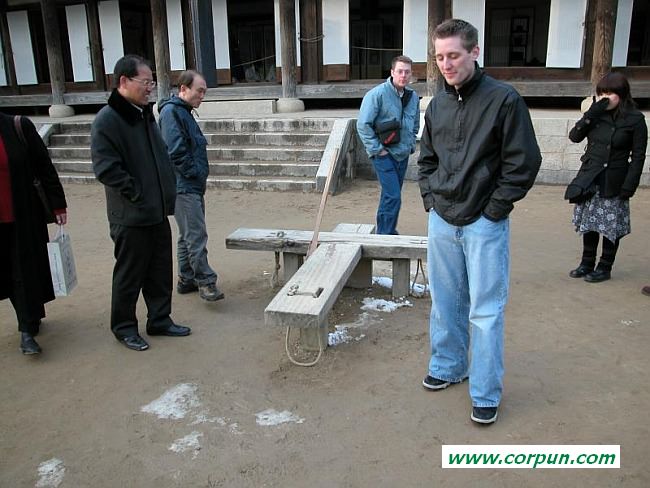
Corpun file 17098
Flogging equipment at Seoul Folk Museum: not in use
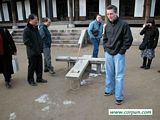
Another picture of the bench, this time without anyone on it, giving a clearer view of the details of the contraption.
Corpun file 19966
Korea flogging tableau
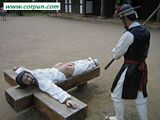
This tableau or model is a representation of a flogging on the same or similar equipment to the previous two items. This makes it clear that the punishment was applied to the bare buttocks.
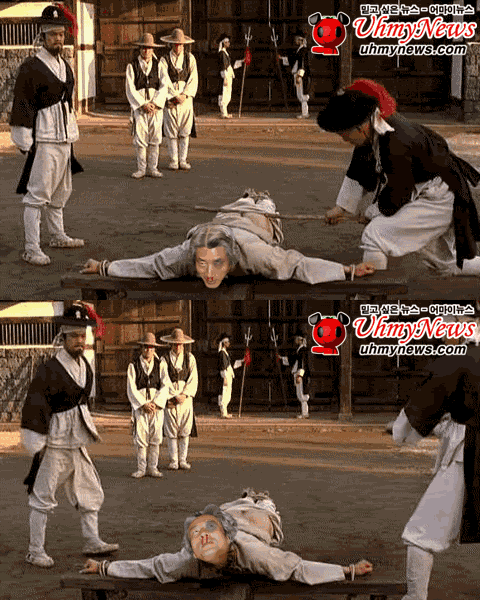
Corpun file 19912
Korea flogging animated gif
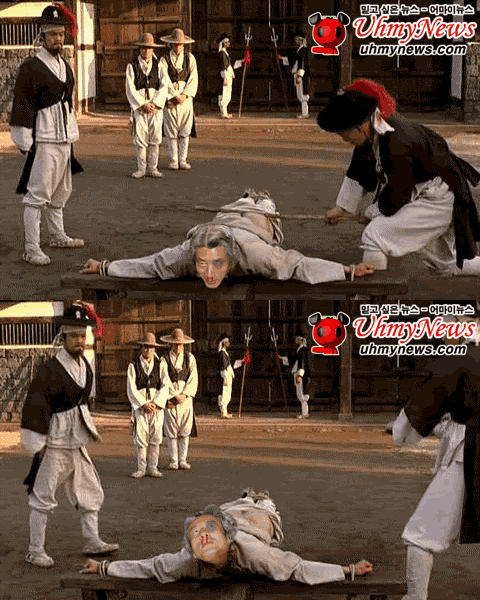
Another re-enactment, this time in period costume, as an animated gif.
Corpun file 20862
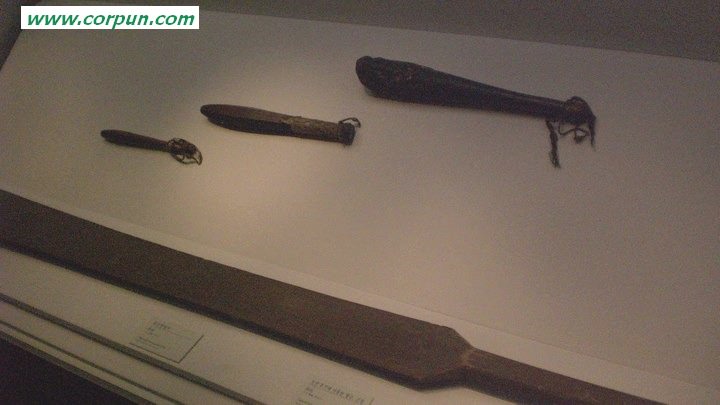
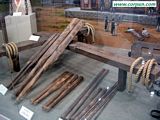
Korea flogging paddle
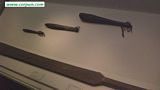
From another museum, or possibly the same one, an example of the big paddle allegedly used in conjunction with the bench shown above -- although the photos from c.1900 (see below) show a different kind of implement in use, something more like a cane. I do not know what the smaller sticks were for -- they look rather like police truncheons.
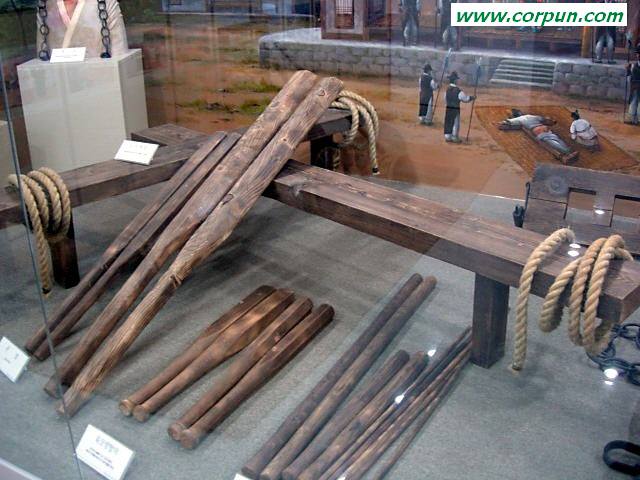
Corpun file 21450b
More flogging paddles
Another museum display, showing a wider range of implements for judicial corporal punishment.
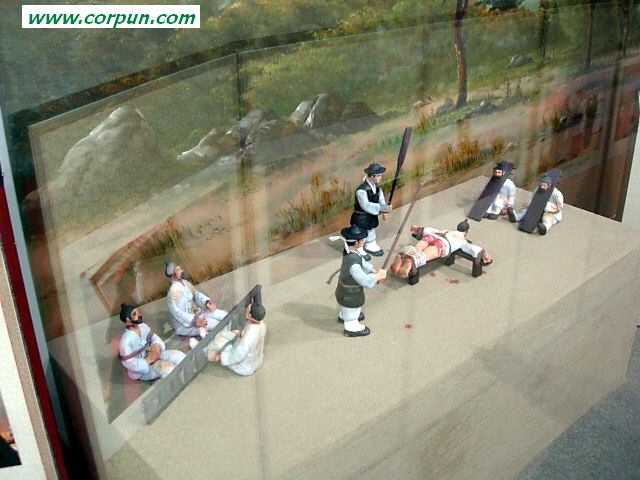
Corpun file 21450a
Tableau of punishments
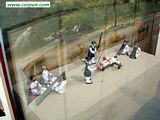
From the same exhibition as the above, this miniature representation with models shows a paddling under way using the equipment previously illustrated, and also some offenders in the stocks.
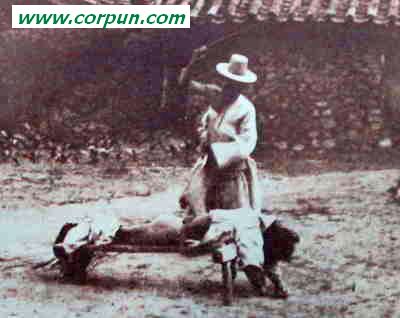
Corpun file 19516
Caning, possibly c.1900
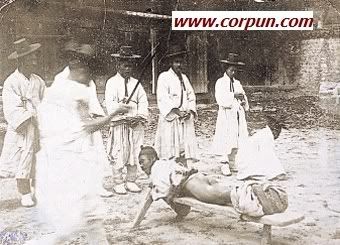
If you think you have seen this picture before, it is because it is very similar to these pictures of judicial CP in Korea around 1900, but this is actually a different picture, new to me. I think this one is more clearly "the real thing" and not posed: the operator is slightly blurred, as though in motion, and the offender looks as if he could be squirming in pain.
Corpun file 20992
Another caning possibly c.1900
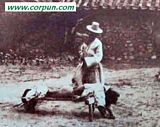
This is a detail, giving a slightly clearer view, of the picture postcard which is the third picture down on the pictures of judicial CP in Korea around 1900 page.
Corpun file 17071
Tableau: flogging of a Christian
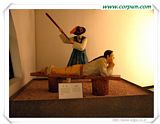
This model is on display at a Roman Catholic church in Korea which has an exhibition showing how Christians were allegedly persecuted and tortured there in the 19th century. However, this particular incident looks like an ordinary Korean punishment flogging rather than "torture and martyrdom" as described in a plaque in English at the exhibition.
Corpun file 21450c
Depictions of bare-bottom floggings
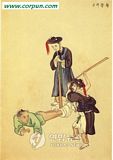
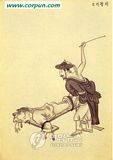
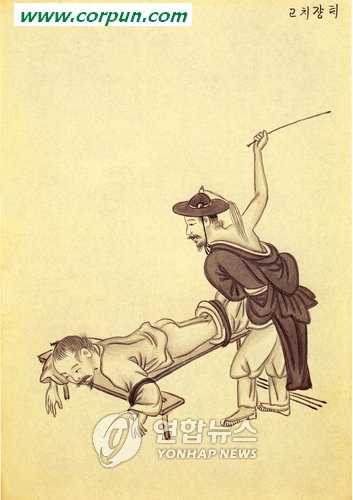
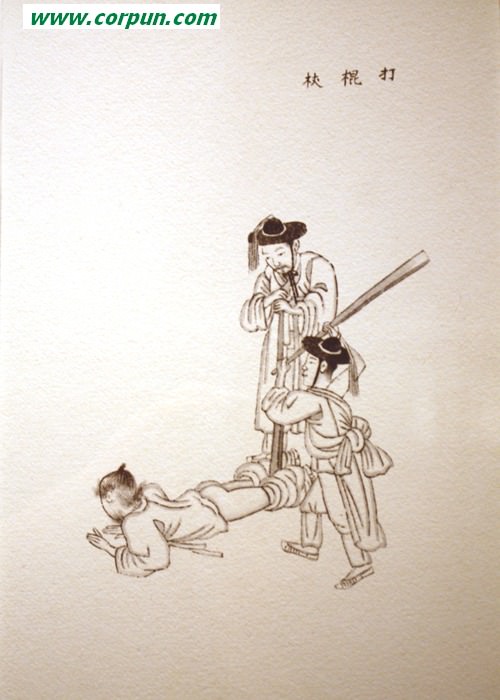
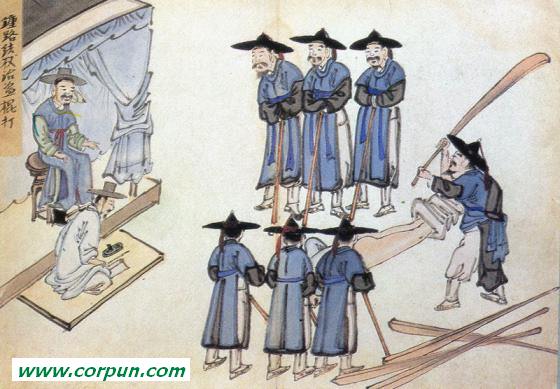
These purport to be old paintings of Korean judicial corporal punishment in progress. Note that the one in which the light cane is being used has the offender strapped to the bench previously seen, whereas the depiction of the big paddle in use shows him simply lying on the ground. In both cases his trousers have been pulled down, as seen in the real-life old photographs.
Corpun file 21448
More flogging paintings
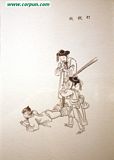
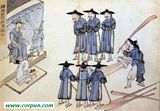
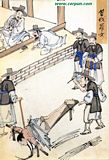
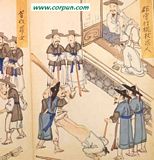
More very similar scenes from old Korea. One of these shows the flogging bench in use as shown in the museum photographs; in the others, the offender is simply lying flat on the ground.
Corpun file 22096
Re-enactment of a public flogging
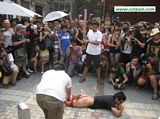
This seems to be a modern-day re-enactment, for what purpose is unclear, of an ancient traditional Korean "lying flat on the ground" flogging as seen in some of the paintings above (see previous two items).
Corpun file 21369
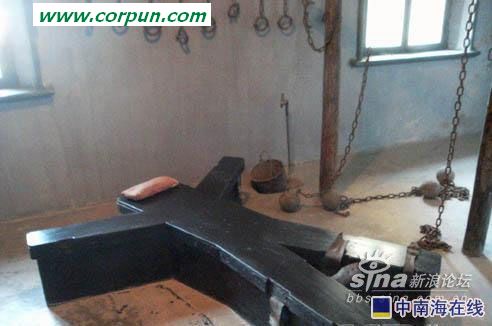
A different flogging bench
Yet another museum display. This version of the flogging bench is somewhat different from all the others, with the arms and legs splayed out diagonally. There is a little pad for the culprit's head, and straps for the legs and ankles.
 MALAYSIA
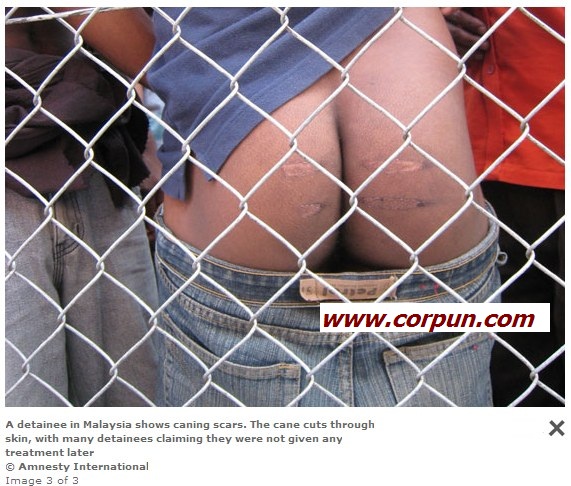
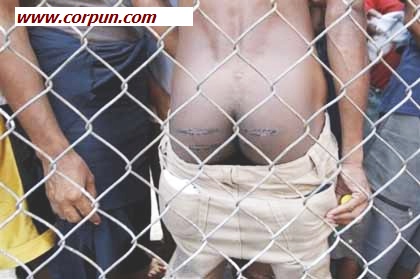
Corpun file 21838
Cane weals
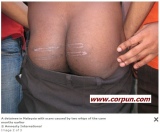
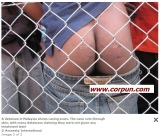
Pictures from Amnesty International article (Aug 2009) about the treatment of foreigners detained for immigration offences. Each appears to have received two strokes of the rotan.
Corpun file 22063
Caning mark
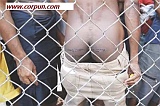
Similar to the above, in this AP picture (July 2009) "a detainee shows the marks from a caning received at a prison before he was transferred to the Lenggeng detention centre". Evidently he likewise received two strokes.
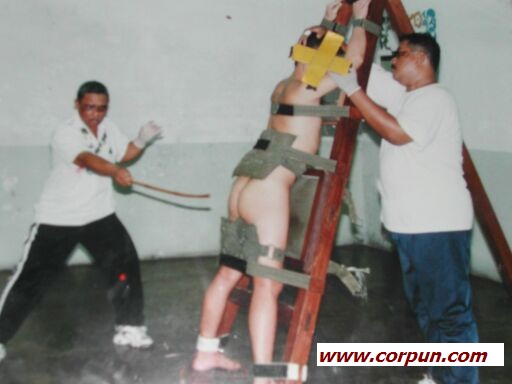
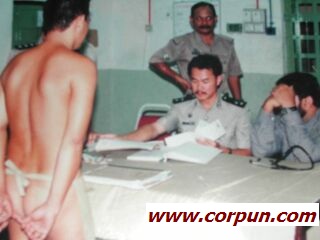
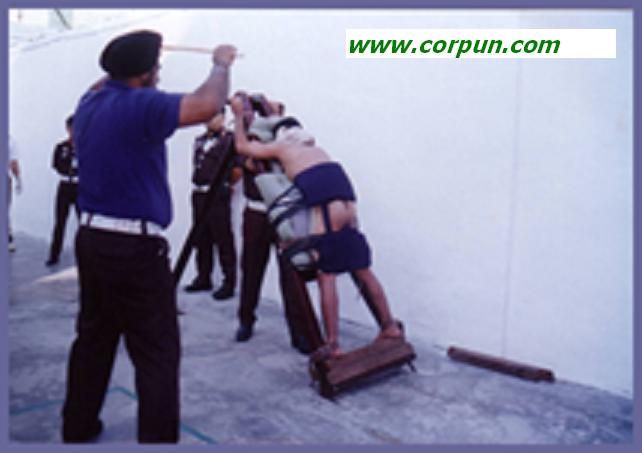
Corpun file 12134
A judicial caning and interview with culprit presumably preceding same
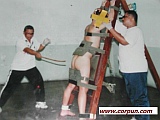
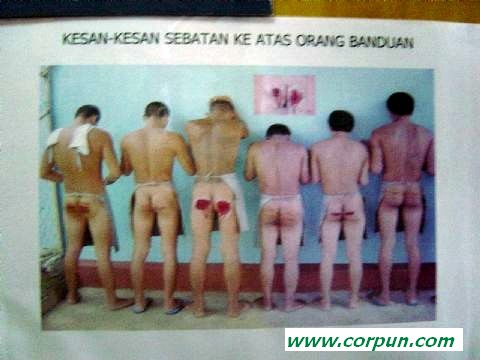
This is definitely from Malaysia, and not Singapore or Thailand as stated on some other websites.
Note that the caning has not started yet -- the prisoner's buttocks remain unmarked at this point. This might indicate that we are seeing only a reconstruction. It would be more convincingly "the real thing" if the picture had been taken after some strokes had already been delivered. But one could well imagine that the operatives, while prepared to pose for a photo before starting, might want the photographer and his equipment out of the way before getting down to the business in hand. On balance, I think this could well be the real thing.
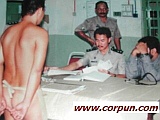
The other picture, of the pre-caning interview, looks very real, with a convincing muddle of bureaucratic paperwork on the desk, and the doctor -- with stethoscope -- looking authentically weary and bored. Meanwhile, the arrangements for fixing the prisoner to the frame are not quite the same as in the other pictures, and the one-piece buttock-framing torso shield had evidently not yet evolved when this was taken. But the caning technique itself, and the holding of the prisoner's head by another officer, appear identical, as do the rubber gloves worn by some of the operatives.
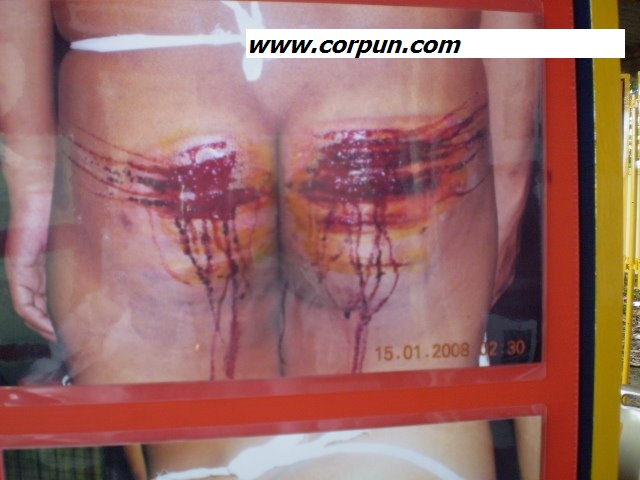
There is also a third picture which looks as if it goes with these two, though we cannot be certain about that. There is now no doubt that it is from Malaysia, as the authorities there have used it in public information displays. It is of a man's raw, mangled buttocks receiving medical attention after a large number of strokes of the cane. WARNING: Squeamish readers should not look at this picture. It is quite disturbing. It may make you throw up. You have been warned!
See extremely gruesome picture of heavily caned buttocks
A reader questions the authenticity of the buttocks photo, citing the implausibly neat and tidy shape of the overall area of the bruising. One possible explanation for this could be that this picture does not, after all, belong with the other two, but is nevertheless a real Malaysian prison picture, and that this caning was done with the more modern one-piece buttock-framing torso shield illustrated here. At all events, other people that I have discussed the picture with lean towards the view that it is genuine.
This nasty picture certainly illustrates the inhumane brutality of canings of a large number of strokes -- at a guess, 24 in this case. But note that the majority of canings are of rather fewer strokes than that, and do not do this sort of damage to the recipient. See for example this picture printed in Asiaweek captioned "The effects of caning in Malaysia", showing weals and relatively superficial bleeding after perhaps three or four strokes. This seems to tally with Michael Fay's own description of the state of his behind at the end of his 4-stroke tanning in Singapore in 1994: "The skin did rip open, there was some blood ..... Let's not exaggerate, and let's not say a few drops or that the blood was gushing out. It was in between the two. It's like a bloody nose" ("Fay describes caning, seeing resulting scars", Los Angeles Times, 26 June 1994).
See also the video clips of genuine Malaysian judicial or prison canings. Even the end of the 20-stroke caning shown in the second video clip, the recipient's buttocks do not look quite as battered as in this picture.
Therefore, I think it would be an error to oppose JCP in Malaysia or Singapore on the strength of this photo. What I would question is what purpose is served by handing down sentences of 20 or 24 strokes rather than, say, a norm of four to six strokes, with a maximum of 8 or 10 for especially serious cases, which would not involve such egregious brutality and physical damage, but would probably work just as well as a punishment. Robert Symes and Aaron Cohen each received six strokes in Malaysia, and it's clear from their accounts that both found it a profoundly salutary experience, almost indescribably intense, traumatic and agonising, with lasting effects on their hearts and minds as well as their backsides. If that can be achieved with six strokes, why attract unnecessary opprobrium by inflicting 15 or 20 or 24?
Corpun file 20047
Another judicial caning
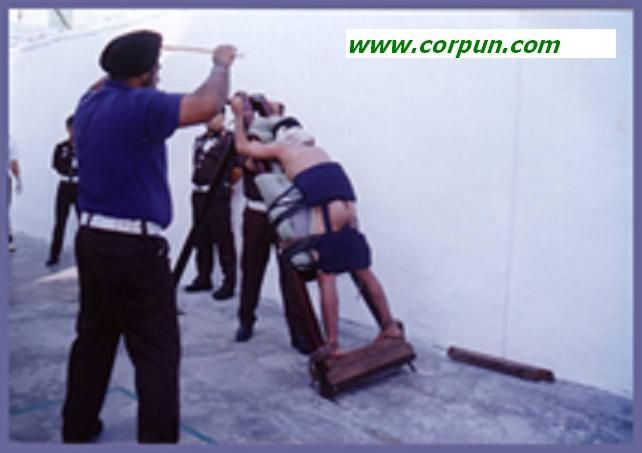
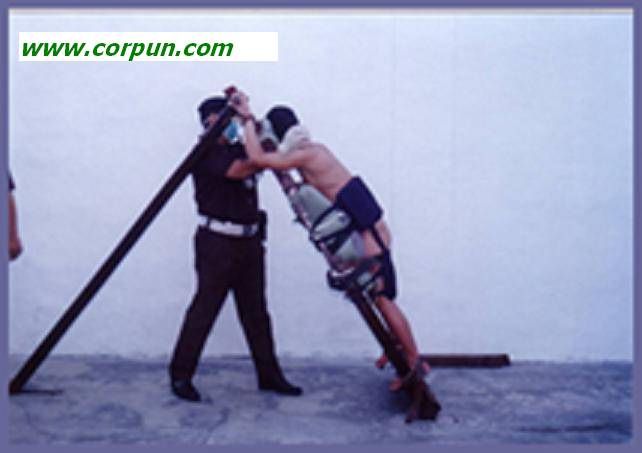
Two views of a caning which appears to be the real thing.
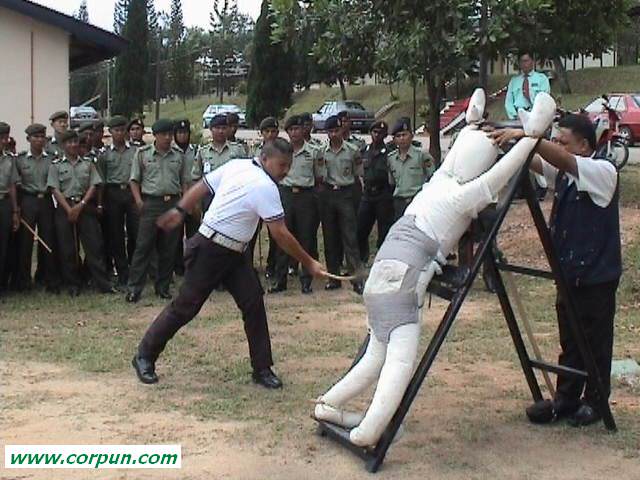
Corpun file 16616
Caning demonstration on a dummy
Picture from the website of the State of Johor Anti-Drug Agency of the Johor Ministry of Internal Security. The caption in Malay says "Demontrasi hukuman sebat bagi kesalahan pengedaran dan memiliki dadah" (Demonstration of caning punishment for the offences of trafficking in and possessing drugs).
What is quite interesting is that, unlike the other dummy caning pictures we have seen, the audience here are not the general public but uniformed staff of some kind. Could this be a sort of preliminary training session for prison officers thinking of volunteering to become whipping operatives?
Note also that this picture captures the cane's trajectory just at the moment of impact and shows that, although these canes when idle appear too stiff and rigid, they are actually flexible enough to bend in use.
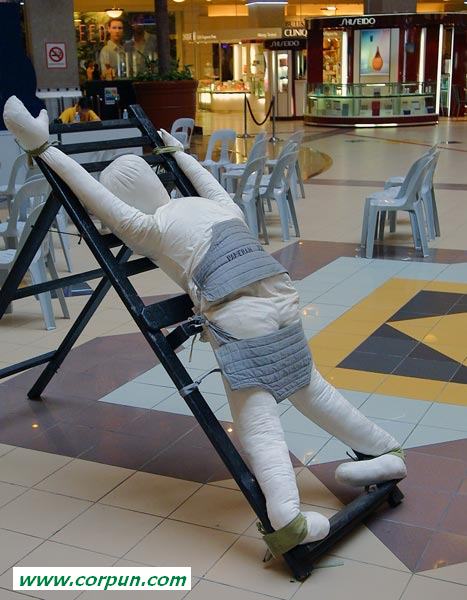
Corpun file 15581
A clearer view of the dummy and punishment canes
Clearly the same dummy as above, this time put on show in a shopping mall in Johore Baru, capital of Johor state, as shown on the website of one Seattle Steve, who was visiting JB as a tourist and found it all a bit much. The trestle shown looks a bit too flimsy to be a real one.
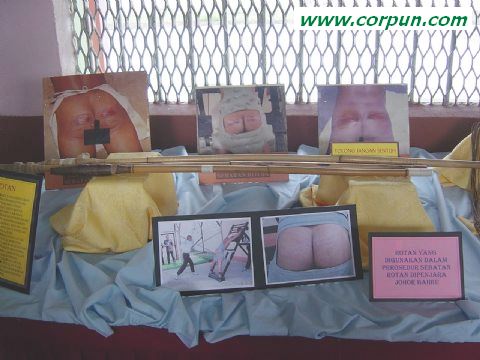
 Also on display were these punishment canes, the smallest one being for punishing white-collar crimes. Steve says he was told the smaller ones hurt just as much as the big one, which seems unlikely to me. Were that so, what would be the point of having a smaller one?
Corpun file 18066
Yet another caning demonstration
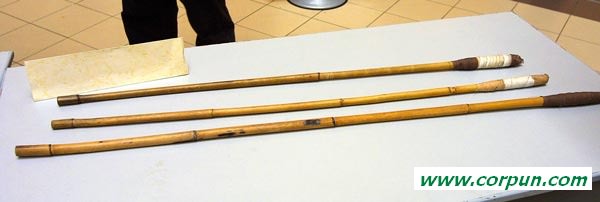
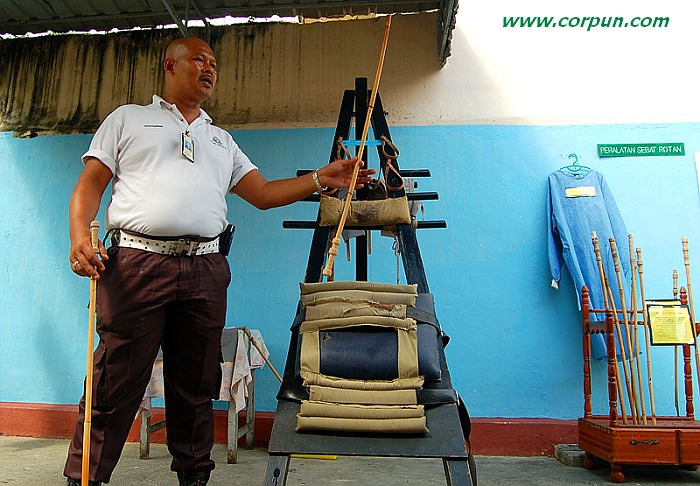
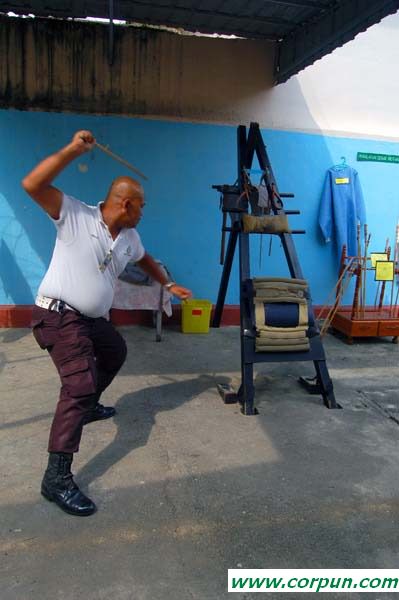
From an exhibition at the jail in Johore Baru, with no dummy but a more convincing trestle than in the previous one. These pictures appeared on a photography website, which also relates a conversation with the prison officer giving the demonstration. The other picture, with more commentary, is on this page. Note that all the canes shown here, unlike the ones in the previous pictures, have been provided with a special grip at the handle end.
For the real thing in action, see these video clips.
Corpun file 18439
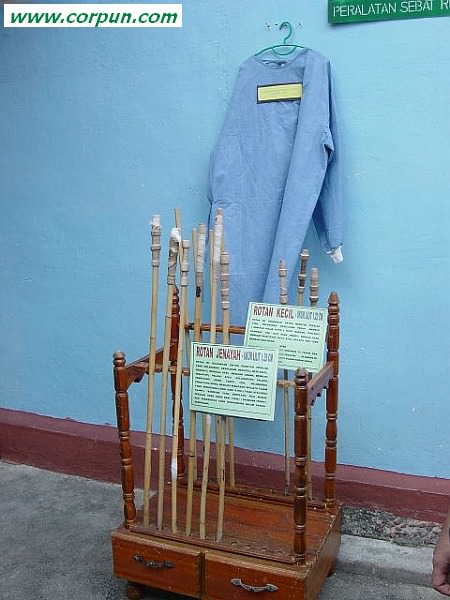
A closer view of the canes
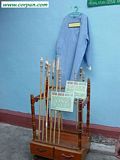
From the same exhibition in Johore Baru prison (see above), a close-up of the rack of canes. "Rotan jenayah" means criminal cane. "Rotan kecil" means smaller cane (the one used for juveniles and white-collar offenders).
Corpun file 18439a
Caned buttocks
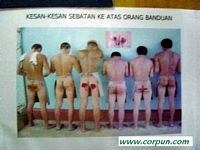
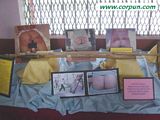
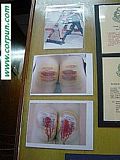
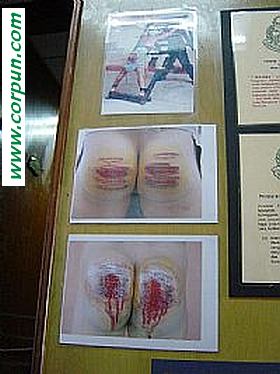
Also from the same Johore Baru exhibition, these pictures of men's backsides after caning, and the canes picture above, all came from a now-deleted blog about a visit to the prison in 2005.
Corpun file 21451
More caned buttocks
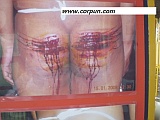
A clearer "caning aftermath" photo from a similar exhibition. Not for the squeamish.
 MYANMAR (Burma)
Corpun file 22061
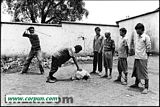 Reformatory caning?
This appeared on the website of a news magazine in Guangzhou (China) but is now thought to depict a scene in Burma. It seems to be a proper formal caning in the walled yard of some kind of institution. Note that two of the witnesses are in ankle chains. I think the men's shirts put the picture in relatively modern times.
 NAMIBIA (formerly SOUTH-WEST AFRICA)
Corpun file 18526
Strapping in German Africa, c.1910
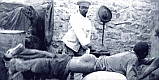
From a ZDF (German public television) web page about colonialism comes this picture, probably taken in South-West Africa (now Namibia), which Germany held for a period up to World War I. Alternatively, it might be from German East Africa (now Tanzania), where, the ZDF website says, "whipping days" were held in Dar es Salaam on Tuesdays and Fridays. It appears that the implement being used is some sort of strap. At any rate it is clear that the prisoner's trousers have been lowered for the punishment to be delivered to his bare seat. Largely out of view to the right of the picture, another officer is holding the culprit down by his arms.
Corpun file 25461
A wider view of the above
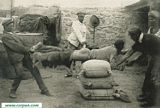
We now have this less-cropped version of the above picture. We can now see that the offender is also being held by his feet.
 NIGERIA
Corpun file 24724
Public sharia caning
This from autumn 2013 is claimed to be a man receiving 24 strokes of the cane for having sex with an unmarried woman. The picture is from Maiduguri in Borno State, north-east Nigeria. It is not clear how "official" this punishment is.
 PAKISTAN
NOTE: Some other pictures that were previously here have now been incorporated into the Judicial corporal punishment in Pakistan article.
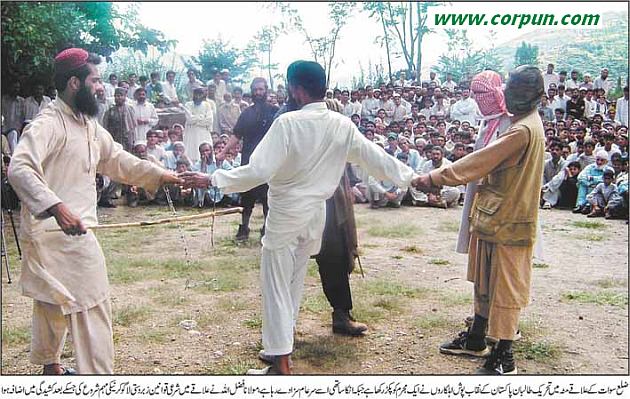
Corpun file 22091
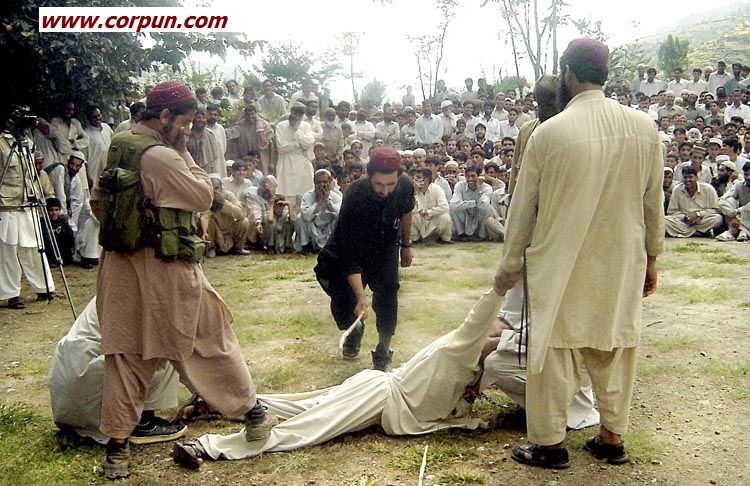
Inept public caning by Taliban
From dailywqt.com (Sep 2008). "Members of Tehrik-e-Taliban (TIP) have 'arrested' a petty criminal, and are meting out punishment in public in Swat as an implementation of Sharia Laws." These people never seem to learn how to do CP properly. Here, the person wielding the cane is also one of those trying to hold the prisoner still, clearly an inefficient procedure.
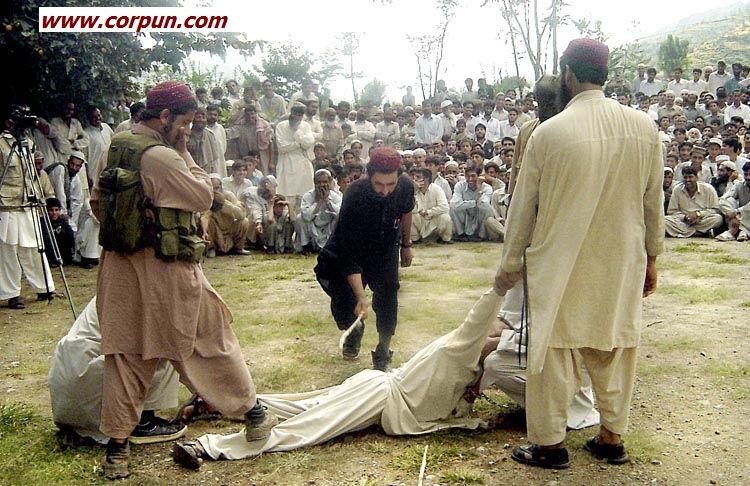
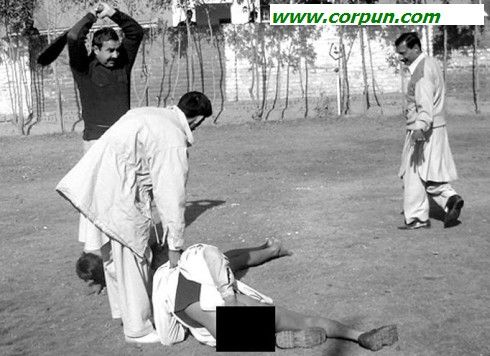
Corpun file 22195
Another Taliban whipping
From the German magazine Spiegel (Feb 2009). Something similar to the above. "Pakistan Taliban in the Swat Valley punish a suspected kidnapper." At least it is clear in this instance that the culprit's buttocks are being targeted.
Corpun file 22579
Punjab police paddling
Punjab police have a special leather paddle for flogging. It seems they use this both for punishment -- it is not clear whether they have official authority for this, but they do it in full public view with apparent impunity -- and in order to extract confessions from suspects. The spanking is applied to the buttocks, either clothed or bare, with the culprit or suspect lying face down on the ground. The implement, called a "patta", has a wooden handle which the operator grasps with both hands to bring it down from over his head. See also several of the video clips on this page.
Corpun file 15922
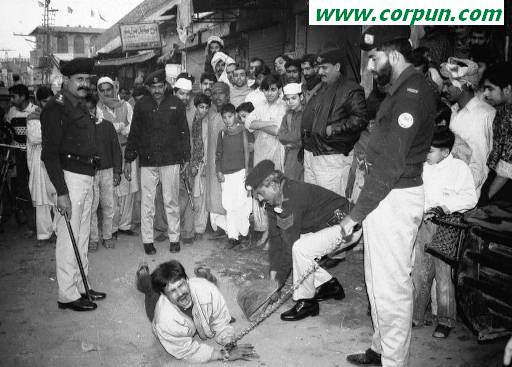
Flogged on the ground
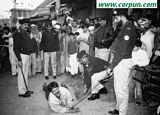
This Associated Press photo is captioned: "Nadeem Butt, a notorious local drug seller, is publicly beaten by police in Lahore Saturday, Jan. 10, 1998. During the Islamic holy fasting month of Ramadan, police are on special alert for vice crimes such as drug pushing and gambling." Which rather gives the impression that this is not a flogging by order of a court, but an ad hoc, not to say ultra vires, informal punishment carried out on the spot at the police's whim. However, it can't have been as ad hoc as all that, (a) because a press photographer was present and (b) because the culprit is being held by a chain to his wrists, so some element of preparation has gone into the event.
In light of the previous item and other recent information, and further study of the picture, it is now clear that this is another case of the use of the patta, the special judicial punishment instrument used by Punjab police. It can be seen in the hands of the officer stooping at right, who has landed a blow with it on the culprit's posterior just an instant before the photo was taken.
 PAPUA NEW GUINEA
Corpun file 15052
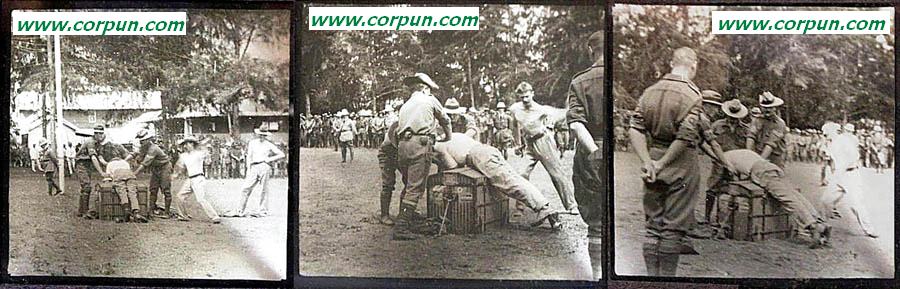
Germans flogged at Rabaul, 1914
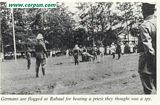
Rabaul is the main town on the island of New Britain, part of what is now Papua New Guinea. The part of New Guinea taken by Britain in the 19th century passed to Australian control in 1906. Other bits of it, including Rabaul, had been in German hands since 1884. When the First World War broke out, Australian forces occupied the German areas, taking Rabaul on 13 September 1914. This photograph, captioned "Germans are flogged at Rabaul for beating a priest they thought was a spy", appeared without further explanation in an unidentified Australian reference work.
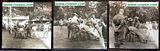 Much more recently, three glass slides came up for sale on eBay showing what is obviously either the same event or a very similar one in exactly the same place. (They are possibly back to front, unless all three chaps doing the whacking happened to be left-handed, which seems slightly unlikely.) The seller could say only that the slides had come in a job lot from New Guinea. These three shots, shown here in a composite picture, are taken from closer up than the first picture and clearly show three different men being publicly flogged over a trunk by Australian army personnel.
All is now explained in this November 1965 article in an Australian newspaper (for which I am indebted, as also for much other Australian historical material with which he has most kindly supplied me over the years, to the indefatigable Glen Ralph of the wonderfully eclectic Wilmar Library). The article is an interview with an eyewitness to the 1914 events, at the time a young serviceman and by 1965 an elderly retiree. He explains the whole background to the floggings and says that four German civilians were flogged altogether, each in turn held over a trunk and given 30, 25, 25 and 10 strokes of the cane, respectively. The ceremony took place in the main square in Rabaul on, he says, 30 November 1914. He also reveals how the pictures were taken surreptitiously in defiance of official instructions. It looks as if he might have been mistaken in thinking that his friend was the only person taking pictures, since the picture printed in the Australian reference book is taken from a different angle and from further away. But there cannot be much doubt that the events he describes are those shown in these pictures: we see the trunk that he mentions, the flagpole, the troops lined up around the square.
The newspaper article also mentioned that a "postcard snap" of the event went on sale around the islands. Perhaps this was the first of these pictures, possibly taken officially; it shows the top brass, standing back from the ceremony, who are out of view in the three closer-up pictures. It seems reasonable to assume that the three glass slides that have now come to light are some of the pictures that were taken secretly.
 POLAND
Corpun file 22743
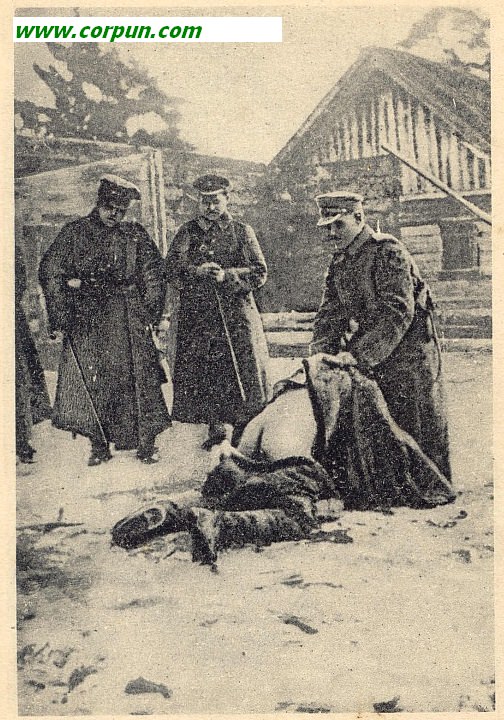
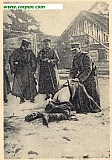 "Polish soldiers punish a peasant in Belarus"
The reader who sent me this says it is from a Soviet postcard of the 1920s or 1930s, with the above title on the back. He thinks the picture was probably taken during the Polish-Soviet war in 1920.
 RUSSIA
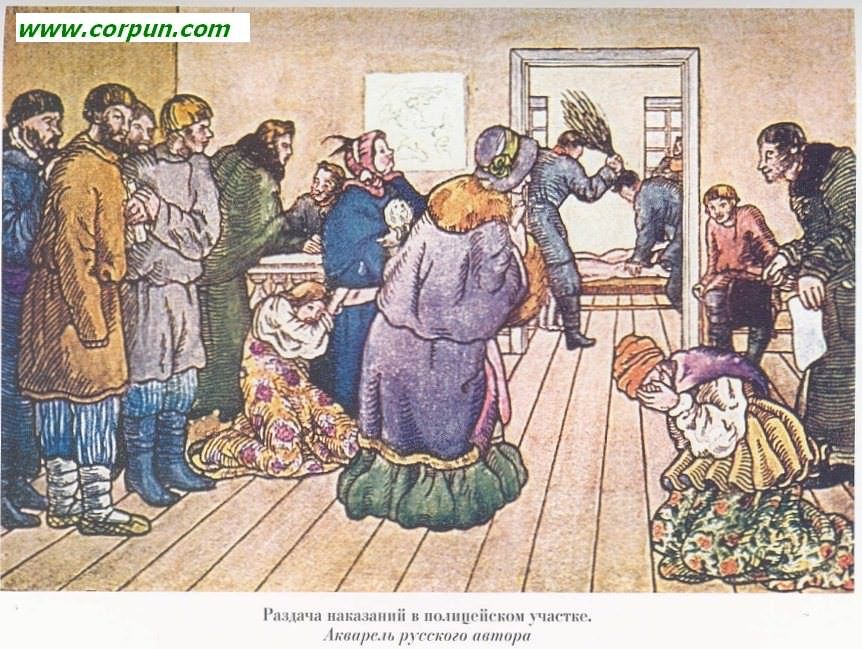
Corpun file 22810
Judicial birching
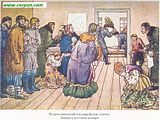
A judicial birching for minor offences, carried out in a police station, is glimpsed through the door into the next room while in the foreground, waiting in anguish, are presumably relatives of the accused. Painting by Antonina Westfalen in 1912; the scene she imagines could date from perhaps a hundred years earlier than that.
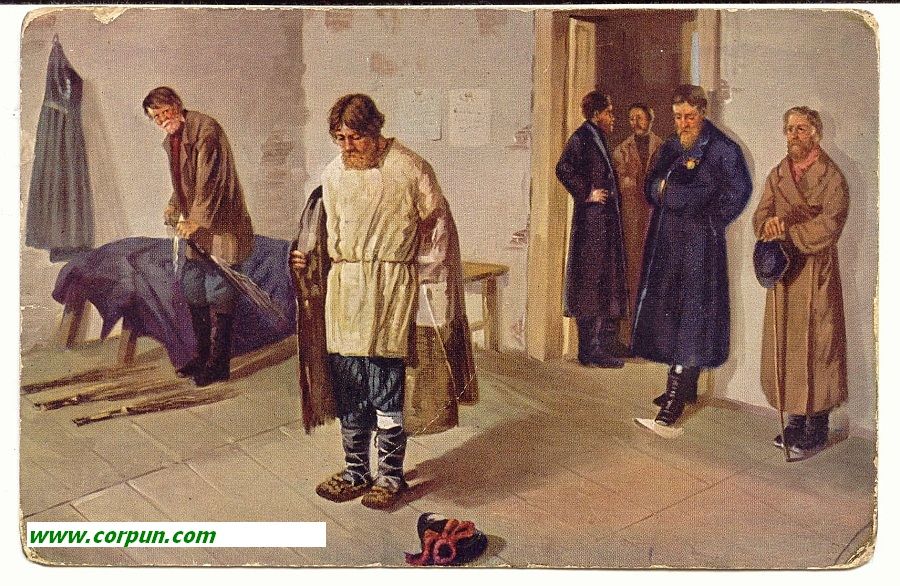
Corpun file 22476
"Preparation for flogging"
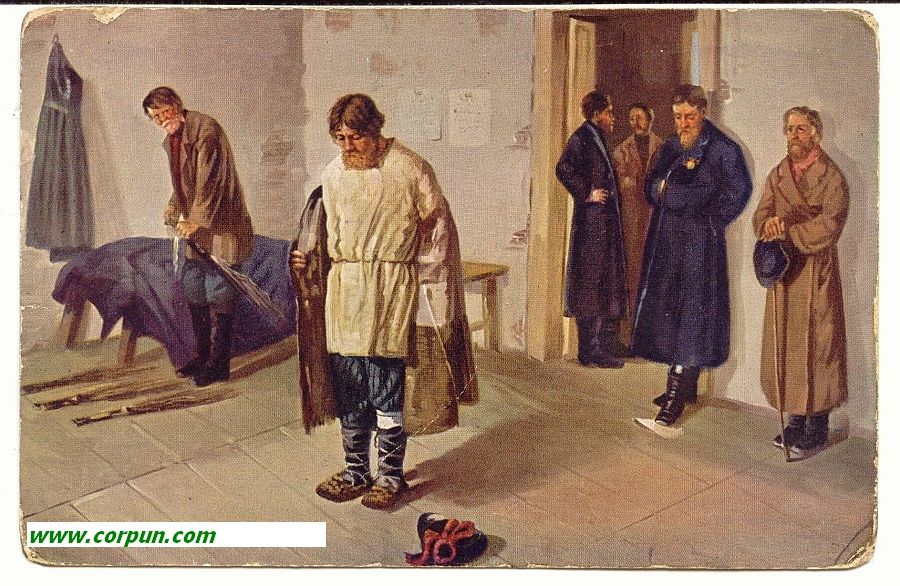
From 1863 to 1903, peasants could be sentenced to a birching of up to 20 strokes. Here a peasant is getting undressed ready for his punishment. In the background, by the flogging trestle, an official is preparing four birches. I do not know who the men at right of the picture are supposed to represent. From a painting by Sergey Korovin, incorrectly attributed on the back of the postcard to his better-known younger brother Konstantin Korovin (1861-1939).
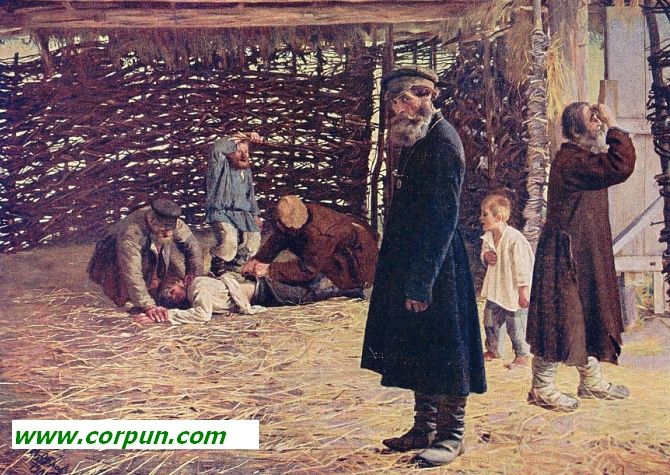
Corpun file 22733
Judicial birching of a peasant
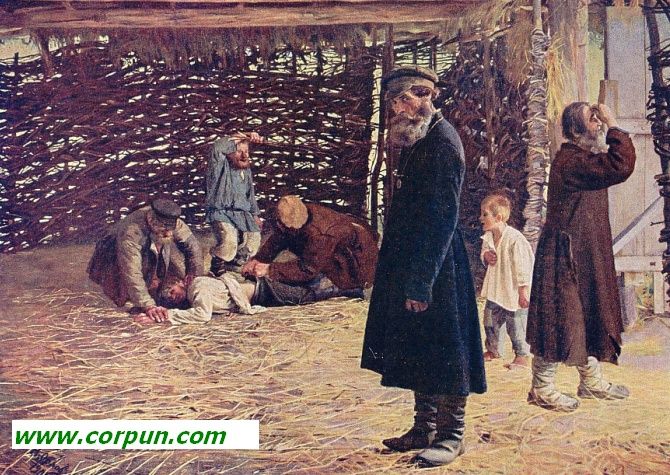
Painting by Nikolay Orlov in 1904, just after JCP was abolished in Russia.
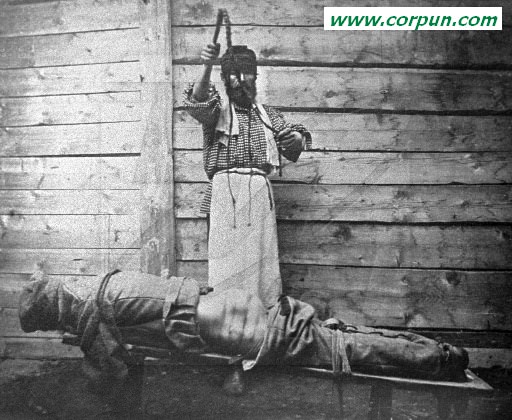
Corpun file 21928
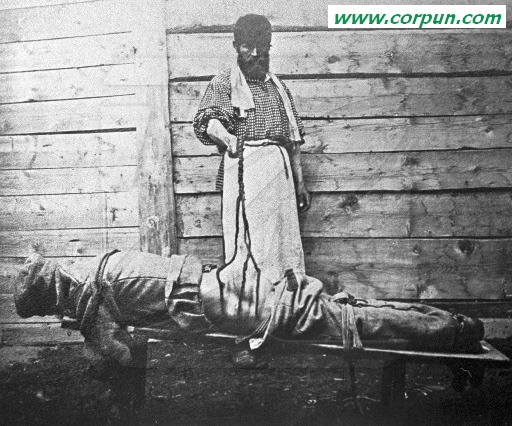
Flogging with the plet, c.1890
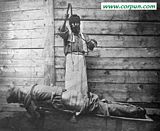
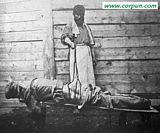
A prisoner is whipped with a plet (not a knout, which was abolished in 1845). We know that the photographs were taken on Sakhalin Island in or before 1890, because it was in 1890 that the writer Anton Chekhov bought them there. Sakhalin was the main Russian convict prison at the time. The plet appears to have been somewhat akin to the cat-o'-nine-tails, but with only three tails. The prisoner has been strapped to a bench and his trousers lowered so that the punishment can be administered to his bare seat.
JCP and prison CP in Russia was abolished in 1903.
Corpun file 22914
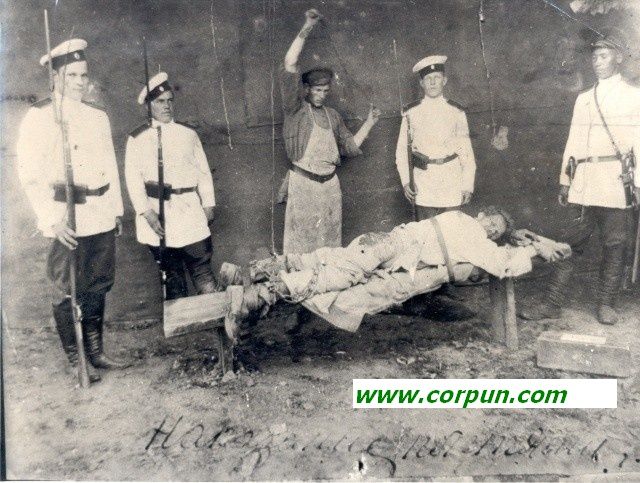
Another flogging with the plet, c.1900
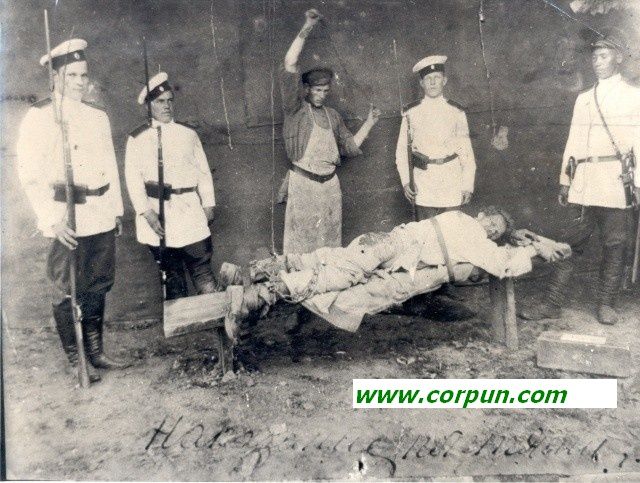
Similar to the above, but with uniformed officials in attendance. I'm told that the plet had been abolished as a court sentence in 1863 but continued to be used for internal prison discipline purposes until 1903. Its use is said to have been rare, the less severe birch being the more usual instrument.
Corpun file 22963
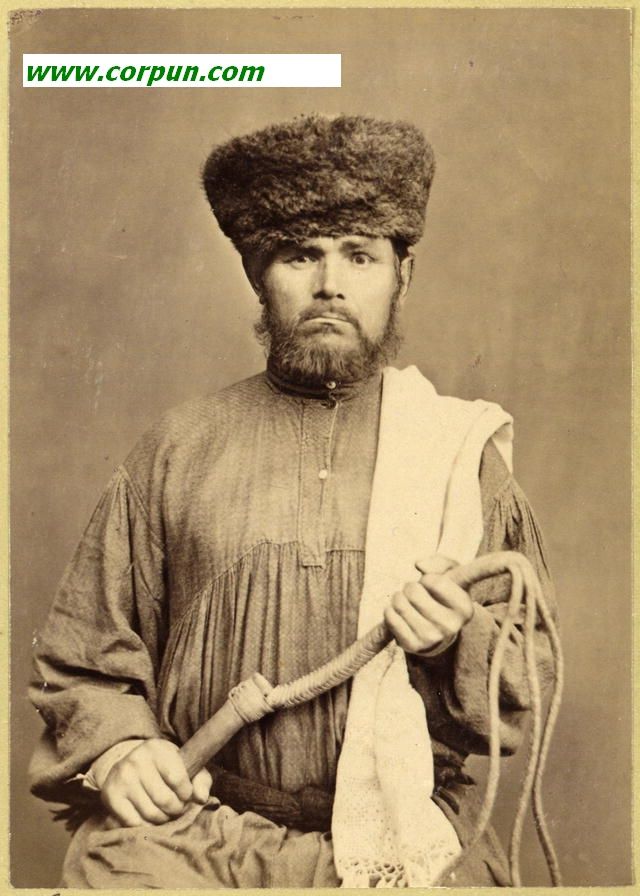
Prison official with plet, 1891
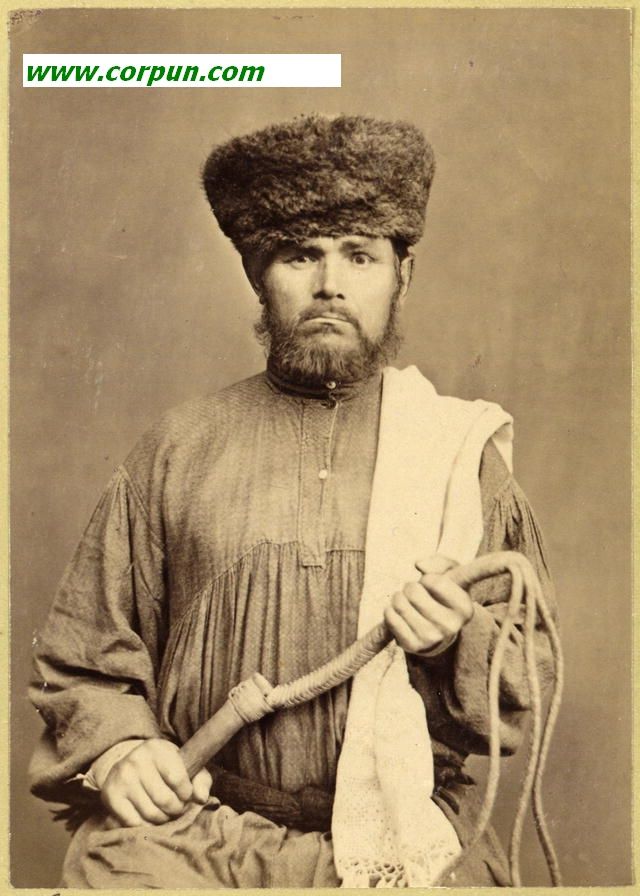
Taken in 1891 at the Nerchinsk hard labour mines. Picture is held the National Library of Russia in St Petersburg.
Corpun file 21787
"Fifty lashes", 1887
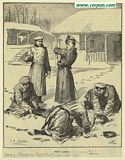
This print by Francis Davis Millet (1846-1912) appeared in Harper's Magazine in 1887 and has "Cossacks" written under the caption. The implement seems to be a whip rather like a riding crop.
Corpun file 21382
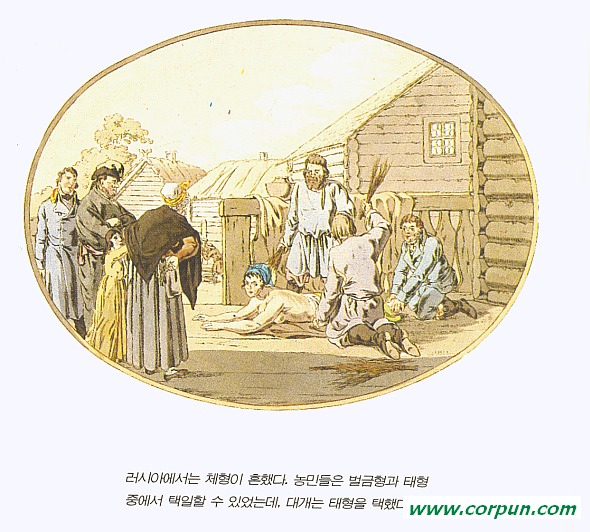
A female serf is birched
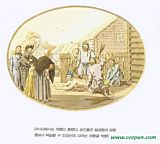
Here is a painting from a Korean history book, showing life in Russia around 1700. The caption says "Corporal punishment was common in the Russian Empire. Serfs who were given a choice of a fine or a whipping usually chose the whipping" (presumably they couldn't afford the fine). In fact rural serfs (landless peasants) were subject to CP until after the end of the 19th century -- see this Sep 1903 news item. The implement being used here is clearly a birch. The picture, by German artist Christian Geissler, was first published in 1805.
Corpun file 20830
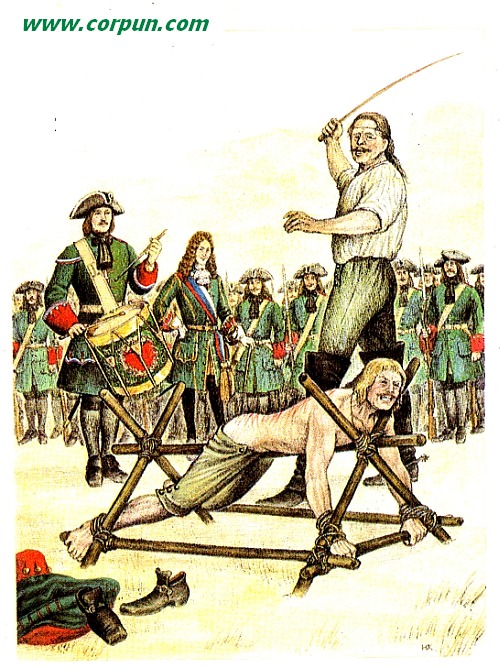
Military flogging c.1700
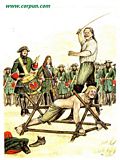
Said to be from a booklet on the army of Peter I published in Moscow in 1994. I have no idea how authentic this is or whether it is just guesswork on the part of the artist. I have not previously seen a contraption quite like this pictured. Note that the cane is being applied to the buttocks as well as the back.
Corpun file 20565
Cossack flogging
A rather small and murky picture from a Russian-language news page (2007), where it was used to illustrate a modern story about Cossack nationalists who, absurdly, threatened to whip members of the Estonian government for being hostile to Estonia's Russian-speaking minority. The report points out that, were they to do so, it would of course be a criminal act whether in Russia or in the now independent Estonia. But where the picture itself comes from is not stated, only that such flogging is claimed to be in accordance with ancient Cossack traditions.
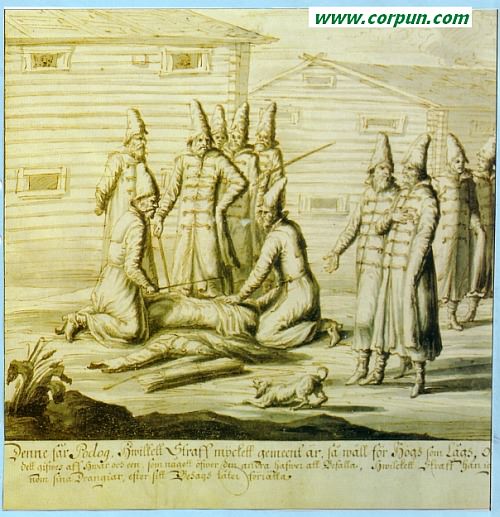
Corpun file 20828
A 17th-century drawing of a Russian flogging
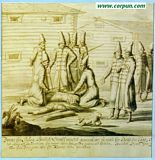
The drawing is said to be of a flogging in Russia, but the text is in Swedish.
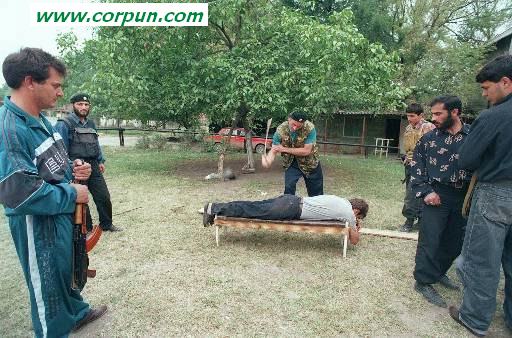
Corpun file 13946
Flogging in Chechnya
Small picture used to illustrate a November 1999 article in the Moscow newspaper Rossiskaya Gazeta. At the time, the Russian government was in the process of regaining control over the breakaway Chechen republic, which had started imposing Islamic law, including public floggings. The article introduces an interview with a Russian official newly responsible for law and order, who described flogging as barbaric and implied that Islamic law was to be, or possibly already had been, swept away and normal Russian penal procedures restored. As far as I know, the Moscow regime has now indeed done away with this sort of thing.
Compare this picture of a Chechen caning three years earlier in 1996. The new picture might of course date from the same time -- it has no caption in the 1999 article. The man administering the caning is evidently so lazy or clapped-out that he has to sit down to do it -- one would not think he would get enough of a purchase from that position.
Corpun file 15272
Another Chechnya caning
This came with the caption "Chechen man caned in Grozny, Sept 15, 1996". The source is unknown, but the picture looks genuine enough.
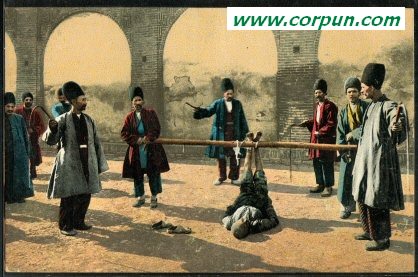
Corpun file 17353
Bastinado in the Caucasus
This is an old postcard, allegedly captioned "Caucasus: Punition of a criminal". No fewer than four officials are wielding whips, presumably taking it in turns to apply the punishment to the soles of the convict's feet. Two others hold up the bar to which the offender's ankles are attached. There is no date. Although described as "Russia", it could well be present-day Armenia or Azerbaijan, which border Iran. Certainly this method of punishment is more usually associated with the Middle East than with Russia proper. Someone who knows the region could perhaps identify the location from the impressive viaduct in the background.
 SINGAPORE
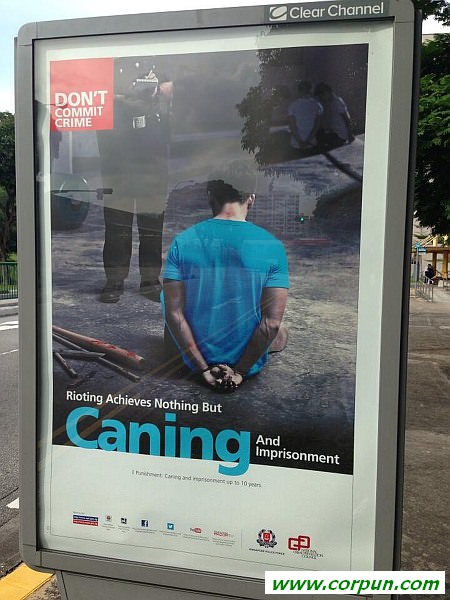
Corpun file 24813
Anti-crime poster
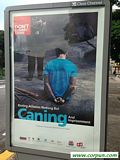
In 2013 the Singapore Crime Prevention Council put posters up at bus stops showing the aftermath of a riot, with the slogan "Rioting Achieves Nothing But Caning And Imprisonment". This is no empty threat: several gangs of rioters have been sentenced to strokes of the cane over the years. Note the emphasis, in terms of type size, on the word "caning", an example of the authorities' continuing confidence in the potency of JCP as a deterrent to disorder.
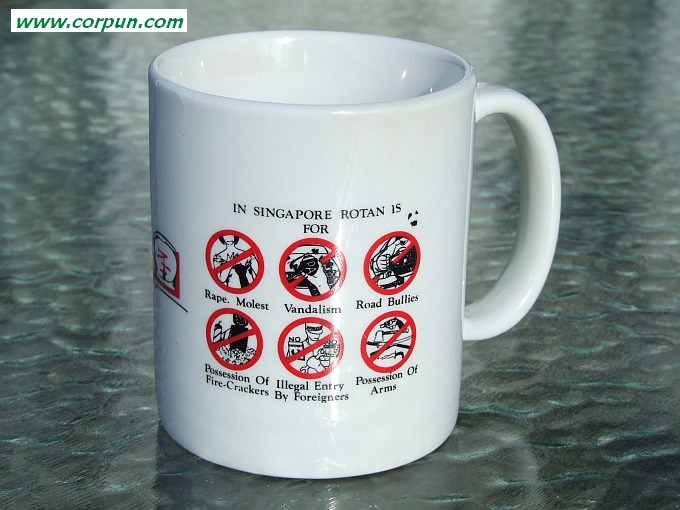
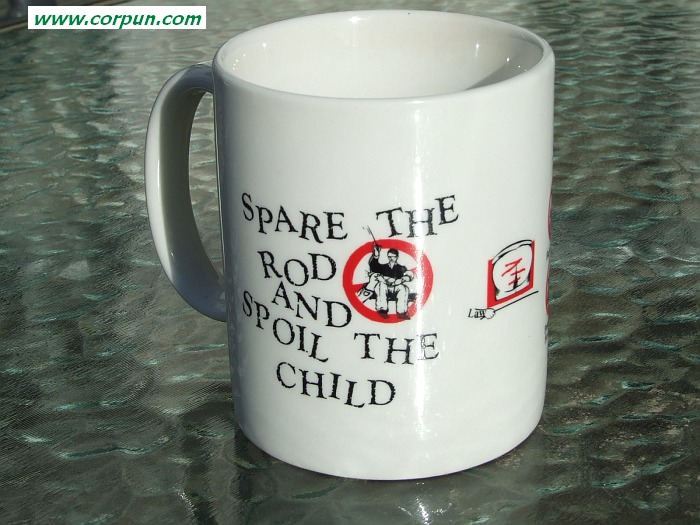
Corpun file 18313
"Spare The Rod" mug on sale in Singapore
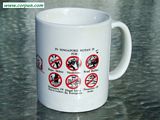

This mug was on sale on Singapore a few years ago, and makes a joke of the country's JCP policies. The over-the-knee drawing rather confuses the issue.
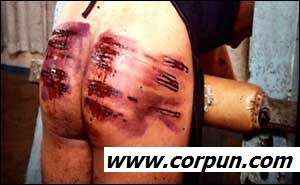
Corpun file 21261
Caned backside
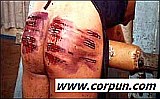
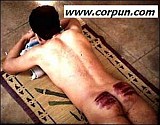
Here we have a couple of clear, reasonably-sized pictures of a freshly-caned prisoner in Singapore. One of them shows him still standing at the A-frame (note the padded bar). He looks to have received perhaps six or eight strokes, delivered with the usual remarkable precision. There are raw weals and limited, not profuse, bleeding, much as described by Michael Fay. I am reasonably confident that this is the real thing and not a mock-up. It came from a Singapore website (housed on a government server), made by students with official assistance, designed to deter youngsters from getting involved with gangsterism.
Corpun file 21921
Caning scar
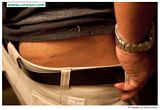
A man who was once caned for drug-trafficking lowers his trousers far enough to show a scar on his right buttock. It is not stated how long ago the caning had taken place. From a general article about Singapore in National Geographic (Jan 2010).
 SOUTH AFRICA
Corpun file 22474
Juvenile caning trestle and canes
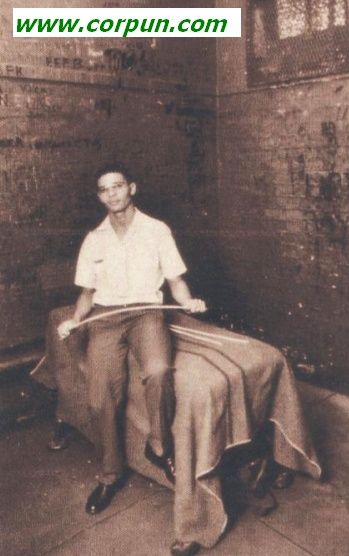
"Sergeant Nicholas Botes on the trestle on which offenders have to lie when they're caned in the cells at Cape Town Magistrate's Court". From You magazine (April 1994). JCP was abolished three years later.
Corpun file 20829
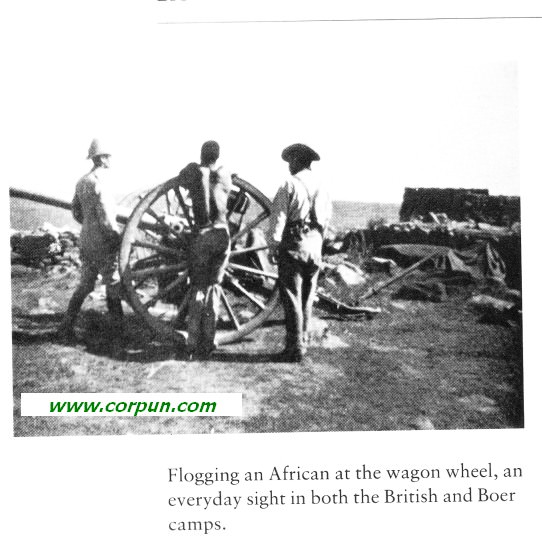
Flogging in the Boer War
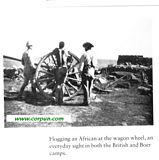
An African being "flogged at the wheel", c.1900, from Thomas Pakenham, The Boer War, Johannesburg, 1993. It is not clear how official or unofficial this was in the context of the war, but the book claims that both sides, British and Afrikaner, punished Africans in this way.
 SWEDEN
Corpun file 20847
A Swedish soldier gets a caning
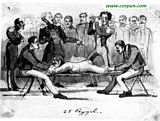
This caricature by Fritz von Dardel dates from c.1830 and shows a Swedish soldier receiving 25 strokes of the cane. From Rehnber, Vad skall vi gra med de blanka gevr, Stockholm, 1966. The modus operandi appears more or less identical to that of the Austrian army in the same century, see Frieze in Prague.
Corpun file 20827
Two soldiers being punished
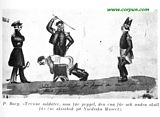
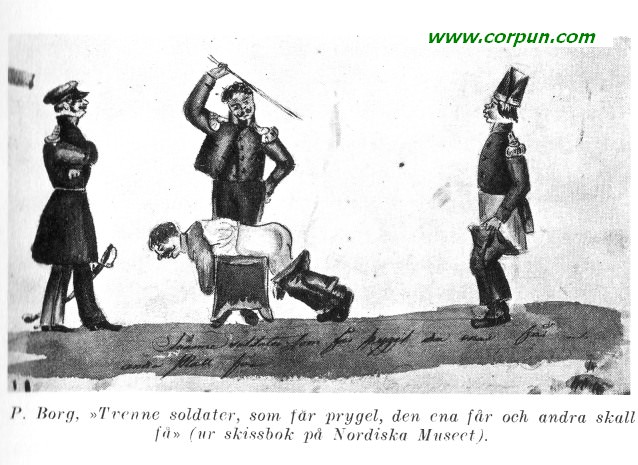
"Two soldiers being punished, one is receiving the other is waiting", cartoon by P. Borg, c.1820. From Lars Levander, Brottsling och bödel, Gidlunds 1975. This picture is rather silly, because the culprit is obviously supposed to be being caned on his bottom but the man with the cane is standing on the wrong side.
 TAIWAN
Corpun file 23229
Pants-down paddlings for Taiwanese soldiers
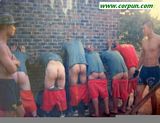

Army punishments in Taiwan.
 THAILAND
Corpun file 24141
Army recruit caned
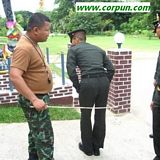
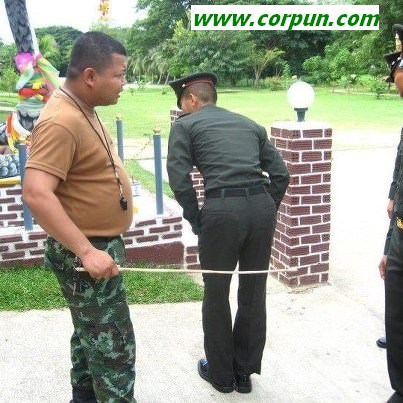
Light caning on the clothed backside seems to be a standard, if "unofficial", minor punishment in the Thai army, which has a lot of youthful conscripts to be kept in order. Here a young soldier bends over to be disciplined with the rattan. See also these video clips.
Corpun file 19909
อ้างชุด ปราบ ยาเสพติด จับ ตี ก้น 4 ผู้ ต้อง หา
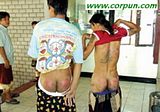
This picture appeared on a Thai-language web page. It appears that these youths had been arrested by the police on drugs charges. They complained that the police had given them extrajudicial CP with batons on their behinds.
Corpun file 20550
Whipping rattan
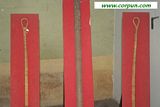
These "rattan whips" in Samut Prakan Central Prison were used to beat prisoners, until abolished in 1896, according to a page that now seems to have disappeared from the Thai Prison Life website.
 UGANDA
Corpun file 13207
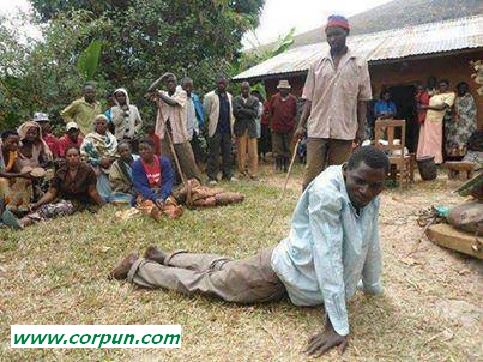
Odo okayo dud lakwo
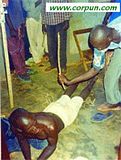
This appeared on 21 April 2004 in a Lira-based Atesot-language paper, Rupiny, with the following text:
odo: LC tye ka miyo odo tye ka kayo dud lakwo dek. LAKWO mo ma oywek atika i Kitgum taun ma dano ngeyo ki nying ni Kao odoo okayo dude malit pi kwalo dek i gang pa min Otoi i Oryang Ojuma icabit ma okato ni J. Moro coyo. Nyeri ikare ma kimake en bene oye ni en ki luwote mogo aye gikwalo dek pa min Otoi kacel ki gweni abic idye wor meno kun giburu dano ni gin gibedo adui LRA pa Kony. LC1 me East Ward Alfred Omara owaco ni rwom me kwo tye malo mada tutwale kwo me dyegi, opego, gweni ki jami odi matino tino calo cupuria. jerry can, kikopo ki cwan.
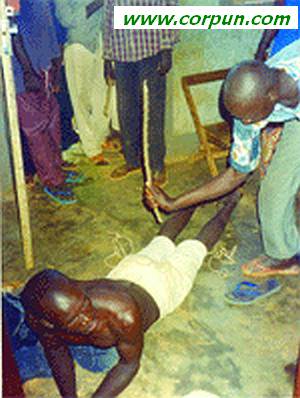
In the unlikely event of anyone looking at this website being able to read Atesot, an English translation would be welcome. Meanwhile, I assume this is one of those on-the-spot local court ("LC" or "LC1") canings reported in Uganda from time to time, such as this news item from March 2004 or this one from June 2002. Note the "lying flat on the ground" posture, which I should have thought was rather unsatisfactory but which seems quite common in Africa for both judicial and school CP. Note also that the offender is stripped down to the waist but keeps his shorts on. This might suggest that the strokes are aimed at his back, not his bottom, though it's hard to tell from the picture. Either way, it looks as if in this particular case the punishment may have been more of a token gesture than a terrible ordeal.
Corpun file 14904
Galamira mangu nkuwe ebibyo
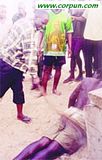
Another local paper, Bukedde, published this somewhat similar picture on 4 January 2005. The text, in the Luganda language, says:
Eyo emu, ezo bbiri.... bwe batyo abavubi ku mwalo gw'e Misonzi mu muluka gw'e Lulamba mu ggombolola y'e Bufumbira mu disitulikiti y'e Kalangala bwe baatandise okubala embooko ow'ebyokwerinda Livingstone Muyinda ze yabadde aweweenyula Musoga oluvannyuma lw'okusingibwa omusango gw'okukuba munne. Kigambibwa nti Ssempappe ono yafunye obutakkaanya ne Asuman n'amulumba n'amukuba ebikonde ng'akuba eng'oma. Bavubi banne baalabye ayagala kumumiza mukka musu kwe kumukwata ne bamutwala ku LC. Ssentebe w'ekyalo yasitukiddemu n'ayita olukiiko lw'ekyalo mwe baamuweeredde ekibonerezo kya kukubwa kibooko 10 era yagenze okuva wansi ng'amakugunyu gababiridde.
Again, any translation would be welcome. Note once more the reference to "LC". We know that "kibooko" means cane, so perhaps "kukubwa kibooko 10 era" means 10 strokes of the cane. This time the picture leaves no doubt that the punishment is being applied across the seat of the offender's shorts, and with some vigour. The cane is of a rather more effective length than the one in the earlier photo.
See also this 2012 video clip.
 UNITED KINGDOM
NOTE: Many of the pictures that were previously here have now been incorporated into the Judicial corporal punishment in Britain article.
Corpun file 24369
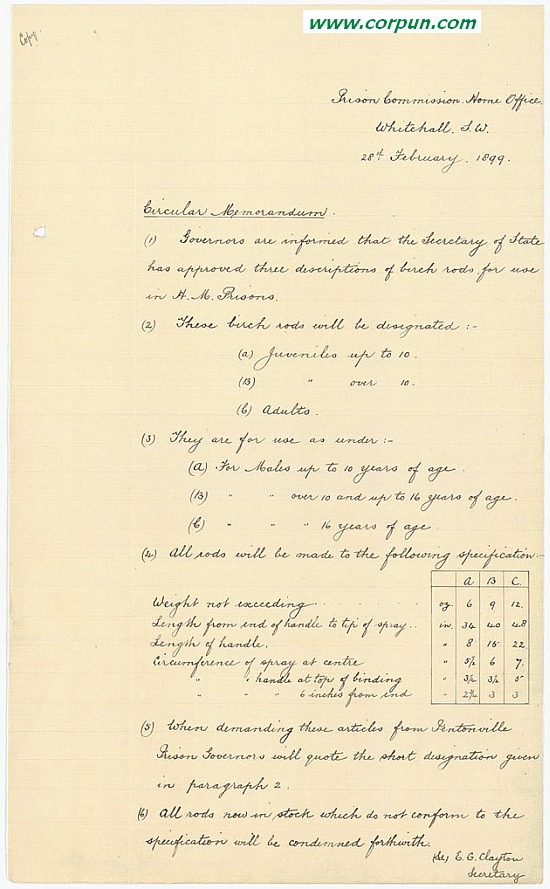
Home Office circular to prison governors, 1899
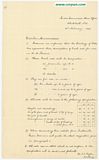
This memorandum from central government to prison governors in 1899 lays down the weights and dimensions of three sizes of birches, to be used according to the age of the recipient. Any birches not in conformity were to be destroyed.
Corpun file 25327
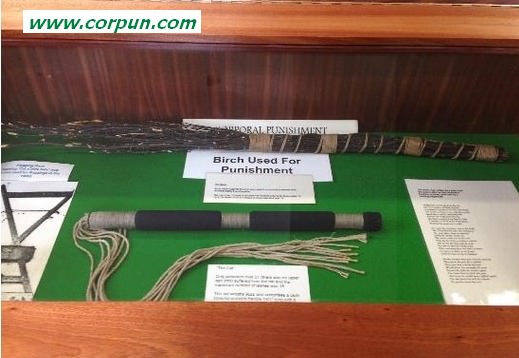
Birch and cat-o-nine-tails used in Northern Ireland
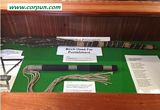
These whipping implements are on display at Crumlin Road former prison in Belfast, now a museum.
Corpun file 25076
Edinburgh birching bench, with birch
A better view of the juvenile birching bench in the Edinburgh police museum -- see here for commentary. However, I think the birch shown here is an inaccurate reconstruction. It looks more like a 1960s Manx birch than the traditional spray birch used on the mainland.
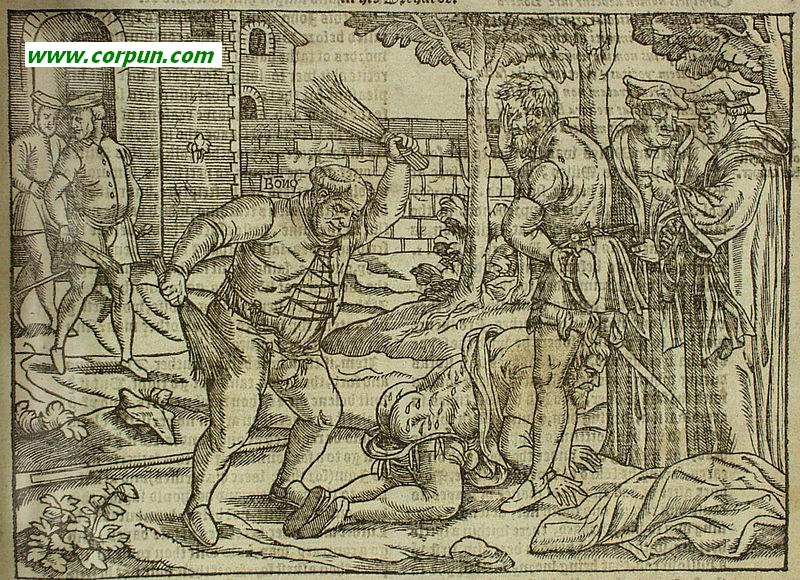
Corpun file 24146
Mediaeval birching
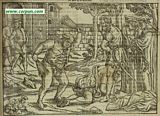
Woodcut of Bishop Edmund Bonner ("Bloody Bonner") (1500-1569) punishing a heretic with not one but two birches. From Acts and Monuments, aka John Foxe's Book of Martyrs (1563.)
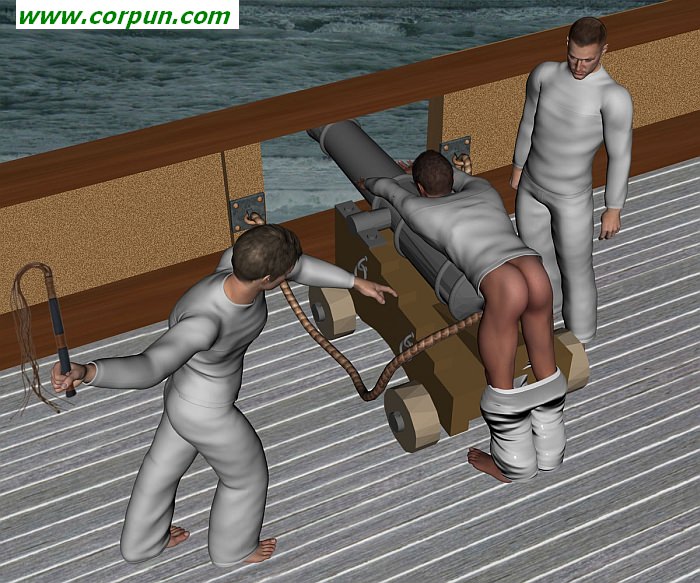
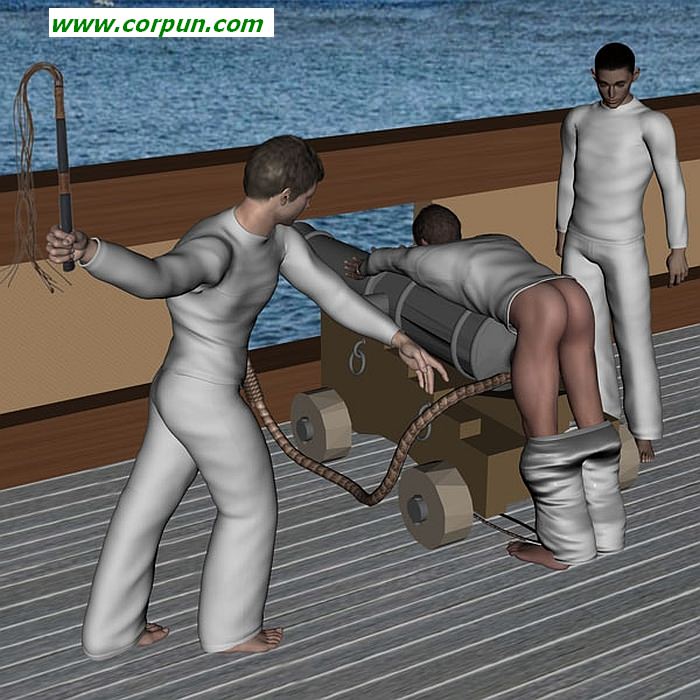
Corpun file 24415
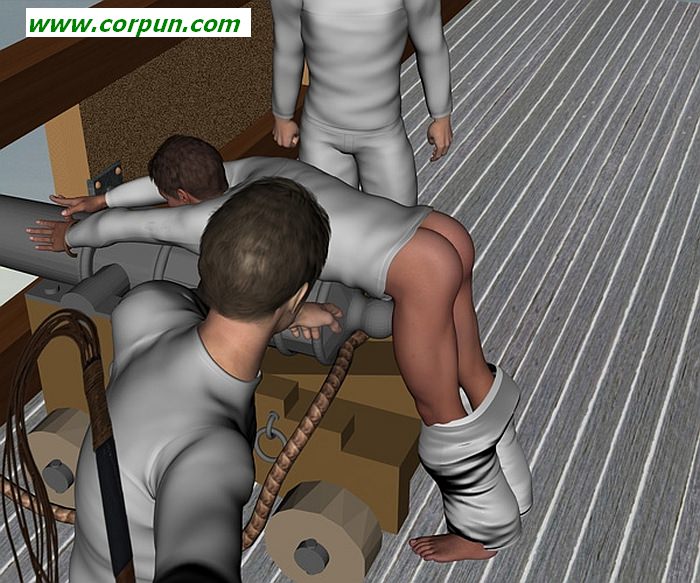
Kissing the gunner's daughter -- 3 views
A new version of a computer-generated artist's impression specially commissioned for www.corpun.com showing the use of the cat-o'-nine-tails on a Boy Seaman on board ship in the Royal Navy in the first half of the 19th century, as explained in this article. The view is seen from three different angles.
Normally in this period, major offences by Navy boys were punished on the Captain's orders with the "boy's pussy", which had only five tails and was lighter than the adult cat. However, in the more serious and much rarer case of a flogging ordered by a Court Martial, the full-sized nine-tail adult version was used, as shown here. Adult ratings were normally flogged on the upper back, but boys (in general, ratings under the age of 18) always received this kind of discipline across the seat, with trousers lowered. For this purpose they were typically tied to a gun in a bending position.
We may imagine this scene on HMS Zealous at 11.15am on 17 July 1813 when Valentine Woods, aged 17, received the first instalment (36 lashes) of his sentence of "60 lashes with a Cat of Nine Tails on his Bare Posteriors" for stabbing a shipmate.
The sentence had been passed two months previously at a Court Martial.
All the boys of the ship would have been mustered on deck (out of view in these pictures) to witness the punishment. Not shown here is the folded hammock often put under the boy's abdomen.
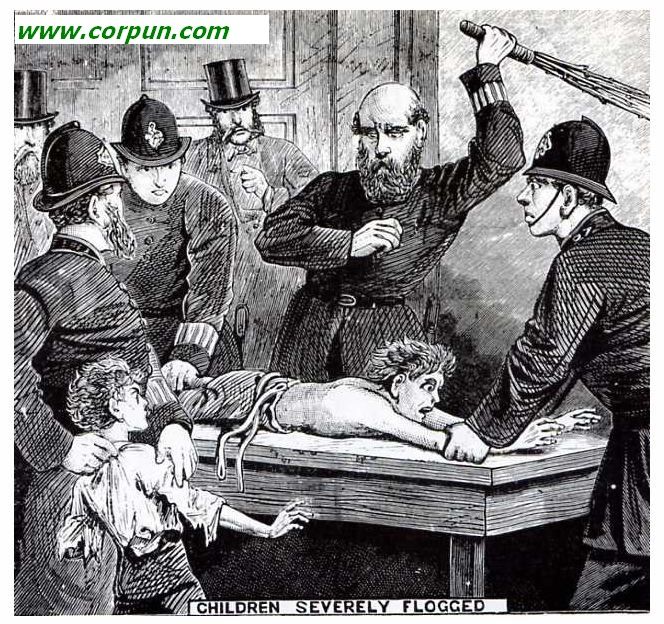
Corpun file 23340
"Children severely flogged"
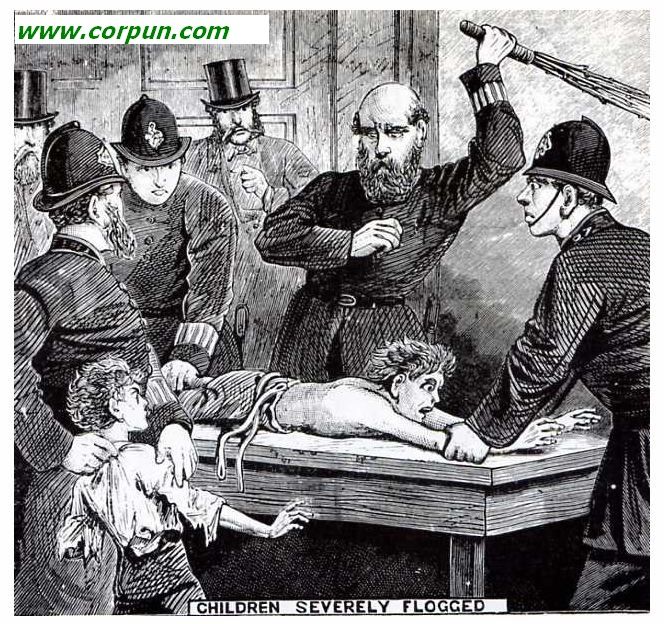
Inaccurate contemporary drawing in the Illustrated Police News supposedly of a boy's judicial birching in the 19th century. In fact of course the punishment was applied to the bare buttocks.
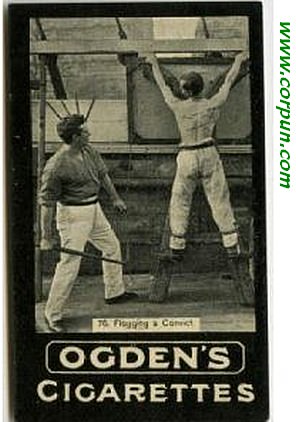
Corpun file 15274
Flogging a Convict
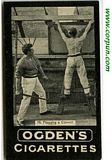
A cigarette card, allegedly from 1902. Although published in the UK, the picture has an American look. In any event it is probably posed by actors and not "the real thing".
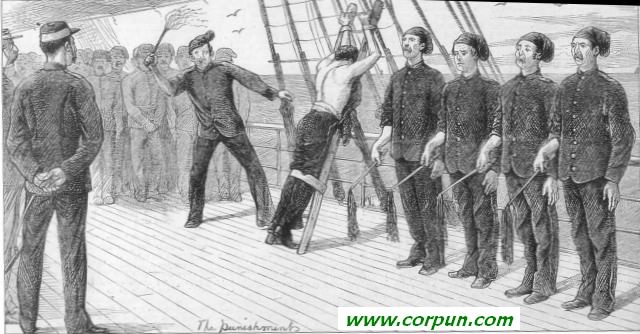
Corpun file 20852
Artist's impression of a British naval flogging
Unlike junior seamen, who were flogged on their bare posteriors as explained in this article, adult sailors usually received the cat-o'-nine-tails on the upper back, as imagined in this mid-19th-century artist's impression from Amy Handy, The Golden Age of Sail, Smithmark, 1996.
Corpun file 24036
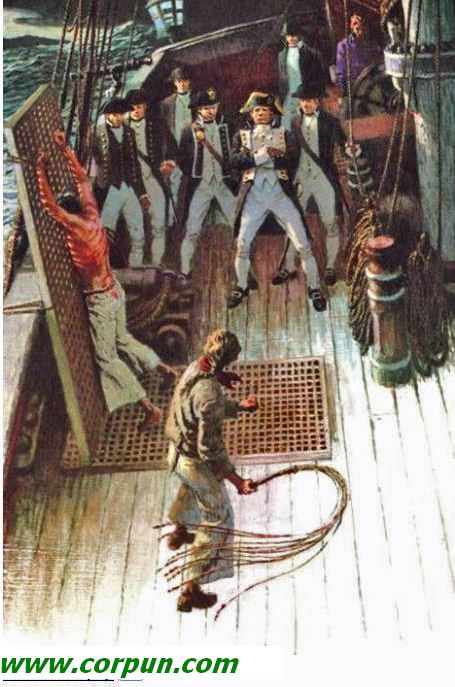
Painting of a naval flogging
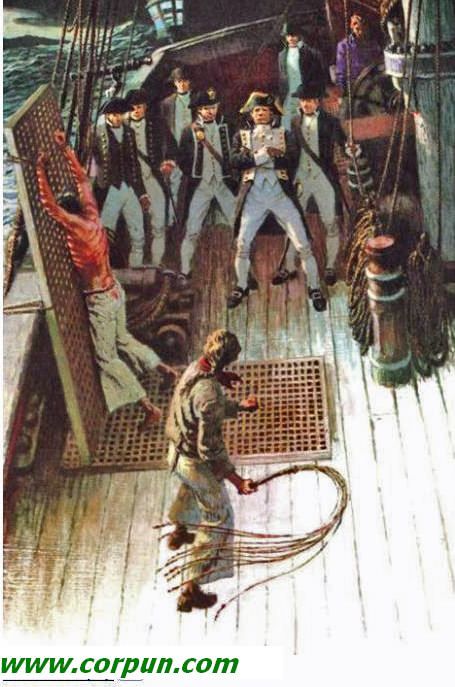
The source of this painting is unknown. It shows a seaman stripped to the waist and tied up to the gratings. Officers are watching the flogging. The details appear to be more or less correct, except that "all hands" would normally have been mustered to witness, and I think the artist has made the cat-o'-nine-tails a good deal too long. These events were quite common in, especially, the first half of the 19th century on board certain ships, though by no means all, depending entirely on the discretion of the Captain.
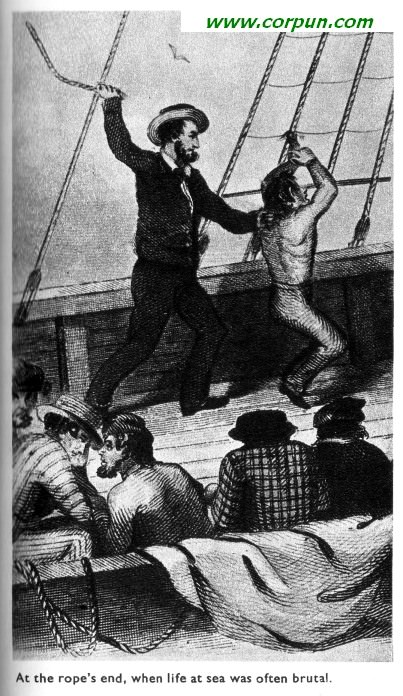
Corpun file 20851
At the rope's end
A more informal, on-the-spot kind of flogging in the 19th-century Navy, from George Goldsmith Carter, Sailors, Sailors, Paul Hamlyn, London, 1966.
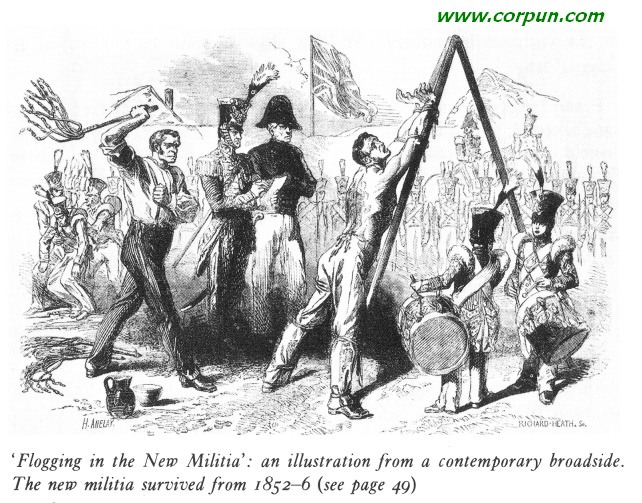
Corpun file 20850
Flogging in the New Militia
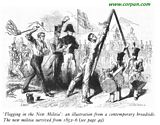
This particular New Militia was the short-lived England/Wales one raised in 1852 to counter the perceived threat from Napoleon III's France. Posters such as this one, showing how brutally militiamen might be treated, were used as propaganda against the idea. The drawing is therefore not necessarily a faithful depiction of anything that actually happened. From Roy Palmer, The Rambling Soldier, Peacock Books, 1977.
 UNITED STATES
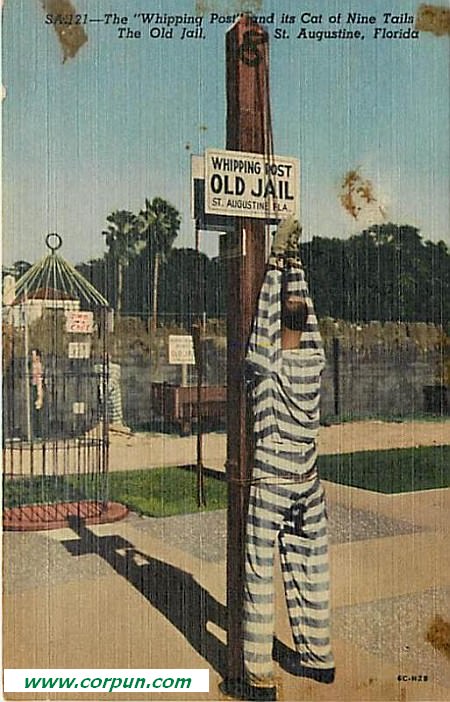
Corpun file 25090
Whipping post
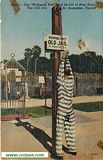
The Old Jail Whipping Post at St Augustine, Florida.
Corpun file 22916
Wife-beater whipped
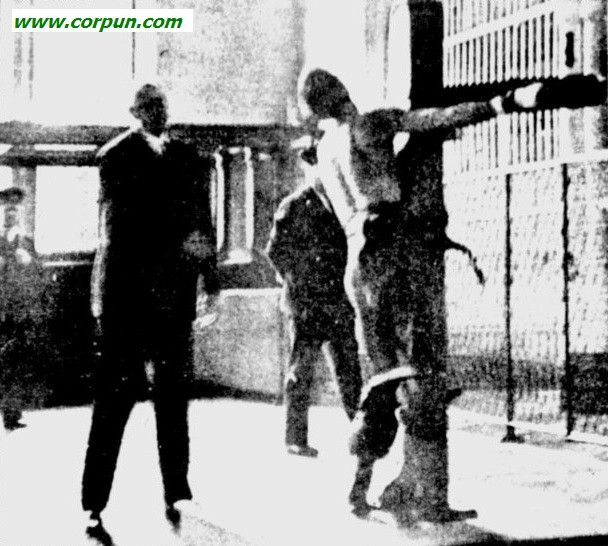
This from 21 October 1931 shows one of the last instances of JCP in Maryland. The Baltimore judge who sent this wife-beater to the City Jail whipping post allowed journalists to be present but forbade cameras, but New York Daily News lensman Joseph Costa foiled the ban with this sneaked picture. The instrument is a cat-o'-nine-tails, applied to the bare upper back. For a similar Baltimore case a few years earlier, see this April 1926 news item. Acknowledgements to Iconic Photos.
Corpun file 25060
An earlier picture of the Baltimore whipping post
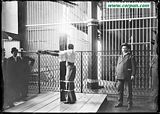
The whipping post came into use in 1885, according to the Maryland Historical Society Library. JCP in Maryland had been revived in 1882, but only for wife-beaters (maximum 40 lashes). It remained on the statute books until 1953.
Corpun file 22000
"Spanking" a thief
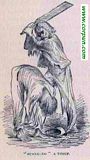
Drawing from Andersonville: A story of rebel military prisons (1879) illustrating punishment employed in c.1864 by Sergeant A.R. Hill, boss of a Civil War prisoner-of-war camp in Georgia which contained 45,000 men. "The instrument used was what is called in the South a 'shake' -- a split shingle, a yard or more long, and with one end whittled down to form a handle. The culprit was made to bend down until he could catch around his ankles with his hands. The part of the body thus brought into prominence was denuded of clothing and 'spanked' from one to twenty times."
Corpun file 21166
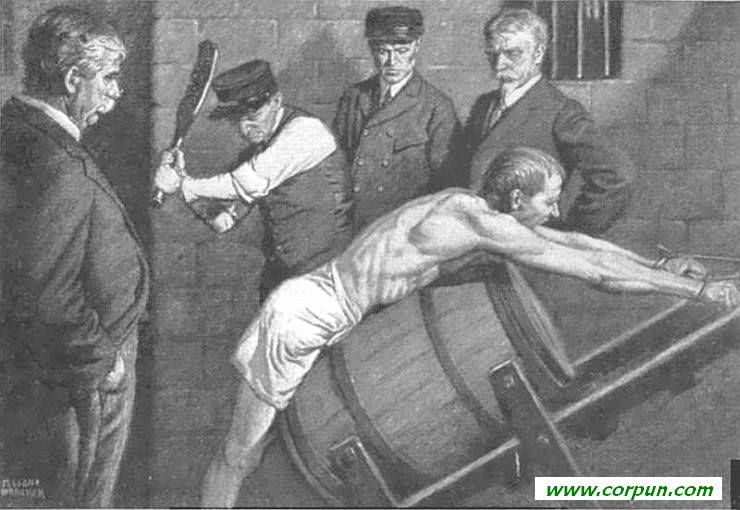
Punishment of the Paddle, 1912
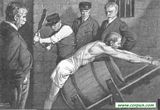
Drawing from The American Magazine purporting to show a paddling in a prison. We do not know whether this is closely based on reality or just the artist's imagination. I do not remember seeing a barrel used in this way before. It would seem more logical to have the recipient placed over the barrel sideways on, as used to be done in Jamaica for judicial CP (see "Stills from The Harder They Come").
Corpun file 20564
Flogging at Charles Towne, c.1700
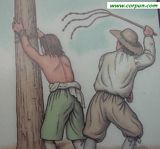
Artist's impression of a flogging at what is now called Charleston, South Carolina, on display at the Charles Towne Landing State Historic Site. Presumably the drawing is modern.
Corpun file 15942
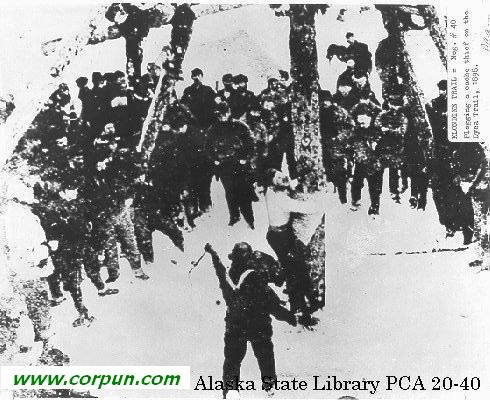
Klondike flogging
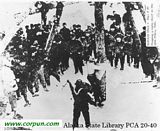
This not very clear photograph in the Alaska State Library is captioned "Klondike Trail: Flogging a cache thief on the Lynn trail, 1896". A man is being flogged on his bare back while tied to a post.
Corpun file 18557
Ohio police station paddling
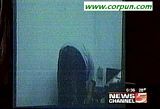
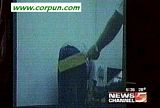
Police chief James Martin was acquitted in Feb 2005 on assault charges after he ran a successful voluntary juvenile diversion program (a kind of informal probation) in Fowler Township, near Warren, which included supervising the teenage miscreants in a range of activities. One optional part of the program was for the young men, with their parents' approval, to be required to report to the police station regularly for a moderate paddling to keep them on the right path.
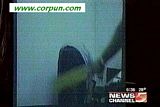
These three stills come from one of the videos taken as a safeguard against any claims of abuse while the boys were being punished. In the first, we see a young offender asked to adopt the "grab your ankles" position ready for his spanking. The other two show the swats being delivered to the seat of the youth's pants.
It seems that at least part of the film was shown on Newsnet5 TV (Cleveland) but unfortunately the video seems no longer to be on the station's website. Can anyone track it down?
 As well as being found innocent of assault, Chief Martin was cleared by the Court of Appeal on all the other, lesser counts against him (except for one minor bureaucratic technicality), thus vindicating his choice of corporal punishment as one means to help keep these youngsters out of the criminal system.
Note that, although some news reports originally alleged that the boys had to drop their pants to be paddled on their bare behinds, these pictures show that, as Chief Martin stressed at his trial, that was not the case.
Corpun file 15343
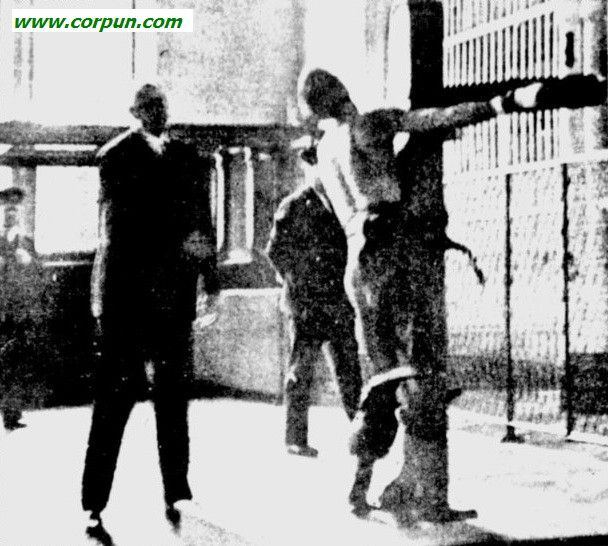
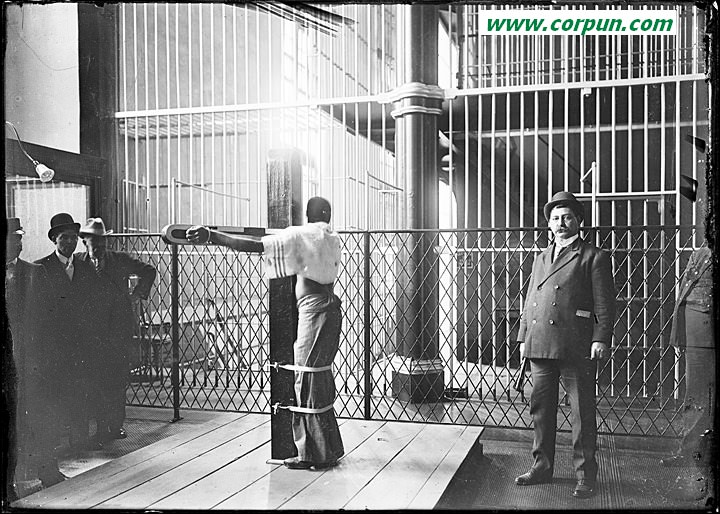
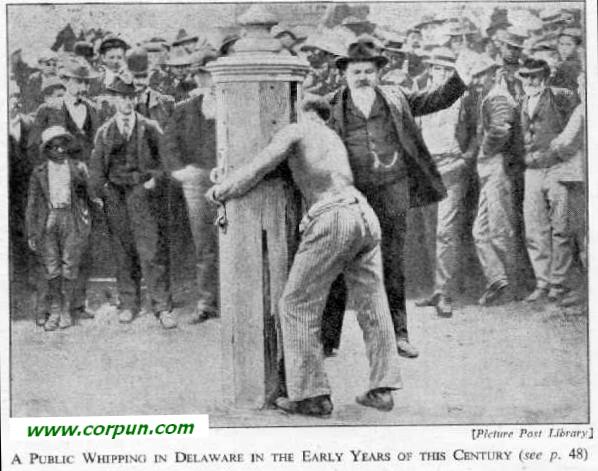
A public whipping in Delaware
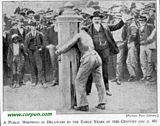
This is one of the most famous Delaware JCP pictures and has appeared in various books, including George Ryley Scott, Flogging -- Yes Or No?, Torchstream, London, 1953. It dates from the early 20th century. The pillar to which the offender is shackled looks very similar to the one captioned as "The whipping post, Kent County Jail at Dover" in this book review, which is also the page to go for more information about flogging in Delaware, which was not removed from the statute book until 1972, though the last whipping there was in 1952.
Corpun file 16946
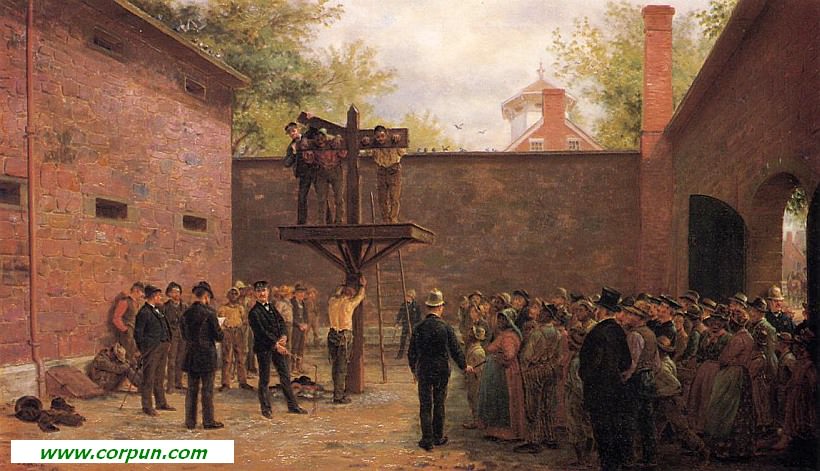
The Pillory and Whipping Post, New Castle, Delaware
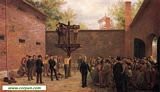
A painting by Edward Lamson Henry (1896). This is clearly the same contraption as shown in the top picture in this book review.
Corpun file 14626
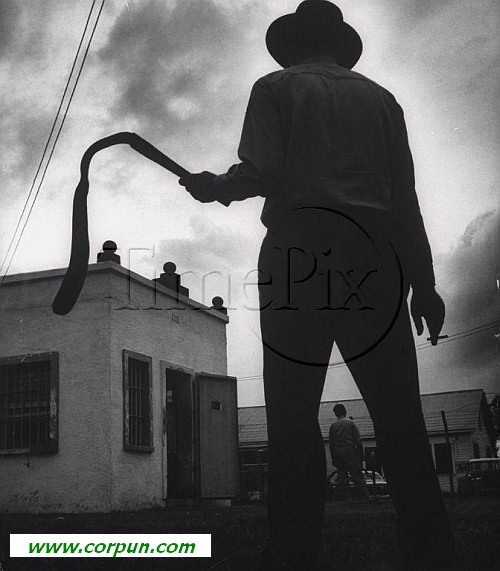
Louisiana prison strap
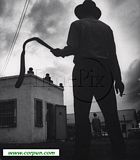
From Life Magazine (November 1955). A guard at the new Louisiana State Penitentiary poses in silhouette with a prison strap, incorrectly described as a bull whip. The caption states that the implement was no longer being used, so one wonders quite why it is shown being brandished in this manner.
Corpun file 14628
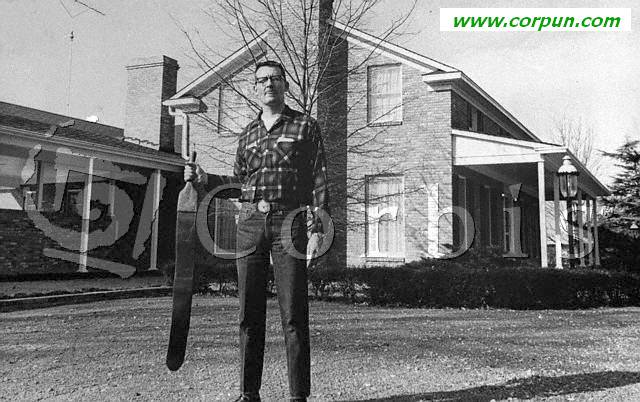
Thomas C. Murton Holding a Strap Outside his Home
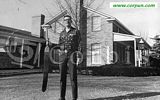
The new superintendent of the Arkansas prison system in January 1968 abolished the use of the strap, which he here shows to the press. The Hollywood movie Brubaker (1980), starring Robert Redford, was loosely based on Murton and his reforms.
Corpun file 6742
Lashing a Prisoner
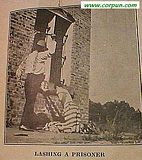
Poor-quality photograph from a book, Avenues Leading to Crime by M.L. Cummings (Raleigh, NC, 1922). The location is not identified, but some other pictures in the book are from Florida. The set-up here is unusual in that the prisoner is kneeling on the ground and holding on to some kind of step or frame against the wall. More often, the method in US prisons seems to have been simply to make the recipient lie flat on the ground. Here, the prisoner appears to have taken his top off and is presumably being whipped on his upper back. The instrument looks to be some sort of whip or cat with a handle.
Corpun file 12157
"Old Gray Mare", Colorado and the same from a different angle
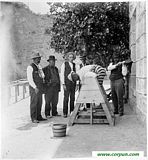
Pictures taken at Colorado State Prison, Cañon City. The padded flogging trestle there was nicknamed "the old gray mare". According to a now disappeared website called "Heritage West", the paddle was "of leather with metal brads" and was dipped in water before use, which may explain the bucket standing by the trestle. The first picture is said to date from about 1898-1900. The second picture turned up somewhere else with a date of c.1910, but that must be wrong as both pictures clearly include some of the same personnel in the same clothes. In fact, it seems virtually certain that both pictures were taken on the same occasion.
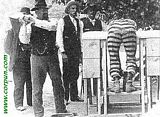
I think they were probably staged for the photographer, for two reasons. First, in the second picture the trestle has been turned through 90 degrees in relation to the tree, with the photographer apparently remaining in the same position, and the man with the strap has suddenly gone from being right-handed to left-handed. His watch-chain is on his right side in both pictures, so it's not just that one of the photos has been printed backwards. If a real flogging were under way, it seems unlikely that officers would start moving the furniture around in mid-infliction. Also, in the first picture the operator hasn't been left enough room to swing the paddle properly - the trestle is too near the wall.
On the other hand, in the second picture the prisoner's trousers do look torn, possibly showing a glimpse of his bottom, though it might equally be an undergarment. (Did prisoners have underwear in 1900?) Could this mean that he actually had been strapped, even if not on this particular occasion, and the strapping had ripped the seat of his pants? It's such a neat little slot in the fabric, dead across the centre of his bottom, that it doesn't really look like ordinary wear and tear. Then again, most accounts of US prison CP have the paddle being inflicted on bare buttocks. Perhaps this prison was an exception, or perhaps in 1900 it would not have been thought proper to illustrate that.
As for the trestle itself, it looks in the second picture as if the prisoner's ankles may be fixed to it somehow. I would imagine his arms and/or wrists are secured on the other side to keep him in the bent-over position. Evidently the main purpose of the apparatus is to bring the offender's posterior up to the arm level of the man with the strap. Conceivably the standing platform is adjustable in height. At all events, this intriguing contraption was still in use 50 years later: see this July 1951 illustrated news item.
Corpun file 25091
Another picture of Colorado's "Old Gray Mare"
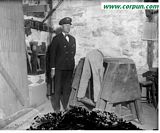
An undated, but clearly more recent, picture of the above device. This has the look of being staged for the camera, rather than a real punishment taking place.
Corpun file 25722
A recent view of the "Old Gray Mare"
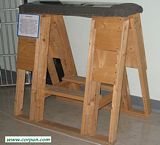
Now on display at the Museum of Colorado Prisons in Cañon City. This looks like a modern reconstruction.
 VIETNAM (formerly INDOCHINA or COCHINCHINA)
Corpun file 13372
Theatrical sketch of magistrate supervising punishment, late nineteenth century
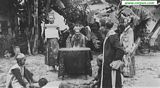
This picture comes from a web page about Vietnam called "Nine Centuries of Independence". It is credited to the Library of Congress, so one assumes it must at least have been thought at some point to be an authentic reconstruction. However, the same photo has now turned up in a French collection (Institut d'Asie Orientale) entitled "Bamboo beating in a drama" and described as a "theatrical sketch", which looks much more likely.
Corpun file 17348
A thief sentenced to whipping
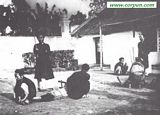
Unlike the previous item, this from French Indochina (as Vietnam was called then) looks like the real thing, captioned "Un voleur condamné au fouet" (a male thief sentenced to whipping). The culprit is being held flat on the ground at both ends and caned on his bare bottom. It is not clear what the other activities shown are supposed to be. The picture comes from this website consisting of many old crime 'n' punishment photos found in various French archives. They are said to date from the late 19th or early 20th century.
 ZIMBABWE
Corpun file 13537
Illicit political spanking
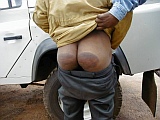
This from 2000 is said to show the results of an unofficial beating by ZANU-PF (ruling party) operatives of a member of the opposition MDC. Normally on such occasions the victim is beaten up in a random manner, typically by thumping and punching all over the body, which is not corporal punishment at all. Here, by contrast, a formal paddling or spanking has clearly been administered, confined to the buttocks, making the result look much more like proper CP.
More JCP pictures:
Botswana
Canada
Guatemala
Indonesia
Nigeria
Saudi Arabia
Singapore
Somalia
Sudan
UK
USA