CONTENTS:
Introduction
The history of caning in Singapore, Malaysia and Brunei
Offences for which caning is imposed
Who is liable to caning
Frequency
How many strokes are given
The dimensions of the cane
Apparatus used
Medical examination
Caning sessions in prison
Inside the caning area
The ceremony
The caning officers
Procedure in detail
Immediate physical effects
Reaction of the prisoner to the caning
Descriptions of the experience
Medical treatment
The healing of the wounds
Humiliation, deterrence and politics
Some differences between Singapore and Malaysia
INTRODUCTION
Judicial corporal punishment by caning is in widespread use for male offenders in Singapore, Malaysia and Brunei, three adjacent and closely linked members of the British Commonwealth in South-East Asia.
This article is about judicial CP (JCP) and CP for infractions of prison rules. There are separate articles on caning in the military, on caning in youth reformatories, and on the caning of boys at school.
Thousands of judicial canings are ordered each year, although the number has been falling sharply since 2008.
Men are caned for serious crimes and also for some non-violent offences like illegal entry and vandalism.
For certain offences it is a mandatory punishment.
These canings are very severe and are criticised by such organisations as Amnesty International and Human Rights Watch.
In all three countries, caning in the case of adult men is administered across the bare seat. Contrary to popular myth, this is carried out privately inside the prison. There has been no public JCP of adults in these countries for perhaps a hundred years.
The prisoner is stripped naked and shackled by strong leather straps to a trestle or A-frame. In Singapore and Brunei he is held in a bent-over position with his buttocks protruding. In Malaysia he stands upright at the A-frame to which he is tied.
He is then punished by a well-built warder wielding a four-foot long length of flexible rattan which has been soaked in water.
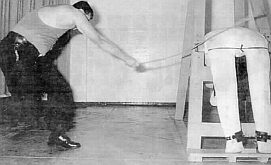
Left: Official demonstration of caning of a dummy in Singapore
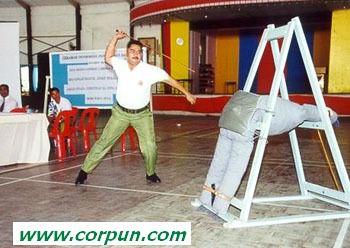
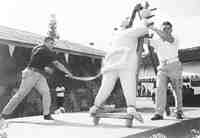 Right: Official demonstration of caning of a dummy in Malaysia
Left: Official demonstration of caning of a dummy in Brunei
THE HISTORY OF CANING IN SINGAPORE, MALAYSIA AND BRUNEI
The penal legislation in what used to be "British Malaya" -- the peninsular part of present-day Malaysia, plus Singapore -- has its historical roots in the criminal laws of England and India.
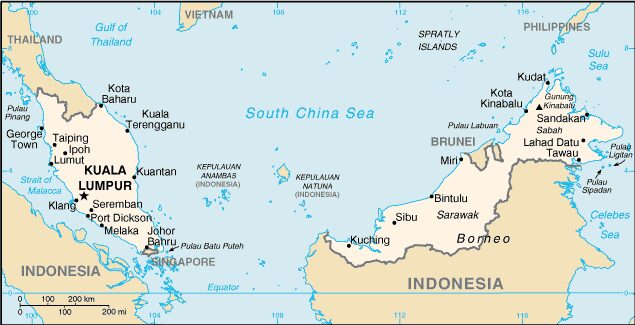
When the Straits Settlements, comprising the three predominantly Chinese-populated port cities of Singapore, Melaka (Malacca) and Penang (George Town), was formed as a British colony in 1826, the criminal law of England applied.
Straits Settlements Penal Code Ordinance IV replaced the common law in 1871. It was based on the Indian Penal Code, enacted in 1860.
Offences punishable by whipping in the Code were robbery, aggravated theft, house trespass or house breaking, assault with intent to outrage modesty, and a second or subsequent offence of rape or living on or trading in prostitution.
This list of "whipping offences" was roughly similar to that of England and Wales at the time.
The remainder of what is now Malaysia consisted of separate Moslem sultanates, nominally independent but increasingly under de facto British control. By the early part of the 20th century, these had coalesced into three groupings:
-- the Federated Malay States (FMS), a fully-fledged British protectorate with a new federal capital at Kuala Lumpur ("KL"); this comprised the sultanates of Selangor, Perak, Pahang and Negri Sembilan;
-- the "unfederated Malay states", a more diffuse (and not geographically contiguous) grouping of five states, four of which were ceded in 1909 by Siam (now Thailand), with a somewhat looser relationship with Britain;
-- and two states on the island of Borneo, British North Borneo (now Sabah) and Sarawak, nowadays together described as East Malaysia.
A separate Malay sultanate on Borneo, the small oil-rich state of Brunei, has, like Singapore, chosen to become independent rather than be part of the new post-1963 Malaysia.
Given all these shifting legal and constitutional complexities, it is not clear exactly how, when or to what extent practice in judicial matters such as CP became unified across the whole territory. However, at least from the First World War onwards, the whole peninsula was in political terms regarded as "British Malaya" and for practical purposes was run as an entity, overseen by a Governor based in Singapore who reported to the Colonial Office in London.
What is clear, anyway, is that the JCP regime as it developed was an outgrowth of British judicial custom and practice. It did not have anything to do with "Islamic justice". The fact that much of the territory (except for the Straits Settlements) had a majority Moslem population was coincidental.
During this period, the instrument used for CP was either a cat-o'-nine tails or a rattan, and "the triangles were of the usual pattern, and the flogging was on the buttock".
The travel writer Bruce Lockhart, visiting Singapore in the early 1930s, was shown round the jail:
"Crossing from one block of buildings to another, we passed a narrow oblong strip of grass surrounded by high windowless walls. [...] There was an atmosphere of cloistered seclusion about the place. [...] And yet there was something uncanny and sinister about these high grey walls which shut out everything except the stretch of sky overhead. The plot is not an architect's whim. It has its uses. Sometimes its walls resound with the dull, heavy sound of the lash and with the screams of prisoners. [...] Since [the 1890s] this plot has been used for floggings and hangings."
(R.H. Bruce Lockhart, Return to Malaya, Putnam, London, 1936.)
Most canings in prison are ordered by the courts for offences against the law, but the punishment can also be inflicted for infractions of prison discipline.
In 1938 canings for breaches of the prison rules in the Straits Settlements were:
24 strokes - 2 sentences
20 strokes - 1 sentence
12 strokes - 9 sentences
8 strokes - 2 sentences
6 strokes - 8 sentences
4 strokes - 1 sentence
For the last three years of the Second World War (1942-45), the whole territory was under military occupation by Japan. It is not known to what extent, if at all, the ordinary machinery of justice functioned during this period.
After the war, Britain resumed control on an interim basis with a view to granting independence. The old Straits Settlements colony was not revived. Instead, Singapore was made a separate colony, while a new Federation of Malaya based in KL comprised all the rest of the peninsula -- the former FMS and the former UMS plus Malacca and Penang.
At this point the Singapore Penal Code retained its provisions for whipping, but they were not particularly frequently used. In 1949, 46 offenders (all adult men) were caned by order of the court, and 26 for prison offences. The 1948 Report of the Singapore Prison Enquiry Commission records the rules at that time for prison offences:
"For aggravated offences against prison discipline -
- ordered by Superintendent: not exceeding 12 strokes with a rottan
- ordered by Visiting Justices: not exceeding 24 strokes with a rottan
- for Juveniles under 15 years, by Visiting Justices: not exceeding 6 strokes with a light rottan.
Punishment with the rottan shall be inflicted on the buttocks of the offender. In the case of adults the rottan shall be not more than half an inch in diameter, while in the case of juveniles a light rottan shall be used."
In 1953 there were 12 cases of caning for internal prison disciplinary reasons, and in 1954 only two (information from annual prison service reports).
Mention is also still made of the possibility of the cat being used, but in practice it seems to have fallen out of use by this period.
The Criminal Justice (Punishment Amendment) Ordinance 1954 removed the cat-o'-nine tails from the Singapore statute book, and thenceforth corporal punishment could be inflicted only with a rotan (or rottan or rattan -- these are simply different spellings of the Malay word for cane). At the same time, the power to order JCP was restricted to the High Court -- a move later reversed, for nowadays local and subordinate courts all have caning powers. In 1954 there had been a mere 7 canings ordered by the courts.
In 1994 a letter from a former superintendent of Changi Prison during the British colonial period confirmed that canings were inflicted on the bare buttocks. He describes 6 or 12 strokes as the usual punishment, and says he never saw profuse bleeding, only severe bruising. This might suggest that the manner of infliction has become more severe over time.
Corporal punishment as a judicial penalty was abolished in England, Wales and Scotland in 1948, and in India in 1955. In all parts of Malaya, however, as in Hong Kong, caning was retained.
In Singapore, independent from British rule in 1965, the scope of JCP was increased by legislation on many occasions from 1966 onwards, providing for its use in a greater range of offences, often requiring its mandatory imposition, and on occasions increasing the minimum number of strokes. Since 1993 it has become mandatory for 42 crimes, and optional for a further 42 (see table below) and partly as a result (combined with rapid increases in population) its use has increased from a few dozen to thousands of sentences a year.
A significant extension of caning powers took place in February 2008, when five new offences were added to the list.
The earlier of these post-independence extensions of the scope of JCP were publicly justified, in part, as the official response to an alarming crime wave: armed robberies tripled between 1966 and 1971. Much of this was gang-related. It was a modern resurgence of an old difficulty: like the rest of the Chinese diaspora, Singapore had historically faced a serious gangsterism problem.
The present regime claims, citing UN figures, that Singapore now has one of the lowest rates of violent crime in the world, even compared with famously tranquil places such as Denmark and Switzerland -- partly no doubt because the authorities have managed to make the island almost entirely gun-free ("No death from killer's bullet in S'pore", The Straits Times, 9 May 2000).
The British colonial authorities had likewise used corporal punishment to deal with organised gang violence in the 1920s and 1930s. The Governor of the Straits Settlements wrote to the Colonial Office in London in October 1929 that "the yearly influx of uneducated Chinese into Singapore has created a situation which can only be met by measures which might at first sight appear to be somewhat at variance with the accepted ideas of punishment at the present time". He enclosed a return showing that, excluding canings for prison discipline, 78 offenders had been whipped in 1928, mostly for armed robbery or -- an offence added to the list only in 1926 -- the possession of weapons.
London seems to have found the figures rather excessive: the Secretary of State had said that "the frequent resort to flogging as a punishment in the Colony appears to require some special justification", so the Governor also enclosed a letter from the Chief Justice, drawing attention to the exceptional prevalence of very brutal gang robberies, mostly committed "by young lawless Chinese of the coolie class who immigrate [...] in a continuous stream every year [...] a continually renewed source of potential crime". The Chief Justice's letter concluded: "I am convinced that the power to whip is essential to the judiciary for dealing with the particular types of crime that are prevalent in Singapore".
This view was echoed by the Deputy Public Prosecutor, Singapore, who observed that prison alone was no deterrent to this type of criminal: "Men who live from hand to mouth and in uncomfortable surroundings [...] find prison life by comparison not unpleasant [...] only flogging would have any real and lasting effect". (Public Record Office, CO 273/554/13.)
It is clear from these and other historical records that, except for the "light rattan" canings of juveniles for much less serious offences, the use of judicial CP was long regarded by the British colonial authorities as appropriate only for crimes involving personal violence or the threat thereof. It is from this long-held policy stance that modern Singapore, Malaysia and Brunei have so radically departed.
OFFENCES FOR WHICH CANING IS IMPOSED (see Table)
These are wide-ranging, particularly in Singapore. There are dozens of offences for which a man might be given the cane -- from serious violent crimes to some non-violent offences that might seem relatively minor in the West but are regarded as serious in Singapore, a highly authoritarian state where the importation and sale of chewing gum is an offence (though not a caneable one) and where people can be fined significant sums for dropping litter, smoking in public places, or failing to flush a public toilet after use.
Malaysia is markedly less authoritarian at that trivial level, but its attitudes towards more serious crime and the use of corporal punishment are very similar. In particular, drugs offences and sexual offences frequently attract very heavy caning sentences in all three countries.
To these severe canings for serious offences have been added, in recent years, in both Malaysia and Singapore, a very large number of much less severe canings of illegal immigrants.
In 2017 came the first caning of a company director for illegal importation of labour. Previously it was only the illegal immigrants themselves who were subject to JCP.
The number of offences for which caning may or must be inflicted has continued to increase in all three countries, and politicians from time to time float suggestions in the local press about yet further crimes to add to the list. In Malaysia over recent years, for instance, there have been calls for caning to be introduced for:
-- illegal bike racers,
-- snatch thieves,
-- traffic offenders,
-- men who desert their wives,
-- perpetrators of get-rich-quick schemes, and
-- vandals.
And in November 2003 caning actually was introduced in Malaysia for illegal moneylenders.
The idea that criminals might be reformed was explicitly abandoned by some senior members of Singapore's judiciary: former Chief Justice Yong Pung How said in 1996, "Rehabilitation is something I have never understood [...] Compassion went out the window a long time ago. Now I just deliver justice."
But in 2006 a new Chief Justice was appointed in Singapore, Chan Sek Keong, who was quoted by the Associated Press as wanting to give judges more room to hand down alternative punishments, with rehabilitation in mind. This emboldened the President of the Association of Criminal Lawyers to describe current practices as "outdated", and he continued: "Everything is jail, or jail plus caning. There must be alternative sentencing options like community service, or probation, or probation with a lot of strings attached to it."
Singapore claims particular success in its war on drugs. In addition to implementing the death penalty for drug-traffickers (as Malaysia also does), in 1998 Singapore introduced a special scheme for non-trafficking drug addicts called the long-term imprisonment (LT) regime. This originally covered users of opiates such as morphine and heroin, but has since been extended to include synthetic drugs like Ketamine, Ecstasy and Subutex. Under the scheme, 4,500 addicts between 1998 and 2006 were jailed for up to seven years and caned (six strokes). Less than 2% of these were caught taking drugs again, and these few were then jailed for up to a further 13 years, and given up to 12 more strokes of the cane. ("All out to nab the junkies", Today, Singapore, 7 September 2006).
As a mandatory sentence
Caning in Singapore is mandatory for over 40 different offences. These include rape, robbery, possession of offensive weapons, vandalism, and the sale or import of fireworks; and also for any drug-trafficking cases where for one reason or another the death penalty is not applied. (Offenders sentenced to death are not caned as well.)
Possession of offensive weapons may likewise attract a caning sentence in Malaysia. Vandalism does not at present, though there have been suggestions that it should.
In some cases a mandatory minimum number of strokes is required -- up to 15 for certain offences.
Men who enter Singapore illegally or who overstay their visas by more than 90 days automatically receive a minimum of 3 strokes of the cane. This provision is aimed essentially at controlling foreign workers.
Malaysia and Brunei have copied Singapore in this respect, and now have similar provisions, except that in Malaysia the minimum sentence is only one stroke.
Most of these immigration offenders come from the three countries' much poorer and much more populous neighbour, Indonesia. But Western visitors also sometimes fall foul of these laws. In 1994 a 45-year-old Frenchman was ordered 5 strokes -- in addition to an 8-month prison term -- for overstaying his visa in Singapore (Los Angeles Times, 27 October 1994).
As a discretionary punishment
For many further offences, the courts may choose at their discretion to order the cane.
In Singapore, these include rioting, extortion, living off the earnings of prostitution, manslaughter, and causing hurt.
The offences added most recently (Feb 2008) to the list include joining an unlawful assembly while armed with a deadly weapon, manslaughter, and causing hurt with poison.
There are many cases where courts convict, but do not hand down a caning sentence, even where they are empowered to do so. Ill-researched articles sometimes appear in Western media suggesting that nearly every Singapore court case ends up with a caning sentence. It is evident from available data, such as this table of selected cases, that this is far from the truth.
Extension by judicial activism
Where the punishment was discretionary, the traditional practice was that it should be imposed only if the offence in question involved a substantial degree of physical violence -- e.g. Lim Thian Han and Others v R; Tan Beng Seng v R; Chua Ah Seng v R [1953] 31 MLJ 213.
However, in 1965 in Anwar v PP [1965] 31 MLJ 63, the plaintiff had been found guilty of possessing a knuckle duster during a period of racial disturbances, although there was no evidence that he was involved in the riots. The then Chief Justice of Singapore nevertheless sentenced him to three months' imprisonment and 6 strokes of the cane. It was suggested that the main factor in that case was the importance of deterrence at a time when society was afflicted with a serious outbreak of violence.
Since the 1990s, moreover, the highest courts have been more inclined to impose sentences of caning where it is not mandatory. Examples are in cases of rape (Chia Kim Heng Frederick v PP [1992] 1 SLR 361); "road bullying" where grievous hurt results (PP v Lee Seck Hing [1992] 2 SLR 745); hiring of persons to assault another; and molesting women.
One molest case attracted controversy. 18-year-old Goh Cheng Yew was convicted of molesting a woman in a lift. The Chief Justice not only dismissed his appeal against a six-month prison sentence, but also enhanced it of his own motion by adding three strokes of the cane. Although caning had never been imposed in such cases before, he felt it should be given in view of the increasing incidence of molest cases. The ruling attracted much publicity ("All molesters should be caned, says CJ", The Straits Times, 20 August 1993).
As a result, in cases of "outraging the modesty of a woman" (indecent assault), Singapore courts are expected to order a minimum of 9 months' imprisonment and three strokes of the cane if the offence involves touching the woman's private parts. This benchmark remains in force ("Sentencing benchmarks that he set", The Straits Times, 1 April 2006).
Liability of employees to caning for crimes committed by a company
In a few instances, Singapore legislation requires that male employees be caned for offences committed by a company. The Dangerous Fireworks Act requires that a manager, director or owner of a company which deliberately or negligently imports, delivers or sells dangerous fireworks must be caned.
Likewise, the manager or director of a company which engages in the business of conveying illegal immigrants must be (in Singapore) or may be (in Malaysia) sentenced to caning if he has authorised, consented to or connived in such activity.
As a punishment for breaches of prison discipline
As was once the case in Britain itself, several former British territories that still retain corporal punishment permit its infliction for serious breaches of the rules by prisoners in addition to its use as a court sentence for offences against the law.
Singapore's prisons contain some 12,000 inmates (2008 figure). Under the Prisons Act, a prison Superintendent may impose a caning of up to twelve strokes for aggravated prison offences (see table). This punishment can be imposed after a "mini-court" hearing within the prison, at which the inmate is given an opportunity to hear the evidence against him and present his defence. In 2008 this system was amended so that an external committee now has to be consulted on each caning case before the Prisons Director can confirm the punishment. These independent committees are made up of such people as justices of the peace and community leaders.
As with judicial caning, only men under 50 are liable for internal prison caning.
A record must be kept in a register for inspection by the Visiting Justices. If the Superintendent thinks his powers are inadequate in a particular case, he may report the matter in writing to the Visiting Justices, who may award up to 24 strokes.
In addition to mutiny or violence against an officer or fellow prisoner, "aggravated prison offences" include wilful destruction to property; wilfully causing to himself any illness, injury or disability; wilfully making a false or groundless complaint against any officer or prisoner; a third repetition of a minor offence (there are 48 acts which are defined as such); as well as a general clause covering "any other act of gross misconduct or insubordination".
In one 1997 case, five prisoners caught smuggling cannabis into Changi Prison were caned and had their prison terms extended. Normally, though, such cases are not reported in the press and remain unknown to the general public.
Prisoners may not engage lawyers to appeal against an internal award of punishment.
Until recently there were no statistics on how often "prison discipline" caning occurs in the modern era. 75 aggravated offences were committed in Singapore prisons in 1984, and 66 in 1985. Presumably, for some of these offences at least, caning was imposed, since the 1974 Prisons Reorganisation Committee recommended the imposition of caning for offences which involved the use of violence.
The Prisons Department previously declined to comment on the number of internal prison discipline canings, but claimed they are "rare" and "only imposed on a very small number of inmates who commit serious or aggravated offences".
But in 2021, for the first time, it was revealed that from 2011 to 2020 inclusive there were 2,875 internal prison discipline canings, or about six per week -- so not as "rare" as all that.
In 1989, caning powers were extended to Drug Rehabilitation Centres in Singapore. Section 58(1)(o) of the Misuse of Drugs Act enables the Minister to make regulations "providing for the control, discipline (including the imposition of corporal punishment) and occupation of inmates" of Drug Rehabilitation Centres. Paragraph 8 of the Regulations made under that Act permits the Superintendent of a Centre to award corporal punishment not exceeding 6 strokes for major offences. These offences are similar to the aggravated prison offences under the Prisons Act, but also include bringing any drug, money, intoxicating substance or cigarette into a Centre without permission, or concealing any of these substances in the Centre, and possessing or consuming any drug while on leave from the Centre.
A former employee at the Drug Rehabilitation Unit in Changi prison said six strokes were given for drugs in the urine or for homosexuality, and three for fighting ("Eye of a Tiger", The Guardian, London, 20 May 1995).
Similar provisions are thought to apply in prisons in Malaysia, but this seems to be even less well documented.
For information on corporal punishment in Singapore youth institutions and reformatories, see this separate article.
WHO IS LIABLE TO CANING
Age limits
Caning is normally confined to males aged between 16 and 50. Cases are often reported in which a man escapes the cane simply because he is over 50. In one Singapore case, a man sentenced to jail and caning when he was 49 was able to evade caning by appealing his sentence. Although his appeal failed, the High Court ruled that he could not now be caned because in the meantime he had turned 50.
Malaysia had for some time discussed abolishing the upper age limit for rapists, on the grounds that if a man is still fit enough to commit rape he is fit enough to be caned. This change in the law was finally made in 2007, and one of the first cases in which a rapist over 50 was sentenced to caning in Malaysia took place in April 2008: a 56-year-old was ordered to receive 12 strokes.
No similar change to the law has been reported in Singapore or Brunei.
Juveniles
In Singapore, younger teenage offenders may not be caned by the lower courts: "The Juvenile Court ... has no power to order corporal punishment" (Helena H.M. Chan, The Legal System of Singapore, Butterworths Asia, 1995). Part III of the Children and Young Persons Act states: "No child or young person shall be sentenced by any court other than the High Court to corporal punishment" (s.37(3)).
The Singapore High Court, then, is empowered to order the cane for boys under 16. Reports of such cases are rare, but in July 1999 the High Court ordered three 15-year-olds to be caned for offences committed while one of them was still only 14. Three months later the Court went even further, sentencing a boy still only 14 to five years in jail and ten strokes of the cane for kicking and robbing an elderly man. Ten strokes is the maximum for boys under 16 (section 230 of the Criminal Procedure Code) and the caning in such cases is applied with a "light rattan" (s.229(4)).
Some statistics on this are available: 20 juveniles were judicially caned in Singapore in 1998, and 39 in the period Jan to Sep 1999. This latter amounts to about one per week.
However, a more recent report [DOC] suggests that 1999 was a blip: there were 76 juvenile canings in the 4½ years from the beginning of 2003 to June 2007, an average of 17 per year.
As far as is known, the procedure for caning boys under 16 in Singapore is the same as for adult men apart from the use of the smaller rattan.
In this respect generally, however, Singapore has become more like pre-1972 Canada -- where the prison and judicial strap was confined to offenders over 16 -- than pre-1948 Britain, where the great majority of judicial corporal punishments were of boys under 16 (Scotland) or under 14 (England and Wales) and the sentences not combined with imprisonment.
The situation in Malaysia and Brunei differs in that local courts do have caning powers over juveniles, and in Malaysia these were actually increased in 1999, with new Children's Courts being given the power to order up to 10 strokes with a light cane for boys aged between 10 and 18. Ordinary magistrates' courts already had this power, but the canings in that case must be given by the boy's parent or guardian within court premises.
Canings under the Child Act 2001 are to be administered "with average force", in the court premises. The boy must remain clothed, and the person administering the cane must not raise his hand over his head, in order that the skin is not cut. The cane must be lifted after each stroke and not pulled. The parent or guardian may be present, if they so wish.
In Brunei, the law provides that in the case of a youthful offender, whipping should be inflicted "in the way of school discipline" with a light rotan. This suggests that here, too, the boy keeps his trousers on.
No information seems to be available as to how often these powers are used. Very few such cases are ever mentioned in the press, but that might just be because reporters do not bother to cover juvenile court proceedings. One which was reported involved a boy of 15; the court ordered his father to give him four strokes of the light cane, and this was done immediately. These Malaysian juvenile canings, unlike the adult ones, need not be combined with a prison sentence.
Foreigners
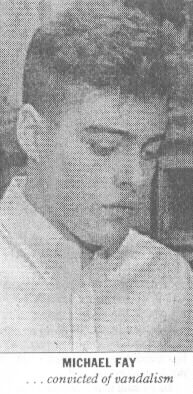 Normally, judicial CP gets into the international news only when Western visitors are caned. In Singapore the best-known example is that of Michael Fay, caned for vandalism in 1994, to whose case we shall return later. Other foreigners caned for vandalism include the Swiss national Oliver Fricker in 2010 and two German youths in 2015.
In 1996, a 48-year-old Dutchman got 6 years plus 10 strokes for importing Ecstasy -- and he wasn't even bringing the drugs to Singapore, merely changing planes on his way to Indonesia. In 1997, a 31-year-old New Zealander was given three months in jail with a three-stroke caning for overstaying his visitor's visa.
In Malaysia, too, there have been high-profile cases of Westerners receiving caning sentences, especially for drugs offences. Examples include the 24-year-old New Zealander Aaron Cohen, caned six strokes in 1991, and the thirtysomething Australian Robert Symes, caned six strokes in 1982.
FREQUENCY
Adult caning in Singapore is never or almost never imposed on its own, but is in addition to a prison sentence.
Many thousands of men have received this punishment, and the numbers rose inexorably over the years from the 1990s until 2007. Some figures for Singapore:
-- 1987: 602 caned (including 115 foreigners)
-- 1998: 616 caned (119 foreigners)
-- 1992: 1,422 caned
-- 1993: 3,244 caned, or over 60 per week
-- 2006: 5,984 caning sentences (about 95% of which were carried out)
-- 2007: 6,404 caning sentences (about 95% of which were carried out), or about 120 canings per week.
But the number of CP sentences in Singapore has fallen dramatically since then, presumably as a result of the more lenient sentencing policy introduced following a change of Chief Justice in 2006, referred to earlier:
-- 2008: 5,437 (Jan-Sep) (98.7% of which were carried out)
-- 2009: 4,228 (Jan-Nov) (99.8% of which were carried out)
-- 2010: 3,170 (98.7% of which were carried out)
-- 2011: 2,318 (98.9% of which carried out)
-- 2012: 2,203 (1,070 of which were of foreigners for immigration offences)
-- 2014: 1,230 (Jan-Sep)
-- 2015: 1,382 (Jan-Oct)
-- 2016: 1,257 (Jan-Oct)
These statistics have not, as far as we can discover, been published in Singapore itself; they were given in the annual US State Department Human Rights Reports, so presumably they are correct or the Singapore authorities would surely have challenged them.
The "60 a week" figure in the 1990s is backed up by a former employee at Changi Jail, who in 1995 said: "They are flogging more and more these days. Before they were doing maybe 60 on Tuesdays and Fridays, now they're doing a hundred" ("Eye of a Tiger", The Guardian, 20 May 1995). And he was evidently talking about Changi prison alone. "I remember one day seeing maybe 60 naked men in Changi waiting to get caned", he added. However, it is possible that this figure includes prison discipline cases as well as court-ordered canings.
What these statistics also show is that the great majority of court cases are not covered in the local press, or at least not in the English-language papers, which typically report some two or three caning sentences a week, on average.
Around half of all Singapore canings are of immigration offenders, who usually receive the mandatory minimum of three strokes as well as being fairly briefly imprisoned and then deported. Channel News Asia reported that 11,790 arrests were made in Singapore for immigration offences in 2004 ("Nearly 11,800 immigration offenders arrested in 2004", 17 February 2005).
An analysis of newspaper reports of caning sentences imposed in Singapore for the period 1997 to 2000 gives some broad information on this topic, although again it must be stressed that only a fraction of the sentences imposed are reported in the media.
During this period about 360 sentences inflicting a total of approximately 3,200 strokes were reported in the English-language local press.
Of those sentenced:
- 30 were in their teens (8%)
- 156 in their 20s (43%)
- 108 in their 30s (30%)
- 66 in their 40s (18%).
Applying these ratios to a possible annual figure of about 3,500 recipients during that period, we can estimate the following numbers caned each year:
- teenagers: 280
- Men in their 20s: 1,505
- Men in their 30s: 1,050
- Men in their 40s: 630
But these figures largely exclude immigration offences. Some Singapore reports refer to dozens of illegal immigrants being sentenced to caning at each court session, as in this 1998 case. The same kind of thing has often been seen in Malaysia, as in this 2004 case in which about 160 offenders were sentenced, all on one day, to be caned, jailed for two or three months, and then deported.
The usual sentence in such cases is 3 or 4 strokes in Singapore and Brunei, but often only one stroke in Malaysia.
In December 2004 it was reported that 18,607 illegal immigrants had been whipped in Malaysia in two years. Only five of these men had been given six strokes. Most (15,214) received only one stroke. 11,473 of those caned were Indonesians.
In December 2006, Malaysia set up special immigration courts. In the first half of 2007 these new courts sentenced 5,657 immigration offenders to jail terms in special detention centres. 2,922 of these were also caned.
In 2011 the Malaysian government said that 29,759 foreign workers were caned between 2005 and 2010 for immigration offences.
Overall JCP statistics for Malaysia only sporadically become available. The US State Department has claimed that 79,487 prisoners were caned between 2005 and 2011, giving an average annual figure of around 11,000. Presumably this includes "prison discipline" canings as well as court-ordered ones.
In 2014 the Malaysian government announced that there had been 8,481 canings in the previous year. 70% of these were of foreign nationals.
Some information is available about the frequency of JCP in tiny Brunei, where the caning of illegal immigrants was introduced in 2004. According to the US State Department, for instance, 184 offenders were caned in Brunei between January and October 2009, mostly for drug or immigration offences.
HOW MANY STROKES ARE GIVEN
The Singapore Criminal Procedure Code lays down that 24 strokes is the maximum that can be ordered. Contrary to popular myth, the strokes must all be inflicted on the same occasion, and not in instalments.
It is important to be clear that most caning sentences are not of anywhere near 24 strokes. Much more common are sentences of between three and six strokes. (Michael Fay's sentence for vandalism in 1994 was six strokes, reduced to four as an act of clemency.) Press reports of sentences probably give a misleading impression of the norm: the more serious cases are the ones more likely to be reported. As we have seen, the great majority of caning sentences do not get into the media.
Most of the more graphic descriptions of the results of judicial caning relate to the more severe sentences and do not really apply when only three or four strokes are given.
It was previously thought that 24 strokes was a maximum sentence per trial, but in 2008 it was clarified by the Law Minister in Parliament that for this purpose "per trial" means "per offence", and the 24-stroke limit per caning is only "a general rule" following a decision by the Attorney-General in 1990 that 24 strokes are "enough of a deterrent measure". The Minister added: "There may be a limit of 24 strokes of the cane in any one caning session but that doesn't mean that if he has been tried for different offences, that when he's sent to prison, he may not be receiving different sessions of caning."
The same figure of 24 is also the maximum in Malaysia and Brunei. It has been reported that in Malaysia, too, the 24-stroke maximum is per infliction and per warrant, not per trial: "if a prisoner is charged under several warrants, he has to serve the combined number of strokes. He can take at the most 24 strokes each time. When the wounds are healed, he has to endure the painful experience all over again". A case was reported in August 2004 in which a rapist was sentenced to 50 strokes in total.
In 1991, Quek Kee Chong, 26, sued the Singapore Government for "grievous injuries to his buttocks" following a 48-stroke caning at Changi jail in April 1988. The court had awarded him 12 strokes on each of four armed robbery charges ("Convicted man sues Govt over number of strokes he received", The Straits Times, 6 June 1991). Clearly he should not have been given all the strokes at once, and the government later gave him an ex-gratia compensation payment in settlement. Other members of Quek's criminal gang have made similar claims, saying they too received more than 24 strokes each, but did not realise at the time that this was contrary to the rules.
Mr Quek's family members said he had later been hospitalised at the Changi Prison Hospital. They were surprised how he withstood the 48 strokes, which, according to informed prison sources, is "quite remarkable for a sturdy man to take".
THE DIMENSIONS OF THE CANE

Punishment canes are made of rattan. Contrary to popular myth, bamboo is not used. Unlike bamboo, rattan is very flexible when wet. The word "cane" causes some confusion because in American English it usually means a thick, rigid stick, as in a walking stick. A rattan punishment cane is nothing like a walking cane. In some pictures the soaked rattan appears to be so bendy that it may be understandable that some observers are said to have mistakenly thought the implements were actually leather whips.
The size and dimensions of the cane are prescribed by regulation.
In Singapore, for adult men it is 1.2 metres (4 feet) long, and 1.3cm (half an inch) in diameter (Prison Regulations 132(2)). The Malaysian cane is very slightly smaller, at 1.09m long and 1.25cm thick.
A smaller cane, the "light rattan", is used for boys under 16, in both Singapore and Malaysia. The dimensions of Singapore's light rattan are not known. It could be similar to the Singapore secondary-school cane, which is only slightly shorter than the judicial cane but somewhat thinner.
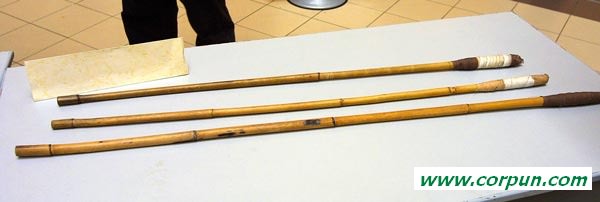
In Malaysia, it has been revealed that the juvenile "light rattan" is also used for non-violent "white-collar" adult offenders, those convicted of criminal breach of trust -- embezzlement and the like (Criminal Procedure Code (Amendment) Act 1994). It has been described as "about half the size of the standard rotan". This seems to be an exaggeration. The picture below, from a display at Johor Baru prison, shows one longer and two shorter canes, and the shorter ones are only a couple of inches shorter than the longer one, but a bit thinner.
Malaysia, but not Singapore, also has separate Islamic religious courts administering Sharia (Syariah) law, applicable only to Moslems. This operates in parallel with the mainstream judicial system. Its provisions vary in detail from one state to another and do not primarily concern criminal matters but, when they do, canings are occasionally ordered for such sins as adultery or drinking alcohol. (In practice this sort of thing appears to happen mostly in the conservative rural northern states, where Islam is much stronger than in KL or the other heavily westernised urban centres on the west coast.) These are carried out in prisons by the same officers who administer the ordinary judicial canings. But, here again, it is the smaller rotan that is used, and it is applied with very much less force, the aim being a symbolic act of shame rather than serious physical pain.
In 2014 Brunei began to establish a parallel system of Sharia law like Malaysia's, but as of late 2018 the CP elements of this new Sharia Penal Code had not yet been introduced.
APPARATUS USED

The prisoner is strapped to a large wooden trestle. The type used in Singapore is clearly closely based on, if not identical with, the British dual-purpose prison flogging frame, originally designed for both floggings with the cat on the upper back (offender standing upright) and punishments applied to the posterior (offender bending over).
The Singapore trestle seen in a 1999 government anti-crime video, "Prison Me No Way", is specially made and painted blue. It is like two H's joined at the top and extended at the base to about three feet. There is a timber base, comprising four pieces of timber joined to form a rectangle, on which the prisoner stands in his bare feet.
On his side of the trestle there are two horizontal bars. The upper crossbar is slightly padded and adjustable, so that in position it is at the level of his waist. The padding is like a sheepskin or piece of foam wrapped around a piece of timber.
The lower crossbar has bolted to it two short lengths of chain, each of four links to which are attached, by D-rings, restraining ankle cuffs. These are of black leather, with chrome fittings; they are about two inches wide with smaller tightening straps.
On the opposite side of the trestle there is a stabilising crossbar, higher up, and another crossbar placed slightly lower than the adjustable one on the prisoner's side. Attached to this crossbar are wrist cuffs, similar to the ankle cuffs. When the prisoner's wrists are attached to these cuffs his hands are able to hold on to this crossbar.
The Singapore Director of Prisons said:
"[...] it is essential that the leather be strong [...] the prisoner struggles violently after each of the first three strokes [...]".
 In some reports the cuffs are stated to be of rubber. Possibly, different equipment is used in different institutions.
It can be seen from several pictures of "dummy demonstration" canings that very similar equipment is used in Brunei.
In Malaysia, on the other hand, the frame (pictured right) is a triangle rather than a trestle, coming to a point at the top instead of having parallel sides. The convict does not bend over but must stand nearly upright (leaning slightly forwards). A specially designed protective shield is placed round the torso, leaving only the buttocks exposed. It is not known when or why this different approach was adopted in Malaysia.
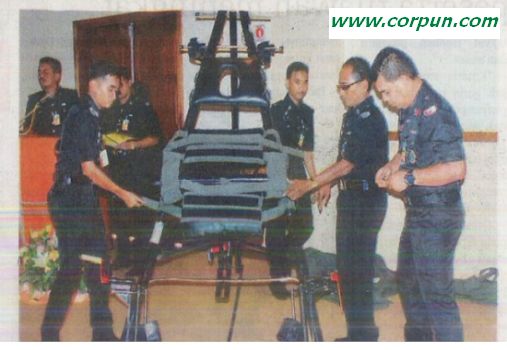
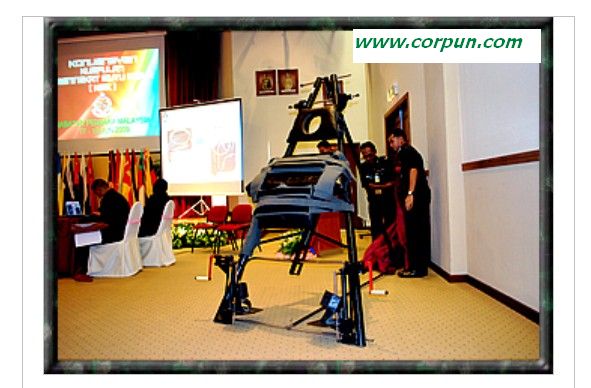
A new design of triangle (above), the "Smart Portable Tripod 01", was developed in 2009 by staff at Taiping Prison in Perak, winning a Prisons Department prize for innovation. It is made of steel and leather, and can quickly be collapsed, carried, stored and re-erected as required, saving prison space and staff time.
[Pegawai penjara cipta alat sebat ("Prison officers invent caning equipment"), Sinar Harian, Shah Alam, June 2009]
THE MEDICAL EXAMINATION
It is a requirement that the prisoner be medically fit to be caned. At the beginning of the official Malaysian caning video, the prison doctor and his assistant are seen carrying out a medical examination on a prisoner about to receive punishment.
The Singapore Criminal Procedure Code, Section 231(1) provides:
"The punishment of caning shall not be inflicted unless a medical officer is present and certifies that the offender is in a fit state of health to undergo such punishment".
There is no appeal against the MO's decision that the prisoner is fit to be caned (Tam Eng Chye v Director of Prisons, Attorney-General's Annual Report 2004/5 [PDF], p.9).
The doctor has the power to stop the punishment at any time, and his duties include medical treatment upon its completion. In the Malaysian video it is seen that each recipient is taken to the prison hospital immediately the caning is over, where he lies face down on a bed and has his buttocks cleaned up and disinfected.
In Singapore the post-caning treatment is said to include the painting-on of gentian violet, a disinfectant which dyes the skin temporarily purple (possibly making the damage look worse than it actually is). However, some Singapore recipients, including Michael Fay, report being taken straight back to their cells without any immediate medical attention (though later he got some sort of dressing on his wounds). One might infer that first aid is not always deemed necessary after only a few strokes.
High blood pressure or heart problems are said to be grounds for exemption in Malaysia. A report in 2003 stated that, out of 19 prisoners being whipped on a particular day at a jail in Sarawak, three (about 15%) were found medically unfit. As we have seen, however, in Singapore it has been stated that at least 95% of caning sentences are actually inflicted.
CANING SESSIONS IN PRISON
In both Singapore and Malaysia, canings are inflicted so frequently that there are regular sessions at which groups of men are dealt with together. The men are made to squat in a line outside the caning room to await their turn.
According to a former Singapore prison employee interviewed in 1994, these sessions are normally held every Tuesday and Friday at Changi, the famous top-security jail. But there have also been other jails, notably Queenstown Remand Prison (now closed), where the American teenager Michael Fay was caned in May 1994 for vandalism.
Prisoners are not told in advance when their caning is to take place.
Fay was one of a group of ten inmates punished that Thursday afternoon:
"Fay was led from his cell to a waiting room, along with nine other inmates". He said "About 2.30 p.m. they brought me down a hall handcuffed". After his number was called, he was taken into the punishment area.
Others have described waiting their turn in groups of ten or even twenty men.
"Peter" (not his real name), who received 10 strokes in Changi Prison for gang offences, recalled his experience in a 1991 newspaper interview:
"That morning, about 10 of us were called up for a medical check-up. Nobody told us what it was for but we knew. The anxiety began when we were led back to our cells after the check up. I kept thinking of the unwritten law. No begging and no screaming. I kept reminding myself.
"After lunch and a short break, our group was led to the caning compound. All 10 of us were made to squat while waiting in a corridor.
"The wait was terrible. We were all hoping to be called first, to get it over and done with. At least you don't have to see the others suffer and be even more scared."
Another man, Sam, who received 15 strokes for rape, described his experience:
"(I was) three months into my prison term when the day of the caning came. There were about twenty of us all lined up in a row outside a room where we were going to be caned. I was number 6. We were all in shorts and singlets.
Another prisoner, Ah Seng, described his wait:
"I was very frightened. I had heard how painful caning was and also what one suffered after the caning."
INSIDE THE CANING AREA
In Singapore:
 This tiny picture from an official "Youth Crime" CD-ROM produced in the 1990s is the only known photograph of an actual judicial caning under way in Singapore. (NOTE: Contrary to some press reports, the CD-ROM contains only small stills, not a video of a caning.)
The room in the picture is large and has a very high ceiling. There is a polished floor. At the end of the room there are tables at which senior prison staff are seated to view the infliction. At the other end of the room is the caning trestle. It is perhaps 9 feet high, solidly constructed from timber, on a wooden base on which the prisoner stands.
It is not known where this photo was taken. Perhaps it is Changi jail. Michael Fay's caning at Queenstown Road Remand Prison, however, took place -- according to the transcript of a later TV interview with Fay -- not in a room at all, but in an open-air prison yard that was partially protected from a tropical downpour by a covering over the trestle to which he was bound.
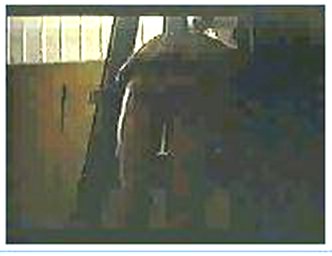 Here is a computer-enhanced version of another picture from the CD. This shows the prisoner from behind as he is strapped into the frame, during or immediately after the punishment. Here it is just possible to discern the raw and bleeding flesh of the lower buttock area, particularly the right buttock, with some blood trickling down the thigh.
Compare these pictures with the following diagram from the government-controlled Straits Times of 1 May 1994, headed "How a Prisoner is Caned", part of an article entitled "Prisons Department sets the facts straight on caning".

One respect in which the artist of the above drawing seems to have got it significantly wrong is in showing the offender's feet spread wide apart, with the ankles strapped to the side legs of the frame. The photos show the legs in fact fairly close together, as in pre-1965 British prison birchings. This ensures that the genitalia are not accidentally struck from behind.
 Another artist's impression (right) appeared in Asiaweek's May 1994 article about the caning of Michael Fay.
In Malaysia:
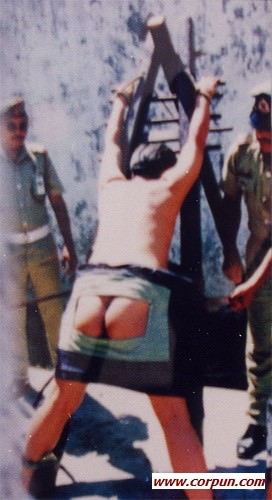 In Malaysian prisons, the punishment is inflicted in an open yard, as we see in these video clips. The main difference with Singapore is that the prisoner stands upright, and his legs are placed somewhat apart (see picture at right). The danger of hitting the genitals is avoided by the use of a special torso shield, which covers the man's lower body, exposing only the buttocks.
THE CEREMONY
Judicial caning involves a formal, ritualised ceremony. Uniformed officers are in attendance, and orders are given by the senior officer.
Although canings are inflicted out of sight of other prisoners, there are several prison officers in attendance, including the superintendent, a superintendent warder, prison officers, the doctor and male nurse or assistants, and the officers administering the caning.
Recipients have described how sometimes the caning officer will be practising on a dummy while the prisoner is being prepared.
"Peter" described being called in for his turn:
"When my name was called, I tried to pretend everything was under control. But I couldn't walk properly and my T-shirt was wet with sweat. The sound of the warder flexing the cane made it worse."
"When it was my turn to go in, I saw six men in the room: two police officers, a doctor, and three men -- the ones administering the caning. I also saw a cluster of rotans."
THE CANING OFFICERS
The caning officers are specially trained.
They are robustly built, and some hold "quite high" grades in martial arts, though official sources have denied that this is a requirement.
Michael Fay described the warder who administered his caning as "young, very fit".
Sam remembered his caner as "muscular". The official interviewed by Maggie O'Kane of The Guardian in 1995 ("Eye of a Tiger", 20 May) was only in his early twenties but had already retired from the job.
The officers are put though a period of training before they are accredited. The chief caner is always present at these training sessions, and often a doctor is there too. The aim is to inflict maximum pain with the least permanent damage.
Caning is practised on sandbags, dummies or banana trees.
The caners wear a T-shirt or similar costume as "freedom of movement is essential".
One former caning operative has said that in the 1960s he was paid SGD 1 for each prisoner caned. The largest number of strokes he could remember delivering in one session was 60. By 1990 the sum paid was SGD 10 to SGD 20 per flogging, plus SGD 20 (about €10) per month on top of the normal prison officer's salary (The Caning of Michael Fay by Gopal Baratham, p.108).
Nick "Rogue Trader" Leeson claimed that the Singapore caners are bodybuilders, who are paid SGD 2 for every stroke (Daily Mail, London, 10 July 1999). However, Leeson was not caned himself and was probably merely retailing prison gossip. He is not necessarily a reliable source, and neither, certainly, is the Daily Mail.
In Malaysia, where canings take place at numerous prisons in the various states, there are some 50 "flogging officers" nationwide. The bonus paid to them was increased in 2005 from MYR 3 per stroke (less than one euro) to MYR 10 per stroke (nearly €3). At Kajang prison, canings are scheduled for every Wednesday and Friday. Selecting and training caning officers is said to be a "long and difficult process": out of 30 candidates among prison officers, only two may be selected following a test of their "strength, precision, consistency and movement of their strokes" and their "discipline, attitude and team spirit".
PROCEDURE IN DETAIL
The Singapore Prisons Regulations require that caning be inflicted on the buttocks (Regulation 132(2)).
In practice the prisoner is required to strip completely naked for the administration of the punishment.
A former prison officer has stated that, before the caning, the prisoner's name is read out to ensure he is the correct person. The offence and the prescribed punishment is read out so the prisoner can confirm it. (The same precautions are taken in Malaysia, as shown in the official video.)
Once he has removed his clothes, the inmate is made to stand facing the trestle so that he can be tied to it.
In Singapore, he is made to bend over a pad between the front legs. His feet are secured to the front base with his hands secured to the back legs, so that he is bent over at about right angles at the hip.
As The Straits Times described it in 1974, "he bends over with his bottoms [sic] up, ready to receive his punishment".
A pillow or cushion is secured across the small of his back to protect the vulnerable kidney area from a mis-stroke.
Michael Fay said "they stripped me and put rubber-lined padding around my sides, leaving the buttocks bare. Otherwise I was completely naked" (interview in Newsweek, 4 July 1994).
The prisoner is not gagged.
Qwek Shi Lei, the then Director of Prisons, gave more details at a press conference in 1974. Prisoners, he said, are frightened that they will be unable to stop themselves crying out. They want to be able to take their punishment like a man, and crying means a loss of face. ("Face" is a big deal in Asian cultures.)
Once the prisoner is secured, the caning officer will take up position, standing about five feet away, and adjusting his position with the aid of the cane. According to Mr Qwek "... correct positioning is critical. If he is too near the prisoner, the tip of the cane will fall beyond the buttocks and thus reduce the effect of the stroke. If he is too far, the stroke will only cover part of the buttocks".
A senior officer stands by, with the doctor.
The cane is soaked overnight in water, so it is supple. The Prisons Department says this is to prevent it from splitting and shearing the skin. They denied earlier claims that the cane is soaked in brine. However, it is treated with antiseptic before use.
A former flogger interviewed by Gopal Baratham has specified more precisely that it is the front third of the cane that is soaked in fluid to make it supple, producing the effect of a lash; the back third is rigid so the caner has greater control (op. cit. p.105).
Once the caning officer is in position and the order given to proceed, the strokes are called out: "One!" "Two!", etc. by a warder.
Michael Fay said "they go 'Count one!' -- you hear them yell it really loud -- and a few seconds later they come".
Each stroke is delivered after the call of the count. The blows are delivered at intervals of about thirty seconds. Sometimes two caning officers take turns to administer the strokes.
| CRIMINAL WHIPPING VS SYARIAH WHIPPING |
|
TO ADMINISTER A CRIMINAL WHIPPING, the officer first twists his body to the left. The aim
is to get as much force as possible behind the stroke. The offender is whipped on the buttocks. After each stroke, the rotan is immediately pulled back.
FOR A SYARIAH WHIPPING, the officer must exercise restraint and keep the upper arm close to the body. The rotan's end is held at the height of the offender's head. The rotan swings downwards with only a movement of the wrist. -- PHOTOS: NEW STRAITS TIMES
|
|
Irrespective of the age of the offender or the type of crime committed, every stroke is inflicted with the full strength of the warder: "Canings are administered with maximum force" (South China Morning Post, Hong Kong, 2 April 1994).
"... when caning, the warder uses the whole of his body weight, and not just the strength of his arms, to strike. He holds the cane rigidly at arm's length and pivots on his feet to deliver the stroke". (Singapore Director of Prisons, September 1974)
A 25-year-old caning officer in Malaysian prisons, Iskandar Radz, said that he underwent a two-week training course during which he was taught how to swing the 1.09-metre cane at a minimum speed of 160kph and produce a force upon impact of at least 90kg.
Apparently different techniques are permitted: "[...] there were those who twirled and those who took a breath and took careful aim. There were those who took three steps forward and those who stood absolutely still. It was all a matter of individual style; some played a serve and volley game and some preferred to play from the base line, some used a type of top spin, others preferred the quick smash. They were allowed to use the method they liked best. Individual preference was respected" (Baratham, p.107).
Others have said "[...] the caner was remarkably good. No two strokes inflicted by him fell on the same spot. It was one slightly above or below the other. The caning was implemented with machine-like precision [...]".
"[...] my men were trained using dummies with chalk lines on their buttocks. The timing and aim of the stroke had to be just right, just like a golf swing [...]"
Michael Fay stated "[...] the caner did not run, but rather walked sharply forward three steps so he can get a little power behind him". The caner in the photo from the CD-ROM, on the other hand, appears to be launching himself into a sort of flying leap.
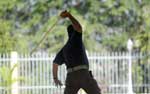
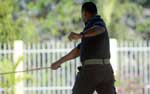
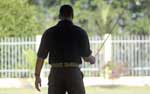
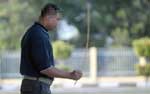
The photo sequence on the right, from The Straits Times of 3 July 2005, shows a Malaysian prison officer demonstrating his caning technique. The accompanying article quotes prison officer Wahid, 35, who metes out 100 strokes in an average week at Kajang Prison in Selangor, near Kuala Lumpur:
"Under the criminal penal code, the whipping officer must use as much force as he can muster during the caning. The power behind an ordinary whipping comes from the wrist, arm, shoulder and the swing.
"Whipping convicts is much more difficult (than administering a Syariah caning) because you have to do it with a lot of 'power'. The harder, the better. If he holds back even one notch, the officer fails in his duty. That's why all whipping officers are tall and big bodied.
"You have to be very focused because there is a very small area to hit. When you have made contact with the buttocks, you must drag the tip of the rotan along the skin to break it."
It could be the use of this "dragging" technique to deliberately break the skin, as much as the size of the cane and the force with which it is used, that makes judicial caning so much more severe in its effects than school caning.
THE IMMEDIATE PHYSICAL EFFECTS
Eyewitnesses and others have reported on the severity of the canings:
"The blows are applied with the full force of the jailer's arm. When the rattan hits the bare buttocks, the skin disintegrates, leaving a white line and then a flow of blood." (Singapore Bar Association report)
"I [...] saw blood at the fourth stroke. The prisoner slumped over in evident terrible pain. The caning stopped" ("Caning -- the most dreaded punishment", The Straits Times, 7 September 1974).
"The skin at the point of contact is usually split open and, after three strokes, the buttocks will be covered in blood." (Singapore Director of Prisons, September 1974)
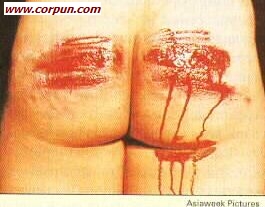 Left: Asiaweek published this picture purportedly of bleeding immediately after a Malaysian caning (number of strokes unknown). Compare with the results seen as canings progress in the Malaysian official video.
"The skin did rip open, there was some blood," said Michael Fay of his four-stroke caning, adding "Let's not exaggerate, and let's not say a few drops or that the blood was gushing out. It was in between the two. It's like a bloody nose".
The Singapore Prisons Department has denied allegations that the cane "causes skin and flesh to fly". But they conceded that it does leave bruises and marks.
This contradicts earlier statements in the government-controlled press. The New Paper, apparently rehashing reports of the notorious 1974 press conference, did report in 1992 that "Pieces of skin and flesh fly at each stroke". A US analyst has suggested that these earlier accounts may have been deliberately exaggerated in the hope of deterring delinquents ("Singapore's Relations With U.S. Still Sore", The Washington Post, 14 May 1994).
Another explanation for some of the apparent discrepancies between different accounts may simply be that not enough distinction has been made between canings of just a few strokes and those at or near the maximum of 24. For a very much more gruesome illustration of what appears to be the immediate aftermath of a caning of a large number of strokes, probably in Malaysia, see the JCP Pictures page (warning: not for the squeamish).
Thus, when Gopal Baratham asked a former flogger "Does the skin break and the flesh fly?", the reply was, "Always after fifteen strokes, however accurate the flogger, the skin will be gone and the flesh will fly" (op. cit., p.119). The Singapore authorities could therefore perhaps claim that many of the more lurid media descriptions ahead of Michael Fay's punishment were exaggerations when applied to what was to be only a six-stroke caning (reduced at the last minute to four). But then it is they or their predecessors, and particularly Prisons Director Qwek in 1974, who were the original source of most of these descriptions.
"If it's a well-trained caner, the skin across the whole backside will split 99 per cent of the time... The well-trained caner will whack on different spots, avoiding already open wounds. (This produces the most pain with the least scarring)."
"The cane leaves huge red welts and permanent scars" (The Straits Times, 8 April 1994).
There seems to be a widespread belief in Singapore that judicial caning in Malaysia is, stroke for stroke, less severe than in Singapore, but we have found no empirical evidence for this.
REACTION OF THE PRISONER TO THE CANING
The Singapore Director of Prisons said at his 1974 press conference that most prisoners put up a struggle after each of the first three strokes. He continued "After that their struggles lessen as they become weaker. At the end of the caning those who receive more than three lashes are usually in a state of shock. Many will collapse, but the medical officer and his team of assistants are on hand to revive them and to apply antiseptic to the caning wounds. Many will pretend to faint, but they cannot fool the prison doctor whose presence is legally required".
Michael Fay said that a prison officer stood beside him and guided him through the ordeal, saying: "Okay Michael, three left. Okay Michael, two left. Okay one more, you're almost done."
He was later told that he shouted out "I'm dying" when the first stroke hit but he could not remember crying out.
Fay did not recall hearing the caner say one word throughout the whole procedure.
One of the floggers interviewed by Gopal Baratham said, "Most are silent, but some pray, some beg for mercy, others scream" (op. cit., p.107).
Nick Leeson was not caned but he says his two cellmates were. He reported: "It causes an awful lot of trauma to the body. People shake and shake. They can't stop themselves. ...The inmates are not allowed to utter a sound when they're flogged if they want to keep face. Five lashes basically leave no unbroken skin on the backside, so if you're having 24 your backside is a mess. But you cannot scream."
DESCRIPTIONS OF THE EXPERIENCE BY MEN WHO HAVE BEEN CANED
It is the clear intention of the authorities that the caning be as painful as possible, and, judging from the descriptions of men who have personally experienced it, this aim is achieved.
Neveille Tan, now a pastor in his sixties, received a total of 30 strokes on three occasions in 1958, 1959 and 1966 in Changi Prison. In his memoirs "Iron Man" he described the excruciating pain of a thick cane landing forcefully on soft flesh:
"He was a tall Indian man with a black moustache which twirled upwards at both ends. He looked fierce and strong. His arms were huge as I glanced at them through eyes of fear and tension. In his right hand was the cane, about as thick as the size of my thumb. He was flexing it, bending it and taking swings at the air with it. Each time he swung the cane it whistled. I began to imagine how much it would hurt when it landed on my bare backside.
"Two 'warders' (prison guards) were busy strapping me on to a contraption that looked like a huge broadside letter 'A'. One of them was strapping a canvas pad just above my buttocks. When he finished, he strapped another pad just below my buttocks to expose only the main part of my backside. By now my heart was pounding inside my chest. I gritted my teeth and prepared to receive the first stroke of the cane. This was the first time I was going to be whipped. My legs began to tremble and my heart pounded furiously as I heard the superintendent of prisons (the warden) reading the court order for me to be whipped with six strokes of the cane. The prison doctor, a thin turbaned Sikh with a stethoscope around his neck, was giving me the final look over. 'Are you OK' he asked me as he pressed his stethoscope on my chest and back. "Breathe in" he ordered me. 'OK?' he asked again. I nodded. I could hear some movement behind me then I heard the voice of the Superintendent of prisons ordering the whipping to begin. 'Satu' which in Malay means 'one' he began the slow count [...] I heard the whizzing sound of the cane as it whizzed its way towards my bare buttocks.
"I heard the sharp cracking sound like the sound of a small pistol shot as it landed square, right across the tender flesh of my behind. There was no pain at first, just a warm burning sensation but slowly, as feeling returned, the heat became unbearably painful. It felt as if a red-hot poker had been pressed against my backside. I felt my flesh tingling and then came the throbbing pain.
"That was only the first stroke. I gritted my teeth as I heard the voice of the Superintendent calling out the second number in Malay - 'Dua!' as the second stroke landed, I found myself shivering with the pain. Every nerve in my body seemed to be reacting to the sting. The pain was now excruciating.
"'Enam!' (six) came the count. Again, I heard the horrible whizzing sound of the descending cane through the air. My whole backside was now totally swollen. The pain had become extremely excruciating. The officer who was administering the whipping was not supposed to hit me on the same spot twice, but he did. I felt like I was ready to black out, but I forced myself to remain conscious and fought back the engulfing darkness. Even then, barely conscious, my pride was still strong. It would be shameful if I could not take even six strokes of the cane. I was not going to let them see my pain. I gritted my teeth so hard that my jaws felt stiff and ached. Then it was all over. I had received the full six strokes, my first six strokes of the cane. They untied me and as I tried to straighten myself, my legs were so wobbly that they almost buckled. It was over. The male nurse swabbed a dark violet blue lotion over my raw backside and I was ushered out of the room."
Later in the book he describes the time when he was awarded 12 strokes for assaulting another inmate:
"(I was sentenced to) solitary confinement for fourteen days and twelve strokes of the cane. Two days later, the prison doctor visited my cell. He was the same, skinny, turbaned Sikh doctor who had attended to me when I was in Changi prison.
"'You again!' he greeted me. 'And this time twelve!' He shook his head as he placed his stethoscope on my chest. He listened for a while and then said 'No problem lah! Twenty-four also can', he smirked and with that, he left. I thought they would at least wait until my arm was totally healed. But that was not to be. The next day I was called out of my cell again and into the familiar room and strapped onto the same contraption as I received another twelve strokes of the cane [...]
"I laid face down on the floor naked from the waist down. I could feel liquid oozing from my wounds but I was too weak to pay any attention to it. That day, I refused to bathe. In the exercise yard, I just leaned against the wall and glared into the sky. I was drained of all emotions. What had I done. How did I get myself into this situation? Had I buried myself in prison for good? The days dragged by very slowly. Finally I counted that there would be only two days left before I would be released from solitary confinement.
"My backside had healed though the scabs were still there. I could wear my shorts now but there was still some bleeding every now and then. My wound was also beginning to itch but I was careful not to itch it."
Further descriptions, from more recent times, are equally graphic:
"I waited for the first blow to land, biting my teeth hard and closing my eyes. I heard the cane crack and felt blood shoot right through my body. The pain was beyond description. If there is a word stronger than excruciating, that should be the word to describe it". (10 strokes)
"Someone said 'count one!' and he took three steps, swinging (the cane) back and forth, before hitting me on the third step. You hear a crack when it hits you. About a second went by and then it just burned all through my body. And it hurts, it does hurt. I felt a deep burning sensation throughout my body, real pain. My flesh was ripped open." (Michael Fay, 4 strokes)
"It sounded like a tree falling onto my buttocks. First, a stinging blow to my buttocks and when the cane was lifted, I could feel blood shooting up from my body. The pain was unbearable. And it got more painful ... my body shook with pain." (Sam, 15 strokes)
"If I was not tied up during the caning, I would have climbed up the wall with my bare hands." ("Jack", 20 strokes).
"The first stroke came... the pain was unbelievable and there were still five to go. There was pain in my whole body. Only my hair didn't feel pain. I thought nothing could be worse than that until the second stroke hit me. Then I really thought I was going to die. By the time the third came, my whole body was just a lump of pain and the other two strokes did not make any difference." (Ah Seng, 5 strokes, interviewed by Baratham, p.111 ff.).
"Another warder stripped me and strapped me to a wooden trestle by my ankles and wrists. By then I was already shivering and perspiring with fear. Then I heard the cane. It sounded like a plank hitting the wall. A split second later, I felt it tearing across my buttocks. I screamed and struggled like a mad animal. All I thought was that I wanted to run away. If I'm not tied up, one stroke could keep me running for a mile... It went on and on, one stroke one minute. Some lashes fell on the same spot, splitting open the skin even more. I felt giddy and went limp on the trestle at the last stroke. My bleeding buttocks throbbed with pain and felt like they were on fire. After we were flogged, a medical officer applied some antiseptic on the wounds. My buttocks then swelled to twice their normal size. My thighs went blue-black. I had to go without shorts for more than two weeks so that my wounds could heal. I couldn't sit on my buttocks or sleep on my back or bathe all this time either." (Account of unidentified prisoner caned at age 17, The New Paper, Singapore, 12 October 1988).
Another description was broadcast on the Voice of America on 21 March 1994:
"(Reporter:) Miss Jones remembers the trauma reported by one man who came to Amnesty International after several strokes of the cane: 'he was shivering and perspiring with fear just before... and then during the caning, he remembers how it felt... it was like a tearing across his buttocks... he talked about how he screamed like a mad animal and how basically, it leaves festering and huge scars on his derriere... it swelled to twice its size and he was not able for weeks and weeks to wear clothing. The tremendous bruising black and blue of thighs. And he says to this day he still has nightmares about it. This happened when he was seventeen. He's now over 40. This isn't just a little spanking. This is truly traumatic. It may be easy for people to say "oh, this is simply a little pain and it'll go away". If one has undergone it, I think one can really understand the cruelty of it'."
"Every stroke was a stroke of hell, which I will never forget as long as I live."
Malaysian judicial canings have provoked very similar first-person descriptions. Aaron Cohen recalled his caning:
"I got six. It's just incredible pain. More like a burning -- like someone sticking an iron on your bum. That's the sort of feeling. Pain -- just ultimate pain. [...] The strokes came at the rate of one a minute -- but it seemed like a lifetime to me. I waited and waited for the first one and as soon as I let my breath out -- "Baamm." Afterwards my bum looked like a side of beef. There was three lines of raw skin with blood oozing out."
Another lively account of being flogged in a Malaysian prison is to be found in Robert Symes's 1991 article in Penthouse. Symes received six strokes in 1982 for drug-trafficking.
MEDICAL TREATMENT
Once the final stroke is delivered, the prisoner is unbuckled from the trestle and given medical treatment:
"The doctor puts that purple medicine (gentian violet) on the wounds and they go back to their cells." "They paint some medicine on the flogged area and send the inmate back to his cell. They get the stuff out of a bucket, and paint it like a man's backside is a wall." "When it is over, the wounds are treated with the antiseptic, gentian violet, and for weeks the prisoner cannot sit down." "After the fifteenth stroke, they untied him and told him to go, after the doctor applied a medicated lotion on his buttocks. He was also given a bottle of lotion." When necessary, dressings are applied to cover the wounds. Michael Fay reported that a doctor changed the dressings on his wounds every day.
"Alex", who received three strokes for vandalism in November 1994, wrote:
"The day I was caned, I weighed about 132 pounds. That was about 40 days after admission. The pain was a bit killing but I was all right and there was no blood just after caning, so the attendant medic did not apply the blue lotion on my buttock. I have no experience so I sat on the floor to cool the buttock. Then the skin split and blood came out."
He said that the blood just wet his shorts but there was not excessive bleeding.
"Most of the others caned on that day had blue lotion applied. It took about 2 weeks or longer to heal, because we were not given medicine or lotion. Also when we assembled, we squatted down. This caused the skin scar to part and blood will come out".
For this reason, he said, men who have been caned seek to be excused from squatting at gate landings while moving about the prison.
Nick Leeson when in Tumah Marah Prison recalled fellow inmates being caned:
"Some people say the easiest way to get over it is to go back to the hall where the floor is very hot and just sit on it to cauterise the wound" ("Repentance of a Rogue Trader", Daily Mail, London, 10 July 1999).
RECOVERY
After he is unshackled and treated, the prisoner is taken back to his cell to recover.
"Peter" recalled that after 10 strokes, he was unable to walk without help from the warder: "As I was being led out of the caning compound, I caught a glimpse of the used canes. They were split and bloody. They even had pieces of skin stuck on them. Some were probably mine".
Some prisoners in Singapore are taken to the prison hospital after their caning. In Malaysia this appears to be routine for all caned prisoners.
AFTER EFFECTS: THE HEALING OF THE WOUNDS
 This tiny picture (right), taken from the above-mentioned CD-ROM, gives a glimpse of the wounded backsides of two young offenders some time (it is not clear how long) after a Singapore caning.
 The photograph on the left (click it to enlarge), found on a Malaysian government (prison service) website, was originally captioned Kesan luka hukuman sebat ("marks of wounds from caning punishment"). It appears to show the position after bleeding has stopped but before the wounds have started to heal, so probably within a few days of the caning.
The following picture was on display at the Johor Baru prison exhibition:
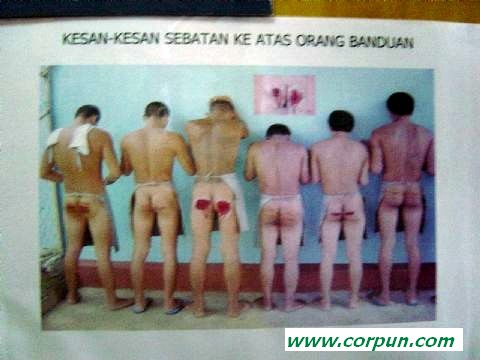
This, too, was probably taken relatively shortly after these prisoners were caned. It is interesting to note how different the wounds can be from one case to another, even allowing for different numbers of strokes.
The wounds take some weeks to heal.
Here are some descriptions of the after-effects by men who have been caned.
"My buttocks felt as if they were burning. They swelled to twice their normal size. I could not sit down or lie on my back. I couldn't even walk properly. The skin on (my) buttocks peeled off and (my) backside was completely bruised. It bled on and off for days [...] (I had to) put on an apron for about ten days as I could not wear shorts. (I was) also unable to sit. Immediately after the caning (I had to lie on my) stomach for about four hours. For two hours (I even had) difficulty standing up [...] Going to the toilet was the worst [...] you don't dare to squat because you may tear open the wounds again. So you try to do it half sitting and half squatting." ("Jack" - 20 strokes).
"I stumbled to an adjacent room and plonked myself down. For the next three weeks (I) slept with my face down. (I) could neither eat or sleep properly. For the first week, I couldn't even sleep. The pain was unbearable. It took more than a month for the wounds to dry. My buttocks didn't look normal after that, with the skin drooping and the scars." (Sam - 15 strokes).
"(After the caning) I couldn't sit down or lie on my back for a week. (Going to the toilet) was the worst of all [...] I could not squat or even bend my knees. I got scared every time I got the urge [...] I tried not eating but this did not work. I still had to go and I had to do this standing up, holding my buttocks wide apart. (This lasted) one week then things came back to normal." (Ah Seng - 5 strokes).
"The wounds take between a week and a month to heal. During that time many cannot sit or sleep on their backs and dare not bathe for fear of getting sores. The wounds heal but the marks are indelible. The caners are supposed to be so skilful that they never hit the same spot twice." (Sunday Times, Singapore, 13 July 1986).
"My buttocks swelled a little bit [...] the wounds hurt for about five days after which they itched as they healed. The first couple of days it was very hard to sit. Now [about six weeks after the caning] on one side there are three dark brown scar patches on my right buttock, and four lines each about 1.2cm wide on my left buttock, where the flesh was torn." (Michael Fay - 4 strokes).
According to statements by Michael Fay's father and one of his lawyers, the US diplomat who saw him in prison, shortly after the caning, was allowed to inspect the damage. Fay was reported to be bleeding through bandages over his buttocks. When the bandages were removed the diplomat is said to have observed that "the flesh was ripped and broken, there were circular wounds, about two inches in diameter, where it appeared there was more serious damage, where the cane had struck twice". Fay senior also claimed that the diplomat had reported that "Mike had a great deal of difficulty in walking, but he was able to sit down at one point, although again it was with a great deal of difficulty. His face was contorted. He was in pain, and when he sat down, he sat down very gingerly" ("Caned Youth Gets Visit In Singapore", The New York Times, 7 May 1994).
However, these are second- or third-hand impressions: the diplomat himself had declined to say anything to the press except that, not being a doctor, he was not qualified to make a judgement about Fay's condition.
At all events the Singapore authorities disputed these quoted accounts, dismissing Fay senior's remarks as "wild allegations and misinformation" and saying that Fay "sat, laughed and smiled during the visit, and wanted his father to 'shut up' about the caning". They also claimed that Fay said the caning was "not as bad and horrifying as described in the press." (USA Today, 9 May 1994; The Washington Post, 8 May 1994).
But then, as Gopal Baratham has written, "There are rumours that the caner was asked to go lightly on the boy so that the lashing did not leave permanent scars on his buttocks, scars that he could expose to the American media: scars that would do more harm to Singapore's international image than they had done to Fay's behind" (op. cit., p.22).
According to Nick Leeson, "My cellmates had five strokes each. They lay on their front for two days. It basically takes two weeks to heal" ("Repentance of a Rogue Trader", Daily Mail, London, 10 July 1999).
SCARRING
Caning as described above will produce permanent scars, according to several reports.
In an NBC documentary shown in 1994, a former prisoner was shown raising his sarong and exposing his bottom to the camera - the scars of his caning were clearly visible.
Likewise, The New Paper in 1991 published the following picture of the buttocks of an ex-convict who, it said, had been caned 10 years previously:
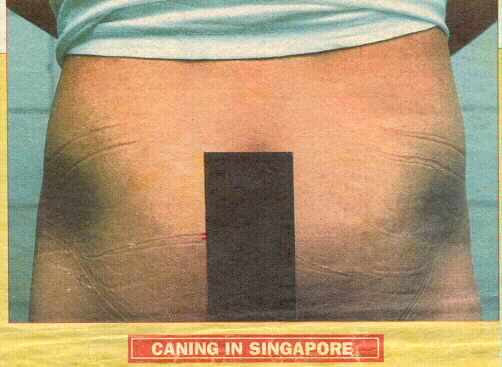
And in Gopal Baratham's book, two pictures are reproduced - in fact almost certainly different views of the same man:
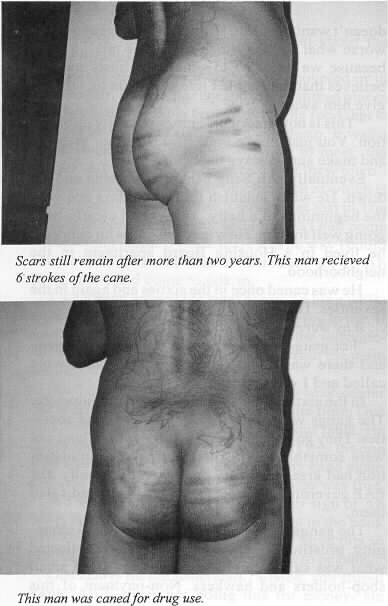
The Singapore Director of Prisons in his 1974 news conference said:
"[...] the cane marks are indelible and these will be a source of humiliation to (the prisoners) for the rest of their lives".
Reporting on the news conference, The Straits Times, in an article called Branding the Bad Hats for Life, stated on 13 September 1974:
"The Director of Prisons [...] yesterday gave a graphic, blow-by-blow account of how criminals are caned so they will walk with scarred bottoms for the rest of their lives."
"Jack" and "Peter", both caned in the early 1980s, told The New Paper that the caning had affected them in their life after prison, and how they had to find excuses to explain away the marks.
Men who have been caned are not permitted to serve in the Singapore Armed Forces.
After the 1974 news conference, one Singapore paper took up the issue of scarring in an editorial, suggesting that "[...] marking a criminal for life -- even on a spot not immediately visible to others -- smacks of barbaric medievalism". The editorial also criticised the whole tone of the Prisons Director's press conference. (Clearly the local newspapers were less rigidly controlled by the regime in 1974 than they are now: even this muted degree of criticism is never found in the Singapore press today.)
However, it is not certain that the marks last forever in cases where relatively few strokes were administered.
The following photograph of 20-year-old Dickson Tan's bottom was taken just one year after his 8-stroke caning:
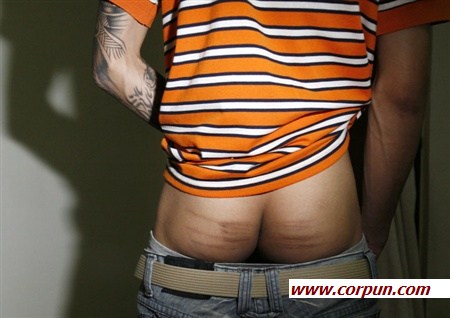 "Dickson Tan, who was caned for helping an illegal money lender, displays his bruises for the camera in Singapore March 27, 2008. Tan is suing the Singapore government for around S$3 million (USD 2.2 million) in damages for mistakenly caning him three more strokes than he was sentenced to, court documents showed. REUTERS/Vivek Prakash"
Despite what the Reuters caption says, we see no bruises here, only weals. Any bruises had already disappeared. In fact this looks at first glance just like an ordinary schoolboy caning, until we remember that it is 12 months after the event. Even so, it is not obvious that this relatively moderate scarring is going to be there for life.
HUMILIATION, DETERRENCE AND POLITICS
Judicial caning is clearly intended to be a humiliating experience. Former Prime Minister Lee Kwan Yew, founding father of modern Singapore, introducing mandatory caning for vandalism in 1966, told Parliament:
"[...] if (the offender) knows he is going to get three of the best, I think he will lose a great deal of enthusiasm, because there is little glory attached to the rather humiliating experience of having to be caned." (Lee often referred to the subject in this oddly juvenile vein -- "three of the best", and so on -- as if to suggest, though he surely could not seriously have believed, that the punishments in question are somehow equivalent to the headmaster's canings he received as a schoolboy at Raffles College in the 1930s, which he mentions in his memoirs.)
In fact, the severity and humiliation of the punishment are widely publicised: compulsory prison visits for juvenile delinquents include viewing what newspapers have described as a film of the execution of the punishment (though it is not known whether such a film really exists for Singapore) as well as a real-life demonstration by a warder on a dummy. The films of Malaysian canings were evidently made by the authorities with a similar aim in mind.
One newspaper article stated in 1974: "In the Singapore context, caning is the most dreaded form of punishment. If proof be needed, I need only recall the very many instances when young and middle-aged offenders, under caning orders, begged the Appeal Court in vain to suspend them and give longer prison terms instead. (But) until Parliament changes the law, there is nothing that can be done".
There is, indeed, little sympathy expressed towards those being caned. A writer from the National University of Singapore defended the punishment:
"[...] it is a part of the law that most Singaporeans are glad to give their support [...] the purpose of caning is to inflict pain. For this purpose, the safest place to cane is really the buttock, and none other [...] According to accounts given by people who have been caned, they suffered immense pain during the caning, and would not be able to sit or lie down on their buttocks for many days, even up to two weeks. And the surface of the skin may split open during the caning. That's all! The result of caning is a lasting mark on their buttocks. This serves a lasting educational purpose; they will always be reminded not to commit the offence again!"
Although the extensive use of corporal punishment in Singapore is a policy associated with the late Lee Kwan Yew and his ruling People's Action Party, it is not a policy on which the PAP has a monopoly.
The only opposition party represented in Parliament, the Workers' Party, while hostile to very long terms of imprisonment and mandatory sentences, does not oppose JCP, at any rate for crimes of violence.
A legal challenge to the very existence of JCP in Singapore was roundly rebuffed in March 2015 by the Court of Appeal, which ruled that caning, because it was subject to a range of procedural regulations and safeguards, was entirely different from "torture" and was thus not unconstitutional. The Court also held that international law norms were irrelevant and could not override the explicit wishes of the Singapore Parliament.
In Malaysia, though, there is more opposition from academics, human rights activists and lawyers. In particular the country's Bar Council, representing lawyers, unanimously passed a resolution in 2007 described whipping as cruel, inhumane and degrading, and called for its abolition, especially for illegal immigrants.
However, there was no sign that the then federal government shared this view. No information is yet to hand on the position of the new Malaysian government elected in 2018.
In addition, in 2007 there was a proposal by the Women, Family and Community Development Ministry to abolish the judicial caning of juveniles in Malaysia. No such change in the law has yet been reported.
SOME DIFFERENCES BETWEEN SINGAPORE AND MALAYSIA
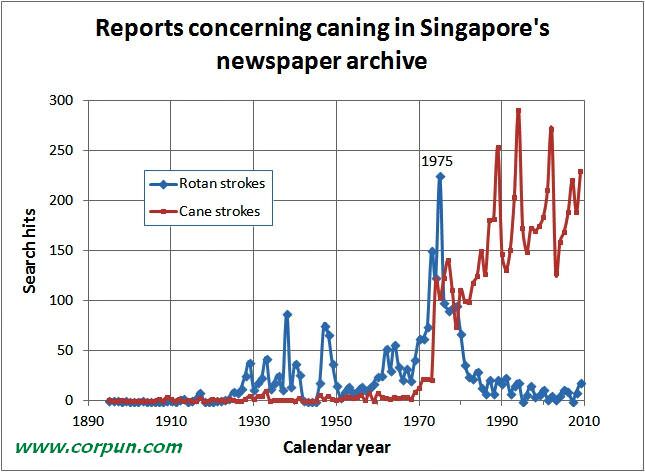
Terminology: In Singapore, the punishment is nowadays always described, both in legislation and in English-language press reports, as "caning". The phrase "strokes of the cane" took precedence over "strokes of the rotan" from about 1980 (see graph). In Malaysia the term "caning" is often used informally, and the phrases "strokes of the cane" and "strokes of the rotan" are used interchangeably, but officially the correct term is "whipping", following traditional British legislative terminology.
Note: when Malaysian newspapers report that someone is to be "whipped three times", it just means three strokes of the cane on a single occasion. In former British times, this would have meant three different caning sessions. In the 19th century, some UK legislation stipulated that an offender might be "once, twice or thrice privately whipped", meaning an unspecified number of strokes on each of up to three separate occasions; but this usage has been lost sight of.
Modus operandi: In Singapore and Brunei the culprit must bend over for his caning, with his feet together. In Malaysia he stands upright at the frame with his legs apart.
Implements: The Malaysian cane is marginally smaller than the Singaporean one. This does not seem to make any discernible difference, if first-person accounts from the two jurisdictions are compared. Also, Malaysia uses a smaller cane for white-collar offenders -- those convicted of non-violent financial crimes such as embezzlement. There are no reports of any such distinction being made in Singapore.
Juveniles: In Singapore, only the High Court may order the caning of boys under 16. In Malaysia local courts may do so.
Islamic law: Malaysia has a parallel judicial system covering some sins that are offences only when committed by Moslems, who constitute about 60% of the population nationally. In theory some of these may attract caning sentences, though this happens rarely. When it does, the smaller cane is used and the mode of infliction is much less severe. Singapore, only about 15% of whose population are Moslems, has no such system.
Main sources in addition to those mentioned in the text:
Director of Prisons press conference, September 1974 (reported in numerous papers, e.g. "Strokes of Tradition", The Australian, Sydney, 19 September 1974, and "Singapore Still Flogs Felons", unidentified US newspaper, 26 September 1974)
Amnesty International Briefing on Singapore, January 1978
"Singapore Lawmen Don't Spare the Rod Or Spoil the Criminal", Wall Street Journal, New York, 6 July 1982
Amnesty International Bulletin, 1989
"10 years on, and we still feel the pain", The New Paper, Singapore, 10 September 1991
"Caning horror show deters the hooligans", The Daily Telegraph, London, 23 April 1994
"Prisons Department sets the facts straight on caning", The Sunday Times, Singapore, 1 May 1994
"An Appeal to Use the Rod Sparingly: A Dispassionate Analysis of the Use of Caning in Singapore", by Mark Lim Fung Chian, in Singapore Law Review, Vol. 15, 1994
"The Caning of Michael Fay: The Inside Story by a Singaporean", by Gopal Baratham, KRP Publications, Singapore, 1994
 See also: