INDIA: Judicial CP
Official judicial CP ordered by the courts in India was by caning, under the Whipping Acts of 1864 and 1909. These provisions were abolished in the 1950s, except in the state of Jammu and Kashmir. However, this did not affect traditional local village justice systems, under which CP remains lawful, according to GPTEVAC [PDF] , which cites the Pipon system in Sikkim as an example. , which cites the Pipon system in Sikkim as an example.
In 1934, according to Benson (1937), there were 6,709 canings ordered by the courts.
Males under 45 could be given up to 30 strokes with a light rattan at least half an inch in diameter for a number of serious offences, with or without a term of imprisonment. Boys under 16 could be caned for any offence, with a maximum of 15 strokes, in lieu of imprisonment.
Some confusion may be caused by references in present-day Indian news reports to "caning" by riot police in the streets. This does not usually refer to JCP. The cane meant is a "lathi", a very long stick originally designed for use in martial arts but here deployed to disperse a crowd during disturbances. Police normally use it to lash out at the unruly mob, rather than to inflict a formal punishment on individuals, though that does also happen occasionally.
Extrajudicial CP by local police is not unknown, and may be quite prevalent in some areas, as seen in these video clips. And in Jan 2015 such a punishment was upheld by a local court, which described as "very fitting" the public chastisement by a policewoman of a youth of 23 who had been harassing girls. She forced him to bend over in the street for an instant spanking -- See "'Creep' publicly spanked for harassing schoolgirls" (illustrated).
It has also become apparent that police in the Indian part of Punjab apply the "patta", a specially-made leather paddle, to the buttocks of detainees, either as an extrajudicial punishment or in an attempt to extract a confession. This implement is more familiar in the Pakistani part of Punjab, and possibly dates from the pre-1947 era, when the whole of Punjab was a single and somewhat distinct entity within British India. See this video clip.
See also this Dec 2008 report that 15 senior schoolboys in Manipur were publicly caned for beating up their school bus driver. One might have expected such a caning to be carried out by the school itself, making it school CP rather than JCP, but this punishment is described as having been administered by members of KYKL-UNLF, a rebel military force in the state.
DOCUMENTS:
Regulations by State under the Penal Code
Mode of infliction of JCP in different Indian states in the late 19th century. In most states mentioned, caning was applied to the offender's buttocks, but in Bombay this applied only to those under 16; adult miscreants in Bombay were whipped across the bare shoulders.
EXTERNAL LINKS: (these will open in a new window)
Act No. XIII of 1852
See page 160. Boys under 16 in Calcutta could be sentenced to "corporal punishment not exceeding fifteen stripes of a light rattan" for larceny.
Abolition of Whipping Act, 1957
The end of JCP in the State of Bombay.
INDIA: Military CP
In modern times there is no official CP in the Indian Army. But these video clips suggest that unofficial caning or paddling of army cadets is quite normal in practice. Also in India there are innumerable private military training schools, called things like "defence academy" or "physical academy", which aim to prepare youths for admission to the army proper. Quite a few of these outfits advertise their use of physical punishments, sometimes including mild caning.
EXTERNAL LINKS: (these will open in a new window)
The Navy (Discipline And Miscellaneous Provisions) Regulations, 1965
See Regulation 81. Seamen (boys and artificer apprentices) under 18 may be caned for serious offences. The language evidently owes something to former British practice, but surprisingly there is nothing about the number of strokes to be applied, nor much detail about the modus operandi. For instance, one assumes that the cane is administered to the offender's backside, but the regulation does not say so. Note also that "When two or more persons are caned on the same day, those who are waiting their turn for punishment shall not witness the infliction of caning on another and no one shall be present whilst the caning is in progress except the person administering the punishment and the officer who witnesses the caning". It is not clear whether these provisions have been repealed.
INDIA: Prison CP
DOCUMENTS:
Prisons Act 1894, Chapter IX
Rules for prison discipline whipping under British rule (max. 30 strokes). This was to be inflicted on the buttocks, presumably bare, except for boys under 16, who were to be punished "in the way of school discipline", which possibly means over the seat of the trousers. The rules are unusual in specifying, for adult prisoners, not a maximum size for the rattan to be used, but a minimum of half an inch in diameter.
EXTERNAL LINKS: (these will open in a new window)
Corporal Punishment in India's Jails
Report (May 2006) from the South Asia Human Rights Documentation Centre makes the surprising claim that the whipping provisions of the 1894 Prisons Act (see above) were at that point still in force and "actively used", especially in Jammu and Kashmir, despite a recommendation of abolition by an official committee in the 1980s. There is no mention of statistics or individual cases.
Jammu & Kashmir: Prisons Act 1977
Chapter XI, s.46, stipulates that male inmates who commit any of a long list of offences against prison discipline may be whipped, "provided that the number of stripes shall not exceed thirty". s.53 adds: "Whipping shall be inflicted with a light rattan not less than half an inch in diameter on the buttock and in case of prisoners under the age of sixteen it shall be inflicted, in the way of school discipline, with a lighter rattan." It is not immediately clear whether this legislation has survived 2019's political upheaval whereby Jammu & Kashmir's special autonomous status within India was partly rescinded by central government in Delhi.
INDIA: School CP
School corporal punishment in India is in the process of being abolished (in theory) on a state-by-state basis. According to press reports it was either banned by legislation, or held to be unlawful by the courts, in Delhi in 2000, Andhra Pradesh in 2002, and Orissa and West Bengal in 2004.
GPTEVAC [PDF] says that CP has likewise been made unlawful in Goa and Tamil Nadu; and also that since 2010 it has been outlawed, but only where students aged between 6 and 14 are concerned, by Federal law throughout India, with some exceptions, notably the semi-autonomous state of Jammu & Kashmir. Certain religious schools, such as Madrasas, are also exempt from the ban.
There is anecdotal evidence that many of these bans are not enforced. For instance, this Feb 2007 news item claimed that shops selling punishment canes were still doing good business with schools even within the city of Hyderabad (in Andhra Pradesh), never mind in the rural areas.
In the West Bengal case, it was reported (2011) that the state government was proposing to outlaw CP by legislation, the 2004 ban being only a court ruling.
It should be noted that the phrase "corporal punishment" is being used particularly loosely on the Indian subcontinent. The "horror stories" about so-called CP that are routinely quoted in support of these various bans, involving pupils being injured by untrained angry teachers who lash out violently on the spur of the moment, have nothing to do with proper formal corporal punishment.
See also this 2014 video clip showing canings of schoolgirls on the hands.
DOCUMENTS:
Delhi School Education Rules, 1973
Rules for caning in schools in the Delhi area of India: if a cane was used, it was supposed to be applied to the palm of the hand, max. 10 strokes.
 External links for India/Schools External links for India/Schools
 INDONESIA: Judicial CP
Official judicial corporal punishment in Indonesia exists only in Aceh province, on Sumatra, where the local government has been allowed to introduce it as a concession to strongly conservative Islamic feeling in the area. (Indonesia, pop. 220 million, is the biggest Muslim country in the world, but in most other parts of the country, people generally follow a much more moderate form of Islam.)
Islamic law was introduced in Aceh in 2002, and proposals for caning errant Muslims first emerged in September of that year. The first reported canings took place in June 2005.
The punishment is administered in public (typically in front of a mosque) to the clothed upper back. Men and women alike may be caned, but not juveniles. At first, most of the reported cases were for alcohol or gambling, but more recently there have also been canings for sexual offences. The authorities maintain that the way the caning is administered is much more humane than in Singapore or Malaysia. Nevertheless, recipients have complained of severe pain and been photographed with bruises and welts.
These video clips show the punishment process in action.
International controversy was provoked in May 2014 when a 25-year-old woman was sentenced to public caning, along with her male companion, for adultery. She had allegedly already been raped by a gang of vigilante youths as unofficial punishment for the offence.
This May 2014 news report revealed that some caning sentences in Aceh are never carried out, because of the financial cost to the local authorities of organising the necessary public ceremony.
In Sep 2014 it was reported that the law in Aceh had been amended to extend the use of JCP to sexual offences such as extramarital and homosexual acts. The first reported caning for gay sex duly took place in May 2017 in front of a huge crowd of onlookers (pictured).
The caning of 34 people on one day attracted wide publicity in Sep 2015, as in this illustrated press report.
For some years it was stressed that the JCP provisions did not apply to Aceh's Christian minority, but in late 2015 this restriction was removed, and the first non-Muslim to be caned was an elderly Christian woman who received nearly 30 strokes in April 2016 for selling alcohol.
This June 2016 illustrated news item reported claims by Amnesty International that public canings in Aceh were on the rise, reaching 108 cases in the latest year.
In Apr 2018 it was reported that, because public floggings in front of a baying mob were giving Indonesia a bad name internationally, the ceremony would thenceforth be performed inside prison, with no photography allowed.
In some other parts of Indonesia, unofficial village whippings are locally condoned -- see these video clips. These have nothing to do with Islamic law.
INDONESIA: School CP
Corporal punishment is lawful in schools in Indonesia, but there does not seem to be any tradition of its use in an official framework or in a systematic or formal way. In this matter the country (once governed by The Netherlands) differs from its neighbours Singapore and Malaysia, former British territories.
A news report in July 2000, inspired by UNICEF, claimed that "whipping" and "beating" and "lashes" were common at some schools. This probably means random spur-of-the-moment violence, not proper corporal punishment.
The formal flogging in East Java of three youths shown in this 2011 video was therefore a surprising exception. This took place not at an ordinary school but at an Islamic boarding establishment. This Dec 2014 news item belatedly discussed the event. The head of the school is quoted as saying that caning was practised only for serious offences -- in the case in point, alcohol use. The boys had been offered the alternative of being tied to a tree for three days but preferred to be flogged because it was quicker.
 IRAN: Judicial CP
Since the Islamic revolution in 1979, floggings have been commonplace in Iran.
|
MAIN ARTICLE: For full details, with links to reports and pictures, see this separate page.
|
 IRELAND: Judicial CP
Judicial CP in Ireland was inherited from the UK (of which the whole island of Ireland was a part until 1920). The newly independent country proceeded to enact fresh JCP legislation of its own (see external links below). JCP was not formally abolished until the 1997 Criminal Law Act, according to this article in the Journal of Social History (which is not primarily about JCP), but had clearly fallen into disuse decades before that. The most recent example to hand is this 1943 juvenile birching case.
Local politicians occasionally urge the reintroduction of JCP, as in this Nov 2015 news report.
EXTERNAL LINKS: (these will open in a new window)
District Court Rules 1942 (Alternative link)
Scroll down to "Form VI: Conviction of child for indictable offence" for the form of words used by the court in sentencing a juvenile male to birching.
Public Safety (Emergency Powers) Act 1923 Section 5 (Alternative link)
Text of legislation from around the end of the civil war that accompanied Ireland's independence from the UK. Surprisingly, it provides for mandatory whipping for male persons convicted of armed robbery and arson -- with a birch for offenders under 18, instrument in other cases not specified. Some of the phraseology is clearly inherited from British practice (e.g. "once privately whipped"). The following year, the identical wording reappeared in the Public Safety (Punishment of Offences) Temporary Act 1924 (Alternative link).
Dáil Éireann - Volume 4 - 12 July 1923
Verbatim account of debate in the Dáil (Parliament) on the flogging clauses in the Public Safety (Emergency Powers) Bill 1923 (see previous item).
IRELAND: Reformatory CP
Extracts from Borstal in Ireland
From a 1975 book comparing the situation north and south of the post-1922 border as regards institutions for older youth offenders. In the Republic CP was officially not used, and mention is made of two 1940s newspaper stories alleging that it was.
IRELAND: School CP
Corporal punishment was widespread in Irish schools. In the Republic it was abolished by administrative regulation in 1982, though there have been occasional anecdotal suggestions that some teachers managed to ignore this for several years. In 1996 it was outlawed by legislation.
A politician's call for the return of school CP in 2002, in the light of "growing lawlessness" in schools, was rejected by teachers' unions.
CP appears on the whole to have been a more rough-and-ready affair than in Britain, with either less official regulation of it or, where rules existed, a greater inclination to disregard them. The cane was widely used, but so was the strap on the hands, notably on the part of the Roman Catholic priests who ran many of the schools. Anecdotal accounts suggest that some of the latter, especially perhaps the notorious "Christian Brothers", were prone to angry, spur-of-the-moment casual brutality rather than proper formal CP.
It was reported in 1968 that two years earlier there had been a change in government regulations so that canings could thenceforth be delivered to the student's buttocks and not only to the hands, as previously.
EXTERNAL LINKS: (these will open in a new window)
The European Court of Human Rights and the Abolition of Corporal Punishment
An 1999 overview from Irish Student Law Review. Considers the implications for Ireland of ECHR rulings on mostly UK cases.
Other external links for Ireland/Schools
 ISLE OF MAN: Judicial CP
The Isle of Man is a Crown Dependency, with its own laws and parliament, culturally British but not in legal terms part of the UK.
Unlike the mainland, the Isle of Man did not abolish JCP in 1948. In the 1950s and 1960s the island became famous for its courts' increasing use of the birch to punish delinquent boys and young men across their bare posteriors. This was usually inflicted in private by the local police, either in a police station near the court or in a private room in the court building, shortly after the court hearing, the offender being held down over a table or chair. The last birching took place in 1976.
In 1978 the European Court of Human Rights ruled that the practice must be outlawed (see "External links" below).
|
MAIN ARTICLE: Birching in the Isle of Man 1945-1976 (with vintage video clips) provides illustrated overview including references to changing legislation and rules over the postwar period.
|
DOCUMENTS:
Bill the Bircher
Interview (1969) with a magistrate who had ordered some 50 birchings.
Birching ... The Facts
A local legal expert speaks in 1972 about the legal and procedural aspects of the judicial birch.
EXTERNAL LINKS: (these will open in a new window)
European Court of Human Rights: Case of Tyrer v. the United Kingdom
This long document from 1978 is the court's judgment on the punishment in 1972 of Tony Tyrer, then 15, who was sentenced to three strokes of the birch in the Isle of Man. There is a detailed account of the birching, and the document also sets out the relevant legislation -- misleadingly, since it includes the absurd "over trousers" requirement that was only introduced much later (and never implemented). You cannot birch people over their trousers.
The description of the actual event makes clear that Tony indeed received the strokes on his bare bottom, which, we are told, was sore for a week and a half.
The court held by six votes to one that the birching was "degrading" within the meaning of the Human Rights Convention. Some will find Sir Gerald Fitzmaurice's dissenting opinion, at the end of the document, a welcome breath of common sense.
Tony Tyrer himself never wanted this legal action to go ahead, and tried to withdraw it; when he broke his long silence in a newspaper interview many years later, he said he believed the birch was a good thing!
Tyrer v UK
A brief legal comment on the above case.
Other external links for Isle of Man/Judicial
 IVORY COAST: School CP
In the west African country of Ivory Coast (a.k.a. Côte d'Ivoire), the Minister of Education has said that CP should not be used in schools, but there is no law against it, according to GPTEVAC [PDF] .
For a relatively recent instance, captured on video and allegedly carried out by agreement with the parents, see this Dec 2011 news report (with video clip). The modus operandi looks to be typically African, with the recipients lying face down on the ground, though in this case they are being held down in that position by soldiers. This makes it look to be as much a quasi-judicial punishment as a school one, but it is the headmaster who is doing the whipping. It is rather unexpected to see proper formal CP, with even a specific number of strokes being decided in advance, in a place where the colonial heritage and the culture are so strongly French.
 JAMAICA: Judicial, prison and school CP
Judicial CP in Jamaica, by cat or by tamarind switch, was quite common as recently as the 1960s. It later fell into disuse but was revived in 1994 before being abolished in 1998.
Prison CP followed the same rules as judicial CP. It is not clear whether it is still on the statute book.
School CP with cane or strap, generally known as "flogging" or "licks", has been in widespread use in Jamaica. It is still lawful, but some think its use may have declined recently.
 JAPAN: Judicial CP
Flogging had been traditional in Japan -- see this picture of such a punishment in the Edo period (1603 to 1868) -- until it was abolished in 1872. But it was imposed, or at least continued, in overseas territories over which Japan took control around the beginning of the 20th century, such as Taiwan (a.k.a. Formosa) (from 1909) and Korea (1912 to 1920), and in Kwantung/ Manchukuo/ Manchuria (part of China), where it remained in force almost up to World War II.
EXTERNAL LINKS: (these will open in a new window)
Inauthentic Sovereignty: Law and Legal Institutions in Manchukuo
Article (accessible with a fee or via library membership) from the Journal of Asian Studies discusses at pp. 757 to 763 the use of judicial flogging in Japan's Chinese and Korean possessions in the first half of the 20th century.
JAPAN: School CP
Corporal punishment was first prohibited in Japanese schools in 1879, reinstated in 1885, banned again in 1890, and unbanned in 1900, and has been prohibited since 1947. However, there have been reports of its illicit use, especially in private schools such as the Juku or "exam-crammers" -- evening or weekend establishments for extra tuition, which many students attend on top of their ordinary schooling. A once well-known example of a Juku near Tokyo was the subject of this 1977 American magazine article, illustrated with several photographs, and this 1978 article about the same establishment, with another photograph. Yet another picture from the same school has now come to hand.
These show students (apparently all boys) being caned across the buttocks with a bamboo martial-arts (kendo) "sword" in front of their classmates while bending over a low desk. It is not known how typical this system is or was of other schools in Japan, or whether such things still go on now. Another photo from the same series, not previously on line, is given below:
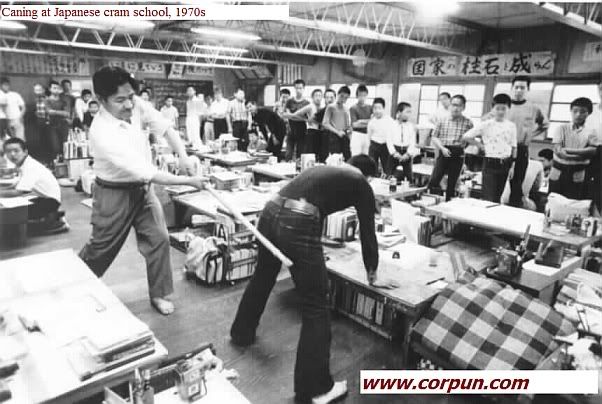
In 2007 a BBC report "Japan schools to rethink beating" gave the impression that, amidst wide concern about bullying in schools, the ban on CP might be rescinded. The headline turned out to be misleading: this later news item clarified that the government's aim was to maintain a prohibition on corporal punishment as we would understand it, but to stress that such penalties as detention, and removing disruptive students from the classroom, do not constitute CP and are permissible.
Corporal punishment has also been noted at other kinds of educational establishment, such as the residential training college for cycle racing or "Keirin", whose students are youths of 17+. Again, a big "kendo sword" is used. See these video clips.
See also these still pictures of students in various settings receiving posterial chastisement of one kind or another.
EXTERNAL LINKS: (these will open in a new window)
GPTEVAC [PDF] states that school CP in Japan was made illegal by the School Education Law of 1947. Recently there have been a couple of hundred or so complaints per year about illegal CP, but it is not clear what is meant by "corporal punishment" in this context. It seems likely that most of these infractions would have involved angry spur-of-the-moment hitting rather than proper formal CP, a crucial distinction that organisations like GPTEVAC always find it convenient to ignore.
Corporal punishment in the schools and homes of Japan
This academic paper (1997) gives the history of the law relating to corporal punishment in schools. There were still 1,000 cases of illegal "corporal punishment" a year (probably random brutality rather than proper CP). The article discusses why it is so difficult to get rid of this phenomenon in practice. There are a couple of statistical charts.
 JERSEY: Judicial CP
Jersey is an island in the English Channel. Like Guernsey and the Isle of Man, it is a Crown Dependency, culturally British but not formally part of the United Kingdom, and like them it retained birching as a judicial penalty when all JCP was abolished in mainland Great Britain in 1948.
In practice, the birch in Jersey seems in modern times to have been applied only to boys and young men under 21. The birch was last used in March 1966 and formally abandoned in 1969. The reason given for its falling into disuse was that it was realised that there was a right of appeal (apparently never previously invoked), which would delay the infliction, and that the essence of the punishment was its immediacy.
The procedure in Jersey differed from that in the Isle of Man in that the birching was carried out not by police but in the local prison, even if the sentence did not otherwise include imprisonment. For this purpose, the court would send the beneficiary to prison for a notional few hours so that he could receive his punishment the same day and then be released.
For some reason, birchings in the Channel Islands (Jersey and Guernsey) never received anything like as much press publicity on the mainland as Isle of Man cases. On average the recipients were a little older (mostly late teens) and the number of strokes higher: 12 strokes was quite a common sentence.
From the 1930s through the 1950s there were just a handful of birchings in Jersey, probably averaging no more than one or two per year. See these sample cases.
This June 1938 case is unusual in that the press report gives a picture of the 17-year-old culprit, who received 12 strokes.
An alleged eyewitness description of a Jersey birching was published in 1973.
In 2008, four decades after it was last used, the "horse" over which the recipient was held for punishment was discovered still in storage at the local prison, pictured here (with video clip).
 JORDAN: School CP
EXTERNAL LINKS: (these will open in a new window)
US State Department Human Rights Report 1993
Corporal punishment in Jordan's schools was prohibited, according to this US State Department document. The same information is repeated in subsequent years' reports up to 1998.
US State Department Human Rights Report 1999
CP was known to occur in Jordanian schools despite the legislative prohibition on it, according to this. This information is repeated in the 2000 report. The reports for 2001 to 2003 do not mention CP.
GPTEVAC [PDF] says that school CP has been banned in Jordan by government regulation since 1981.
Other external links for Jordan/Schools
 KAZAKHSTAN: School CP
Not a lot is known about this big Central Asian country which was once part of the Soviet Union. School CP is theoretically unlawful but prevalent in practice, according to GPTEVAC [PDF].
See this video clip showing the caning of four teenagers at a religious school in 2015. The punishment appears surprisingly "British", in that the boys bend over to be disciplined across the seat of their trousers, though the unsuitable big stick being used is not much like a proper cane.
 KENYA: Judicial CP
Official judicial canings in Kenya were administered in prison and applied to the bare buttocks. The procedure was inherited from British rule. A Bill to abolish JCP was published in 2000, but caning sentences were still being handed down by the courts in Feb 2003. Abolition finally took effect in July 2003.
A Kenya magistrate from 1926 to 1936, Sir Bernard Shaw, has been quoted as saying that he "frequently" had to impose sentences of up to 24 strokes of the cane, and was present when they were carried out. He said the strokes left "little weals" which would have "become inconspicuous in time and probably would have eventually disappeared altogether" (Anthony Babington, The Power to Silence: A History of Punishment in Britain, Maxwell, Oxford, 1968).
According to Benson (1937), there were 450 floggings in Kenya in 1930. By 1935 this figure had fallen to 264, of which 221 were for juveniles.
Allott (1970) stated that magistrates' courts, including district magistrates, were at the time still empowered to order CP of not exceeding 24 strokes.
The application of JCP to juveniles in the pre-independence era is illustrated by this Jan 1960 case in which white schoolboys were sentenced to canings for various robberies. Courts also ordered adult offenders to be caned in this period.
Village elders in some parts of Kenya carry out unofficial (or perhaps quasi-official) public floggings for alcohol and sex offences, according to this May 2014 news report and this Dec 2017 one (illustrated). See also this video clip of the public caning of a woman for adultery in 2015. Whatever the legality of these punishments, they evidently have the support of the local communities concerned, and perhaps the official authorities tacitly support them by turning a blind eye.
EXTERNAL LINKS: (these will open in a new window)
US State Department Human Rights Practices Report 1995
This, the first extant USSD report on Kenya to refer to formal CP, mentions a case in which alleged robbers (in fact, political dissidents; it was widely seen as a frame-up) were sentenced to prison plus three strokes of the cane. The document also states that rapists were in a number of instances ordered several strokes of the cane in addition to jail terms. (The USSD report for 1996 adds nothing new.)
US State Department Human Rights Practices Report 1997
Here it is stated that men convicted of rape normally received several strokes of the cane as well as prison sentences. (The USSD reports for 1998 to 2003 inclusive merely repeat the same information. From the 2004 report onwards there is no reference to JCP.) Not mentioned is the fact that throughout this period JCP was imposed for other offences too, such as robbery. See for instance this Dec 1999 news item.
Amnesty International Report 1998
Notes that in 1997 many young men under 18 were caned in Kenya by order of the courts.
KENYA: School CP
|
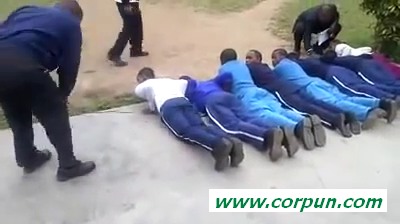
See 2014 video clip of 10 Kenyan secondary schoolboys being vigorously caned across the seat of the pants.
|
Corporal punishment in Kenyan schools was originally banned by administrative decree in 1996, but this was never enforced. It was announced in 2000 that the ban was now to be taken seriously. The legal provisions under which caning had been permitted were formally repealed in 2001.
This change proved highly controversial, and even university professors warned that it would lead to chaos in schools.
Reports in 2002 and in 2004 and 2007 made it clear that many schools in Kenya were ignoring the new law and that CP continued to be applied widely. More recently, that impression is strengthened by the appearance of these video clips of canings under way.
Demands for the reintroduction of the cane have been persistent, and continued in 2008 and 2009 amidst claims of a widespread collapse in student discipline.
In Aug 2011, Muslim leaders added their voices to calls to bring back the cane, saying that its abolition under Western pressure had contributed to deteriorating moral standards among young people. 11% of Kenyans are Muslims.
In 2016, in the light of a spate of arson attacks, strikes, and a wave of unrest in schools and a general sense of collapsing discipline, further calls for the restoration of caning came from senior politicians including the Chairman of the Senate Education Committee.
EXTERNAL LINKS: (these will open in a new window)
 Spare the Child: Corporal Punishment in Kenyan Schools
A long report (1999) by Human Rights Watch, claiming that the official regulations were routinely ignored and that pupils were caned for trivial reasons. There is also a brief summary of the report.
US State Department Human Rights Practices Report 2000
Section 5 notes that corporal punishment of students, including caning, was widespread in Kenyan schools.
Other external links for Kenya/Schools
 KOREA: Judicial CP
There is no official judicial CP in either part of present-day Korea. Flogging with a cane or paddle appears to have been common until 1920. This July 1912 news item describes the detailed rules laid down for this by the then Japanese occupying power. These specify that the whipping was to be applied to the unclothed "hips"; from the pictures available (see below) it is clear that this was a translator's euphemism for the buttocks.
DOCUMENTS:
Old pictures of judicial canings
Six photographs from the beginning of the 20th century. The cane was applied to the bare buttocks, with the offender tied down to a specially constructed bench, lying flat face down. At least sometimes, the penalty was evidently carried out in public, which is probably why so many photographs of it exist.
EXTERNAL LINKS: (these will open in a new window)
Colonial-style Democracy
Article in the Korea Times (Nov 2008) describes the situation after Korea was taken over by Japan as a colony in 1910. It says that "until 1920 Koreans could be subject to corporal punishment, a practice that had been long outlawed in Japan proper". However, this was only a continuation of what had already long applied before the Japanese arrived. It is claimed that floggings were ordered for "trifling offences" instead of imprisonment or fines.
KOREA: School CP
Present-day Korea remains divided between the affluent, highly developed, western-oriented South and the poor, communist, isolationist North.
School caning has been commonplace and was until recently fully lawful in the South, but is prohibited and allegedly unknown in the North.
70% of South Korean schools used CP, according to a survey in 2003.
|
MAIN ARTICLE: For a detailed illustrated overview with links and documentation, see this separate page.
|
 LEBANON: School CP
Corporal punishment in Lebanese public (but not private) schools was banned by the Education Ministry in 2001, though it is not actually against the law, according to GPTEVAC [PDF].
In March 2014 a video clip showing a teacher striking students with a stick on the soles of the feet gained wide circulation, and as a result he was banned from teaching, according to this illustrated news report. This cruel form of CP, known as Falaka or Bastinado, is quite typical of the Middle East.
 LITHUANIA: School CP
Lithuania was from the 1940s until 1990 part of the Soviet Union, where school CP was in theory officially outlawed. Since 2004 it has been a member state of the European Union.
EXTERNAL LINKS: (these will open in a new window)
Amnesty International Report 2002
This makes the surprising claim that in 2001 corporal punishment was widespread in schools as well as families. I wonder if this really meant proper corporal punishment in the deliberate formal sense that we normally understand.
GPTEVAC [PDF] now says school CP in Lithuania was explicitly prohibited by statute only as recently as 2017.
 MALAYSIA: Domestic, judicial and school CP
Caning is widespread and frequent. See this separate page.
 MALDIVES: Judicial CP
In this small state which consists of a group of atolls off India, courts are empowered to impose floggings for certain offences under Islamic (Sharia) law. In this July 2007 case, a man was sentenced to 19 lashes, in addition to banishment to one of the outer islands, for sexually assaulting a 12-year-old girl.
Following the death of the man whose job it was to administer the punishment, there was over a year's pause, according to this June 2008 news item. A new operator began work on 15 May 2008 by publicly flogging two women and three men who had been sentenced during the hiatus. The report claims that the penalty is intended to be symbolic, causing humiliation rather than pain.
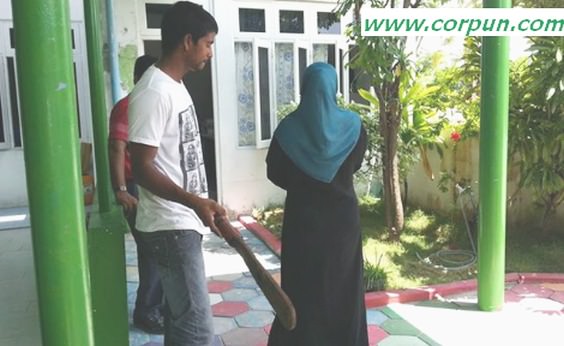
(Minivan News Feb 2015)
The implement used is a stiff leather paddle called a "duraa", according to this July 2009 news item. The "duraa" is pictured above being administered to a female offender. It is applied to the clothed posterior.
A July 2009 report stated that 150 women and 50 men were to be flogged for adultery. Most of these sentences had been handed down in 2006 but had still not been carried out.
There have been a number of reports of cases in which girls aged 13 to 18 have been ordered to be flogged for having pre-marital sex, even where they were unwilling victims (i.e. rape). In such cases, the punishment may be postponed until the girl turns 18. An example was this case in Sep 2012. Another, very similar, instance was reported in Feb 2013, after which the country's President expressed shock and said the government would seek to overturn the sentence. This duly occurred in Aug 2013.
This video clip shows what is said to be the public flogging in 2013 of a young woman in the capital, Malé. It is taking place in the entrance to the court buildings, apparently visible to anyone who happens to be walking past. In practice it looks much more like a "spanking" than a "flogging".
EXTERNAL LINKS: (these will open in a new window)
US State Department Human Rights Report 1998
There were no public floggings in 1998 but there were two private floggings for adultery. (The 1999 and 2000 USSD reports merely repeat the same information.)
US State Department Human Rights Report 2001
Public flogging was still allowed but there were no reports of it in practice. (The 2002 USSD report repeats the same information.)
US State Department Human Rights Report 2003
Reports that public floggings under Sharia law had resumed in Maldives. In October 2002, two women were given 15 lashes each for homosexual activity. In July 2003, five women got 10 lashes each on drug charges.
US State Department Human Rights Report 2004
Mentions that there were several public floggings during the year, particularly for adultery, but gives no details.
US State Department Human Rights Report 2005
This states that the punishment for homosexual behaviour is "whipping 10 to 30 times", but does not say whether the penalty was implemented, either for this or for any other offence. (The reports for 2006, 2007 and 2008 merely repeat the same information.)
US State Department Human Rights Report 2009
There were 180 public floggings in the Maldives for extramarital sex in the year under review, according to this. The report for 2010 adds nothing new.
US State Department Human Rights Report 2011 [PDF]
96 persons were sentenced to flogging, most of them women and mostly for adultery.
US State Department Human Rights Report 2012 [PDF]
98 persons were sentenced to flogging, again mostly women for adultery.
US State Department Human Rights Report 2013 [PDF]
71 adults were sentenced to flogging, 63 per cent of them women. In addition, the Juvenile Court ordered corporal punishment for 6 girls and 6 boys.
US State Department Human Rights Report 2014
97 adults were sentenced to flogging in the Maldives, as also 7 minors under 18.
US State Department Human Rights Report 2015
46 adults were sentenced to flogging, as also 6 minors under 18.
 MYANMAR (Burma): Judicial CP
The theoretical legal position in Myanmar (previously known as Burma), a highly corrupt and dysfunctional country under military rule, is not very clear. In practice, canings in more or less British style are carried out with impunity by various government forces: see this video clip from 2015.
EXTERNAL LINKS: (these will open in a new window)
US State Department Human Rights Report 2019
No mention here of formal CP in Myanmar, but there are several mentions of (presumably extrajudicial) "beatings" by government forces.
GPTEVAC [PDF] notes that the British colonial-era 1909 Whipping Act was repealed in 2014. Judicial CP for offenders under 16 had already been abolished in 1993. However, GPTEVAC thinks a 2001 law permitting the whipping of 16- and 17-year-olds may still be in force.
 NAMIBIA: School CP
School caning in Namibia (once known as South-West Africa) was ruled unconstitutional by its Supreme Court as long ago as 1991, but there have been reports of its use since then, as in this March 1998 news item and this July 1999 one and this June 2005 one. According to this June 1999 report, teachers were frustrated that students could not be punished properly, and some boys asked for a spanking (presumably instead of some other punishment) but had to be refused. An article in The Washington Post reported on the situation in some schools as at 2005.
In April 2013 it was reported that a conference of educators, civil servants, business leaders and local officials had lamented the state of indiscipline among school students and called for the restoration of CP.
The High Court ruled in Sep 2016 that the legal ban on CP applied to private as well as government schools.
EXTERNAL LINKS: (these will open in a new window)
Where Policy Hits the Ground [PDF]
Report (1999) by the US Agency for International Development. It reproduces a 1991 circular from the Namibian Ministry of Education informing schools that corporal punishment had been ruled unconstitutional. But the practice was deeply entrenched, and took a long time to die out. See pages 18 to 22, 67, 73 and 74.
Other external links for Namibia/School CP
 NAURU: Judicial CP
Nauru is a tiny island nation in the South Pacific. Judicial whipping was abolished in 1955.
EXTERNAL LINKS: (these will open in a new window)
Criminal Code Amendment Ordinance 1952
Sets out the provisions for whippings ordered by the court in Nauru. These were apparently adapted from those once applicable in Queensland, Australia. There was a maximum of 24 strokes for offenders of 17 or over, but 10 strokes for ages 15/16 and only six strokes for those aged fourteen or under. Either a cane or a leather strap could be used.
 NEW ZEALAND: Domestic CP
A call for the outlawing of spanking ("smacking") in New Zealand, even by a child's own parents, was made in December 1999 by the Commissioner for Children.
This suggestion proved highly controversial, and a long period of public debate ensued. A Green MP introduced a Bill in 2006 to put such a ban into effect, making smacking a criminal offence. Although this passed into law, many New Zealanders refused to accept it, and in 2009 a citizen-initiated referendum produced an 87% majority for repealing the legislation. The government failed to do so, however, and in Nov 2009 a 4,000-strong demonstration in Auckland, the "March for Democracy", protested against the failure of the regime to follow the overwhelming public view.
EXTERNAL LINKS: (these will open in a new window)
Referendum results
Official results of the referendum, showing a large majority in every district for decriminalising parental CP.
NEW ZEALAND: Judicial CP
New Zealand law permitted birching for juvenile offenders. In this 1905 case, five boys aged 14 to 16 were ordered 12 strokes each for stealing, which were administered on the day of the court hearing.
Originally however it was the cat that was used, even on boys aged only ten to twelve, according to this report of a July 1876 trial and description of the subsequent punishment.
In those earlier times adult men could also be flogged with the cat, as described in detail in this Feb 1877 news item.
EXTERNAL LINKS: (these will open in a new window)
The Fall and Fall of Corporal Punishment
According to this, judicial whipping for boys under 16 was introduced in 1867, last used in 1935, and abolished in 1941.
NEW ZEALAND: School CP
Corporal punishment was banned from all New Zealand schools in 1990. Previously the caning or strapping of secondary schoolboys had been routine, deeply ingrained in the culture and extremely widespread. (Girls were generally exempt.) For details of how this worked in practice at one elite Christchurch boys' school in the late 1960s, see this book review.
In this Jan 2016 news item, severe canings in the mid-1980s at another boys' boarding school in the same city are recalled.
The celebrated 1981 "caning video" case at Rongotai College shows that this culture was by no means confined to "posh" schools. See also this October 1997 news item for recollections of canings at Nelson College between 1856 and 1983.
All sources seem to concur that canings were typically delivered in the English manner to the seat of the trousers, with the student bending over, either hands on knees or, perhaps less often, touching his toes.
Anecdotal evidence suggests that the strap (pictured here) was more favoured at primary school level, typically given on the hand, and here sometimes applied to girls as well as boys. Some secondary schools used it too, either instead of or as well as the cane.
Half the population of New Zealand in 2010 still wanted corporal punishment restored in schools, according to this May 2010 report.
DOCUMENTS:
Caning in a mixed-sex city school in the 1960s
Light-hearted anecdotal descriptions from the autobiography of a teacher. It is taken as read that boys might expect to be caned on a more or less daily basis, while girls were exempt.
EXTERNAL LINKS: (these will open in a new window)
No corporal punishment in early childhood services or registered schools
This is the legislation outlawing corporal punishment in all New Zealand schools, part of the Education Act 1989.
Shards of teacher and curriculum development in four New Zealand secondary schools [PDF]
According to research cited in this paper (see p.80), 94% of boys' schools used CP in 1985, and 67% of mixed schools. However, its use was already decreasing: "In 1975, a mean of 30 canings per school had been administered to fourth-form boys compared with 11 in 1985".
Other external links for New Zealand/School CP
 NIGERIA: Judicial CP
This 36-state federation, a member of the Commonwealth, is Africa's biggest country, with 180 million residents. It has for practical purposes two legal systems, one in the mainly Moslem north, the other covering the mainly Christian south.
This north-south divide dates back into history: there were two separate British colonial territories, Northern Nigeria and Southern Nigeria, until they were merged in 1914.
Benson and Glover (1931) report 1,385 judicial CP cases in Nigeria in 1929. This figure rose to 1,722 as a court sentence in 1935, plus another 298 for prison offences, according to Benson (1937).
Allott (1970) records that, in the northern states, in addition to ordinary canings imposed by magistrates' courts, "native courts" had power under the law to order "symbolic or Haddi lashing".
Anderson (1970) noted that such punishments had to be confirmed by the Emir or district officer before being carried out. He added that it was "important [...] to distinguish the lashes imposed under the Shari'a from any form of corporal punishment permitted under the Criminal Code. The former must be inflicted with a cowhide whip held only between certain fingers of the hand, while the one who inflicts it must also hold some object under his arm throughout. It is clear, therefore, that this punishment at least in modern Nigeria is to be regarded as a disgrace [...] rather than a very severe physical ordeal".
The emergence since 1999 of explicitly Islamic regimes in many of Nigeria's northern states has brought the distinction between north and south into sharper focus, following a long period of centralised military rule.
Flogging sentences by local courts under Sharia law -- often for fairly minor offences -- have become commonplace in some northern states. These are typically administered in public, immediately after the court hearing. See this 2007 BBC report, which includes two video clips showing public whippings being ordered and inflicted in Zamfara. These particular punishments are seen to be applied to the clothed buttocks, but some photographs from other states, such as in this 2002 report from Katsina, show whippings on the bare upper back.
Those examples feature male beneficiaries, as do most of the reports we have seen, but females are not exempt: see this Sep 2019 case in which a 19-year-old girl in Kaduna State was sentenced to 80 strokes of the cane for using drugs.
For more serious offences, CP is combined with a prison sentence, as in this June 2008 case in which a rapist was sentenced to 10 years' jail plus 41 strokes of the cane.
In Abuja, the federal capital, there have been frequent reports of local courts sentencing boys and girls to six or seven strokes of the cane for minor offences, while adults doing the same crime were given short prison sentences, as in this Nov 2010 report. More recently, though, there has been a spate of reports from Abuja of adults being sentenced to caning without imprisonment, predominantly for stealing.
This long piece in The New York Times (Feb 2014) describes a punishment with a "leather whip" in an Islamic courtroom in Bauchi, under new legislation against homosexuality.
Judicial caning also still exists, along more "British" lines, in the mainly Christian south. The Criminal Code Act 1916 still applies in these states, under which adult males may be sentenced to caning for any offence punishable by six months or more in prison. Also, in some southern states, boys aged up to 16 may be sentenced to caning by magistrates for any indictable offence. The Criminal Procedure Act 1945 (art. 386(1)) limits the number of strokes to 12.
These southern cases seem to be less often reported, in the English-language press at any rate, and the frequency of the use of JCP is unknown. One 2008 case was, however, reported in the (southern) Kwara State: a young man was ordered to receive 12 strokes of the cane, without imprisonment, for stealing a mobile phone, which sentence was carried out immediately at the court premises "by security agents".
Another southern (non-Islamic) case was reported in Aug 2011 when a university undergraduate was ordered six strokes of the cane, likewise for stealing a telephone. The strokes were administered immediately by police. See also these Dec 2011 juvenile canings in the southern state of Edo, these Sep 2013 ones in the southern state of Ogun and these Aug 2017 ones in the central (non-Sharia) state of Nasarawa. The latter case is unusual in that the culprits are named in the press report despite being aged 15 and 16. The same is true of this Nov 2017 case, also in Nasarawa, in which a named 16-year-old was sentenced to 14 strokes (plus 8 months in jail) for a sexual offence. The caning was administered by a court official, presumably there and then, and not at the prison as one would normally expect for a sentence combining JCP and jail.
This video clip shows a 25-stroke caning sentence being administered at a local court in Cross River State, in the south of the country, in 2013.
This video clip shows two young men being publicly flogged in 2017 by village elders for stealing a chicken.
EXTERNAL LINKS: (these will open in a new window)
Corporal punishment in Nigeria: An overview
A useful explanation by local lawyers in the International Journal of Education and Research (May 2023).
Sharia in Nigeria
This Wikipedia article (with map) explains in more detail the way Islamic law applies fully or partly in some states and not at all in others.
GPTEVAC [PDF] tries to unpick some of the complexities of the several parallel legal systems in Nigeria, as they apply to youngsters. In the country as a whole, under the Children and Young Persons Act, courts may order juveniles aged 7 to 17 (it is not clear whether this applies to girls as well as boys) to be whipped, and the law states that this is preferable to imprisoning them. The Criminal Code (South) provides that boys under 17 may be ordered to be caned for any offence. Under Sharia law in the North, children as young as 10 are reported to have been sentenced to JCP.
Indian Hemp Act
A piece of legislation from 1966 about cannabis, which includes provision for the caning (up to 21 strokes) of teenage boys.
Nigeria: Inhuman sentencing of children
This document from the Child Rights Information Network goes into even further complicated detail, particularly as to the different ages at which people are regarded as children, young people or adults in each state.
US State Department Human Rights Report 1996
This is the first extant USSD report to mention formal CP in Nigeria, and states that caning was used as a punishment for "minor infractions or public disturbances".
US State Department Report on Human Rights Practices 1997
This says that caning continued as a form of punishment, in many cases not as a formal court sentence so much as by the security forces taking the law into their own hands. However, in the year under review, four men publicly received 100 strokes of the cane each as a formal court sentence for adultery. (The 1998 and 1999 USSD reports do not mention official JCP.)
US State Department Report on Human Rights Practices 2000
Some detail is given about the various provisions under which formal judicial CP may be inflicted, under the national common law (though no cases of this are cited) and the Northern Nigerian Penal Code as well as by Shari'a courts in the north. The then recent extension of the latter in certain states is noted, and the question is raised whether such punishments constitute "torture or [...] inhuman or degrading treatment" as forbidden by the Constitution.
Time for justice and accountability
Amnesty International document (2000) with more detail of some Islamic floggings in Zamfara and Katsina states.
US State Department Report on Human Rights Practices 2001
This notes that, by the end of 2001, 12 northern Nigerian states had adopted versions of criminal Islamic shari'a law. Cites a few cases, including one in Zamfara in which a 17-year-old girl was given 100 strokes of the cane for fornication and slander. This Jan 2001 news report says that she received the strokes on her buttocks, unlike many shari'a floggings. (The USSD report for 2002 adds nothing of substance.)
Nigeria: Teenage Mother Whipped
Human Rights Watch reaction to the Islamic flogging of a girl in Zamfara (see previous item), which provoked an international outcry.
US State Department Report on Human Rights Practices 2003
The number of northern states in Nigeria applying shari'a law remained at 12. There had been no constitutional challenge to JCP. The report noted that in some cases convicted persons were offered a choice between paying a fine and being caned. Caning sentences were usually carried out immediately. Also mentions a Zamfara case in which a woman was ordered 30 strokes plus a fine for arson, and given the option of five years' jail instead. (The USSD reports for 2004 to 2018 inclusive add nothing new of significance.)
US State Department Report on Human Rights Practices 2019 New!
Mentions a case in which a sharia court publicly flogged a 20-year-old man with 40 lashes for eating a mango during Ramadan. (The 2020 report adds nothing new.)
NIGERIA: School CP
Corporal punishment is prevalent in schools in both North and South Nigeria. The British-derived phrase "strokes of the cane" is widely used.
This Dec 2007 news item reported that school corporal punishment had been "reintroduced" in Osun State, although there is no indication to hand that it was ever banned.
This Feb 2011 news item claimed that the use of CP was declining, and included a photograph of a boy and a girl being whipped in the schoolyard in front of their peers.
These video clips show schoolboy canings under way in Nigeria.
In Feb 2018 it was reported that school CP had been banned in Nasarawa State, following a case in which male teachers had allegedly flogged secondary-level girls on their buttocks.
A handful of Nigerian schools state on their websites that caning is part of their disciplinary procedures.
EXTERNAL LINKS: (these will open in a new window)
GPTEVAC [PDF] notes that corporal punishment is lawful in Nigerian schools under Article 295(4) of the Criminal Code (South).
Rights of the Child in Nigeria
Corporal punishment is explicitly permitted in Nigerian schools, for students under 18, under Article 55 of the Penal Code (North). The government says it may be carried out only on the authority of a head teacher.
 PAKISTAN: Judicial CP
Judicial caning, sometimes carried out in public, was commonplace during the regime of General Zia (1977-1985). It appears to be less common now, but has not been abandoned altogether.
Unofficial floggings by Taliban-related Islamicists take place in areas of the North-West that are beyond the control of central government.
Quite separately, the police in Punjab (Pakistan's largest province) routinely spank male offenders on their own initiative, without troubling the official judicial system. A big specially-made leather paddle called a "patta" is used, applied to the buttocks while the recipient is held face down on the floor. Often this takes place inside police stations, but in some cases in public places.
|
MAIN ARTICLE: For full details, with links to news items, pictures and various other documentation, together with video clips, see this separate page.
|
PAKISTAN: School CP
At federal level, corporal punishment is lawful in Pakistan's schools under Article 89 of the Penal Code. Ministerial directives in the different provinces have instructed teachers not to use it, in some cases even in private schools -- see this April 2005 news item and this Sep 2005 one -- but these are clearly not enforced in practice. Press reports have carried various "horror stories" about what they describe as "corporal punishment" and sometimes "caning", but these always turn out to relate to random brutality by out-of-control angry teachers, not proper CP.
When proper moderate formal CP does occur, from numerous video clips that have come to hand so far -- though the schools concerned may not be representative -- it appears in many cases to owe more to a British tradition inherited from colonial times than to any Islamic notions. A cane is typically applied to a bending student's clothed buttocks, or in a few cases to the hands; a slipper is sometimes used instead. The beneficiaries are always boys, mostly in the mid to late teens. Some appear more or less adult, at the very senior end of secondary school or even at college (post-secondary) level.
Most parents and teachers in Punjab support CP in schools, according to this June 2013 news report.
EXTERNAL LINKS: (these will open in a new window)
GPTEVAC [PDF] says (Feb 2022) that CP has been outlawed by local legislation in Islamabad Capital Territory, Sindh, Punjab, and Gilgit-Baltistan, and possibly in Khyber Pakhtunkhwa. There is no such prohibition in Balochistan.
Violence Against Children within the Family and in Schools [PDF]
This 2001 document sets out Pakistan school heads' (mostly positive) opinions of corporal punishment and gives various other survey statistics, including the types of punishment used. One of these is called "murgha banana" or "to assume the position of a cock with his head down and buttocks up", which is a very uncomfortable position to hold for any length of time. Murgha is a common punishment in its own right but also often a prelude to being spanked. As with much material from the Indian subcontinent (and some other places), the definition of "corporal punishment" here seems much too widely drawn to be useful or sensible.
 PALESTINE: Judicial and reformatory CP
According to Benson and Glover (1931), there were 20 judicial floggings in Palestine in 1929. The territory was under the British Mandate until the state of Israel was established in 1948.
In general the birch was the implement used, generally on teenage boys, as in this Oct 1934 case and this Dec 1935 case and this Mar 1938 case and this Apr 1939 one, while in a famous 1946 case that had political repercussions, the sentence was initially described as birching but in later reports as "18 cuts with a cane".
EXTERNAL LINKS: (these will open in a new window)
GPTEVAC [PDF] clarifies that JCP is still lawful, in theory, in Gaza under 1938 British Mandate legislation that remains unrepealed. The assumption is that this is a dead letter. In the West Bank (under former Jordanian legislation) and East Jerusalem (under Israeli rule) there is no JCP.
Encyclopaedia of the Palestine Problem
Summary of events in the Palestine emergency of 1946, when Zionist terrorists were attacking the British forces. One of them was sentenced to a whipping for a bank robbery, and they kidnapped British soldiers and flogged them in retaliation. For more detail see these Dec 1946 news items.
On the Legislation Relating To Palestinian Children
Big document produced by the Law Centre of Birzeit University (1996) explaining the complicated legal situation inherited from various different jurisdictions and shortly to be replaced (or so it was hoped at the time) with modern legislation by the new Palestinian Authority. See Section 6, "Children as Offenders/Juvenile Justice". Rules made under the British Mandate in 1922 and added to in 1930, not spelled out in detail here, empowered courts to order flogging for those aged under 16 for any offence. This legislation was strengthened in 1937 and 1941 with a statement that no young person should be sent to prison if he could suitably be dealt with in some other way, including corporal punishment.
Under Jordanian jurisdiction these provisions were repealed for the West Bank in 1954 but apparently remain in force up to today in the Gaza Strip, at least in theory. Also still applicable in the Gaza Strip are reformatory regulations from 1932 providing for corporal punishment to be used (no details given). The Israeli authorities made various legislative changes after their invasion of 1967 but left these particular provisions unamended. However, it is not clear whether the occupying power has allowed these rules to be invoked in practice.
PALESTINE: School CP
The law does not prohibit corporal punishment in schools in any part of Palestine, except in Israeli-controlled East Jerusalem, according to GPTEVAC [PDF].
See this 2014 video clip of a mass classroom caning of high-school boys in Ramallah, on the West Bank.
 PAPUA NEW GUINEA: Judicial CP
Magistrates in PNG could formerly order male juveniles to be caned in public, as in this March 1966 case. It is not known when JCP was outlawed.
In November 2010 the Madang Urban Youth Council announced that it would cane school students found roaming about when they should be in school. It is not clear what legal basis this initiative had, if any, but it evidently had the support of the police.
EXTERNAL LINKS: (these will open in a new window)
Crime in Papua New Guinea
This 1976 paper says at page 156 that the courts ordered five canings of juvenile offenders in 1968-69, rising to 24 in 1971/72.
PAPUA NEW GUINEA: Prison CP
DOCUMENTS:
Prisons Ordinance, 1923-1938
Rules for whipping by cane or birch rod. Sentences had to be confirmed by the Administrator only where the offender was "a person other than a native"!
PAPUA NEW GUINEA: School CP
Corporal punishment remains lawful in PNG schools but is believed to have fallen into disuse.
DOCUMENTS:
Call for corporal punishment
News item (Feb 2006) reporting that the PNG Prime Minister had called for the "reintroduction" of caning in secondary schools and for its use also in universities and technical colleges, complaining of a lack of discipline in educational institutions.
PNG minister considers corporal punishment in schools
Five years further on (Sep 2011) comes another ministerial suggestion that the cane be restored.
 PERU: Judicial CP
There is no official JCP in Peru, and no history of it at national level, as far as can be ascertained. However, indigenous or local communities in some areas carry out whippings, notably in the northern region of Cajamarca. As in some other South American countries, these often have the tacit approval of the authorities, or at any rate little or no action is generally taken against those who carry them out.
This illustrated article on Aljazeera.com in July 2016 focuses on Cajamarca's own local judicial system or "rondas" (typically rendered in English as "rounds", but a better translation is probably "patrols"), including public or semi-public punishments with a stiff whip called a "binza" made from braided bull's pizzles.
Offences so punished have included adultery, robbery or theft, brothelkeeping, and assault.
See these video clips of such punishments taking place. The videos show that the whipping is generally applied to the clothed buttocks of males and females, often in an unexpectedly formal, almost "British schoolboy"-style ceremony with proper bending over. In other cases the beneficiary simply lies flat on the ground or just stands up straight. The recipients are frequently required also to perform push-ups or other strenuous exercises. When youngsters are being disciplined, it is sometimes their own parents who wield the binza.
This video clip shows the process of manufacturing the binza.
This Aug 2019 illustrated news item claims that national legislation from 2002 gives certain judicial powers to these local vigilante organisations.
EXTERNAL LINKS: (these will open in a new window)
Vigilantes of the Andes
Article in Contributoria (May 2015) sets Peru's Cajamarca "rondas" phenomenon in its legal, historical and political context. The system dates from the 1970s, according to this.
In Peru, vigilantes serve up justice with whips made from bull penises
Another view of the same topic, from Global News of Canada (Nov 2014).
 PHILIPPINES: Judicial and prison CP
Perhaps because of the cultural influence of American rule (1898-1946), the wooden paddle appears to be the CP instrument of choice in the Philippines. This is seen for instance in numerous anecdotal references to US-style college fraternity punishments. This May 2018 news item notes that the police and army use long wooden paddles (pictured) on the buttocks of election-law violators.
Inmates could apparently be paddled for offences against prison discipline, but in Cebu Province this practice was banned in August 2013, according to this news report, though that article seems to conflate official punishment with getting beaten by fellow prisoners. GPTEVAC [PDF] now implies that the 2013 ban was a national one, stating that the prisons administration "in 2013 issued a Memorandum ordering the confiscation of instruments used for corporal punishment, including sticks, paddles and belts".
PHILIPPINES: School CP
In both private and public schools, corporal punishment was banned in 1987, according to GPTEVAC [PDF].
 POLAND: School CP
It is always claimed that school CP was abolished in Poland in 1783, but since the country went out of existence as an independent political entity from 1795 to 1918, this may not mean very much.
We know little about what happened between 1918 and the German invasion in 1939, but some anecdotal evidence suggests that CP was not unknown in classrooms. During the communist period (1945-1989) the official propaganda line, as in most communist states, was that there was no CP.
Matters are complicated by the fact that Poland's borders have kept moving around over history. It is known that school students were caned in the area of Poland occupied by Prussia in the 19th century and up to World War I -- see these 1901 news items.
EXTERNAL LINKS: (these will open in a new window)
US State Department Human Rights Report 1996
According to this US Government report, the Polish teachers' work code guaranteed legal immunity from prosecution for the use of corporal punishment in classrooms, which the report clearly deems to be "abuse" (rather oddly, since it is not legally so regarded in the USA itself). The identical wording is repeated in the each year's USSD report for Poland up to 2005. It is not mentioned in the 2006 or subsequent reports.
GPTEVAC [PDF] says that CP in public schools in Poland was explicitly forbidden by government regulation only as recently as 2001. It adds that CP had already, in 1991, been outlawed in private schools. It also cites a 2001 survey which found that 20% of adult respondents recalled experiencing "corporal punishment" (undefined) by schoolteachers, which might lead one to suspect that the proclaimed ban on CP during the communist era was possibly somewhat theoretical. On the other hand, there could easily be confusion about what is meant by "corporal punishment". No hard evidence is currently to hand one way or the other.
 QATAR: Judicial CP
Flogging remains on the statute book as an Islamic punishment in this small Gulf state. It is applied, to women as well as men, for moral offences, particularly to do with sex or alcohol. This 2006 court case, in which a man and a woman were ordered 100 lashes each for adultery, is probably typical. The flogging may be combined with a prison sentence, but this is not always so, as in this April 2013 case in which a man was sentenced to 40 lashes, and fined but not imprisoned, for drinking alcohol.
A British man who was flogged in Qatar in 1994 (or 1993 -- accounts vary) has described the experience. From this it appears that the strokes are applied indiscriminately from the shoulder blades to the calves, with clothes kept on.
A description of the punishment is given in this June 2016 local news report, which also quotes a former minister of justice opining that flogging should be abolished because jail time is just as effective. It adds that nowadays (unlike in 1994 apparently) the penalty is applied only to Muslims.
EXTERNAL LINKS: (these will open in a new window)
GPTEVAC [PDF] quotes a law stipulating that juveniles under 16 may not be flogged in Qatar.
US State Department Human Rights Practices Report 1995
This says that an American in Qatar received 90 lashes on 6 June 1994 for homosexual activity. He had been offered expulsion without prison, or caning, but opted for the caning in order to be able to return to Qatar. According to this account, he was "bruised but in good health". It is remarkable how little publicity this got at the time, in comparison with the case of another US citizen, Michael Fay, caned in Singapore one month earlier.
US State Department Human Rights Practices Report 1998
This mentions corporal punishment in passing but gives no details. (The 1999 and 2000 reports on Qatar add no further information.)
US State Department Human Rights Practices Report 2001
According to this, corporal punishment in Qatar is not administered in public. (The 2002, 2003, 2004 and 2005 reports merely repeat the same information.)
US State Department Human Rights Practices Report 2006
This report mentions the application of lashes (in private) for alcohol consumption, but fails to note that the punishment is also ordered for sexual offences. (The 2007 and 2008 reports add nothing of significance.)
US State Department Human Rights Practices Report 2009
No corporal punishment was applied during the year under review, according to this. Qatari courts typically reduced such sentences to a fine on appeal. (The USSD reports for 2010, 2011 and 2012 add nothing new.)
US State Department Human Rights Practices Report 2013
A man was sentenced to 40 lashes for alcohol use in 2013 but it was not known if the flogging was carried out, according to this. (The USSD reports for 2014 and 2015 add nothing of significance.)
QATAR: School CP
Corporal punishment in Qatari schools is prohibited by a ministerial decree of 2001, according to GPTEVAC [PDF] . However, there have been reports of this rule being breached, according to this brief news item from March 2005.
 RUSSIA: Judicial/military CP
Judicial flogging was once commonplace in Czarist Russia, but only for peasants. It was administered with either the knout (abolished 1845), the plet or the birch (abolished 1903). The plet was also used in prisons for internal discipline. The plet was somewhat like a cat-o'-nine-tails but with only three strands. Photographs exist of it in use. See these pictures.
109 years after abolition, it was reported that 27% of Russians said in an opinion poll that they approved of flogging for certain offences. See this Sep 2012 news item, which also claims that some Russian Cossacks ignored the legal ban and continued to use CP, presumably within their own communities. See also this photograph.
Cossacks subject to corporal punishment in modern times include Russian-backed fighters in the present insurgency in Eastern Ukraine, according to this Oct 2014 news item. The two accompanying video clips show soldiers undergoing whippings -- on the bare back in one case, and on the seat of the underpants in the other -- apparently for excessive drinking, among other things.
In the Russian army proper there is a tradition of initiation ceremonies for young recruits involving a belting across the buttocks, as seen in several video clips.
 ST VINCENT AND THE GRENADINES: Judicial and school CP
EXTERNAL LINKS: (these will open in a new window)
NGO Initial Report on Saint Vincent and the Grenadines [PDF]
Submission (2002) by the local Human Rights Association to the UN Committee on the Rights of the Child. Part IV(f) quotes the 1959 regulations, involving use of a leather strap, for CP in schools. Part VII(c) mentions the judicial caning of juvenile offenders -- up to 12 strokes on the bare buttocks, usually given by a policeman in a police station.
GPTEVAC [PDF] confirms that the above provisions are still in force (Dec 2019).
Other external links for St Vincent/School CP
 SAMOA: School CP
This is a group of islands in the Pacific previously known as Western Samoa, and not to be confused with nearby American Samoa.
School corporal punishment is outlawed in Samoa under the 2009 Education Act, according to GPTEVAC [PDF] , which however adds that this ban applies only to government schools and even then only to students aged 5 to 14.
The Prime Minister was reported in August 2012 as wanting to reintroduce CP because of indiscipline by students.
This July 2017 news item quoted the Education Minister as saying that the government was still looking into it, and that he hoped the cane could be brought back, particularly to deal with students fighting.
 SAUDI ARABIA: Judicial CP
Local courts routinely order floggings, often of hundreds of lashes -- or even thousands, inflicted in instalments. Women as well as men may be flogged.
SAUDI ARABIA: Reformatory CP
EXTERNAL LINKS: (these will open in a new window)
Adults Before Their Time
According to this document (2008) from Human Rights Watch, only boys over 15 are flogged at the Riyadh Social Observation Home. The floggings are administered in front of other detainees. "Every Tuesday a staff member prepares 15 or 16 files for flogging." There are no details of what exactly is meant here by "flogging".
SAUDI ARABIA: School CP
Schools in Saudi Arabia have long been "instructed" or "advised" (depending on whose translation one reads) by the Education Ministry not to use corporal punishment on students, but there is no explicit prohibition on it in law. Teachers are opposed to an outright ban on CP, according to this May 2013 news report, arguing that discipline is bad enough already.
Anecdotal evidence suggests that CP is usually applied with a ruler or cane to the outstretched palm of the student's hand in the classroom on the spur of the moment. Supposedly, teachers in Saudi may be penalised if they ill-treat students, but enforcement seems patchy or nonexistent: there have been scenes of teachers slapping students around the head in anger, and this kind of abuse is sometimes wrongly described as "corporal punishment".
An opinion poll in 2003 found that 60% of the Saudi population approved of CP in schools.
There have been no reports of properly regulated formal CP, and there seems no strong tradition of applying punishment to the posterior, as is the cultural norm in much of the world outside the Middle East. An exception is seen in this video clip, in which 13 schoolboys each receive a stroke of the cane across the seat.
 SIERRA LEONE: Judicial CP
The Corporal Punishment Act 1960 allowed up to 36 lashes (up to 12 lashes for boys under 17). No details are to hand of the instrument used or the modus operandi.
GPTEVAC [PDF] states that that legislation was repealed in 2007.
Nevertheless, it was reported in 2008 that a magistrates' court in Sierra Leone had ordered a 19-year-old thief to receive 24 lashes for petty theft in lieu of imprisonment. The punishment was administered "in public view inside the courtroom".
According to Benson (1937), there had been 57 instances of judicial CP in Sierra Leone in 1930.
EXTERNAL LINKS: (these will open in a new window)
Juvenile Justice in Sierra Leone
This document (2000) gives details of corporal discipline that magistrates' courts used to be empowered to impose on boys. "Only canes or birch rods should be used on juveniles and only on their buttocks." However, the document says this was rare. More often, cases were dealt with by the village chief under customary law, often involving flogging.
US State Department Human Rights Practices Report 2004
In its first extant mention of JCP in Sierra Leone, the USSD says that in 2004 there were reports of Councils of Chiefs administering floggings as part of a traditional code of justice outwith the official penal system.
US State Department Human Rights Practices Report 2005
A magistrate sentenced an 11-year-old boy to 6 lashes for stealing a phone, according to this. (The report for 2006 adds nothing new.)
US State Department Human Rights Practices Report 2007
Local chiefs continued to administer harsh punishments. Meanwhile, the official Corporal Punishment Act was still in force, though no actual cases are cited. (The report for 2008 merely repeats the same information.)
US State Department Human Rights Practices Report 2009
The application of judicial lashes occurred less frequently in Sierra Leone than before, according to this. (The USSD reports for 2010, 2011 and 2012 add nothing new.)
SIERRA LEONE: School CP
Corporal punishment is lawful in Sierra Leone schools under article 3 of the Prevention of Cruelty to Children Act 1926 and article 33(2) of the Child Rights Act 2007, according to GPTEVAC [PDF] . Various recommendations to ban it have not been followed up.
Anecdotal evidence suggests that the caning of students' buttocks is widespread. This video clip shows the chastisement of a girl and two boys in front of their schoolmates.
 SINGAPORE: Judicial and prison CP
 Since independence from Britain in 1959, this island city-state in south-east Asia has developed into a high-tech, first-world country. Its 6 million residents enjoy a standard of living on a par with that of Western Europe or North America. They regularly vote in free elections for a paternalistic and rather authoritarian government with strict laws, harsh punishments, restricted freedom of speech, and no free press. It is one of the world's least corrupt regimes. Singapore is easily the cleanest and most efficient country in Asia. Crime rates are low. Since independence from Britain in 1959, this island city-state in south-east Asia has developed into a high-tech, first-world country. Its 6 million residents enjoy a standard of living on a par with that of Western Europe or North America. They regularly vote in free elections for a paternalistic and rather authoritarian government with strict laws, harsh punishments, restricted freedom of speech, and no free press. It is one of the world's least corrupt regimes. Singapore is easily the cleanest and most efficient country in Asia. Crime rates are low.
With thousands of court-ordered canings administered each year, Singapore can reasonably claim to be the JCP capital of the world -- especially pro rata to its population -- even though the number has been falling drastically over the last few years.
Only males under 50 may be so punished. In practice, the impression given by press reports is that a large proportion of canings are of offenders in their late teens and twenties. However, most cases go unreported in the media. About half of all canings are of illegal immigrants.
Contrary to popular myth, all these sentences are carried out privately in prison; there have never been public canings in Singapore. The punishment is applied with a long, heavy, soaked rattan (not bamboo) across the offender's bare buttocks. The number of strokes ordered varies from one to 24, depending on the offence.
Corporal punishment is always combined with a prison sentence; the prisoner generally receives his caning fairly early on in his prison term, once any appeal has been exhausted. The country's main jail, the huge Changi complex, is said to hold a mass caning session twice a week, with typically dozens of prisoners waiting in line outside the room for their turn to be chastised.
In an earlier era, courts ordered canings for juveniles without a jail term, as in this Aug 1933 case.
|
MAIN ARTICLE: See comprehensive feature article Judicial caning in Singapore, Malaysia and Brunei (illustrated) for full details of history and modus operandi, first-person and eyewitness accounts, links to press articles, and an overview of the legislative situation.
|
See also a (somewhat out of date) table of offences for which caning may be ordered by the courts in Singapore.
EXTERNAL LINKS: (these will open in a new window)
Aggregated caning and the risk of double or disproportionate punishments
Detailed article in Singapore Academy of Law Journal (May 2021) about the much-publicised case of the 29-year-old Londoner Yuen Ye Ming, sentenced to 24 strokes of the cane in 2019 for drugs offences. The discussion centres on whether the Court was right to conclude that multiple caning sentences must be ordered consecutively as opposed to concurrently. The implication is that, from an academic legal point of view, the corporal part of Yuen's punishment was excessive.
This is Ken's story
Document (Feb 2021) from the Transformative Justice Collective, a newish campaign for penal reform in Singapore. Now 31, "Ken" describes being caned at a Reformative Training Centre (RTC) at age 18. Reformative Training is an especially rigorous kind of prison sentence for certain sorts of offenders under 21. RTCs are run by the prison service. They are separate from the ordinary adult prison but as far as corporal punishment for internal discipline reasons is concerned, it would appear that the rules and practices are the same, with typically two caning sessions held per week, according to this.
'You don't see the sky': Life behind bars in Singapore
A much more comprehensive report (May 2022) from the Transformative Justice Collective (see previous item). This 73-page PDF contains quite a lot of interesting information, though much of it is derived from interviews with former inmates, who may not always be 100% reliable sources. "While waiting for one's turn, a window allows one to see others being caned." See in particular pages 33 to 36. Four interviewees who had been caned all claimed that after receiving his strokes each beneficiary has to thank the officials present. This is news to me, and seems implausible. The government denies that there is any such rule.
Written Reply to Parliamentary Question on Cases of Canings Administered by the Singapore Prison Service without Judicial Sentencing over the Past 10 Years, by Mr K Shanmugam, Minister for Home Affairs and Minister for Law
Here is the Singapore government revealing (Aug 2021) -- seemingly for the first time ever in the modern era -- statistics about the number of canings imposed for internal prison discipline reasons, as opposed to those ordered by the courts. Over ten years from 2011 to 2020 inclusive, 2,149 inmates underwent 2,875 caning sessions. This averages out to just under six canings a week. The median number of strokes per caning was three, it adds.
Corporal Punishment Needs a Linguistic Makeover
Revised version (Nov 2021) of a Jan 2019 article a in a local "alternative" online magazine called RICE. Originally it was titled "We Don't Know How to Talk About Corporal Punishment Because We're Using the Wrong Words". The author argues that it's misleading to describe JCP as "caning" because the same word is also used in Singapore for the trivial punishment of young children by their parents.
CRC Initial Report
Singapore is signatory to the UN Convention on the Rights of the Child. As such, it is obliged to report periodically on its progress in implementing the Convention's provisions, and this is its initial report (2000). The document makes no apology for the fact that the High Court could, at that time, sentence boys under 16 to "caning with a light rattan" for serious offences (and also the fact that "corporal punishment is meted out judiciously to errant male pupils" at school). Clearly Singapore had no intention of changing its tried and tested procedures at the whim of an unelected and unaccountable UN Committee.
Of particular interest is that at section H the document quotes some rare statistics: 20 juveniles were judicially caned in Singapore in 1998, and 39 in the period Jan to Sep 1999. This latter amounts to about one per week, which is a lot more than I had assumed from the infrequent reports of such sentences in the press, such as this Oct 1999 report of a case in which a boy of 14 was awarded 10 strokes of the light cane (plus five years' jail) for a violent robbery that caused the death of the victim.
2nd and 3rd Periodic Report [DOC]
This is a follow-up (2009) to the above. It continues to robustly defend Singapore's use of carefully regulated formal caning for boys in schools, reformatories and the judicial process. The document reveals a decline in juvenile judicial canings ordered by the High Court: 76 such punishments were carried out between 2003 and June 2007. This averages out to roughly one juvenile caning every three weeks.
Replies of Singapore to the list of issues concerning additional and updated information related to its second and third periodic reports
I somehow previously overlooked this 2011 supplement to the above document. It states that "For criminal cases which were tried in the High Court from 2005 to 2009, no juvenile offender was imposed with the sentence of judicial caning". This must mean that the 76 canings of boys aged 7 to 15 inclusive referred to in the previous entry were in fact concentrated in the period 2003 to 2004, giving an average of roughly one such punishment every ten days, followed by a sudden drop to zero.
4th and 5th Periodic Report
A further instalment (2017) in this sequence of reports for the UN Committee on the Rights of the Child. The caning of boys under 16 by the High Court is no longer mentioned. Does that mean it has ceased? It rather looks like it in practice, although the provision remains on the statute book as at mid-2021. Could this be a rare case of the Singapore regime finally falling into line with the will of a UN committee? At all events, the tone of this document seems less gung-ho and a bit more on the defensive about CP than in earlier years; it makes the quite startling claim that "Corporal punishment is not a common punishment in Singapore and is only conducted as a last resort". I suppose it all depends what you mean by "common". Still, as before, "Singapore does not view corporal punishment as torture or cruel, inhuman or degrading treatment".
Abunehneh
A young man who in 2006 received three strokes of the cane in a Singapore prison describes the experience, writing two years later.
The Caning of Michael Fay: Can Singapore's Punishment Withstand the Scrutiny of International Law?
Detailed legal analysis (1995) in American University International Law Review. The authors are incorrect in stating that Singapore adopted judicial caning only after independence in 1965. In fact the practice was then already many decades old, having been inherited from British colonial rule.
To cane or not to cane
Results of an online survey (2015) of Singaporean opinions about JCP. Support for the caning of rapists was higher than for non-violent crimes like vandalism. Also, older people tended to be more in favour of caning than younger people. However, the author admits that the sample was not a representative one, so these conclusions do not mean very much.
Mandatory Caning of Foreign Workers Who Overstay
Question and answer in Parliament (May 2008). The minister says that mandatory caning (minimum 3 strokes) of those who overstay in Singapore by more than 90 days is necessary to deter immigration offenders.
Prisoners inflicted with more than 24 strokes of the cane
Verbatim account of a debate (Feb 2008) in the Singapore Parliament about cases in which prisoners have received more than 24 strokes at a time, in apparent breach of the rules. A more succinct version of the Minister's reply can be found in this news item.
Consultation on the Criminal Procedure Code Bill [PDF]
Government consultation paper (Dec 2008). See p12/13 for changes to caning provisions, mainly to do with the cap of 24 strokes per occasion.
Second Reading Speech on Moneylenders (Amendments) Bill 2005
A government minister explains to Parliament why the penalties were being increased for harassment by loan sharks, including caning where damage to property or hurt to persons is caused. The first such punishments were handed down in March 2006.
Things Singaporeans do and what they can expect to get
An unofficial (and now very out of date) list of selected court cases, with links to the relevant official court reports. A few involve caning sentences, but it is also interesting to note how many of them do not. Perhaps we ought to regard extremely long prison terms, rather than caning, as the truly distinctive characteristic of Singapore justice.
Fay v Public Prosecutor
The official court record of Michael Fay's unsuccessful appeal against his caning sentence in 1994. It goes into a bit more detail about the facts of the case than any of the news reports gave at the time.
Public Prosecutor v Roszaili Bin Safarudin
Official court record of a March 2003 case in which a 15-year-old boy was sentenced to 10 strokes of the cane for sexual offences. At the end of the document it is specified that, as the offender is a juvenile, the caning is to be performed "with a light rattan".
Subordinate Courts Research Bulletin, April 1998 [PDF]
See page 9 onwards for statistics and graphs on the subject of convicted youth rioters and their sentences, including the proportion caned (12% of those aged 16 to 21) and the number of strokes (in most cases six).
Singapore caning
 Computer-generated visualisation of the successive stages of a judicial caning. This is evidently partly based on the real photograph of a caning under way. But it is not quite accurate: there ought to be an additional, padded crossbar on the front of the A-frame, adjustable to the level of the culprit's genitalia, over which he bends. For photos of the actual equipment, see these stills from an official Singapore government film showing a dramatised reconstruction of a caning, and a video clip from the film.
Amnesty International Report 1997
Reveals that three prison officers were jailed and caned for causing the death of a prisoner. I wonder if any of them had been involved in administering canings themselves and if so what they thought about now being on the receiving end.
Amnesty International Report 1998
Caning remained mandatory for some 30 crimes in 1997. The document mentions a case (see this contemporary news report) in which a 16-year-old boy was awarded 24 strokes for trafficking in cannabis.
Amnesty International Report 1999
In 1998 Singapore's laws were beefed up: caning was introduced for a wider range of drug and immigration offences.
US State Department Human Rights Report 2001
The existence of judicial caning is mentioned at some points in this document, but it will not tell you anything that you do not already know if you have read the feature article Judicial caning in Singapore, Malaysia and Brunei. Reports for other years up to and including 2005 add nothing new.
US State Department Human Rights Report 2006
For the first time since 1993, this report reveals JCP statistics: 5,984 persons were sentenced to the cane, and 95% of these sentences were carried out. It is not clear where these figures came from: I cannot find them on any official Singapore government website and I have not seen them reported in the Singapore or other press.
US State Department Human Rights Report 2007
The number of JCP sentences in Singapore increased to 6,404 in 2007, according to this. This is about 120 canings per week, and roughly double the figure for 1993. By my calculations, this appears to mean that about one-third of all police arrests (of which there were 19,371 in 2007, according to this police website) led to a caning sentence. Once again, it is stated that about 95% of these punishments were actually administered.
US State Department Human Rights Report 2008
Caning sentences in Singapore in 2008 for January to September inclusive numbered 4,078, equivalent to an annual figure of 5,437, a significant year-on-year decline. 98.7% of caning sentences were carried out.
US State Department Human Rights Report 2009
There was a very significant decline in the number of canings ordered, according to this -- 4,228 sentences in January to November inclusive, for an annual equivalent of 4,612, of which 99.8% were carried out.
US State Department Human Rights Report 2010
Another very sharp drop in the judicial caning figures, to 3,170. This is less than half the 2007 figure, and more or less on a par with the level of caning in 1993. 98.7 percent of these sentences were carried out.
US State Department Human Rights Report 2011
Caning sentences declined by 27% year on year, to only 2,318, of which 98.9% were administered. It now becomes apparent that slightly belated effect was indeed given to the desire expressed in 2006 by the then new Singapore Chief Justice to "give more room to judges to use alternatives to harsh punishments". It might be noted that this dramatic decline in the use of JCP has not been highlighted in the Singapore press (which rarely if ever discusses such figures) or even, as far as I have seen, mentioned locally at all.
US State Department Human Rights Report 2012
This report reveals a steadying of the trend, with 2,203 canings carried out in 2012, a mere 5% reduction after the steep decline in JCP sentences of the preceding few years. Of these, 1,070 canings, or almost half, were of foreigners for immigration offences (these are normally 3-stroke punishments). The report for 2013 adds nothing new.
US State Department Human Rights Report 2014
The number of caning sentences handed down from January to September 2014 was 1,230, equivalent to 1,640 for a full year and thus continuing the downward trend. 1,430 men were caned, of whom 663 were foreigners.
US State Department Human Rights Report 2015
A further slight decline: from January to October, the courts sentenced 1,382 persons to judicial caning, and authorities carried out 1,129 caning sentences, including on 516 foreigners.
US State Department Human Rights Report 2016
The downward trend continued. From January to October, the courts sentenced 1,257 persons to judicial caning, and authorities carried out 987 caning sentences, including on 373 foreigners. (The reports for 2017, 2018, 2019 and 2020 add nothing new. The US State Department has evidently given up reporting statistics on JCP in Singapore.)
Other external links for Singapore/Judicial
SINGAPORE: Military CP
Under Singapore law, male members of the armed services may be caned for a variety of military offences. The punishment is imposed by a military court, with a maximum of 24 strokes at any one court martial. For offences by servicemen while detained in a disciplinary barracks, caning may be ordered by the officer in charge, without a court martial, but the sentence has to be approved by the Armed Forces Council.
Caning under this regime is less severe than JCP under the Criminal Procedure Code. It was originally aimed primarily at recalcitrant teenage conscripts. Military service is compulsory for all Singaporean males.
|
MAIN ARTICLE: For full details of military CP in Singapore, with illustrations and links to documents and news reports, see this separate page.
|
SINGAPORE: Reformatory CP

Click to enlarge |
The Singapore government's main young offenders' institution is the Singapore Boys' Home (SBH). (CP has been abolished at the equivalent institution for girls.) The name is misleading: it is really a high-security youth prison, with a razor-wire perimeter fence and bars on the windows. It holds about 400 inmates aged 11 through 21, sent there by the courts for serious offences such as theft, robbery or rioting, or because they have been deemed to be Beyond Parental Control. SBH has been described as "the institution with the most rigorous regime [...] the toughest and most stringent of juvenile institutions" (1).
(1) Lim Hui Min, Juvenile Justice: Where Rehabilitation Takes Centre Stage" (Academy Publishing, Singapore, 2014). See page 76.
According to informed sources, SBH residents receive formal, vigorous canings across the seat of the trousers for serious offences such as fighting, bullying, or failing to return from home leave. This seems to be a fairly routine event: for instance, this 2006 press article about SBH said there were two bullying cases per month on average, and notes that one youth said he had been caned over 60 times in his three years at SBH (he probably meant 60 strokes in total, rather than 60 separate caning sessions). These canings are more severe than the ones meted out at secondary schools. In particular, there is a maximum of ten strokes per caning (reduced some years ago from 12), not three as at school, and it is known that the full ten strokes are sometimes administered, at any rate for offenders aged 17 or older.
This Apr 2014 news article revealed that, at the Singapore Boys' Home, residents who "lay hands on each other" are "caned on the spot".
Caning for misbehaviour was introduced in Oct 2006 at the Darul Ohsan Orphanage, and three boys had been caned there by the time of this Apr 2007 report.
Inmates of the Singapore Girls' Home used to be subject to caning, on the palm of the hand only. This provision was rescinded in 2020.
EXTERNAL LINKS: (these will open in a new window)
4th and 5th Periodic Report
Singapore government report (2017) to the UN Child Rights Committee. "In Juvenile Rehabilitation Centres (JRCs) and MSF Youth Homes, caning is used as a last resort and only for very serious misconduct [...] A light rattan cane is used which is different from the cane used on adult offenders."
Children and Young Persons (Government Homes) Regulations 2011
Regulations for the Singapore Boys' Home and the Singapore Girls' Home. These are closed institutions for delinquents aged up to 16 at the time of admittance, but also for older teens deemed to be beyond the control of their parents. The usual length of stay is two to three years, so residents may be aged 18 or 19 when they leave. For the caning provisions, see paras 22, 24, 25 and 27. This is an amended version dated July 2020 which explicitly forbids the caning of girls.
Punishment for indiscipline is at the discretion of the Manager of the Home, who may award up to 10 strokes of the cane. These may be delivered to the hand or the clothed buttocks. It is understood that, in practice, Boys' Home residents are always caned across the seat of the trousers. There are rules about record-keeping, official witnesses and privacy. The regulations give no list of specific offences for which the cane may be applied, except to say that residents who abscond, or fail to return on time from home leave, may be kept separate from other residents for up to 30 days, and/or caned.
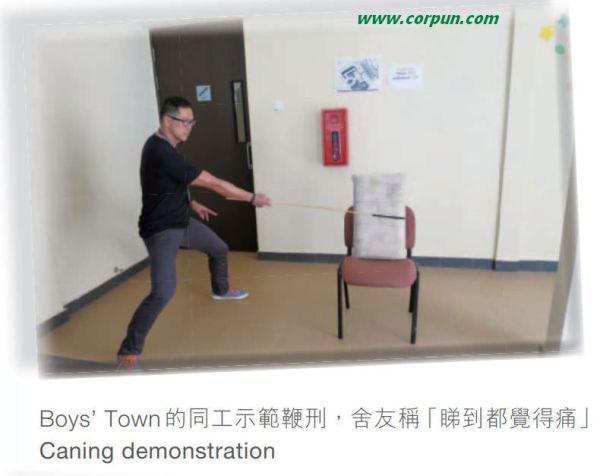
An official of Singapore Boys' Town acts out the stance adopted when punishing residents aged up to 21 with not more than 10 strokes of the cane across the seat of the trousers. Demonstration for a visiting delegation of youth workers from Hong Kong in 2015. Source
Children and Young Persons (Licensing of Homes) Regulations 2011
These are the equivalent regulations for juvenile institutions operated by voluntary welfare organisations, such as Boys' Town (run by the Roman Catholic Brothers of St Gabriel for ages 11 to 21). Boys' Town is less strict than the government-run Singapore Boys' Home, with which it is commonly confused. For instance, Boys' Town is not a high-security facility: there are no bars on the windows. But as far as corporal punishment is concerned the rules are exactly the same -- including the 10-stroke maximum -- except that the Head of the home must seek the approval of the management committee before administering the punishment. There is no evidence that caning at Boys' Town is any less severe than at SBH.
In 2015 a local TV channel broadcast a 45-minute documentary called "Crossroads" which followed several Boys' Town residents over a period of many months. At 25 minutes into the programme, a 17-year-old is seen being told that he is to be given six strokes of the cane for absconding. Although the punishment itself is not shown, one can infer from the film that formal caning is a standard part of the disciplinary regime at Boys' Town.
Children and Young Persons (Remand Home) Regulations 1993
For corporal punishment at a Remand Home, the provisions are almost identical to the above, except that the maximum number of strokes per caning is 8 instead of 10.
Runaway youths in Singapore: Exploring demographics, motivations, and environments (Abstract)
The full article (July 2008) mentions a juvenile delinquent who described his stay at the Boys' Home as "like heaven!" -- despite having been caned there on five occasions, 27 strokes altogether (presumably four canings of six strokes and one of three strokes).
Brothers of St Gabriel: A Caning Disciplinarian
Singapore Catholic News (June 2006) gives a note about Brother Emmanuel, "whose cane has graced the backsides of many" both at Boys' Town and at St Gabriel's School.
Speech by Mrs Yu Foo Yee Shoon: Juvenile homes
A government minister replies (March 2006) to questions in Parliament about the rehabilitation of young offenders in juvenile homes (see paragraphs 9 to 14). Asked specifically about bullying, she states that residents found to be bullying others may be punished by detention in a segregation room and caning.
SINGAPORE: School CP
Singapore schools are renowned for strict discipline. Caning is a lawful punishment, for male students only, and has the full support of the government. Most secondary schools administer CP at least occasionally, typically in the traditional English style, with powerful strokes of a long, whippy rattan delivered across the seat of a bending teenager's trousers in a formal ceremony. In some of the big mixed-sex neighbourhood secondary schools, caning is accepted as a routine penalty. In several boys-only secondary schools it is said to be a daily occurrence. It is generally administered by specially-trained staff members, usually called "Discipline Masters". Beneficiaries may be aged up to 19. Many schools set out their rules on this and other matters in online handbooks.
|
MAIN ARTICLE: For full details, with links to reports, pictures and video clips, see this separate page.
|
 SOMALIA: Judicial CP
Civil war has been going on for many years. There is no established rule of law or stable central government. Local ad hoc Islamic courts in some areas order floggings.
In 2006 the Union of Islamic Courts took control (temporarily as it turned out) of the capital, Mogadishu, and instituted a series of high-profile public floggings, as reported in these Aug 2006 illustrated news items.
Further public floggings by Islamic courts took place in Mogadishu in 2009.
Public floggings in 2008 and 2009 by the anti-government Al-Shabab group of extreme Islamicists, as seen in these video clips, were carried out in a lackadaisical and inept manner.
Benson (1937) recorded that there had been 96 floggings in Somaliland in 1930; the total for 1935 was not available, but it included 85 corporal punishments of juveniles.
EXTERNAL LINKS: (these will open in a new window)
US State Department Report on Human Rights Practices for 1997
Shari'a courts in Somalia regularly sentenced convicted thieves to public lashings.
Amnesty International Report 1998
Civil war continued; no central government or criminal justice system was in operation. However, ad hoc Islamic courts handed out many floggings (no details given).
US State Department Report on Human Rights Practices for 1999
According to this, there were no reports of public whippings in Somalia in 1998.
US State Department Report on Human Rights Practices for 2000
Cites "occasional reports" of public whippings by clan-based Shari'a courts in Mogadishu, including one of a journalist for writing an anti-Islamic article. Elsewhere in the country, chaos reigned.
US State Department Report on Human Rights Practices for 2001
Says that, unlike in the previous year, reports of public whippings were rare. (The 2002, 2003, 2004 and 2005 reports make no explicit mention of JCP.)
US State Department Report on Human Rights Practices for 2006
Notes that the Islamic Courts controlled the area around Mogadishu for part of 2006, and carried out public floggings there under Shari'a law.
US State Department Report on Human Rights Practices for 2007
There were no reports of public floggings in Somalia during 2007. (The 2008 report says the same.)
US State Department Report on Human Rights Practices for 2009
Various extremist groups controlled different parts of the country, some of whom carried out public floggings.
 SOUTH AFRICA: Judicial CP
Judicial caning of males (informally known as "cuts") used to be common, particularly in the 1950s and 1960s when it was a mandatory penalty for certain offences.
Local courts routinely sentenced male youths under 21 to be caned for a wide range of minor crimes, and this punishment was provided by the police. Until 1977 it was applied to the unclothed posterior, max. 10 strokes, and thenceforth across the trousers seat, max. 7 strokes. Typically, the offender would be disciplined on the same day as the court hearing, all that day's beneficiaries at a particular court being dealt with in each other's presence and then immediately released.
Caning of adult men (aged 21 to 30) was a significantly more severe penalty. It was usually combined with imprisonment and was administered in prison.
JCP was abolished in 1995 for juveniles and in 1997 for adults.
|
MAIN ARTICLE: See comprehensive 12-part feature article Judicial corporal punishment in South Africa (illustrated), with historical background, legislation, modus operandi, eyewitness accounts, first-person accounts, statistics and case law.
|
DOCUMENTS:
Criminal Procedure Act - No. 51 of 1977
Former legislation relating to judicial whipping by cane.
EXTERNAL LINKS: (these will open in a new window)
Abolition of Corporal Punishment Act (No 33 of 1997)
Text of the 1997 Act which removed judicial caning from the South African statute book.
South Africa's Nuremberg Laws (Alternative link)
Chapter 9 of a 1969 book on "The Rise of the South African Reich". Gives some detail on the Criminal Sentences Amendment Act 1952, which introduced mandatory caning for certain offences, leading to a huge increase in the amount of judicial corporal punishment awarded. For example, in the year to 30 June 1963, 17,404 offenders received 83,206 strokes.
The Liberal Cape
Chapter 1 of a 1968 book on "Class and Colour in South Africa". Under Ordinance 1 of 1835, apprentices could be sentenced to a whipping of 15, 30 or 39 stripes.
The State versus Henry Williams, Jonathan Koopmann, Tommy Mampa ..... [PDF] (Alternative link)
Detailed report of the milestone 1995 case in the South African Constitutional Court which brought to an end the long-standing practice of court-ordered canings for male teenage offenders.
Republic of South Africa Department of Correctional Services
A visitor from Ohio describes seeing the "discipline rack used for caning prisoners", now in a museum.
The Defiance Campaign Recalled
In 1952 the then fairly new Afrikaner nationalist government introduced draconian measures against political protests and campaigns, including provision for greatly increased use of whipping sentences (the Criminal Law Amendment Act). This was a reaction to a campaign of defiance, celebrated in this document, by the ANC and other non-white groups excluded from power.
SOUTH AFRICA: Prison CP
DOCUMENTS:
Prisons Act No 8 of 1959
This law provided for up to 10 strokes of the cane for certain prison offences. It is no longer in force.
SOUTH AFRICA: School CP
|

Upper secondary school students in South Africa
|
Corporal punishment, mostly by cane, was very widespread in schools under the Afrikaner nationalist regime. This had nothing to do with apartheid: boys at white schools, whether Afrikaner or English, were just as likely to receive "cuts" or "jacks" as black and "coloured" students.
Anecdotal accounts generally recall canings delivered in the English style, across the seat of a bending boy's trousers. The use of a strap has also been mentioned as an alternative at some schools.
School CP was in theory outlawed in 1996, in private as well as state schools. In practice, reports of its continuing use have been legion. This very clear video from 2012 shows a senior boy bending over for a traditional formal caning at a private secondary school. And in this Oct 2013 case, a teacher was caught on video caning several schoolgirls on the hands. Similarly this Oct 2018 news item includes a picture of a secondary teacher caning a girl and a boy on their hands.
Long-standing rumours that some elite boys' high schools had continued to use corporal punishment, supported by students and parents and with a tacit agreement to keep this hidden from the outside world, were given further credence in March 2019 when the story broke of allegations of routine CP at Paarl Boys' High School, though the school denied them.
A survey in the Western Cape published in 2009 found that 63% of citizens wanted to bring back caning in schools. Another survey, in Gauteng in 2011, found high-school students overwhelmingly in favour of the return of CP. This 2015 newspaper reader's letter, making a detailed plea for the restoration of CP, seems typical. Students themselves again called for reintroduction in Oct 2018 according to this news item. Some opposition political parties have long advocated the same.
In Dec 2011 it was reported that thousands of teachers had resigned from the profession in response to a collapse in discipline and an escalation of violence caused, they claimed, by the abolition of caning.
This 1999 press article includes a photograph of what appears to be a real caning under way in an elementary school classroom.
DOCUMENTS:
Regulation 1143 under the Education and Training Act, 1979
Former rules governing CP at state schools (Afrikaans/English bilingual). It was to be awarded only to boys, and administered only to the student's buttocks, either with a cane or a leather strap (the dimensions of both of which are specified). A maximum of four strokes in any one day was laid down; anecdotal evidence suggests that many schools ignored these rules in practice.
Attitudes of Students, Parents and Teachers towards the Use of Corporal Punishment in Senior Secondary Schools [PDF]
Abstract of an academic thesis from 1997, just after school CP was theoretically outlawed in South Africa.
External links for South Africa/Schools
SOUTH KOREA
See Korea.
 SRI LANKA: Judicial CP
Judicial corporal punishment, described in the legislation as "whipping", was outlawed in Sri Lanka in 2005. For an instance of a JCP sentence on adults, described in the report as "lashes with a rattan" (it is not clear how this differs, if at all, from ordinary caning), see this Mar 1956 news item. For a more recent case involving a 17-year-old thief, see this Sep 1999 report. It is interesting to note that the youth was given his 15 cuts "in open court" by the court sergeant, evidently there and then; no implement is mentioned.
In Sep 2013 a government minister proposed the reintroduction of judicial caning to counter a drastic increase in child abuse and rape.
EXTERNAL LINKS: (these will open in a new window)
Human Rights Committee considers reports from four countries
UN press release (Nov 2003). Judicial corporal punishment was still on the Sri Lanka statute book, though not imposed for about 20 years (not true -- see this Sep 1996 news item). The document adds that CP was still in use for prison disciplinary purposes.
April 1998: Children in South Asia Securing Their Rights
This Amnesty International report states (towards the end of Chapter I) that courts in Sri Lanka may order whipping for male juveniles, and that this provision was in use in 1995. (In fact it was still in use in 1999, as noted above.)
Corporal Punishment (Repeal) Act, No. 23 of 2005
Legislation removing judicial whipping from the statute book of Sri Lanka.
SRI LANKA: School CP
The Ministry of Education in 2005 asked Sri Lankan government schools not to use the cane, according to GPTEVAC [PDF], but CP remains lawful.
In Oct 2016 the country's President opposed moves to outlaw school caning.
In Aug 2018 a Deputy Minister of the government "called for new laws to restore corporal punishment", saying it was the only way to establish discipline in schools.
 SUDAN: Judicial CP
JCP in present-day Sudan reportedly takes the form of lashes with a leather whip. This punishment is often ordered for "Islamic" offences such as adultery and drinking alcohol, and there is conflict over whether it should also apply to non-Moslems, as in this Oct 2005 court case. Women as well as men may be flogged, as in this July 2009 report about 10 women being given lashes for wearing trousers.
It seems clear from US State Department reports (see external links below) that flogging sentences have been routine in Sudan. Only a few cases reach the attention of the western media, such as this Aug 2010 news report about 19 men flogged for wearing women's clothes, and this Dec 2010 item about a woman given 53 lashes in public for wearing trousers. The latter report includes a video clip of part of the flogging, from which it is apparent that the punishment is not administered in any systematic manner or on any particular part of the body, but consists of the brutal and random use of a whip while the offender flails around on the ground -- a procedure so cack-handed that it scarcely qualifies as proper "corporal punishment" at all.
DOCUMENTS:
Wote Timamu, Effendi
Amusing eyewitness account of juvenile judicial caning in 1950s Sudan under British colonial rule.
EXTERNAL LINKS: (these will open in a new window)
1994: Human rights violations enshrined in law
Amnesty International report stating that hundreds of floggings had been imposed in Sudan since the 1991 Penal Code was introduced.
Amnesty International Report 1997
Reports that numerous school and university students were whipped in Khartoum immediately after being convicted of instigating demonstrations.
Amnesty International Report 1998
Floggings were a common judicial penalty in 1997 in Sudan for women as well as men, according to this report.
Situation of human rights in the Sudan
UN Commission of Human Rights document from 1998. Section VII "The Rights of Women" quotes various legislation about such seemingly piffling things as men not being allowed to enter ladies' hairdressing salons, and the punishments laid down for violating these rules, including flogging (no details given).
US State Department Human Rights Practices Report 1998
US State Department Human Rights Practices Report 1999
US State Department Human Rights Practices Report 2001
The 1991 Criminal Act provides for flogging (no details given). The minimum punishment for rape is 100 lashes. The 1999 report mentions a case in which 25 students from Ahlia University were sentenced to be flogged for disturbances and obscene acts. (The report for 2000 adds nothing fresh.) The 2001 report mentions the case in which 53 Christian demonstrators in Sudan were flogged, reported in slightly more detail in this April 2001 news item.
Church shootings and arrests must be investigated
April 2001 Amnesty International document on the flogging in Sudan of over 50 Christians arrested during a disturbance in a church.
US State Department Human Rights Practices Report 2002
According to this, the Sudanese government exempted the 10 (largely non-Moslem) southern states from applying the "physical punishment" parts of Sharia law if they did not wish to. Despite this, there were apparently reports of lashings in at least some of those states, as well as in the Moslem-majority ones, in the year under review. The report also mentions a sentence of stoning on a woman for adultery that was reduced on appeal to a flogging of 75 lashes. In another case, 17 women received 100 lashes each, also for adultery. (More recently, the southern states have seceded to form a new country called South Sudan.)
US State Department Human Rights Practices Report 2003
Mentions a case in which a girl of 13 was sentenced to 30 lashes for not wearing socks. The sentence was carried out the same day.
US State Department Human Rights Practices Report 2004
This report says that there were flogging sentences in the year under review, but few of them were carried out. However, one Christian woman was lashed for not wearing a headscarf. A 16-year-old girl sentenced to 100 lashes for adultery in 2003 had her sentence suspended.
US State Department Human Rights Practices Report 2005
Following riots in Khartoum, hundreds of persons, primarily in the south, were flogged, according to this. The report also states that there were no reports of physical punishment of non-Moslems in the north, possibly implying that there were cases in which Moslems were flogged.
US State Department Human Rights Practices Report 2006
According to this report, courts in the mainly Moslem north routinely imposed floggings, especially for the production of alcohol. Some judges in the mainly Christian south also still reportedly observed Sharia law, possibly including flogging. Also, a policeman was sentenced to 100 lashes and 3 years' jail for raping a child. On the other hand, a woman received 30 lashes for defamation after complaining of police abuse. (The 2007 report adds nothing fresh.)
SUDAN: School CP
The law in Sudan does not prohibit corporal punishment in schools, except in Khartoum State. These recent video clips of secondary school students being disciplined in class reveal a procedure that is in some respects quite "British" -- boys caned across the seat of the trousers, girls on the hands.
 SWAZILAND (Now renamed Eswatini): Judicial CP
Courts in Swaziland could until 2012 order male juveniles under 18 to be caned (Criminal Procedure and Evidence Act 1938, amended 2005). As far as can be ascertained, this punishment might be awarded for any offence, generally in lieu of imprisonment. It was delivered to the boy's buttocks in private with a light cane, after a medical examination by a doctor. The parent or guardian might be present if desired. It is not clear whether or not the offender got to keep his pants on.
Typical would appear to be these July 1999 cases (four strokes each for theft).
Less common was this February 2005 case in which a 16-year-old was ordered six strokes for stabbing a bus conductor, who later died. This seems a very lenient penalty for manslaughter, and the press report notes that the boy was lucky not to be jailed.
One case which attracted international attention was that of three baboons who conducted a year-long reign of terror against women. Suspicions were aroused when it was observed that the baboons were speaking English. When caught, they turned out to be teenage boys in baboon suits. As noted in this July 2001 news report, two of them received caning sentences -- a singularly appropriate outcome, one might think, given that baboons are famous for their bright red rear ends.
An apparent oddity is this Jan 2000 case, in which a 20-year-old youth was sentenced to six strokes of the cane for assaulting his mother, presumably under some legislation other than the juvenile provisions mentioned above.
Allott (1970) records that 1st- and 2nd-class subordinate courts in Swaziland were empowered to order a maximum of 8 strokes of the cane.
EXTERNAL LINKS: (these will open in a new window)
GPTEVAC [PDF] previously cited some statistics, now gone: 388 boys were judicially caned in Swaziland in 2003, 233 in 2004, and 235 in 2005. The latest version states that JCP was abolished in 2012 for "children" (age not defined).
Amnesty International Report 2007
Amnesty says in this report on Swaziland covering 2006, "the courts continued to impose corporal punishment on under-18-year-old boys".
US State Department Human Rights Practices Report 1993
This claims that in 1993 the use of juvenile judicial caning in Swaziland had declined compared with earlier years. (The 1994 and 1995 USSD reports make no mention of JCP.)
US State Department Human Rights Practices Report 1996
Mentions, but gives no details of, a May 1996 case in which two 10-year-olds were caned for housebreaking.
US State Department Human Rights Practices Report 1997
Mentions that "children" in Swaziland (in fact boys up to 18) convicted of crimes were sometimes caned as a punishment. The reports for subsequent years up to and including 2004 merely repeat this information.
US State Department Human Rights Practices Report 2005
Cites a case in June 2005 where a 14-year-old boy was sentenced to four strokes of the cane for shoplifting. The USSD reports for Swaziland for 2006 to 2011 inclusive do not mention official JCP (as opposed to random unofficial beatings by police).
US State Department Human Rights Practices Report 2012
Mentions that the penalties for statutory rape and prostituting a girl include "up to 24 lashes with a whip".
SWAZILAND (Now renamed Eswatini): School CP
Corporal punishment is lawful in Eswatini (formerly Swaziland) schools. The Education Act 1982, read together with the Education Rules 1977, lays down that a cane of max. half an inch thick and 2ft 6in long must be used, to be applied strictly to the buttocks only, max. four strokes for students under 16 and six strokes for those over 16: see this Sep 2005 news item, which, however, also suggests that the rules are not always followed, a claim borne out by this Oct 2005 news report about senior students caned on their hands and not on their buttocks. Another rule is that only female teachers are supposed to cane girls.
There has been some pressure to abolish the cane, based partly on a disinformation campaign seeking to convey the false impression that CP is contrary to the Convention on the Rights of the Child. (In fact, the words "corporal punishment" appear nowhere in the Convention.) This pressure has so far been resisted by local politicians, as reported in this June 2006 news item.
In April 2010 the rules mentioned above were reiterated by the education ministry, which added that corporal punishment must not be administered in public, and that it must be recorded in a punishment book.
For caning scenes in a Swazi village school, see this video clip.
In 2016 a high school in the capital, Mbabane, stated that it was achieving better results following stricter use of the cane by a new deputy principal -- see this Dec 2016 news report.
This Aug 2017 news item reported that a boys-only high school in Manzini chastised its students on the bare buttocks with what sounds like a large paddle. Exactly the same claims about the same school had also been made four years earlier. On that occasion the headmaster did not deny the trousers-down allegations but maintained that he rarely administers more than three strokes.
EXTERNAL LINKS: (these will open in a new window)
GPTEVAC [PDF] confirms that school CP was still lawful in Eswatini/Swaziland as at Aug 2018, contrary to what some news outlets have asserted, but notes that a government source said in 2014 that caning was discouraged and "the eventual aim was to abolish corporal punishment completely".
US State Department Human Rights Practices Report 2011
This notes that CP by school teachers and principals in Swaziland was routine, and that the official limits on the number of strokes to four (age under 16) or six (age 16 upwards) were "often exceeded with impunity". It also mentions an anti-CP boycott of classes at Mpofu High School.
 SWEDEN: Judicial and Prison CP
According to Benson and Glover (1931), JCP in Sweden had by then been abolished; but prisoners could still be whipped for offences against prison discipline, to a maximum of 40 strokes, with a "stick" for adults and with a birch for juveniles. There had been three cases in the latest year for which statistics were available.
EXTERNAL LINKS: (these will open in a new window)
The Early History of Data Networks: Penal Code 1809
Telegraphists in Sweden who neglected their watch were to be flogged.
Child Welfare Councils
Swedish local authorities could "apply corporal punishment" (details not specified) to juvenile offenders aged 15 to 18, according to this League of Nations report from 1937. There were 123 such cases in 1915, falling to only 18 in 1931. These were girls as well as boys, but mostly boys.
 SWITZERLAND: School CP
Education in federal, highly decentralised Switzerland is a matter for the 26 local cantons, so there is no national policy. This could mean that corporal punishment was abolished on a different date in every canton, and it is difficult to find out what those dates might be. Anecdotal hearsay has it that in some (probably rural) parts of the country there might have been school CP as recently as the 1970s, but I have not yet found any corroboration for this. Further research is needed.
In Canton Berne it was decided in 1900 to restrict caning to boys and to use it only for moral offences, not for poor work, according to this news item.
EXTERNAL LINKS: (these will open in a new window)
Anti-CP agitators GPTEVAC [PDF] say that in 1991, the Federal Court ruled that corporal punishment may be permissible in some cantons in certain circumstances, but a ruling in 1993 stated there can be no customary law that would allow teachers or other persons taking care of children to apply corporal punishment to them.
 SYRIA: Judicial CP
There has been, as far as is known, no provision for formal JCP under the Assad regime in Syria, but Islamist forces who have taken over parts of the country implement their own justice systems, involving public floggings of a more or less ad hoc nature. See these video clips from 2013 and 2014.
References:
-- Allott's Judicial and Legal Systems in Africa, 2nd edition, Butterworth, London, 1970
-- Benson, Sir George, Flogging: The law and practice in England, Howard League for Penal Reform, London, 1937 (in particular Appendix I, "The law and practice of other countries").
-- Cadogan Report (Report of the Departmental Committee on Corporal Punishment), London, 1938.
-- Keefe, Eugene K., Countries of the World, Bureau Development Inc., 1991.
-- Kalet Smith, Anna, Juvenile Court laws in foreign countries, Children's Bureau, Social Security Administration, US Federal Security Agency, Washington DC, 1949.
|