A very conservative version of Koranic law is in force in this exceptionally backward, corrupt and repressive country, a ruthless totalitarian dictatorship run by an absolute monarchy.
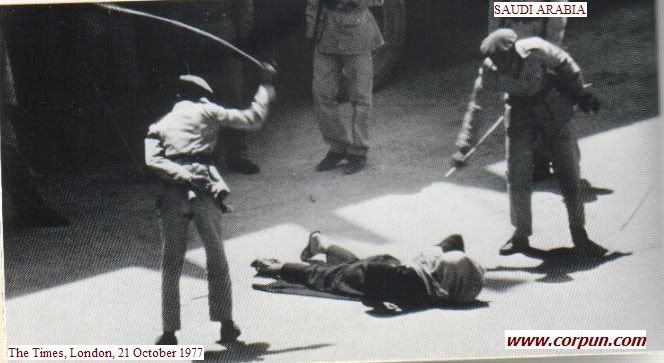
Local courts routinely order floggings, often of hundreds of lashes -- or even thousands, inflicted in instalments. Women as well as men may be flogged. Some sources suggest that hundreds of these flogging sentences are imposed every week, mostly without press publicity. On occasions they have been carried out in public, as in this 1970s photograph and also this one. Some reports (e.g. by Human Rights Watch) claim that floggings are "often" public. If this is true, the paucity of such photographs might be explained by the fact that anyone caught taking pictures of such events is himself severely punished, according to some anecdotal evidence. (UPDATE: but see video clip below.)
Flogging sentences are normally combined with imprisonment. This November 2005 court sentence is probably typical for a fairly routine and minor case.
Different reports suggest that, as one might expect under a regime where the rule of law is a wholly alien concept, there are no formal procedures and little consistency about the modus operandi: either a whip, a leather strap, or a long cane may be used; sometimes the lashes are confined to the buttocks, more often it seems they are spread out from the neck to the ankles, and usually with the prisoner simply lying face down on the ground. In one or two reports the offender was said to be tied upright to a post.
Quoted in this Nov 2007 American TV report, Human Rights Watch went so far as to say that flogging was "almost always" a component of any Saudi court sentence. HRW has sometimes been prone to exaggeration in the past, but if this is true, I should think it must make Saudi Arabia pretty well unique in the world. (In other countries where JCP is used a lot, such as Singapore and Malaysia, there are still very many court sentences that do not include caning.) The HRW spokesperson adds that the accused is "shackled" during the punishment, and is "sometimes" permitted to wear a single layer of clothing; I had had the impression that that was always so. HRW describes the implement used as "a bamboo whip about 7 feet long". (I suspect they are wrong about that. Bamboo is too stiff and brittle to behave like a whip.)
Even when a cane is used, the punishment is normally referred to as "flogging" rather than "caning"; and the lashes (rarely "strokes") are reportedly not (or anyway not usually) inflicted with the full strength of the operator, as they are required to be in countries with a British judicial caning tradition such as Singapore and Malaysia, with their maximum of 24 strokes at any one infliction; indeed, if Saudi-style sentences of hundreds of lashes were inflicted in the Singapore manner, the prisoner would surely not survive.
This difference in approach is supposed to reflect the idea that Saudi floggings are intended primarily as symbolic humiliation rather than intensely painful retribution, and is in line with a rule in the Koran that the operator is required to keep a copy of the holy book under his arm, so that he will not swing the whip from the shoulder but only from the elbow.
However, some observers, notably Amnesty International (see external links below), reject these claims as mere propaganda by the regime; they say this Koranic rule is by no means always followed, and suggest that the floggings, at least in some cases, do in fact cause injury to the recipient.
It is certainly clear in one of the two available photographs (see above) that the operative is raising his caning arm high and has no book under it.
In a May 2008 opinion column in Arab News, it was claimed that lashes were now being given out by traffic police, presumably meaning "on the spot" and without a court sentence. However, no news reports to that effect have come to hand. The article also claims that there is unhappiness in the country about inconsistent sentencing, suggests that there are too many flogging sentences, and calls on the government to codify the laws.
RELATED VIDEO CLIP
The following 40-second video clip was filmed surreptitiously on a mobile telephone.
A man is seen being whipped in public. It is not absolutely certain that this is official JCP ordered by a court. It all looks decidedly informal and ad hoc and arbitrary, but then the whole Saudi system is very ad hoc and arbitrary. At all events, this punishment is being inflicted by officials in uniform, who are presumably police or judicial officers of some sort.
The prisoner in this case is allegedly a sex offender, though there is no way of verifying that. He is being held up (somewhat incompetently) against the back of a police van and punished with what is either a somewhat rigid whip or an extremely flexible long cane. We see roughly 50 lashes, though nobody appears to be counting. It is the extreme rapidity of the strokes -- about four per second -- which is perhaps most surprising, and which makes this seem quite a different kind of thing from the formal and ceremonial manner in which JCP has typically been conducted in the British world (Malaysia, Pakistan, etc.), where a very specific number of strokes is delivered slowly and carefully.
The caning, if so it can be described, is targeted very approximately at the culprit's buttocks, but its administration is so hasty and slapdash that some of the strokes appear to fall on the small of his back. As one would expect when there are so many of them, the strokes are not particularly hard. And, as is common in the Arab world, the prisoner keeps all his clothes on. Nevertheless, surprisingly soon he is heard moaning and shouting.
It can be seen clearly that the official administering this whipping does not have a book under his arm (see commentary above).
HERE IS THE CLIP:
[VIDEO CLIP TEMPORARILY UNAVAILABLE]
 For another video clip, showing a quite different kind of Saudi JCP or prison CP (falaka - whipping of the feet), see this separate page.
EXTERNAL LINKS: (these will open in a new window) 
US State Department Report on Human Rights Practices for 1997
US State Department Report on Human Rights Practices for 2000
Flogging with a cane is administered for less serious offences, such as drinking alcohol. This happens "sometimes". In earlier years' editions it was "frequently". The report for 2000 adds that 5 persons were sentenced to 2,600 lashes, and 4 persons to 2,400 lashes, for "deviant sexual behavior".
US State Department Report on Human Rights Practices for 2001
This implies that the Saudi authorities draw a distinction between "moral" offences to do with sex or alcohol, punished by caning, and political or religious crimes, punished by flogging with a leather strap. The same information is repeated in the 2002 USSD report.
US State Department Report on Human Rights Practices for 2003
Mentions that hundreds of political demonstrators were sentenced to flogging, but it was not known whether these sentences had been carried out.
US State Department Report on Human Rights Practices for 2004
Cites press reports that Saudi flogging (which the USSD seems to think is something different from caning) is administered with a "thin reed" by a man holding a book under his arm. "The strokes, delivered through a thin shirt, are not supposed to leave permanent damage, but to leave painful welts that bleed and bruise."
US State Department Report on Human Rights Practices for 2005
The USSD has now decided to refer to all Saudi JCP as "lashing" and makes no reference to different implements. Several press reports of notable JCP cases during 2005 are summarised, all of them already covered by me in The Archive.
US State Department Report on Human Rights Practices for 2006
Cites a Human Rights Watch claim that "judges routinely issued sentences of thousands of lashes as punishment, often carried out in public". Reportedly, those flogged do not receive medical treatment.
End secrecy, end suffering - an Amnesty International briefing
Amnesty document (March 2000) in which two people, one male and one female, describe the experience of receiving a court-ordered flogging in Saudi Arabia.
Men 'Behaving Like Women' Face Flogging
April 2005 release from Human Rights Watch gives a bit more information about the case of 35 men sentenced to jail and lashes for "deviant sexual behaviour" at an alleged gay party.
UN Committee Against Torture, 10 May 2002
See paragraphs 24 and 29-31 for the Saudi official response to accusations that judicial flogging constitutes torture. At paragraph 32 we are informed that the Saudi Arabian judiciary is "completely independent", a claim not supported by various USSD and Amnesty reports.
The Saudi Media Debates Flogging by the Saudi Religious Police
Hundreds of Saudis were flogged every week, according to this January 2004 report from MEMRI, which gives a flavour of the debate inside the country at that time.
Defend labour rights
Another Amnesty International report (1998). Scroll down to "Migrant workers in Saudi Arabia" for a first-person description of a Filipino woman's judicial caning.
Saudi lawbreakers face rough justice
June 2001 article in The Guardian (London), largely recycling information from Amnesty reports, including a first-person account of being flogged.
Saudi Justice Through British Eyes
Propaganda page by the Saudi government. This was provoked by a 1997 case in which two British nurses were convicted of murder (but later released). One of them had been sentenced to lashes, which were never inflicted. There are highly selective quotes from various naive letters to British newspapers upholding tough sentences. One reader describes being himself judicially caned in Saudi Arabia in 1994 (probably a hoax: it was in the Daily Mail).
It seems not to occur to any of the writers that, since the whole Saudi set-up, including the judicial system, is ruthlessly corrupt from top to bottom, convictions of innocent people are even more likely than in Britain. If (as seems probable) the nurses did not actually do the crime, the question of punishment is irrelevant.
UN Human Rights Commission: 1997: Thematic Reports
Reveals that the Saudi authorities have contested the UN view that judicial corporal punishment constitutes torture.
Report of the Special Rapporteur
Paragraphs 587 to 589 of this 1995 UN document refer to various Saudi flogging cases.
1994: Unwelcome "guests": The plight of Iraqi refugees
Amnesty International document. Cites several whipping cases, with some detail of how particular floggings were carried out. It is evident that practice in Saudi Arabia is far from uniform.
November 1997: Behind Closed Doors: Unfair Trials In Saudi Arabia
Amnesty International document. Various references to flogging, including a 1996 case in which two secondary school students were whipped for assault in front of their fellow-pupils and teachers.
Amnesty International Report 1997
States that at least 27 individuals were sentenced to flogging in 1996.
Amnesty International Report 1998
Judicial floggings continued in 1997. The document casts doubt on past claims that these are relatively lightly administered and meant as a symbolic humiliation rather than as serious pain.
Amnesty International Report 1999
In 1998 judicial floggings continued to be imposed "routinely".



 SAUDI ARABIA: Judicial CP