Countries A-R are here. Countries A-R are here.
 ST HELENA
Extracts from the St Helena Records
Mentions various sentences of whipping in the 1730s on this remote British outpost in the South Atlantic.
 ST LUCIA
The Week That Was: February 20, 2001
Brief report (about two-thirds of the way down the page) about a senior police officer alleged to have beaten a young man on his buttocks with a cane for stealing his brother's dog, apparently without any trial or authority.
 ST VINCENT AND THE GRENADINES
NGO Initial Report on Saint Vincent and the Grenadines, submitted to the United Nations Committee on the Rights of the Child [PDF]
Mentions that corporal punishment is sometimes used on juveniles by the criminal courts, but gives no details.
 SAUDI ARABIA
See Country files.
 SINGAPORE
Remember Michael Fay? Does caning sound familiar?
Someone who says he was a teacher at the Singapore American School when Michael Fay was arrested in 1994 describes the mood and the reaction there at the time.
David Marshall on Singapore society
Belated, posthumous publication of a 1994 interview with David Marshall, Singapore's Chief Minister in the middle 1950s during negotiations with Britain over independence, and long-time political foe of Lee Kuan Yew, whose People's Action Party captured the reins of power not long afterwards and has managed to hold on to them ever since.
Here, after nearly four decades in the political wilderness, he is magnanimous about Lee's and the PAP's extraordinary social and economic achievements but persists in his outspoken opposition to the regime's tough judicial policies, including the ever-increasing (as it was at the time) use of caning.
Boon Siwala: The Life of a Thai Migrant Worker in Singapore
Document from 1997 highlighting the plight of illegal immigrants to Singapore who are duped by traffickers into going there to work. In the case described, a Thai worker was given the usual three strokes of the cane, which "made him sick and left scars on his bottom".
 Brother Cane: The Exception that Articulates the Norm [PDF] Brother Cane: The Exception that Articulates the Norm [PDF]
This is Chapter 7 of a highbrow academic paper (2003) about censorship, culture and artistic expression, "Performing the Singapore State 1988-1995". "Brother Cane" was a piece of avant-garde performance art put on in Singapore at the beginning of 1994, in protest against caning sentences on six men in November 1993 for homosexual offences. The authorities took exception to the fleeting portrayal of bare buttocks on the stage.
This was also, by coincidence, just after Michael Fay and his friends had been arrested but before Fay and Shiu were sentenced to caning.
In the fuss that ensued, says the author, there was "an uncanny correlation of images and imaginings of buttocks that filled the press during the first five months of 1994: the imagined caned buttocks of the six men; Ng's 'sacrificial' restoration of their transgressions in his performance; the constantly reiterated "white buttocks" of Michael Fay and the buttocks of his schoolmate, Shiu Chi Ho; and the many exemplars of earlier caned buttocks, along with diagrams and descriptions of the caning process and its deleterious effects on buttocks ... Suddenly buttocks were on everyone's mind, and the Singapore state had to contend with the unexpected proliferation of a new reification: Singapore = mall, airport, hotel, escalator, and bleeding buttocks." See pages 221-223 and 234-236.
Myths About Singapore
In this attempt to correct the "one-dimensional world view" of Singapore, see Myth 2 on caning and Michael Fay. The document is itself full of egregious errors. For instance, it says that Fay "got only one stroke of the cane and served no jail time". Wrong on both counts. For a more accurate account of the whole sorry tale, see this May 1994 magazine article.
Recommended Reading on Singapore
Mentions a play called The Caning, based on the Michael Fay case.
Life in prison: Open letter from Dr Chee
An opposition politician, imprisoned for five weeks in 2002 for organising a public gathering, writes about his prison experience. He saw "an endless row" of new inmates arriving, all illegal immigrants sentenced to caning and looking terrified, and was told by those who claim to know that the recipients can be heard screaming after each stroke. This seems likely to be an exaggeration.
Singapore's Godfather Makes His Case
Ill-informed review by Bruce Nussbaum in Business Week (2000) of the memoirs of Lee Kuan Yew, founder of modern Singapore. It suggests that his enthusiasm for caning reflected his "British upper-class education" more than his Asian origins. This is a serious misreading. As a boy in the 1930s, Harry Lee -- whose father was a failed nouveau-riche playboy, not an aristocrat -- was caned for tardiness at Raffles Institution, an English-language boarding school run on British lines, but he didn't set foot in Britain itself until he went to Cambridge University after World War II. Back in Singapore in the 1950s, Lee became a rabble-rousing, street-fighting, populist political organiser against the old regime, for whom the phrase "noblesse oblige", used of him here, could hardly be less appropriate.
The reviewer goes on to say that corporal punishment wasn't originally an Asian thing at all. This is utter nonsense -- judicial flogging existed for centuries in China and Korea, long before Britain had anything to do with the Far East. Chapter 1 of the memoirs themselves, in which Lee describes his school caning, can be read here.
Crime in Singapore: A Statistical Comparison with Major Cities
Singapore government document (2008) showing big differences between crime rates per head of various large cities. Singapore is near the bottom of the list. Several US cities are at the top. But Japanese cities are also shown to be relatively crime-free, and Japan doesn't have JCP, so it could be as much an Asian vs. Western cultural thing as anything to do with the use of different penalties.
Remarks by the President in MTV's "Enough is Enough" forum on crime
Bill Clinton answers a question (April 1994) about Michael Fay's then-imminent caning.
US Department of State Daily Press Briefing Thursday, May 5, 1994
State Department spokesman answers questions a few days after Michael Fay's caning on how it would affect relations between the USA and Singapore. Much huffing and puffing here, but with hindsight we can see that it made little difference in the short term and none in the medium term: see this book review.
 Sarcasm, Reality and Justice a la Singapore Sarcasm, Reality and Justice a la Singapore
Letter in The New York Times (June 1996) from Christopher Lingle, a US academic who fled Singapore University after being accused of "scandalising the judiciary" in a newspaper article. Here he comments on the stage play, "Six of the Best", which was inspired by the Michael Fay affair but which Lingle says did not address the real issue -- whether Fay received due process and whether the punishment was proportionate to the crime.
Fetching Bums: The Quest for the Callipygian Ideal
Spoof academic thesis on the cultural significance of buttocks. For women it is all a question of whether they are beautiful, claims the author, but for men they are noted mainly as the recipient of administered justice, especially if you live in Singapore or attended a paddling school in the US. Refers at some length to the Michael Fay case. (The author is, of course, entirely mistaken in stating that judicial canings in Singapore are carried out in public.)
Conversations with Past Presidents
Journal of the Singapore Medical Association. See "Caning of Michael Fay" about three-quarters of the way down the page. The SMA says it was "bombarded" with letters from medical associations in other countries, attacking Singapore doctors for agreeing to officiate at canings. Quotes from the SMA's reply, with a robust defence of the status quo.
June 1994: Physician Participation in Corporal Punishment
Amnesty International thinks it unethical for doctors to be present at judicial canings, but the Singapore Medical Association does not agree.
It was Michael Fay in Singapore
Comment on a message board from someone who has evidently studied the ins and outs of the Fay saga in detail. She says "it is clear that" the punishment was not a "light" one, contradicting the widespread suspicion that the official administering it was given a nod and wink to go easy on him. We are not told whether this conclusion is based on published accounts or whether the writer has some inside information.
Have a Good Trip Back to China?
Scroll a long way down to find this article. A US national living in Singapore defends his adopted home and bemoans the hypocrisy and ignorant insularity of much US comment on the Fay case.
More documentation for judicial CP in Singapore
 SOMALIA
See Country files.
 SOUTH AFRICA
External links that were previously here have been moved to the Country files pages. Others are included in the 12-part illustrated feature article Judicial corporal punishment in South Africa.
 SOUTH KOREA
The Dawn of Modern Korea (344) Law of the Land
Background to the history of the legal system. Flogging had been used for centuries, and when the Japanese annexed Korea in 1910 they decided to leave that aspect of Korean justice in place. Half a million people were flogged for "trifling offences" between 1910 and 1920, at which point the punishment was finally abolished, according to this.
 Description of the Kingdom Korea Description of the Kingdom Korea
Life in Jeju
From the 17th-century Journal of Hendrick Hamel, translated into English from Dutch. Mentions soldiers being flogged on the bare buttocks for running out of gunpowder. Also, under "Administration of justice", adulterers were publicly caned in the city square. There is a detailed description of the beatings. Men had to take their pants down, but women kept them up "for moral reasons". Under "Life in Jeju" it states that after receiving 25 strokes on the bare buttocks, they had to stay in bed for a month.
 SRI LANKA
See Country files.
 SUDAN
SUDAN
See Country files.
 SWAZILAND (now renamed ESWATINI)
See Country files.
 TAIWAN
See Country files.
 TANZANIA TANZANIA
See Country files.
 THAILAND THAILAND
Thai Papers on August 2, 1999
Thailand doesn't have official JCP, but a news item reproduced here from the Bangkok Post refers to a village in the northern hills that is run de facto by a drug gang. There is no crime and no drug addiction, and a sign allegedly tells visitors: "No drugs allowed. If caught you will be caned seven times and handed over to the authorities."
 TRINIDAD & TOBAGO TRINIDAD & TOBAGO
See Country files.
 TUVALU TUVALU
See Country files.
 UGANDA UGANDA
See Country files.
 UNITED ARAB EMIRATES UNITED ARAB EMIRATES
See Country files.
 UNITED KINGDOM UNITED KINGDOM
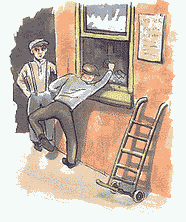 Powys: A Day in the Life Powys: A Day in the Life
Documentation of an 1891 Petty Sessions case in Wales in which a 13-year-old was birched for breaking into a railway station booking office and stealing money.
Hidden Lives Revealed: Poverty and Juvenile Crime
Mentions a case in 1846 in which four boys convicted of theft were sentenced by the Quarter Sessions to a month in prison, plus a birching to be given immediately before they were released. This was described by the court as a "lenient" sentence.
Labour and the Poor
Writing in 1850, Henry Mayhew expresses concern about rampant juvenile crime in London. He quotes interviews with a boy of 12 and one of 10, both of whom had already been in prison more than once as well as having been sentenced to whippings.
Criminal and destitute London juveniles, or the Ragged School class
Chapter 1 of The Million-Peopled City, by John Garwood (1853). It cites cases in the 1840s in which boys as young as 8 were sentenced to be whipped for stealing.
The Utilisation of Flogging
Various illustrated comments in Punch from the 1860s and 1870s about robbery with violence and the use of the cat-o'-nine-tails to try to suppress it.
Why Labour has the young in its sights
In 2004 the Scottish government was getting tough on anti-social behaviour by gangs of youths running riot, apparently the number one issue of concern to the electorate. At public consultation meetings, corporal punishment, and the re-introduction of compulsory military service, were the most popular responses, according to this report in the Glasgow Sunday Herald.
Punishing young offenders
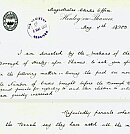 Exhibit from the National Archives. A letter from local magistrates to the Home Office in 1903 asked whether they could order persistent school truants to be birched. The answer was no. Exhibit from the National Archives. A letter from local magistrates to the Home Office in 1903 asked whether they could order persistent school truants to be birched. The answer was no.
Bring back the birch!
On a BBC page for North-East Wales, a forum about crime and punishment.
Patentability [PDF]
Document from the UK Patents Office. One case cited, from 1992 (see paragraph 1.24), is "a scheme under which prisoners could exchange all or part of a prison sentence for corporal punishment". I thought for a moment we were talking about a spanking machine invention here, but I think they just mean an abstract scheme. Anyway, the idea was refused. Apparently it lacked "industrial applicability".
The Glorious Revolution of 1688: Titus Oates
Brief note about a "ruthless and amoral" agitator who was "sentenced to annual whippings". See this May 1685 news item, which records two immediate whipping sentences, plus an order to stand in the pillory five times a year on specified dates for the rest of his life, but says nothing about being whipped every year.
My prescription for juvenile delinquency
Short essay by "a member of the older generation" who left school at 14. He advocates the return of both school and judicial CP.
"I have changed, genuinely"
Article from the London Guardian about a politician who as a Tory MP formerly advocated the reintroduction of judicial flogging, but had now (Feb 2000) joined New Labour and completely changed his mind. Of course, the fact that the Tory Party had become entirely unelectable, whereas New Labour was at the time carrying all before it, will have had no connection whatsoever with this remarkable volte face.
Flogged in prison, 1885
Extract from a school log book in Wales describes an incident in which one of the pupils was imprisoned and birched for theft.
Punishment by whipping
Part of an education module on history in Wales. Quotes some examples of whippings ordered by local courts in the 18th century.
Judge law courts for yourself
History of the Magistrates Court in Newark, a Midlands town. Whippings were commonplace in the 18th century; the birch was used there "as recently as 1920" when a 13-year-old got 6 strokes (the document fails to note that the birching of juvenile offenders in the UK in fact continued until 1948).
Mr Dykes and the Reform Party
From the journal of the Libertarian Alliance, a review of a 1991 book called "Fed up with Government?" calling for severe measures to restore law and order, including possibly judicial corporal punishment, to be administered not in prison but before any prison sentence begins.
More documentation and links for judicial CP in Britain
 UNITED STATES UNITED STATES
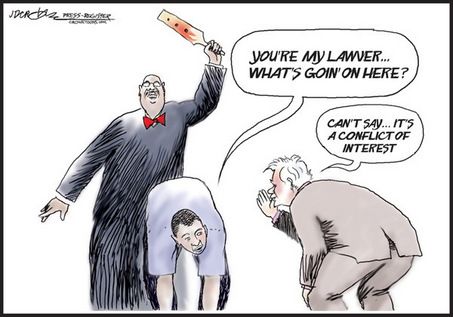 Sunday Spank Tank Report Sunday Spank Tank Report
Local blogger J.D. Crowe comments (Aug 2009) on the odd case of Mobile (Alabama) Judge Herman Thomas, who seems to have taken it upon himself to administer paddlings to inmates in exchange for less prison time. See also this Sep 2007 news item and its many follows-up; and see next set of items below.
Alleged Victims tell of sexual encounters
Figures dominates at end of week in Thomas Trial
Hermie update
Wild Day in the Thomas Trial
Herman Thomas trial recap
What didn't happen in the Thomas Trial Today?
Lying Canaries and Dwindling Charges
Thomas case handed to jury
Still awaiting decision in Thomas case
Thomas Found Not Guilty on All Charges
Thomas order reveals more detail
Further to the above, these are very detailed accounts of former Judge Herman Thomas's criminal trial as reported (c. Oct 2009 - the dates on the pages are not accurate) in Mobile's local alternative newspaper Lagniappe, which appears to have provided much fuller coverage than the mainstream press.
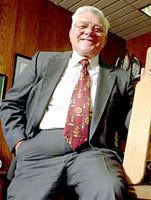 Life In Legacy - Week ending September 24, 2005 Life In Legacy - Week ending September 24, 2005
This reports the death of former California Assemblyman Mickey Conroy, pictured right with a big paddle. In 1996 he introduced a bill allowing judges to order the paddling of juvenile graffiti vandals, but his measure was rejected.
Corporal punishment
Entry in the 1911 Encyclopaedia Britannica. The situation in the USA is mentioned near the bottom of the page: in 1911, judicial flogging was on the statute book not only in Delaware, as is well-known, but also in Maryland (for wife-beating).
The Policy Initiative That Dare Not Speak Its Name
Entry in an anti-Bush blog (2004). There is nothing here that has not been said before, including by me, but it bears repeating (the prison system is in practice more cruel than CP, and costs the taxpayer far more for no obvious result; CP is more certain and precise; etc. etc.).
Pandagon: Spank me
The Ethical Werewolf: The doing/allowing distinction
More blogs, with various people's comments on the above. "I've always felt that the complete abolition of corporal punishment was a mistake", writes one contributor; "if you knew you weren't going to be able to sit down for a week, wouldn't you think twice about stealing that bag of chips or spraypainting that overpass?"
Raising Cane, by Mark Soppet [DOC]
On his Conservative Corner website, yet another thinker lists the advantages that caning would have over imprisonment. However, he is mistaken in saying that caning "is the standard method of punishment in Singapore". Actually the standard method of punishment in Singapore is very long terms of imprisonment, which is exactly what the writer says he wants less of. Caning in Singapore is always as well as prison, not instead of it.
The Case for Koranic Justice
Scroll down to December 27, 2004. Blogster Bradford Plumer, too, thinks public flogging would make more sense than spending vast amounts of tax dollars on counterproductively locking people up in horrific jails. Clearly, a lot of obviously intelligent and literate people think this, and apparently not only crazed "conservatives", so why doesn't the case get taken more seriously?
Corporal Punishment & Crime: America and the Singapore Solution
Another quick trip over much the same territory. This one is by a Ted Litschauer Jr. and quotes favourably from, among other things, Graeme Newman's Just and Painful: A Case for the Corporal Punishment of Criminals.
Commonwealth Party of America
This far-right political party says it supports the application of corporal punishment, possibly in public, for certain crimes, but doesn't specify what sort of corporal punishment it has in mind.
Justifying Imprisonment: On the Optimality of Excessively Costly Punishment
Abstract of an exceptionally abstruse and theoretical economics thesis. I don't even understand the abstract, let alone the paper itself. But it seems to relate in some way to the question whether whipping or caning would be a better punishment than imprisonment.
The Sentencing Boomerang: Drug Prohibition Politics and Reform
1995 paper in the Villanova Law Review about sentencing in US courts. Part II mentions caning and whipping as theoretically possible judicial penalties, but says this would only be a gimmick aimed at deluding the public into thinking that "severe" punishments were being maintained.
Sample Memorandum
A mock memorandum by a law student. It considers a hypothetical judicial caning sentence in an imaginary US state and whether this would violate the constitution.
Council Bluffs and Winter Quarters: 1846-47
Part of a history of the Mormons. In the 1840s they were settled in camps in Iowa and Nebraska. They had no jails, so they found it necessary to administer corporal punishment. Indians and whites alike would be whipped if caught stealing.
Genealogical research: Rickards
Extracts from 17th-century court records in Virginia including lashes on the bare back for men and women alike.
Crime and Punishment in Plymouth Colony
Meanwhile, around the same time in what is now Massachusetts, there were whippings for fornication, stealing and "denying the Scriptures".
Citizens for Effective Justice
This 1990s campaign for judicial corporal punishment grew out of the book Fed Up With The Criminal Justice System. The link for downloading the book no longer works, and the campaign seems to be defunct. It argued for whippings on the upper back (for women as well as men) using a length of electrical cable. There is much legal and procedural stuff to support the claim that in certain cases, even without changing the law, it is already possible in the USA, by means of waivers and plea-bargaining, for a lawyer to ask a judge for his client to be whipped instead of imprisoned.
Whatever you think of the particular method proposed, do read the "Overview" a little way down the first page of the site, which sets out some (in my view) pretty well unanswerable arguments for the principle of judicial corporal punishment.
Judges should give juvenile delinquents a beating
February 1995 article from the Daily Illini.
Prosecutorial misconduct (if your screen is all black, highlight the whole page with your mouse to read text, or view the source code)
Story of a county attorney in Kansas who had to resign because of unprofessional behaviour. He had a large wooden paddle in his office labelled "Board of Education", and parents were invited to bring their kids in for paddlings.
Mayflower Scandals
17th-century court records involving whipping sentences.
Crime and Punishment
Harsh penalties in 17th-century Long Island.
Dr Spock, Call Your Singapore Office
1994 article by Conservative Christian commentator Joe Clarke suggesting the US should draw lessons from Singapore's methods.
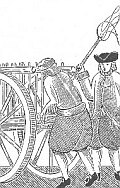 Curious Punishments of Bygone Days Curious Punishments of Bygone Days
Reproduction in full of a book published in 1896. See the chapters headed "The Whipping Post" and "Military Punishments".
History of the New England Colonies
Article published in the 19th century refers to whippings and floggings imposed by the Puritans in 17th-century Massachusetts.
Savage Thoughts - Our Prisons
A certain Leo Savage brings a slightly new angle to the argument in favour of judicial flogging. He points out that prison is like a paid holiday for serious career criminals, but horrendous for ordinary people. Flogging is cheap and quick.
It's time to reconsider corporal punishment
Column in a university newspaper (1994) calling for more domestic spankings and school paddlings and for the introduction of judicial caning.
South Carolina Slave Laws Summary and Record
A South Carolina Act of 1712 not only provided for the whipping of absconding slaves but also imposed fines on anyone else who, upon apprehending such a slave, neglected to "punish him by moderate whipping".
Flogging Michael Fay
A writer in a blog called the "Port Whitman Times" calls (1998) for judicial corporal punishment in the USA. A good flogging costs next to nothing, and the present system is an expensive flop, he argues.
The Struggle for Equality by Connecticut Blacks in the 18th and 19th Centuries
A teachers' information pack. Even in this liberal Northern state there were slaves until 1848, and they were subject to special laws with whipping for various offences.
Red Hannah -- Delaware's Whipping Post
Brief review of 1947 book on the history of the last redoubt of official judicial corporal punishment in the USA. Whipping in Delaware continued until 1952. There is also a list of the author's other works. See also this website's own review of the same book.
Get Tough on Criminals? Yes
1996 article originally from "Intellectual capital", apparently a conservative magazine, in which a Texas think-tank pundit argues for "shaming sentences" and points out that corporal punishment is constitutional, efficient, effective and egalitarian.
Public paddling beats prison
Article (October 1996) calling for public paddling for minor crimes -- in addition to, not instead of, proper rehabilitative measures. Why should punishment and rehabilitation be seen as mutually exclusive?
More documentation and links for judicial CP in USA
 YEMEN YEMEN
See Country files.
 ZAMBIA ZAMBIA
See Country files.
 ZIMBABWE ZIMBABWE
See Country files.
THE WORLD
Corporal Punishment
Spanking
Caning
These are Wikipedia articles. Maybe the subject is too controversial and complex to lend itself to the Wikipedia collaborative method. Anti-CP campaigners keep making additions that do not comply with Wikipedia's "Neutral point of view" rule because (as is clear from the discussion pages) they cannot bring themselves to accept any purely factual text that does not explicitly condemn all CP.
Paul's Crime and Justice Page: Corporal Punishment
Expanded version of an article originally written as an encyclopaedia entry. The author is a criminology academic in the US and this is just a small part of his website, which is well worth studying. I love his description of the present prison-based justice system as equivalent to "mopping the floor while the tub overflows". In the CP article, particularly interesting are his comments on Graeme Newman's book Just and Painful, which I have briefly noticed here. I declare an interest here: the author makes flattering reference to my site. Note: the website does not appear to have been updated for many years, and many of its links no longer work.
Hidden scandal, secret shame: Torture and ill-treatment of children
A very large Amnesty International document from 2000, in fact a whole book. The most substantial mention of corporal punishment is in the Introduction.
Certifying fitness for corporal punishment
Correspondence in a medical journal about the moral dilemma faced by a doctor asked by the regime (in an unspecified African country) to certify an offender fit to be caned.
The Oxford History of the Prison: The Practice of Punishment in Western Society
Review of a 1995 book. There are passing references to flogging and whipping.
Corporal punishment
Entry from the Columbia Encyclopaedia. It is mostly not bad as a brief summary, though it is out of date as regards CP in British schools. However, the article includes the surprising statement that "within British and American prisons flogging and beatings are still used, unofficially, to maintain order", citing no source for this highly tendentious claim, or indeed for anything else.
|