RED HANNAH: Delaware's Whipping Post
by Robert Graham Caldwell
University of Pennsylvania Press, Philadelphia, 1947
142 pp. plus six black & white illustrations; detailed notes; three appendices with tables of statistics; extensive bibliography; index
Review by Robert
Robert Caldwell was a professor of sociology at several American universities from about 1940 to the 1970s. He undertook a study of Delaware's use of corporal punishment, specifically the lash at the whipping post, in the mid-1940s at the urging of his academic mentor, Thorsten Sellin, a criminologist at the University of Pennsylvania.
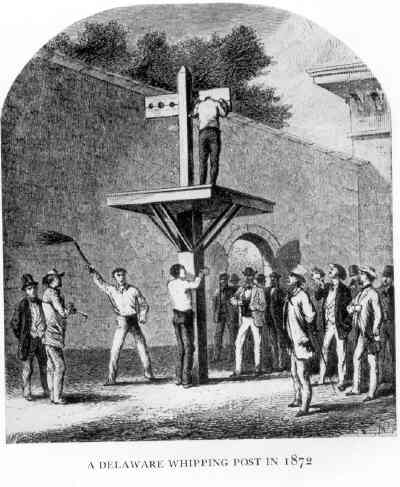 Caldwell's stated intention for carrying out his research project into "Red Hannah" (a colloquial name for the whipping post, said to have originated by black convicts who "hugged Red Hannah" -- the red-painted post -- when undergoing their lashings) wasn't in its elimination as such, but in a more general reform of the system of punishment of criminals. His somewhat Utopian goal was "the introduction of a system of scientific treatment" that would include individual psychosocial analysis, rehabilitation, and behavior modification.
Caldwell and similar reformers were well aware of the vast inertia and lethargy of their fellow citizens with respect to any sort of social change, and in particular to their penal system. He provides a detailed history of the evolution of Delaware's criminal law, from the founding of the colony in 1638 up to the most recent codification of Delaware's criminal statutes in 1945. At that time, 24 offences were made punishable by fines, imprisonment in the New Castle Workhouse at hard labor, and a flogging with a prescribed number of lashes using a cat-o'-nine-tails "well laid on the bare back", applied by the superintendent of the county jail or workhouse. Time and again reformers attempted to have the CP penalties removed from the statutes, and time and again they were either ignored or rebuffed.
 Reformers of Delaware's anachronistic penal system, and in particular the abolitionists of the "post", realized in the late 1800s that incrementalism would be the only successful approach to modernizing the system and getting rid of Red Hannah. They lobbied successfully first for the establishment of a state prison for Delaware, the New Castle Workhouse, which was built around 1899-1901. The reformers thought that by orienting Delaware away from the medieval concept of physical or corporal punishment -- the lash and pillory -- and toward the "modern" concept of doing penitence and useful, rehabilitating work in a monastery-like setting -- the penitentiary -- CP might be abolished in the state. But no! The whipping post remained in active use in Delaware right up through the 1940s.
The second success of CP abolitionists was the removal of the pillory from the statutes in March 1905. The pillory -- a sort of stocks, in which the offender had to stand in public, with his head and wrists enclosed by a wooden yoke -- admittedly was a rather antiquated sort of punishment, popular in the 17th, 18th, and 19th centuries in Europe, but decidedly out of style in the twentieth. Since the convict stood in the pillory for only an hour, and in the prison yard where the public usually wouldn't circulate anyway, I am mystified as to why it was used at all.
The harsh Delaware penalties had also been gradually softened for juvenile and female offenders. In 1883, whipping was made optional (at the judge's discretion) for juveniles, and in February, 1889, all CP -- the lash and pillory -- were abolished for female convicts. In 1885, the state built its first reformatory for boys, and followed this in 1893 with one for girls.
But try as hard as they could, the reformers couldn't persuade the Delaware legislature to abolish Red Hannah. State demographics had much to do with this. Delaware was a small, mostly rural state, comprised of only three counties, New Castle, Kent, and Sussex. The main urban centre was then, and is today, the city of Wilmington, in New Castle County in the extreme north of Delaware, near the Pennsylvania border. The state constitution gave equal electoral weight to each county, so representatives of the country folk in Kent and Sussex counties outnumbered and dominated those from urban New Castle County, and they ruled the legislature for decades.
The demographics described by Caldwell in his statistical tabulations remind me of a similar situation in the equally rural state of Arkansas. There, the conservative country population was strongly opposed to the abolition of CP in their state in 1967, when it was attempted by the idealistic young prison superintendent, Tom Murton, with the support of the reformist Governor Winthrop Rockefeller (as recounted in the book, Accomplices to the Crime, The Arkansas Prison Scandal, Tom Murton and Joe Hyams, Grove Press, New York, 1969).
We have to remember that in the first half of the twentieth century CP was generally used much more freely than today. Children were disciplined more severely then than now, as were convicts, who were subject to CP both on conviction from a judge, and as a disciplinary measure while in county jail or state prison. Custodians of dependents, whether of children or prisoners, had little compunction in that era about controlling and disciplining their wards with CP.
So there was always a foundation of conservative, often rural-based traditionalists in favour of CP, and a small, liberal, "modernist" minority vociferously lobbying their governments for its abolition. This certainly seems to have been the case in Delaware in the century roughly spanning 1850-1950, and in Arkansas (and other southern states) in the late 1960s. The traditionalists were always in control of the Delaware legislature in that era, so they dictated the CP penalty statutes -- even adding to the number of offenses punishable by whippings, in the revised penal codes of 1893, 1915, and 1935.
Caldwell discusses the issues of race and class only peripherally, but I got the uneasy feeling that these were really the source of the remarkable longevity of Red Hannah over the decades. He provides detailed statistics of the types of convicts whipped, tabulated according to their crimes, home counties, race, etc., and makes an excellent point that the statutes discriminated against the urban poor, and generally were lightened for the middle and upper classes.
His figures show that blacks were whipped much more (at least twice as much, roughly: Chart 1, page 71) in the period 1900-1944; however, African-Americans formed only 13% of Delaware's population in 1940 (Table 1, page 62). On a per capita basis, we would expect that blacks would have been whipped upon conviction only 13% as much as whites; instead, they were whipped 200% (twice) as much as whites, or 200/13 = 15 times as often as whites, per capita. That looks like racial discrimination to me!
This is easy to understand. The two southern counties of Delaware were rural and predominately populated by whites of Anglo-Saxon heritage. The black population of the state tended to concentrate in the more urban New Castle County and in Wilmington. Also, middle-class citizens were less likely to be affected by the justice system than those of the lower and working classes.
Since western society in general is dominated by the middle class, it may be argued that the legal and penal systems are there to protect the middle class against encroachment by the lower class, who form the bulk of the imprisoned population.
It should come as no surprise, then, that the lash fell almost exclusively on convicts from the lower classes, and was rarely if ever applied to the backs of middle-class "situational" and white-collar criminals. African-Americans, largely confined in poverty-stricken urban slums and ghettos, were the main constituents of the lower strata of society that were affected by harsh, punitive justice and penal systems imposed by a dominant white, mostly rural (in Delaware's case) middle class.
In 1941 the crime of petty larceny was no longer punishable by whipping, and this had the effect of reducing the use of Red Hannah. The frequency of the judicial imposition of the lash on convicts declined from about 70% of convictions in 1900 to around 7% or so in 1942 (Chart 2, page 72). Indeed, I think what eventually caused Red Hannah to be retired to the history books was the gradual "modernizing" of the judiciary in Delaware.
According to John P. Reid, on his website Collecting Delaware Books , the last public whipping in the state occurred in 1952, and the penalty of lashing was removed from the statute books in 1972. In other words, the judges simply let the practice "wither on the vine" by refusing to sentence felons to whipping.
Caldwell provides numerous graphic eyewitness descriptions of whippings at the post. Here are a few brief accounts:
A large number of persons, much larger than usual …… collected about the New Castle County jail this morning at 10 o'clock …..to witness the whippings ……
The most touching sight was the suffering of the two lads, aged about thirteen, whose contortions and cries while they were being whipped were very pitiful to see.
-- Wilmington Daily Commercial, 22 November 1873, p. 1, col. 6.
The whipping of Thomas Oliver, the negro who pleaded guilty to assault on two white women, was entrusted to the hands of Jim Wingate …. well known for his fiendish hatred of the black people. The punishment was 60 lashes. Thirty of these were inflicted in the morning. The instrument employed was a cowhide, which was used with such fury that the blood flowed at every cut, causing the fellow to utter the most piteous screams …. The man was again brought out in the afternoon, and the lashes were reversed across his back, making cross bars. The wounds were afterwards washed with brine ……There is no doubt that Oliver will additionally be convicted, at another Court, of rape, for which, it being a capital offense, he will be hanged. This torture is, therefore, a mere preliminary to his execution.
-- Wilmington Daily Commercial, 7 November 1867, p. 4, col. 1.
By 1935 the lashings at the post apparently weren't as severe as the two incidents described above. The following is a description of the whippings, which seemed to be only light swattings, of three white teenage boys, each sentenced to ten lashes and three years labour in the New Castle Workhouse for robbery. The warden of the Workhouse, Elmer J. Leach, had publicly gone on the record opposing CP, but he was legally required to administer it to those convicts whose sentences included it:
Delaware's whipping post isn't all it's lashed up to be. By reputation, it's pretty terrible. But in actual practice - well, I saw Warden Elmer J. Leach "lay it on" three youths this morning at the New Castle County Workhouse, at Greenbank, with all the enthusiasm of a gentleman brushing dust off his coat.
The average American boy takes a harder "spanking" when the average American "Pop" gets out the shingle …..
In the hands of a sadist, it could be a punishing instrument. But Warden Leach doesn't use it that way. The punch behind his blows was just sufficient to overcome the force of gravity in raising the whip to drop it across the back of his prisoners.
You could almost imagine him whispering to the youth as he whipped him: "Son, this hurts me more than it does you".
The three prisoners were smiling when they reached the infirmary after the "floggings".
-- Mac Parker, Philadelphia Record, 20 January 1935, p.1, cols. 3,4, p. 4, col. 1.
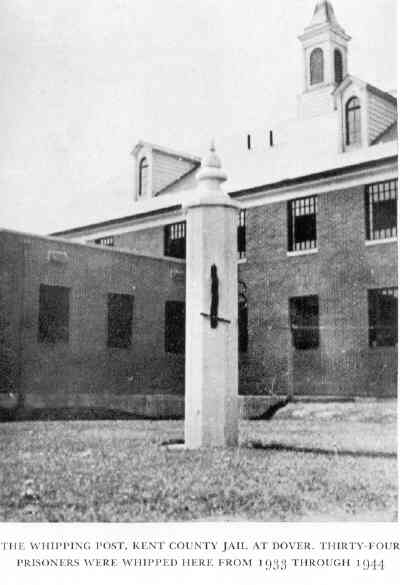
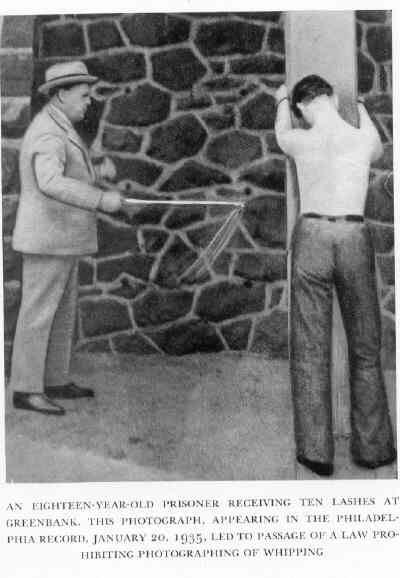 By the way, there were actually four Red Hannahs in Delaware: one each at the three county jails, and the fourth at the New Castle Workhouse. Caldwell doesn't mention if whipping was used as a prison disciplinary method at any of these facilities. The implements used were either like a horsewhip (Kent and Sussex counties), or a cat-o'-nine-tails with a 20-inch handle and nine 20-inch lashes (New Castle county).
The eighth chapter of the book, "The Post in the Forum", is a summary of Caldwell's arguments against the use of CP, and of Red Hannah in particular. He was a devoted penal reformer and CP abolitionist, and was in essence preaching against the evils of CP in this book, much as George Ryley Scott was in his books about CP and torture. Caldwell reviews all the arguments for and against the "post", demolishing with philosophy and statistics all the cherished mythologies surrounding CP. He lists the five main "pro" arguments on page 98:
-- retribution: "paying back" the criminal for the pain and suffering he has caused his victims;
-- economy: CP is a "quick fix"; simple, fast, and effective, which can replace some or all of the more expensive penalty of prison;
-- public opinion: publicly delivered CP rallies the public -- read "middle-class" -- against the criminal and crime -- read the "lower and working classes";
-- rehabilitation: harsh punishments help convince the criminal to "go straight" upon release; and,
-- deterrence: similarly, harsh punishments will act to deter recidivism and generally to frighten people away from crime.
 I agree with Caldwell on most of his rebuttal of these five myths, with the possible exception of the second one, "economy". CP could indeed be a "quick fix" penalty; for example, the judge gives you an option of a fine of $135 for driving through a red light at an intersection, or a week in the local jail, or a certain number of strokes of CP. That would be an interesting penalty option, although I can't see it ever being instituted in western societies.
The trend in western countries has inexorably been away from CP in all its forms, and to the more "scientific treatment" advocated by Caldwell and other reformer criminologists. Even so, such humane psychosocial treatment of offenders has a long way to go. The main penalties today are fines, probation, community service, and incarceration; indeed, long-term "warehousing" of the more dangerous criminals is the norm nowadays.
Caldwell argued persuasively for the abolition of CP in Delaware, and by extension, everywhere. However, he is too persuasive; his arguments could successfully be used to lobby for the abolition of any sort of legal sanction or penalty imposed on offenders.
Caldwell stuck to a gradualist approach in the abolition of CP: one small step here and there, gradually solving one problem at a time. Red Hannah disappeared only with the later modernization of Delaware and her judiciary. There would be no revolution in the justice and penal systems in North America, or in western societies generally; only a slow, peaceful, almost unnoticeable evolution away from the harsh, oppressive, and even cruel punishments of the past centuries, into a milder, more moderate regime of bureaucratized "corrections".
Judicially ordered CP has thus disappeared from western countries, to undoubtedly be followed in the next few decades by CP in all remaining "normal" areas of life (i.e. in the home and school). Professor Caldwell's book about Red Hannah will then become of purely historical and sociological interest. However, it will remain one of the most complete and detailed studies of judicial CP available to the student of criminology and penology.
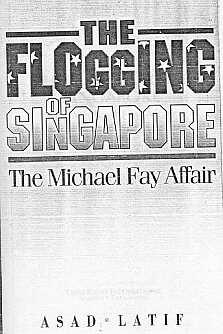
THE FLOGGING OF SINGAPORE: The Michael Fay Affair
by Asad Latif
Times Books International, Singapore, 1994 (103 pp) ISBN 981 204 530 9
Review by C. Farrell
Michael Fay's trial and caning for vandalism in Singapore in 1994 was, of itself, an exceedingly minor event. Yet for a while it generated an astonishing amount of media coverage -- including almost certainly more column-inches and broadcasting time on the subject of corporal punishment than ever before in history.
Why did this trivial affair create such waves? Asad Latif's modest effort at instant history -- published within a few months of the case -- does not quite succeed in providing the answer.
From the corporal punishment researcher's point of view, the book is a disappointment because it tells us very little about the Fay case itself that we did not know already.
Thus, after noting that many Americans appeared to support the caning sentence -- contrary to what Fay's parents apparently expected -- the author goes on:
Editorial-writers and columnists in what might be called the liberal American media argued that supporters of caning did not know what it entailed. They confused judicial caning with the paddling that many American fathers delivered to recalcitrant sons till recently. Caning -- or "flogging", or "thrashing" as the sentence on Fay was described -- was a form of mutilation so painful that the victim went into shock and was unable to sit or lie on his back for days, some writers said. It left permanent physical and emotional scars. It was carried out, allegedly, by trained martial law [sic] experts, and if the victim passed out while being struck, he was revived by the prison doctor -- so that the caning could go forward. (p. 8)
 "Some writers said"? "Allegedly"? These words seem to suggest that the author does not know whether these claims are true or not. And yet he was the Senior Leader/Feature Writer on the Straits Times, Singapore's only serious English-language newspaper and the principal media voice of the one-party state.
Surely such a senior journalist ought to have been able to find out, for instance, whether the allegation about the doctor reviving the victim "so that the caning could go forward" was true or false?
The same goes for Fay's claim that he and his friends had their confessions beaten and tortured out of them. The author refers to this allegation and tells us that the government investigated it, but makes no attempt to find out whether there was any truth in it. Many years on, we still don't know the answers to all these questions. And yet they are crucial to any attempt to make a balanced assessment of the whole story. If Fay was in fact innocent of the charges to which he pled guilty, it casts the whole affair in a quite different light.
When President Clinton was persuaded to make his ill-advised public intervention, it was about whether the punishment was proportionate to the crime. To begin with, there was no suggestion that US officialdom was telling Singapore that it should not use caning at all, or even that it should not cane Americans. Indeed, the US Embassy in Singapore, in a statement after Fay's sentencing on 3 March 1994, stressed that "American citizens overseas, as guests in the host country, are subject to the laws of that country". All the Embassy wanted was to "ensure that [Fay's] legal rights under Singapore law were accorded to him". But the Chargé d'Affaires, perhaps unwisely, went on to say:
"We see a large discrepancy between the offence and the punishment. The cars [spray-painted by Fay and his chums] were not permanently damaged; the paint was removed with thinner. Caning leaves permanent scars."
This clearly amounted to public meddling by the US in Singapore's internal affairs, and Singapore made its displeasure clear. It is this resentment over American attempts to interfere in Singapore's sovereignty which is at the core of Asad Latif's book.
He devotes many pages to what he calls the "media war" between US liberal commentators, especially in the New York Times, on the one hand, and the Straits Times on the other. The latter's various writers lambasted US insularity, arrogance and ignorance as reflected in the American press:
"Incredulity would be the reaction of many a Singaporean who learns that the world's most powerful politician, upon prompting from a reporter's question in the White House last Friday, has taken a personal interest in a case which concerns neither political hostage-taking nor a breach of national security...... Singaporeans who find his intervention objectionable need to understand that heroic gestures go down well with the American public."(1)
"What the Americans are now pushing for.... amounts to an altogether different proposition -- namely, that an American should be exempt from Singapore's tough laws because some Americans find these laws distasteful .... Worse, that Americans should now argue that a country's laws should be applied with provisos makes a mockery of their high-minded, long-held advocacy of the rule of law.... But when these rules no longer suit them, do not be too surprised if they are ignored ever so blithely, or worse, modified summarily. After all, it would not be the first time."(2)
[On the reduction of Fay's sentence from six strokes to four:] "In wanting to meet President Clinton part of the way, as the government says, it has dismayed a section of Singaporean opinion which holds that the authorities should have stuck it out.... Neither could it mollify Washington and the merchants of hysteria and disinformation in the American liberal establishment, whose campaign against Singapore has been asking that the basis of its penology be scrapped as it does not conform to American values.... [some] Singaporeans... are... incensed by the gorilla heaviness of some American media advocates whose chutzpah they see as exceeded only by their ignorance....."(3)
What is a little sad is that the author doesn't seem to realise that few outside Singapore will have given a hoot about any of this. Similarly, he
overlooks the fact that, while New York Times articles are read in Singapore and everywhere else in the world, most Americans have never even heard of the Straits Times. His supposed "media dialogue" was an entirely one-sided conversation.
To this media war was gradually added a diplomatic one. Singapore government spokesmen began to make unflattering remarks about law 'n' order in the States. Quite a lot of ordinary Americans, many of whom are a good deal less liberal than the New York Times, heartily agreed with them. But here too there was a mismatch of perceptions. Most US citizens were probably quite unaware that the two countries were close military and strategic allies, or that Singapore was the USA's tenth largest trading partner and 11th largest export market, with 900 US companies based there.
From numerous comments made at the time it's clear that, as far as many Americans were concerned, Singapore was just some tinpot little place a long way away, or it was part of Red China, or it was on a par with (or actually was) one of those filthy places in the desert where they chop people's heads off in the market square.
But Asad Latif attempts to situate the whole affair in a much wider geopolitical context. This is not very convincing. True, he rejects the suggestion that the Singapore government deliberately set out to use the Fay case to "teach the world how superior its laws were". But he tries to persuade us that the affair gained resonance because of the emergence of the "Pacific Century" -- what some used to call the "coming renaissance of the Orient":
What was happening was this. US relations with almost all Asian countries are undergoing a process of readjustment following the end of the Cold War, the disappearance of the Soviet threat and the emergence of Asian centres of power, principally China...... Asian countries began seeking a new relationship with the US, a new deal closer to their own terms, which were no longer tied to the past partnership directed against the Soviet Union. In this new deal, they wanted recognition of the fact that the world's economic centre of gravity was moving towards Asia as the Pacific Century dawned. (p. 28)
What on earth, you may well ask, does all this have to do with a case of petty vandalism? Well, according to Asad Latif,
... the US, and the West generally, have come under criticism from emergent Asian systems, which claim that they are better than decadent systems in the West. The US media's response to the Fay case was at heart a response to these criticisms. Fay became a symbol of the helplessness of America... in a world where not only were other systems on the ascendant, but where they dared to punish an American on their own terms -- and, by implication, reject the values of the system that had produced Fay. The caning of Fay sublimated the insecurities facing America as it witnessed the international challenges thrust upon it... The very mental image of an American being caned became a challenge to the self-image of America as its media pictured it. (p. 30)
I think this is all terribly overblown. Surely most US editors simply saw the Fay case as a splendid "human interest" story, raising interesting questions about whether the USA might learn something from Singapore's approach to crime, and conveniently involving a photogenic young "innocent abroad".
It was, you might remember, around this time that we were hearing rather a lot, notably from Singapore's Lee Kuan Yew and Malaysia's Mahathir Mohamad, about "Asian values" and how superior they were to Western ones. These were supposed to include respect for authority, strong family ties, acceptance of hierarchy, and a sense of duty and of community overriding issues of individual choice.(4) "Asian values" allegedly brought about a degree of social cohesion that led to both economic success and low crime rates. (The theory failed to explain why, if this was so, China -- for example -- though once a great civilization, has been in a state of backwardness and chaos for several centuries.)
The author quotes, but does not tell us whether or not he agrees with, the following passage from a Christian Science Monitor editorial (8 April 1994):
[The sentence on Fay] "did not just happen.... It is an object lesson for the West, whose culture Mr Lee and other Islamic (or Confucian) leaders feel is lost in a degenerating moral nihilism. It is not going too far to say that the caning of Fay is an almost literal expression of what Samuel Huntington has called an emerging 'clash of civilizations'."
Actually, I suspect the sentence on Fay did "just happen". I think the whole thing was probably a bit of a cock-up, and there is some evidence that the Singapore authorities came to regret the effect all the publicity had on the country's image, though they could not lose face by saying so explicitly, just as they could not be seen to be backing down from the caning sentence itself once it had been passed.
And since September 2001 we have our clash of civilizations all right, but it has turned out to be not at all the simplistic East/West one posited here. As for "Asian values", several scholars have pointed out that the concept was half-baked and self-serving from the outset.(5)
To this European reviewer, the similarities between Singapore and the USA are at least as striking as the differences. Both countries operate a particularly ruthless kind of all-powerful capitalism in which workers may be sacked at the drop of a hat and consumer protection is minimal by European standards. Neither country has universal health care or very much of a social-security safety net, both fundamental aspects of European (and Canadian) life. And both are enthusiastic users of the death penalty -- utterly unimaginable in modern Europe -- and of extraordinarily long prison sentences.
Thus, in various respects, Europe and Canada are lot more "liberal" than the USA, and yet their crime rates are significantly lower, though not as low as Singapore's.
In other respects, too, Singapore is probably the least Asian, most pseudo-Western place in Asia. I have even heard it described as the place Asians like to go (those who can afford it) to get away from Asia -- or, at any rate, from the squalor, corruption and inefficiency that characterise much of the region.(6)
So the crude idea that there is a decadent, weak, soft, liberal, failing "West" and a strong, tough, safe, successful "Asia", with Singapore as its foremost exemplar, doesn't stand up to a moment's examination. The socio-cultural-political differences between various societies are far more complex and multifaceted than that, and do not lend themselves to glib generalisations.
As far as attitudes in Singapore itself are concerned, the book does make one interesting point about the case. When the original spate of vandalism was discovered, and quickly traced to foreign school students, the Straits Times made front-page headlines of it, thus turning it into a "big story". This may have been a mistake, since after that it would have been impossible to bury the affair quietly. From that point on, the authorities must have been obliged to pretend that these were very serious offences, even if they weren't really.
The public may have expected the perpetrators of these outrages to be foul-mouthed gangster-style yobboes from Central Casting. Imagine their surprise when the alleged ringleader turned out instead to be a good-looking, polite boy, quietly-spoken, clean and tidy, even perhaps pious (in one TV news clip he was seen to be crossing himself on emerging from a court hearing). Maybe the authorities were surprised too. Fay made an improbable poster boy for all the supposed evils of the West. This in itself seems to me to make it unlikely that the whole affair was deliberately set up to make an anti-Western propaganda case.
For a couple of years there was a lot of noise in the USA about the desirability of emulating Singapore's methods. But eventually it all died away and nothing actually changed. This could be related to the fact that, tabloid headlines and shock-jock hysteria notwithstanding, US crime rates were actually falling during this period.
Meanwhile, the USA and Singapore are getting along fine. In fact the diplomatic spat appears, at least outwardly, to have been patched up just as soon as Michael had taken his four whacks and gone home to Ohio.(7) Certainly the two countries are still economically and strategically intertwined -- probably more so now than ever, with Singapore a key US ally in the "war on terror".
And Singapore is still caning merrily away, though since the region's economy went into meltdown in the late 1990s there has been rather less hubris about the wonders of Asian values.(8) With the benefit of hindsight, perhaps the Michael Fay affair wasn't really very significant after all.
-----------------
(1) Editorial, The Straits Times, 10 March 1994.
(2) Warren Fernandez, The Sunday Times, Singapore, 10 April 1994.
(3) Editorial, The Straits Times, 6 May 1994.
(4) Or as one Malaysian dissident intellectual sarcastically puts it, "the values of blind deference to authority, submission to power and the inability to stand up for one's rights". Farish A. Noor, The Other Malaysia: Writings on Malaysia's Subaltern History, Kuala Lumpur, 2002, p. 300.
(5) See for instance Francis Fukuyama, Asian values and the Asian crisis, Commentary Magazine, February 1998; Fareed Zakaria, in "The Dustbin of History: Asian Values", Foreign Policy, November/December 2002; and Nguyen Gia Kieng, Asian values and ASEAN, paper for conference of the International Studies Association, Paris, August 1999.
(6) "Singapore's surprising prosperity is due to its bold adoption of Western concepts and methods" -- Nguyen Gia Kieng, op. cit.
(7) This view is not wholly shared by one commentator, who points out that levels of Singapore-US trade fell in 1994 and did not recover until 1997. However, he adduces no evidence for, but merely infers, a causal relationship between this and the Fay affair. Joel Hodson, "A Case for American Studies: The Michael Fay affair, Singapore-US relations, and American studies in Singapore", in American Studies International, George Washington University, Vol. 41, No. 3 (October 2003) (available online with a library card or for a fee at JSTOR). Hodson does offer an astute commentary on the diplomatic and political fallout from the case, and seems more perceptive than Asad Latif on the way in which the two countries' politicians, media and people misread each other as the affair unfolded.
(8) Lee Kuan Yew later himself repudiated much of the "Asian values" thesis. See Michael Hirsh, Rethinking Confucius: Lee Kuan Yew recants, Newsweek, 28 January 2001.