THE CANADIAN REGULATION SCHOOL STRAP: How the strap was adopted, dispensed and ultimately banned, and why it is gone forever. Corporal punishment policy, practice, procedure, regulation, and world, judicial and parental CP influences
by Harold A. Hoff
ISBN 978-1475239492
$16.95 (US) (black-and-white version) from Amazon com
Review by C. Farrell
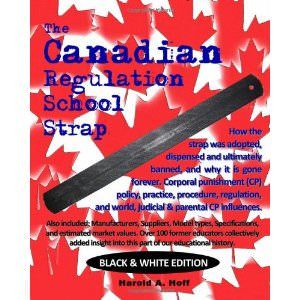 This is Mr Hoff's third book about corporal punishment. In part it is a natural development from his earlier work, "THE COLLECTOR'S GUIDE TO THE SCHOOL STRAP: Scotland, England, Ireland, Canada, Australia & Others", reviewed further down this page. As the title suggests, at its core is a lot more detailed research on the school strap in Canada and its use, which lingered on in one or two provinces until as recently as 2004.
The book is published in two versions, one with colour photographs and the other in black and white.
Do not be deterred by its seemingly narrow focus. Here the long subtitle gives a clue to a wider range of concerns. Indeed, the very first picture in the book is not of a Canadian strap at all, but has the caption "In 1941, a worker sprays a coat of varnish on a wooden punishment paddle", and shows industrial-scale production of school paddles under way, presumably in the USA -- a fascinating and revealing photo that was entirely new to me. As the author notes in his Preface:
"It is simply impossible to do justice to this subject by looking at it in complete isolation. It is inseparably woven with other practices in society. Therefore, we must also examine aspects of judicial CP, and parental CP, to understand the dynamics behind school CP. In the same way, the experience of other countries is highlighted to demonstrate why this necessarily influenced the Canadian one."
Thus, chapter 1, "General History", adopts a world focus, or at least a European/Christian one, starting with Solomon and illustrating how British school practices had arrived in Canada by the 18th century, and discussing the English common-law doctrine of in loco parentis, which gave schoolteachers the same legal powers of punishment as parents. This concept was explicitly adopted by Canadian education authorities, the school setting being seen as an extension of the domestic one.
The author shows that in the early days a variety of different punishment implements arrived in the New World from the Old; in particular the cane or switch from England and Germany, and the leather strap from Scotland and Ireland. (France, oddly enough considering Canada's history, does not seem to feature.) It was only later that the rubber/canvas strap -- unique to Canada, as far as I know -- came to be the standard instrument of choice in Canadian government schools, although canes, leather straps and US-style paddles were all used in certain private ones. This trend towards standardisation, Mr Hoff shows, was the product of various unrelated influences between 1850 and 1900, and echoed similar trends (though with different results) in the UK and Australia.
Here I would quibble with the suggestion that, in the late Victorian era, the usual target area for punishment in England, as well as in Scotland, shifted from the buttocks to the hand. It never did so for boys in the vast majority of English grammar schools, or of boys' schools of any kind; it certainly did not do so in private schools; only in government elementary schools, mostly new in the very late 19th and early 20th centuries, could one say that caning the hands was perhaps the norm. In more recent times, at English secondary schools of all kinds ancient and modern, leaving aside the minority that used the strap rather than the cane, there is a huge mass of evidence that boys were most frequently punished on the seat, and only girls (where caned at all) generally on the hands. In this respect, as well as in choice of implement, Scotland and England went sharply different ways, Canada seemingly following the Scottish route, while many other territories in the world -- Singapore, the USA, Thailand, Vietnam, Korea, Taiwan, New Zealand, and most of the "British" parts of Africa -- have tended to follow the English one, with Australia somewhat split according to State, and a mixed picture also in Malaysia, the Caribbean and the Indian subcontinent.
I fear that in this matter the author may have placed too great a reliance on "Professor" R.G. Van Yelyr (very likely a pseudonym of George Ryley Scott) and his poorly researched, ill-informed, anti-CP tome of 1941, The Whip and the Rod. "Van Yelyr", writing about England, said that "the modern procedure is to apply it [the cane] to the hand instead of the buttocks". This is quite simply a myth. And much too much is made of the supposed psychological disadvantages of punishing on the bottom. The physical danger of caning the hands is far more significant, in my view. It is for just this latter reason, Mr Hoff reveals, that the Lochgelly tawse -- whose makers always said that it was designed to be applied only to the hands -- was invented in Scotland in 1884.
Chapters 2 ("The Regulation School Strap"), 3 ("Practice and Procedure") and 4 ("The Punishment Book") go into unprecedented detail about the ins and outs of school CP in Canada. This is clearly based on a phenomenal amount of research which I am sure nobody has ever done before (the book as a whole contains no fewer than 363 footnotes). Standards or guidelines for CP were gradually defined in more detail by the various authorities, starting in Toronto in the 1870s. This is where the strap made of rubber (or, more precisely, rubber-impregnated canvas) first makes its appearance in place of the traditional leather one, mainly it seems because it was thought that leather could not be relied upon to be consistent across multiple examples -- a concern which, whether soundly based or not, never seems to have troubled the Scots.
This central part of the book might have been subtitled "Everything you never realised you never knew about Canadian CP". There are detailed regulations from different school districts, with precise measurements, though it is interesting to note that some districts never did adopt a specific policy, just as in England. There are also court cases, anecdotes, surveys, and statistics. As time went on, there was a gradual trend towards greater restrictions on the use of CP, for example stipulating a maximum number of strokes, requiring the punishment to be administered in private, providing a punishment register in which each instance is to be recorded, and in some cases allowing an element of parental choice -- all concepts with which we are familiar from various examples elsewhere, notably the USA in the present day. Mr Hoff has managed to trace some of these concerns back to their first appearances.
As usual with standards and generalisations, the rare exceptions to the rule are of particular interest. Thus, we learn about a few schools that used the US-style paddle instead of the strap, and some (pretty well all private) ones where the English-style cane prevailed.
There is some quite detailed discussion of modus operandi, with subheadings such as "Hand strapping procedure" (along or across the hand?), "Holding the Wrist", and "Avoiding Self-Contact". The question of training teachers in how to administer CP is also examined.
Mr Hoff has tracked down some old punishment books, and produces interesting statistical analyses of some of their contents.
Chapters 5 and 6 of the book concentrate on the decline of CP, setting the stage for its eventual abolition at different times in different places,for which the author has found many detailed references; and finally leading to the Supreme Court's 2004 decision which outlawed it nationwide, though by then the number of districts still using it was very small. Along the way we even visit the question of judicial corporal punishment, abolished in Canada in 1972. This has some relevance because the author is able to show by reference to numerous countries that the abolition of judicial CP always precedes the abolition of school CP, which in turn invariably comes before the possible banning of parental (domestic) CP.
In Chapter 7 the author examines many of the justifications that have been put forward for ending the use of CP, and rehearses at some length the arguments on both sides, with many quotations from a wide variety of sources. His own opinion is that some of the claimed justifications for abolishing school CP do not stand up; for a start, most of the statistics put forward by CP opponents are bogus, and he comprehensively demolishes the "violence begets violence" myth: "As the 'violence of punishment' has been incrementally removed from Canadian youth, they have become steadily more violent". Despite that, he thinks there is now no possibility of its reintroduction, for various practical reasons which he sets out fully. (He is even more scathing about official attempts to stop parents from spanking their own kids, as in Europe and a growing number of other places.) All of this applies of course to the world, not just Canada.
In the final section of the book, we come back to the straps themselves. Many models are described in detail and illustrated, all of them subtly different. For those interested in collecting such things, an estimated valuation is given -- although in most cases surviving examples are rare. Lastly -- and here again this is obviously the result of much painstaking and groundbreaking research -- there is a list of known historical suppliers, with illustrated extracts from their catalogues. These contained slogans like "Regulation Strap, Specially prepared to meet School Requirements", and "Every school should have one of our straps". One or two of these exist in French ("Courroie de correction") as well as English, and this would seem to put to rest any idea -- which I have encountered in the past -- that French Canada did not go in for this sort of thing.
Harold A. Hoff's meticulously researched 248-page work contains many dozens of high-quality photographs. It is a most impressive contribution to the serious literature on corporal punishment. In this short review I can only hint at the vast range of its scholarship. All students of our subject should order a copy.
THE COLLECTOR'S GUIDE TO THE SCHOOL STRAP: Scotland, England, Ireland, Canada, Australia & Others - Second Edition
by Harold A. Hoff
ISBN 978-1460976425
$46.00 (US) from Amazon.com
Review by C. Farrell
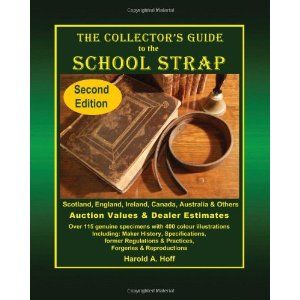 This marvellously well-researched catalogue of school punishment straps first appeared in 2009. Now for 2011 comes the second edition, considerably enhanced: there are now some 400 high-quality illustrations, mostly in colour. The book is over 200 pages long, and goes into tremendous detail about the different kinds of straps used in different countries.
As before, the Scottish leather tawse takes pride of place -- more than half the book, in fact. There is a surprising number of different kinds: not just numerous varieties of the famous Lochgelly, about which we get an interesting potted history, but several other manufacturers too. The Scottish section also has an addendum in the form of a short section on the judicial tawse, reminding us that until 1948 the Scots courts could order boys aged between 14 and 16 to be given up to 36 strokes of the tawse across their bare buttocks, as an alternative to the birch. Remarkably, the author has managed to track down one of these implements, made in the reign of George V (1910-1936), and provides us with photographs. It has three tails and, as one might expect, is rather larger than the typical school strap.
There is a much-expanded section on the school strap in England, and here I must declare an interest: some of the information in this part of the book came from your humble reviewer. While the cane was by far the implement of choice in most English schools, there were significant pockets of strap use, like Walsall in the Midlands (a centre of leather manufacturing). Unlike in Scotland, errant schoolboys in Walsall were strapped across the seat of the trousers, not the hand.
Canada, the home of the book's author, where in modern times the straps tended to be made of canvas and rubber rather than leather, likewise gets expanded coverage in this new edition. There are again sections for Ireland, the USA, Australia and Germany (these being places where the strap was not the most usual CP implement). In each case there is a page or two of background information on the (former) corporal punishment situation in the country concerned.
For each kind of strap listed and pictured, the dimensions are given, years of production, and estimated value at auction or from dealers if you want to buy a genuine used one today. It is evident that, since school corporal punishment was declared illegal in most of the countries covered, such of these items as remain in existence fetch in many cases a high price from collectors: some rare examples run to many hundreds of dollars.
For that very reason there are also fakes and forgeries around, and a section of the book warns against these and how to tell the real thing from the fraudulent impostor.
As before, the book is remarkably well-produced, with a great deal of attention to detail. Though aimed primarily at those who are interested in collecting these objects, it is also of great interest to non-collectors who are students of the history of CP.
JUST AND PAINFUL: A Case for the Corporal Punishment of Criminals
by Graeme Newman
Review by C. Farrell
This is an entire book on the Web, by an American academic, Graeme Newman. He is Professor of Criminal Justice at Albany University. The book argues the case for judicial corporal punishment (JCP). It was first published in 1985.
Briefly, he argues that JCP can be justified on the grounds that society requires offenders to be punished as well as reformed, and that prison does neither properly, as well as costing the taxpayer a fortune.
What I found most interesting was Chapter 13, in which he pulls to shreds the Cadogan Report - the 1938 British government study which has always since, even very recently, been trotted out as the justification for claiming that JCP does not work.
Cadogan's resilience over all that time, and not only in the UK, has been quite extraordinary. Nobody ever seems to have dared to question it publicly. I always thought some of its argumentation pretty shallow and arbitrary, so it's most welcome to find it subjected at last to critical examination by a real academic philosopher.
Unfortunately the kind of corporal punishment Newman has in mind is electric shocks - because, he says, they can be scientifically administered and accurately regulated. However, he does countenance the possibility of "whipping" (details not specified) for violent offenders.
The book is no longer available for download. I am told that a new edition is to be published.
SONS OF THE BRAVE: The Story of Boy Soldiers
by A.W. Cockerill
Leo Cooper / Secker and Warburg, London, 1984
Review by C. Farrell
The universe of discourse for this work is a tad vague at first glance. The blurb gives the impression that it might be about boy soldiers the world over. And, goodness knows, there are still plenty of them fighting terrible wars in awful places like Africa and the Middle East.
But no, it turns out that what we are essentially studying here is the British military tradition, a story which lies pretty firmly in the rapidly-receding past. However, that includes the Commonwealth, and there are some snippets of fact about such previously little-known phenomena as boy soldiers in Canada. Much of the book's information, at least about relatively recent times, appears to come from letters the author received in response to an appeal for reminiscences. So the emphasis is on anecdotal rather than official evidence (of which, the author complains, there is very little), and on daily life as seen from the point of view of the boy soldier himself.
Cockerill touches on the issue of CP quite early on in his chronological tale. He has discovered a documented case in 1694 of a boy soldier, John Coopman, being sentenced to be whipped for desertion in Ostend (in what is now Belgium), where the English were helping the Dutch to repulse the Spaniards.
Flogging for army disciplinary offences in general arises here, too, if only in passing, because of the curious and long-standing custom in the British Army whereby one of the duties of boy drummers was to administer the cat-'o-nine-tails to offending adult soldiers. The author fails to discover a reason for using boys to perform this distasteful task. At all events, the number of army floggings rose sharply in the eighteenth century, not because the regime became more severe but because, on the contrary, there was a growing disinclination to use the death penalty for relatively minor infractions.
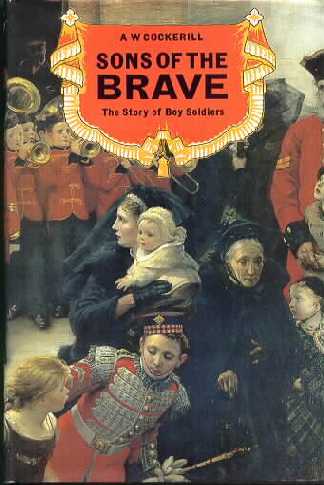
But it is not until the nineteenth century that we get into much detail. By then special educational institutions had been set up for army boys. They seem to have been a particularly unruly lot in the early days: at the Royal Military Academy in Woolwich, established in 1741, the boys were said to "fight like wild animals" and the main role of the duty officer was to protect the masters from being pelted with missiles thrown by the students.
At another such establishment, the Duke of York's school in Chelsea (later moved to Dover), it is recorded that in 1852 "Privates Bateman and Barry stole a muff from the regimental chapel and cut it to pieces. For this offence they collected 18 strokes of the birch each and four days in the black hole, followed by six days of extra drill. ... They were both 13 years of age."
Birching was also used at the Royal Hibernian Military School in Dublin, but a six-foot-long bamboo cane was the more usual instrument of punishment there. This seems unusually long for a cane. As in the Navy, the word "cuts" rather than "strokes" was officially used as the unit of measurement, as these extracts from the punishment books show:
3 March 1852: Pte Vialls, aged 13. Trade, Shoemaker. Charged with breaking two awls and telling an infamous lie. Punishment: 18 cuts.
30 December 1852: Pte Ends Seta, aged 13. Charged with answering the Commandant in a disrespectful manner. Punishment: 6 cuts and 6 hours in the black hole.
31 December 1852: Pte Ends Seta, aged 13. Charged with kicking and making a noise in the black hole, and being insolent and disrespectful to the sergeant major. (He threw his mug of water out of the hole and called the sergeant major a fathead.) Punishment: 18 cuts.
Thus Private Seta was caned twice on successive days. Cockerill provides us with a description from contemporary sources of how these penalties were inflicted:
"For administration of the cuts awarded, a sergeant major gripped the offender's head between his legs, high in his crotch, pulled out the boy's shirt tails and took a firm grip on his trousers. With his feet set apart for balance and his posterior raised, the boy, doubled over, gripped his sergeant major's legs with his arms. Then would the regimental sergeant major's rod be poised ready ... Boys waiting for cuts were said to be
'standing by to receive boarders'."
At the Duke of York's School a boy called William Tart received no fewer than 106 strokes of the cane in the course of 1888. However, the author assures us that "the majority thrived on the discipline they received".
All this sounds pretty much par for the course in what were basically boys' schools like any other, albeit with military ethos and jargon thrown in. It would be interesting to know more about the canings given on ordinary active service, either "in the field" or in camps and barracks where boys were serving alongside adult soldiers. But here the author fails to come up with anything very specific. What regulations applied, and how often were they put into effect? Were any records kept? We are not told. There are simply several anecdotal references to teenage soldiers receiving "six of the best" from their superior officers - whether officially or unofficially remains unclear.
For example, one Frank Ebdon joined the Royal Rifle Brigade in the First World War and was sent to the Isle of Sheppey, where he remembers "being caned good and hard by the Provost Sergeant in the yard of the Quarter Guard building for being absent from retreat parade". One waits for more details, but they are not forthcoming. Even more tantalising, another correspondent recalls a birching as recently as 1928 in the Royal Horse Artillery - but we learn nothing more about it.
Caning continued in the army schools until recent times, but Cockerill reveals that by the late 1940s it was becoming customary for the authorities to seek parents' consent first. Back at the Duke of York's School, older boys ("sergeant prefects") lost the right to cane younger ones in the middle 1950s. The author is himself an old boy of that establishment.
Of course, this book does not set out to be about CP so one cannot accuse it of failing to deliver what it promises. As a first stab at producing a history of an evidently under-researched aspect of past British military life before all the first-hand witnesses die off, it represents a commendable effort to come to grips with a hotchpotch of rather disparate evidence. The result is a bit of an unfocused ramble, but as unfocused rambles go it is scholarly and well-produced.



 About this website