A READER asks about use of the cane and the tawse in British schools -- in particular, how the balance of usage between these two instruments varied in different parts of the UK until school CP was finally outlawed altogether in 1998. First, let us focus on Scotland.
As far as state schools are concerned, the tawse was pretty well universal in Scotland. ('Tawse' was the official term, but in conversation it was always called 'the belt'.) It was the only instrument permitted under the 1968 Code of Practice agreed between the Scottish teachers' unions and the Scottish Education Department.
Bizarrely, and in my view foolishly, the Code also specified that it be applied only on the hands; and there is no doubt that, in modern times, this was how the tawse was generally inflicted in Scottish schools.
BEATINGS ON THE BOTTOM
But apparently it was not ever thus. Bill Fyfe Hendrie, a Scots head teacher, has written:
"Describing his school days in Montrose, 19th century poet Alexander Smart records that when he and his school fellows were to be punished they were ordered to bend over a long wooden bench, to which they were bound so that there was no escape while the master, Mr Norval, administered what he considered to be the requisite number of strokes of his tawse across their legs and bottoms. At Ayr Grammar School the boys suffered the even greater indignity of being 'horsed', that is hoisted on the shoulders of two of their classmates, so that their bottoms presented an even better target for the tawse.
"Beatings on the bottom were apparently common in Aberdeenshire, for many schools in that county boasted what were known as "cooling stanes". These were large stones just outside the school door to which pupils who had been chastised could rush at play times to sit and take at least part of the stinging sensation out of their wounds. Indeed it is claimed that one irate kirk session complained bitterly to the dominie that his scholars were using one of the large tomb stones in the adjacent grave yard for this unseemly practice.
"One boy went through the rest of his life with the nickname, "Leather Doup", because when he was wee, he persuaded his mother to sew a sheep's skin inside the seat of his trousers, in order to minimise the impact of the dominie's leatherings." ("The Tingle o' the Tawse", Scottish Memories, July 1994)
Not quite all state-school teachers followed the modern-day rules about applying the tawse only to the hand. Mr David Johnstone, headmaster of Plockton High School in Wester Ross, was "severely censured" by Highland Education Committee for his disciplinary methods in 1979. He was "accused of spanking teenage boys on the bare bottom with his belt. The incidents are said to have taken place in his study with the door locked and curtains drawn." ("School belting inquiry begins", Daily Record, Glasgow, 13 March 1979.)
Mr Johnstone had previously been a teacher in Edinburgh, where I have been told that men who were his pupils in the mid-1970's claim they too received the belt on their backsides. Apparently at the time nobody complained!
A couple of years earlier, teacher James McQuade agreed at Dumfries Sheriff Court that he had put pupils across his knee and spanked them in front of the class at Lincluden Primary School, Dumfries. An 11-year-old boy, who admitted that he was "a menace in the classroom", said Mr McQuade had punished him "by pulling his trousers and underpants down, putting him over his knee, and striking him on the buttocks". ("Teacher spanked pupils", The Scotsman, Edinburgh, 17 September 1977.)
"I FELT THE BOY EXPECTED TO BE PUNISHED"
And the headmaster of Dunoon Grammar School, Mr Alexander Thain, was cleared of indecent assault following the bare-backside spanking of a 15-year-old boy who had been playing truant.
Mr Thain told Dunoon Sheriff Court how he went to the parents' house and took the boy to his own home, the school being shut that day. There followed what the boy called 'hypnosis' and the headmaster called 'relaxation therapy'. Mr Thain continued: "The father had told me that he had caned the boy. I said: 'I've nothing here to punish you with and I'll have to use my hand and use it on your bare bottom'."
The boy described to the court how he had removed his own trousers and bent over the settee. "He pulled down my underpants and started to smack me with his hand, five or six times," he said.
Mr Thain explained: "I felt the boy expected to be punished and I felt his parents expected him to be punished. It was meant as a symbolic punishment." ("Head hypnotised me, says boy", The Scotsman, Edinburgh, 12 June 1980; "Head acquitted of assaulting boy", The Scotsman, 13 June 1980.)
PUBLIC FLOGGING OF BOYS
These last two bare-bottom spanking cases, whilst not involving the belt, do tend to confirm both that the Code of Practice was sometimes ignored, and that trousers-down punishments were not unknown in state schools in Scotland.
There is certainly evidence of them if we go a little further back in time. One man who in 1946 was a 12-year-old pupil at St Andrew's RC School, Dumfries, wrote:
"The use of the tawse was a daily occurrence for trivial offences. Public floggings in the school hall in front of the assembled school were for 'serious offences', for example, stealing a pair of plimsolls. The boys were brutally beaten on the bare backside by the headmaster whilst two male teachers held the struggling victim across a school desk. Female teachers were excused witnessing the spectacle, so they would not see a bare backside." (Letter from 'D.D', Dumfries and Galloway Standard, 5 February 1982.)
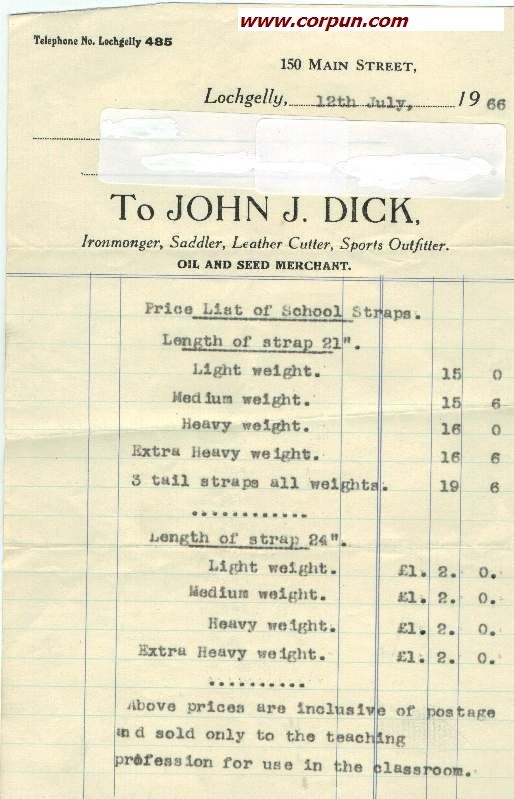
Price list of Scotland's main tawse supplier in 1966.
Generally, however, the tawse in Scotland was given to both boys and girls on the hands, typically in front of the class. And it was applied remarkably frequently: a 1977 survey by the Educational Institute of Scotland (the teachers' trade union) found that 36% of 12-to-15-year-old boys were belted at least once in 10 school days; 21% of these were strapped three or more times in the same period.
19 OUT OF 20 BOYS STRAPPED
And in 1980 a study by Edinburgh University's Centre for Educational Sociology, conducted among 40,000 school leavers, showed that only 1 in 20 boys went through secondary school without getting the tawse ("Children under shadow of the belt", Daily Record, Glasgow, 26 November 1980.) This suggests a considerably higher level of usage of CP overall than the average in England and Wales.
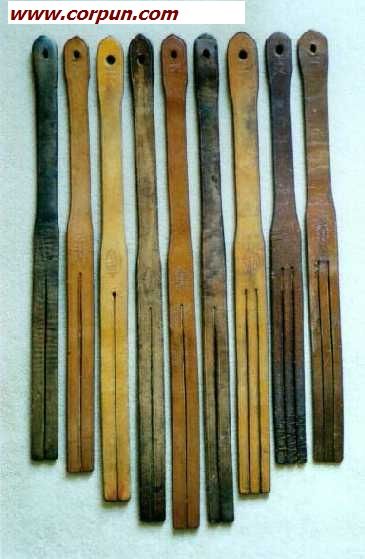 An array of Scottish tawses.
There is one significant exception to the dominance of the tawse in Scottish education, and that is the independent (private) schools. Here there was no general rule; the Code of Practice did not apply. I understand a few private schools, such as Glasgow Academy, did use the strap on hands, perhaps regarding this as a more Scottish thing to do, but most followed their English counterparts in using the cane on bottoms.
CANE ACROSS THE BACKSIDE
A fictional, but probably reasonably authentic, example of the latter can be seen in the short film "The Dollar Bottom", made by Roger Christian in 1980. Set in an Edinburgh boarding school in 1953, and based on a story by James Kennaway, it is a light-hearted tale about an enterprising boy who sets up an insurance scheme against getting the cane, and quickly makes a fortune.
A real-life private school, Dollar Academy, announced in 1983 that it was giving up using CP altogether, but there is anecdotal evidence that in the mid-1960's it was still using the cane across backsides in quite a big way and - on occasions - with much force and ceremony. This was apparently administered by senior boys in the boarding houses; teachers themselves used the tawse on the hand, said to be a daily occurrence.
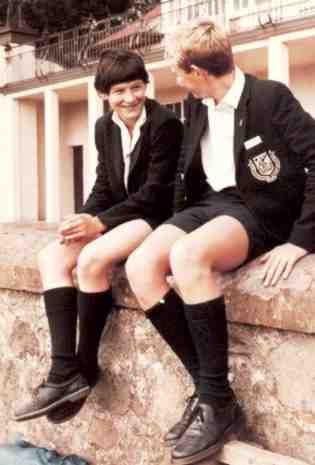 Students in Dollar Academy's distinctive uniform. The school used both forms of corporal punishment.
BOY, 17, CANED FOR DRINKING
Fettes College, in Edinburgh, also used the cane. Fettes is often considered "Scotland's Eton", though it is a Victorian and not a mediaeval institution. The following curious item appeared in Scotland's biggest-selling popular daily paper:
"A boy has been caned at one of Scotland's top schools .... for under-age drinking. The caning took place at exclusive Fettes College, Edinburgh, the night before 17-year-old Russell Young was fined five pounds at the district court.
"Two other teenagers from the six-hundred-pounds-a-term school, Ian MacConachie, now 18, and Christopher Cape, now 17, were also fined five pounds at the same court when they admitted drinking beer.
"Both were told by headmaster Mr Anthony Chenevix-Trench, who came to Fettes from Eton, that they would not be allowed to leave the school grounds for a time.
"'They have simply been naughty', said Mr Chenevix-Trench, 'but they should not have been drinking'." (Daily Record, 25 February 1977).
The news story did not explain why Russell got the cane, while Ian and Christopher apparently didn't but were gated instead. Nor why the Daily Record thought a caning at a "top school" -- of which there must have been, at the least, dozens daily in Scotland alone -- was unusual enough to justify being brought to the attention of its several million readers. Presumably the canings were mentioned during the public court case; normally of course that kind of information remains private.
NO ORDINARY FLOGGER
In his former capacity as headmaster of Eton in the 1960s, Mr Chenevix-Trench ("A quick beating can be the kindest thing to do" -- Liverpool Echo, 6 January 1979) would have been accustomed to caning boy's bottoms -- bare, in that case. We are not told whether the canings he administered at Fettes - such as 17-year-old Russell Young's in February 1977 - were also done trousers-down (or kilts-up?) but it seems highly likely, in view of revelations by journalist Paul Foot, who went to Shrewsbury School when Chenevix-Trench was a housemaster there in the 1950s. Foot wrote on the occasion of the great man's death:
"... Trench was no ordinary flogger. He would offer his culprit an alternative: four strokes with the cane, which hurt; or six with the strap, with trousers down, which didn't. Sensible boys always chose the strap, despite the humiliation, and Trench, quite unable to control his glee, led the way to an upstairs room, which he locked, before hauling down the miscreant's trousers, lying him face down on a couch and lashing out with a belt .....("London Diary", New Statesman, London, 13 July 1979.)
Foot's claims about Trench have been fully vindicated much more recently, and I hope to return to this topic in a future article about Eton.
SIX OF THE BEST WITH RIDING CROP
But to return to Scotland, and Fettes College. Another account of life there, this time in 1966, has been provided by Richard Gibbon, columnist on the Newcastle-upon-Tyne Sunday Sun. Gibbon, who was 13 at the time, was caught talking after lights out. He writes:
"I was made to wait 12 hours before my punishment and during this time I ate, tried to swot (exams the next day) and duly attended evening chapel service.
"After finishing my Divinity essay...I was summoned to the holy room of house prefects: eight individuals, average age 17, whom I viewed as Gorgons from my lowly height. They explained how badly behaved I had been, warned me I must be made to suffer, and duly frog-marched me to a room referred to as The Big Dormitory.
"Thirty feet away stood two chairs back to back, on which I was to have six of the best.
"Thud! - the first stroke of the riding crop made contact and my assailant slowly returned to the waiting group of would-be thrashers.
"A dozen steps later there was another almighty clout and my chairs lurched violently forward, and so my dose was repeated another four times.
"Several screams later I emerged from my torture stools, pulled my clothes together, wiped away my tears and shook hands with the head of house.
"For three days my rear ached, the thick weals stayed for two weeks, and the scars finally went about six weeks later. For a few days I was a mini-hero. How much did it hurt? When did you start crying? etc. But the whole event was quickly erased from school life.
"By everyone but me, that is. I have never forgotten the beating and I doubt I ever will. It served as an excellent reminder that if I was caught doing something wrong then I had to expect punishment."
("Punishment? You can't whack it", Sunday Sun, Newcastle-upon-Tyne, 20 August 1978.)
A rather more famous product of Fettes College is the British Prime Minister from 1997 to 2007, Tony Blair. It seems he was something of a rebel at school, and around 1970 he too received "six of the best" there, when he was a six-foot 17-year-old. The caning was delivered by his exasperated housemaster, who described the future PM as the most difficult boy he ever had to deal with ("Rebel pupil Blair was given six of the best", The Daily Telegraph, London, 28 March 2001).
SIX BLACK MARKS = ONE WHACKING
For our final look at caning in Scotland's private schools, we turn once more to Dumfries.
In 1979 Mr Peter Spencer, former headmaster of what was described as "one of Scotland's oldest-established prep schools", was charged on 12 counts of assault involving 7 boys over five years:
"Five schoolboys told a court yesterday how their headmaster beat them over the buttocks with a shoe, riding crop or cane. And one of them claimed their boarding school was nicknamed Colditz.
"A jury at Dumfries heard the boys - aged between 12 and 14 - tell about life in the 75-pupil school. They described the disciplinary system, under which bad conduct marks could be awarded by teachers at St Ninian's in Moffat, Dumfriesshire.
"Any boy accumulating six had to go to the head's study where punishment was administered by him. They alleged that he hit them over their bottom, in some cases causing red marks, weals and bruising.....
"Roderick Baillie, 12, of Edinburgh, told how he was punished on three occasions, once in 1974 when he was seven, and twice last year. On the first occasion he received four strokes with a shoe on the backside, from the headmaster." ("Colditz head beat us, say pupils", Daily Record, Glasgow, 26 September 1979.)
On the second day of the trial, the school doctor, Dr. Hamish Macleod, took the witness stand. He had been called in January 1979 to examine two boys, Mark Bishop, 13, and Michael Lambert, 11, who "were each given six strokes of the cane on their buttocks".
BRUISED BUTTOCKS
The doctor stated that four days after the caning "the weals were still about a quarter to half an inch in diameter and their buttocks were bruised", and that "days later, the boys were still suffering pain". He added that "the force with which they were struck must have been extremely excessive".
The doctor agreed however that "it was an excellent school academically and also in character training". Michael Lambert himself told the court that "he and Mark Bishop were punished for not owning up to breaking a thermometer" ("Doctor condemns canings", The Daily Telegraph, London, 27 September 1979; "Doctor tells of boy's school cane wounds", Daily Record, Glasgow, 27 September 1979).
Headmaster Spencer, giving evidence on the third day of his trial, said he considered a horse crop less severe than the cane. He told the court he used the slipper for less severe punishment, then the horse crop, and then a cane for more serious cases. "I regard the riding crop as being not so thick and much lighter than a cane."
"Spencer, .... a National Service Officer instructor in the RAF, said ... when he took over at St Ninian's in 1973 he never made any secret of the fact that he believed in and administered corporal punishment.
".....He went on to say that in his opinion he had beaten the two boys involved reasonably hard, but certainly not as hard as he could have done. He did not think his use of the cane had been excessive". ("Riding crop less severe than the cane, says former head", Glasgow Herald, 28 September 1979.)
COURT UPHOLDS DISCIPLINE
On the fourth and final day of the case, the Sheriff told the jury that "the crime of assault requires as an essential ingredient some measure of criminal intent". There was no evidence of this, and he instructed them to return a verdict of not guilty.
As he walked "elated" from the court, Mr Spencer said he had not changed his views on CP. "Had I been found guilty I feel that many other teachers in other schools would have felt inhibited. I hope that this will be an encouragement to other teachers trying to uphold discipline and good behaviour" ("Caning head cleared of assault", Glasgow Herald, 29 September 1979.)
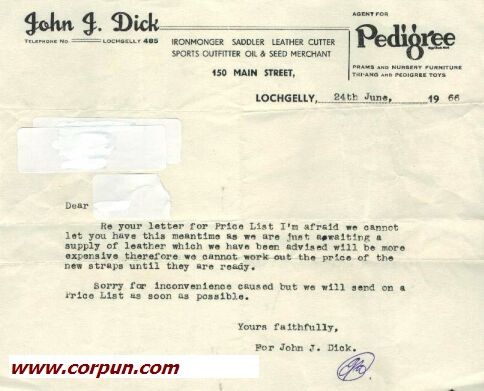
A final note on the tawse: In 1982 its monopoly manufacturer in Scotland, Lochgelly saddler John Dick, "whose family firm had been making the tawse in their Fife workshop since Victorian children were learning their three R's and being belted", went out of production.
"It is almost fading away in any case because of the difficulty in obtaining the special leather. It was now being manufactured principally for export: 'There are outstanding orders for Australia, New Zealand, Canada and America. There's medium, heavy and extra-heavy ... The two-tail heavy has been the most popular and retails at £5.90.'" ("Rise and fall of the belt", Sunday Standard, Glasgow, 28 February 1982.)



 External links on school CP in the UK