 Stripes in Magenta, issue 2
Stripes in Magenta, issue 7
Tales from Assembly
Initiation rites
Strap Meister
Re: Strap Meister
Re "Spike"
Register of discipline administered at St Augustine's Grammar School
Former students of a Roman Catholic boys' school in Manchester write in to describe their strappings in the 1960s and 1970s. Part of a (mostly) touchingly affectionate website devoted entirely to this school which no longer exists, having been absorbed into a different one in 1977, but which clearly made a great impression, in more ways than one. "Stripes in Magenta" is the ex-school's electronic newsletter, with yet more anecdotes. Each one contains a spoof "letter from the headmaster" (actually he is long dead) and the one in issue 7 is a witty fantasy about proposed European harmonisation of the size of his strap. The website's Visitors Book repays careful study, too, both the current one and earlier years linked therefrom. Read also such fascinating documents as school policy, Duties of masters and mistresses on duty, and The Green Room, a place where the duty master administered the strap twice daily, with the miscreants lining up to bend over a chair. "Do you remember how you had to tuck your elbows into the chair so your posterior was presented properly?" Truly remarkable. The website has now (2025) been rejuvenated and expanded.
Hartlip School's Punishment Book
Article about a village primary school in Kent. The punishment book covers the period 1909 to 1936. There is a bit of statistical analysis. Recipients of the cane were "almost exclusively boys".
Rod's Ramblings: School 1958 and my first caning!
A brief account of corporal punishment at Sharmans Cross secondary modern school in Solihull (West Midlands). Compare with this feature article about the very same school around the same time.
Corporal Punishment at Woolmer Hill School in the mid 1970s
The author of this piece, something of a left-wing rebel, sets out at length why he was not happy at his secondary modern school in Surrey. It does sound to have been remarkably badly run. (But also he was clearly at the wrong school: it's obvious from his lucid prose that he ought to have passed the eleven-plus exam and gone to grammar school.) Caning and slippering loom much larger in his memory now than seems to be justified by the actual incidence of CP at the time.
In the Shadow of Empire
This chap attended Tonbridge School (an elite and famously tough boys' boarding school near London) in the early 1950s, where he received a prefect's caning over his pyjamas. There is what purports to be a photo of the effects on his bottom, supposedly taken the same evening.
1950s Prefects
At Cranbrook School, a boys' boarding school in Kent, prefects were authorised to mete out two strokes of the cane.
Barnsbury Boys
Memories of the cane and the slipper in the 1950s and 1960s at a north London boys' secondary school.
Life under The Doctor (1958-63)
Many mentions of canings and slipperings in these reminiscences of Harrow County School, a boys' grammar school, not to be confused with the famous Harrow "public" school.
Carrot or Stick?
See pages 15 to 17. Recollections of CP at Ipswich School, then a private boarding school for boys. Prefects ceased slippering students in 1968. The last canings by staff were in 1978.
#78 Punishment Book
A bit of CP history from Merchant Taylors' School, a private boys' secondary school in Merseyside, illustrated with a punishment-book page from 1895.
Hasmo Legends I
Hasmo Legends II
Hasmo Legends III
Hasmo Legends IV
Reminiscences from the 1960s and 1970s about Hasmonean High (formerly Grammar) School, a secondary school for Jewish boys in north London. There are numerous references to caning and slippering.
Scenes From the Battleground: Corporal Punishment
A teacher who is on balance opposed to the reintroduction of CP is nevertheless irritated by the "punishment puritans" -- the "hysterical appeasers of the badly behaved convinced that everyone who disagrees with them about corporal punishment is some form of barbarian or primitive". He goes on, "Words like 'child abuse' or 'torture' are thrown around as if every teacher before 1987 was a cross between Josef Mengele and Fred West. Of course, this argument is worthless." He notes that, as I myself have pointed out, most of the arguments used against CP are actually arguments against all forms of punishment.
Shut up and take your pills
The Times columnist Libby Purves notes (2005) that we have stopped caning disruptive schoolboys and now diagnose them with ADHD and give them Ritalin instead. She suspects this is a "conspiracy against boyish boys", as part of our "heavily feminised, mimsy tick-box culture" in which "the very nature of boyhood attracts disapproval".
So Why Did We Spare the Rod and Spoil the Child? Lincoln Allison fondly remembers being caned
The Emeritus Reader in Politics at the University of Warwick argues (2010) for the caning at school of teenage boys as a contribution to human happiness. Its demise was largely just a matter of educational fashion, he says. In an interesting twist, while he supports school CP he disapproves of parental spanking.
The Old St Beghian July 2014
Graphic account of prefects' canings at St Bees boys' boarding school in Cumberland in the 1940s.
Discipline and Punishment at CCB
Canings by prefects at Campbell College, Belfast, during the first world war.
The Highbury Estate in the 50s -- Part 9
Description of getting a housemaster's caning at a grammar school in Portsmouth in 1956.
Peter Snow: 'I got caned at school and I caned some boys too... it was simply part of the culture'
Veteran TV presenter Peter Snow attended Wellington College, Berkshire, in the 1950s.
Michael Ball: 'I can't count the number of times I was caned'
West End musical star Michael Ball was frequently punished in the late 1970s at Plymouth College.
Old School and Simon
Recollections of slippering and caning in the 1970s at John Willmott Grammar School in Sutton Coldfield.
Crunwere School, Llanteg: Minute and Log Book Entries
Canings recorded at this Welsh elementary school (ages 5 to 14) from 1906 to 1918.
Barbarism in English Education
1873 article in Popular Science Monthly discusses "tunding" (whipping on the small of the back with ground-ash rods), a strange punishment peculiar to the elite Winchester College.
School's Out in London and Steve 'Ginger' Finch (illustrated)
From the "Another Nickel In The Machine" social history blog about London, a brief look at the May 1972 demonstrations by the short-lived Schools Action Union against bad food, school uniforms and corporal punishment, among other things. Decades later it emerged that this ineffectual rabble had been infiltrated by the secret services, suggesting that the authorities took it much more seriously than anyone else did at the time. Allegedly, the middle-class far-left organisers tried to adopt Cockney accents and dressed badly so as to appear working-class. Some commenters below the line give a different view. See also these May 1972 news items.
Hong Kong -- Typhoon Sailing
Near the bottom of this page is a caning anecdote from an unidentified English school.
An American Sings the Blues [PDF]
Old Clayesmorian Society: Letters 1997
Letters 1998
McIsaac and The Flying Horse Hair Mattress [PDF]
Newsletter 2004
The Old Clayesmorian 2009 [PDF] (see pages 20, 21, 40)
The McIsaac Tapes [PDF]
Various CP reminiscences -- some (see the first in this list) in great detail -- from Clayesmore, a private school in Dorset, from the 1940s to the 1980s.
 From the archives: RGS and Corporal Punishment
Information about caning and slippering at the academically stunningly successful Royal Grammar School, High Wycombe, an unusual selective state boys' school that has always behaved more like a private one.
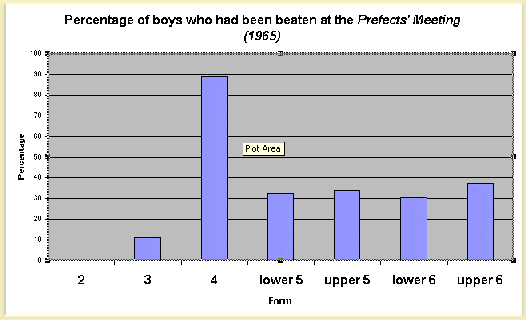
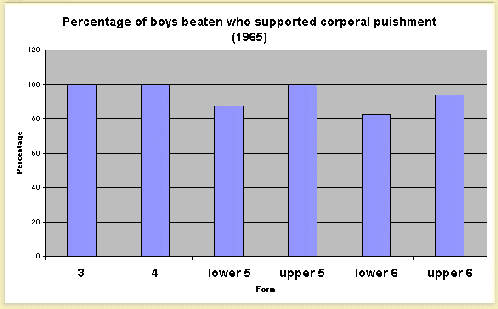
Including a 1965 survey of the boys' attitudes and CP statistics (the missing graphics are reproduced below). Until at least 1965, the weekly prefects' "court" was allowed to hand down a "sentence" of a formal slippering of up to six whacks. The offender had to bend over a chair at one end of the prefects' room, and the head boy or his nominee, wielding the gymshoe, would take a run-up for each stroke. It is interesting to discover that almost all the school's fourth-formers got their behinds officially thrashed by their older peers at some point. More remarkable still is that even upper-sixth-formers (who at age c.18/19 could be older than some of the prefects) were still called upon to undergo this boyish penalty with some frequency.
See also reminiscences of 1950s mass canings and Minutes of the Prefects' Meetings from the 1930s, when prefects still had the right to cane.
The Prefects' Meeting page provides some CP reminiscences from the 1950s and the 1920s.
See also the following RGS Old Boys Newsletters for more CP recollections (all are PDFs):
May 2002
December 2002
July 2003
September 2003
November 2003
March 2004
May 2004
July 2004
November 2004
January 2005
May 2005
July 2005
May 2007
July 2007
May 2008
RGS Old Boys January 2010 [PDF]
See page 9 for a couple more anecdotes from the above. At a Prefects' Meeting in 1932 a boy called Saunders chose to be caned instead of copying out lines of text. "His wish was complied with, but after the first stroke, he wished the punishment be commuted to the original number of lines,
but it was decided that the caning should be proceeded with. Three strokes were administered in all."
School's in for summer
Article about the 2003 reality-TV series "That'll Teach 'Em", which put 30 youngsters for a month in a re-creation of a 1950s boarding school that claimed to be authentic in every respect except one -- for legal reasons there could be no corporal punishment. As it happens, the series was made at Royal Grammar School in High Wycombe (see items above). Much of the comment about the show was to do with the fact that today's students had great difficulty with the 1950s curriculum and exams, but a significant subplot was debate about the absence of the cane, whether this was a good or bad thing, whether it invalidated the experiment, and how and whether the producers might have got round it if they had really wanted to.
For more, see this July 2003 news report and this July 2003 comment piece.
Woolverstone Hall in the sixties
Woolverstone Hall was a rarity, a state boarding school. Though run by the Inner London Education Authority, it was set far out in rural Suffolk. The writer of this piece says he received corporal punishment (both cane and slipper) so often that "the outline of my backside must have been as familiar a sight to the staff as my face". He describes a number of these occasions. See also this Nov 1987 news item.
Woolverstone Hall Old Boys Association Dec 1996 (scroll down to "Confession")
More caning anecdotes from Woolverstone Hall (see previous item).
The Bishop Stopford's School
At this Anglican state secondary school in North London, offenders were offered a choice between a caning and manual labour, according to this Wikipedia article. "The miscreant was presented with a cushion bearing a pair of blue and a pair of black shorts. If he opted to be caned, he would select the blue shorts; if he chose the black shorts he would receive forgiveness. The shorts were carried on the cushion in procession in House Assemblies." ("Forgiveness" means an hour's worth of arduous tasks or physical exercise.) The school seems to have had quite a few such "ancient traditions", but wasn't even founded until 1967! How bizarre is that?
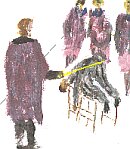 An 'Old Grange' from the Inside
Punishments (Alternative link)
A Caning at King's School (Alternative link)
Detailed description of prefects' canings at King's School, Canterbury. There is a rough drawing of the procedure (right), and two photographs of caned buttocks, allegedly dating from the author's schooldays in 1942, which seems a bit unlikely. Also a reconstruction of a noticeboard announcement of a mass caning. Prefects (here called monitors) got training in how to do caning properly: "It's not just a matter of hitting him with a stick, you know!" -- a very important statement and a fact that has been insufficiently widely understood.
Restore order!
A campaign (2008) for the reintroduction of CP in UK schools, among other things, to tackle the "widespread chaos" that is "leading to a huge drop in standards". This page goes into more detail about the corporal punishment proposals, involving parental opt-in and the use, in secondary schools, of a US-style paddle rather than a cane.
Old Emanuels: Leavers from the 1950s
Old Emanuels: Leavers from the 1960s
Old Emanuels: Leavers from the 1970s
At this London boys' school, look for numerous references to slippering and caning. Boys could ask to have detentions "caned off" so they could do sport. Note also that prefects still had the power to cane in the 1960s. See also this 1973 TV discussion featuring the caning headmaster of Emanuel and two of its students.
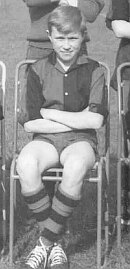 Battersea Grammar School: Remember ....
Memories of this London boys' school include a teacher "prowling the corridors looking for boys to beat"; the lines of people waiting outside his room to be caned; and an occasion on which an entire class was strapped. Despite all this, much fun seems to have been had.
And on this separate page, a former pupil of the late 1950s apologises belatedly to his fellow students for charging them half a crown for the loan of his lederhosen, which he claims served as undetectable protection when worn under the trousers. Can it be true?
The End of Corporal Punishment at Finchley [PDF]
Analysis of punishment books in the 1970s and 1980s at Finchley Catholic High School, a boys-only state secondary school in north London which continued with caning right up to its abolition in state schools in 1986. Unusually for this kind of school, some of the canings were given on the hand.
Roald Dahl's schooldays
A biography of the late author describes discipline at Repton school (Derbyshire) in the 1930s. Dahl hated Repton and clearly had a bee in his bonnet about corporal punishment, which crops up all over the place in his writings. Most of the canings were administered by senior boys. The piece also revisits the well-worn ground of Dahl's mistake in attributing to Geoffrey Fisher (subsequently Archbishop of Canterbury) a severe headmaster's caning in 1933 that was actually the work of Fisher's successor, John Christie. New to me was that the recipient of this punishment was in fact 18 at the time and had himself been accused of abusing younger boys, which casts a slightly different light on the whole affair from the impression given in Dahl's autobiography.
The old school days at 'The Tec'
At Coventry Technical School in the 1950s, any transgression by a boy who was already "on report" meant a visit to the Head for "four strokes on the buttocks or sometimes six of the best". There were also informal slipperings in front of the class.
Why somehow wanting to write about students sitting in a circle ended up being more about getting a good thrashing
One Mark Sullivan recalls receiving, at age 15, six of the best with a strap on his bottom in the headmaster's study at a northern grammar school, for leaving the school without permission at lunchtime. There was also a physics teacher who had a collection of plimsolls behind his desk.
Spare the Rod and Michael Croft
Michael Croft was author of the 1954 anti-CP novel Spare the Rod, made into a film starring Max Bygraves in 1961. In retrospect it anticipated the liberal and permissive attitudes that became more prevalent in the education system a decade or so later.
Telling tales out of school
A 1950s "public caning" at Ashmole Secondary Modern School in London N20 is recalled.
Grammar schools: Old school wisdom
The headmaster of King Edward Grammar School in Chelmsford from 1949 to 1977 still maintains (2010) that there was no doubt of the efficacy of the cane if used with proper discrimination.
Malcolm McDowell
This brief biography of the star of the 1969 boarding-school film if...., with its memorable prefects' caning scene, says that he had been slippered and caned regularly in real life.
Me and my school photo: Johnny Vaughan
Radio DJ and TV presenter Johnny Vaughan says he got six of the best from the headmaster at Bramcote, a prep school near Nottingham, c.1980.
Me and my school photo: John Suchet
Newscaster John Suchet and his actor brother David were both caned at Grenham House prep school in Kent in the 1950s, "a monstrous place".
Ten of the best floggings
Quirky article in The Guardian about CP in literature.
Me and my school photo: Nicholas Parsons
Veteran radio presenter Nicholas Parsons (b. 1924) loved St Pauls School in London (he doesn't mention CP there, which is a bit odd, because they certainly used it in those days) but before that he attended a prep school in Hendon (North London) where there were canings for "the slightest misdemeanour".
Slip Sliding Away
A blogster recalls a severe caning headmaster at primary school in Hertfordshire in the 1960s, and also getting "a mighty whack on the backside with a handy piece of 2" x 1" timber" in woodwork class at secondary school.
School that bred Black Country hero
Article (2005) about Sedbergh, a rigorous boys' boarding school in the wilds of Cumbria, where students "rebelliously carved their names in any exposed woodwork, and accepted the inevitable caning with good grace".
Wellington College
Reminiscences of canings at this private school in the 1960s, and by the writer's father in 1914-1918.
No more school, no more stick, no more arithmetic
Plenty of caning at Derwent School in Derby in the 1970s, according to this.
Holte Grammar School Memorabilia (Alternative link)
"Six strokes of the slipper" are remembered at this Birmingham school in the 1950s, while another contributor says that in the 1940s "most mornings boys would be lined up Mr Lewis' curving staircase to the 'turret' for a probable caning".
Of red ink and bearded boys
A columnist in York's The Press (2008) remembers when "Sid the Slipper" ruled the classroom.
Record of a baffled spirit
Teaching practice in Milford Haven, Wales, in the 1970s: "There was only one cane in the school and it was passed from classroom to classroom as and when needed".
 The Grammar School Years
An account of life as a pupil at the very traditional Boston (Lincs) Grammar School, starting in 1969. The author and his friend were the first two in their year to get "the Swish" (schoolboy slang for a caning). "We were asked, 'What was it like?', and 'Did it hurt?', but we shrugged it off and said 'Nahhh, not really', which was a complete lie because we had whip marks on our arses for a week!"
Victorian School: The Cane
There are now more and more of these "school museums" where today's students learn what it was like at school in Victorian times. This one has a short blurb about caning.
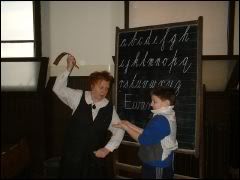 The Victorian Classroom at Scotland Street School
This school museum is in Scotland. On this visit, several students volunteered to pretend to be belted by the "teacher" but only one was chosen (right). Nothing particularly Victorian about this punishment, of course -- it was rife in Scottish schools until the early 1980s.
Adrian Edmondson
Interviewed in the Times Educational Supplement (2008), actor Adrian Edmondson claims that he received in total 66 strokes of the cane at Pocklington School in East Yorkshire between 1969 and 1975, "to say nothing of the regular slipperings".
Six of the Best!
Purportedly the recollections of a caning headmaster. I am not sure whether this is real or made-up.
Does your daddy know you're here?
Article (2000) in The Guardian (London) in which John Vidal writes about his time at boarding school in the late 1960s, when prefects were still allowed to cane younger boys. He doesn't name the school, but elsewhere Vidal reveals that he attended St Bees School in Cumbria.
Keil School Old Boys' Club [PDF]
Keil, now closed, was a small but prestigious private boys' school in Dumbarton, Scotland. It appears to have been one of those "healthy outdoor pursuits, compulsory short trousers for all ages and open-necked shirts" schools, like Gordonstoun, but by all accounts rather stricter. Anecdotal evidence suggests that the most common punishment by teachers was severe strapping of the hands, but there were also dormitory slipperings by the "Chief" (head prefect), known as "getting the peech ('ch' pronounced as in loch)", described here.
Bring back the cane
Sharply divided views on corporal punishment on this message board (2006) for UK teachers, with a surprising number of them regretting that there is no prospect of its return. The thread continues for 29 pages.
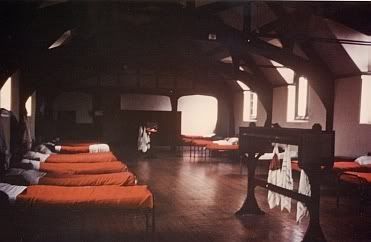 Old boy slang
A glossary of schoolboy slang from Bancroft's, a private school on the eastern edge of London. Canings in the 1950s were called "beats", consisting of up to six strokes "administered to the rear of a boy bending over and holding his knees for stability". They could be meted out by a monitor ("Mon beats"), a housemaster ("House beats") or the Headmaster ("Sid beats", named after Mr Sidney Adams, a former HM). "Dorm beats" were given in the dormitory (pictured right). At an earlier period, a good thrashing was called a "lamming".
Old Oakhamians -- Summer 1999 [PDF]
See pages 18 to 22 for "Reminiscences of Oakham School in the late 19th century", including various birching and caning references.
Starring you and me
In a piece from 2004, The Guardian's film man, Peter Bradshaw, considers movies about school life, with particular reference to differences between the USA and the UK. Among British films he considers If... (1968) and Kes (1969) and The Guinea Pig (1948), all of which feature caning in English schools of one kind or another. All these, he notes, can be seen as essentially serious films about (among other things) class and caste. There really aren't any American equivalents.
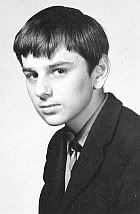 Sweet fifteen
This lad was disappointed by the mildness of his two-stroke caning in the headmaster's study at Cardiff High School in 1967: he'd hoped for some "nice red weals across his bum" to show off to his brother.
"Dickie" Slaney [PDF]
See pages 2 and 4 of this issue of Chesterton Gossip, a Staffordshire newsletter. Mr Slaney was headmaster of the Junior Boys School in the 1940s and 1950s; it is alleged here that he proved that corporal punishment, in the form of "six of the best across the bare behind", did work, and had parental support.
Ouch!!!
Reminiscences of punishment at West Hartlepool Grammar School for Boys.
Solihull in Wartime 1939-1945 [PDF]
At page 35, a caning on the stage in front of all the boys at Lode Heath School is described.
The Croydon Archives: Register of Corporal Punishment 1952-78
Former students of John Ruskin School near London come across their old school's punishment book in the local archives. Amusing extracts are quoted and a little statistical analysis is attempted. The text is wrong to state that CP was forbidden in all (state) schools around 1978; that didn't happen until nine years later.
Chris Green recalls school life in the late fifties (Alternative link)
More on the John Ruskin School in Croydon (see previous item). Scroll down to near the bottom of the page. This correspondent refers to the birch, but I imagine he means the cane. The methods of headmaster Mr "Joe" Lowe are described. He seems to have been a strict disciplinarian. He got a potato shoved up the exhaust of his Morris Minor in revenge!
What Life Was Like in the 1940s
Reminiscences about whackings at Giggleswick School in North Yorkshire.
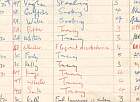 Memories by David Edwards 1947-1952
My memories, by John W. Cartwright 1945-1950
Corporal Punishment Book
Pages for King's Norton Boys' School in Birmingham. In the 1940s the headmaster used to make each offender go out and buy the cane with which he was to be punished. David Edwards got six of the best for smoking on a tram. John Cartwright didn't get it, but saw the weals of a boy who did. Also here is a genuine punishment book page (names not blanked out!) from 1970, with only three or four canings per month recorded. Either this school used CP rather less than most of its kind, or many canings never got entered.
Bognor Cane Company
Information on a message board about this outfit which supplied punishment canes to schools, and its eccentric boss, Eric Huntingdon. See also these April 1981 news items.
Stouts Hill School: Crime and Punishment
Ex-pupils of this boys' boarding school recall canings.
Punishments
A delve into the archives at what is now a Middle School in Northamptonshire. In the 1940s the cane was a last resort and used infrequently, but on one occasion 20 boys were caned in turn for not owning up when the headmaster was struck by a piece of coke. In the 1950s and 1960s, the cane had largely given way to the slipper. All the recipients listed in the punishment book were boys, and the most severe penalty was "four strokes of the slipper on the buttocks". In the 1970s, however, boys again got the cane, and the slipper was for girls.
Schooldays with the Strap (Alternative link)
Numerous former students of Scottish schools remember being on the receiving end of the belt.
That's quite enough poetic licence, Mr Motion
The Poet Laureate from 1999 to 2009, Andrew Motion, wrote a book attacking his prep school, Maidwell, describing the headmaster as "a cane-waving sadist". In this Observer piece (Dec 2006), Tom Fort, who was there at the same time, agrees that there was "constant corporal punishment" but points out that that is just what such schools were like at the time, and that actually the headmaster was a very nice man. Fort was happy at the school, and thinks Motion, who admitted not liking anybody much, "was clearly a boy who should never have been sent away to school in the first place".
Public or Private
Discussion on a message board, with personal reminiscences quoted in evidence, about the relative merits of being caned or slippered in front of the class vs. privately punished in the headmaster's office.
The Victorian Era
Diary entries by a school headmaster in 1850 who had hoped to dispense with CP but found this was not possible as long as "parents are so indifferent about good moral training at home".
Six of the best kinder than zero-tolerance
Author Magnus Linklater attended Eton in the 1950s, when the punishment for being caught with alcohol was six strokes of the birch "wielded with some ferocity by the headmaster".
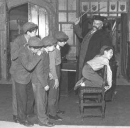 Memorable images: Whacko!
The Sterling Times British nostalgia website celebrates Jimmy Edwards' 1950s TV comedy programme, from a time when corporal punishment was accepted as a normal aspect of school life.
The John Gillatt "It's My Life And I Did What I Want" HomePage
At Maidenhead Grammar School in the 1960s, when you got to about five detentions in a row you could go to the headmaster and ask to be caned instead.
Dartech and Wilmington Newsletter, June 1995
For alumni of a boys' grammar school in Kent. Scroll down to "The Old Dartechs' and Wilmington's Book of Records'. It records the name of the last pupil to be caned, a 15-year-old, and the date (10 October 1985). There is also an analysis of the punishment book for the final two years of caning, drawing the conclusion that "the cane was beneficial". Old Boys could apply to purchase a school cane as a souvenir!
Autobio 2000: A Personal View of the Twentieth Century
The author of this piece attended a prep school in Kent in the 1930s. He reports seeing blue marks on the bottoms of boys who had been caned. There is also an interesting anecdote about a bully who was cured of his habit by being ceremonially slippered by each of his victims in turn -- a punishment offered to, and accepted by, his parents in lieu of expulsion.
Christ's Hospital: The War Years
For the uninitiated, Christ's Hospital is a school, not a hospital. Various sorts of whackings in the 1940s are recalled here.
Does School Help or Hinder the Road to Success of a Chief Executive
Alistair Owens, retired former boss of a chain of DIY stores, attended a secondary modern boys' school in Kettering in the early 1960s, having "failed" the 11-plus. (He is, I think, mistaken in generalising from his own particular experience to the effect that secondaries-modern were run-down schools in dilapidated Victorian buildings, while grammar schools were lavishly provided with modern facilities: in the town I grew up in, the situation was almost the exact opposite.) Anyway, in Chapter 2 some canings are described, one of them carried out in front of the whole school. It sounds harsh but, as the author wisely points out, "it's all too easy today to condemn past attitudes with the benefit of hindsight and with today's rather than yesterday's values as the measure". And he adds, "for all its faults, the school did turn out pupils with basic literacy and numeracy abilities which I believe would shame quite a few of today's comprehensives".
Cambridge colleges 1504-1509
Younger undergraduates at Cambridge university, who in the 16th century might be only 14 or 15, were liable to be birched by the Dean for cutting lectures, according to this. Actually that was still the case nearly 150 years later: see this May 1648 news item.
Peakirk Cum Glinton Primary School - School History
Floggings were so frequent at this Peterborough school that in 1882 it was a matter for special note that no corporal punishment was recorded for a whole week.
Eminent Victorian, Alas
Review in The New York Times of a biography of a British crackpot called Francis Galton (1822-1911), the "father of eugenics". Caned and birched frequently at school, he once timed his Greek teacher thrashing 11 pupils in eight minutes.
The Parish Of Middleton In Norfolk
Evocative description of a village primary school in 1950. Any misbehaviour by boys resulted in a painful visit to the headmaster, but girls were exempt from the cane.
Mr Whiteley's Headmastership and the Chancery Suit (1789-1815)
Information about Leeds Grammar School 200 years ago. Discipline had deteriorated in the Upper School, and a rule was made that any "corporal correction" by the headmaster or his deputy "shall be public and with such instruments as cannot do any bodily injury".
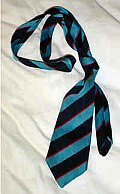 Glaisdale School, By Chris Richards
My Glaisdale Saga
Memories of a secondary comprehensive school in the English Midlands from 1973 to 1978. There is an account of a youth being formally caned, six strokes, in front of all the other boys, in the outside school yard. That must have been very unusual at an ordinary state school in the 1970s, and one might have suspected the story had been embroidered, but now comes corroboration in the second of the above links (only a fleeting mention, a long way into the section headed "Back for a new year").
Experiences at St Vedast (now St. James) and the S.E.S.
Message board for survivors of this famously cranky group of private schools in London, secretly controlled by a bonkers brainwashing cult innocuously called the School of Economic Science. More pertinently for our purposes here, they were also among the very few schools to carry on with caning until at least 1996.
What an extraordinary can of worms is opened up here. Very long (40 pages) and deeply depressing.
Much of what is described really can, for once, be described as "abuse", though corporal punishment is a relatively minor part of that -- there are numerous complaints here about unfair and excessive non-corporal punishments, too, as well as more general brutality and much cruelty of a more psychological kind.
However, the most remarkable claim is that headmaster Nicholas Debenham, as recently as the 1980s, was in the habit of caning boys on their bare bottoms, a fact never hinted at during his numerous sallies into the media to speak up for caning, such as this October 1996 news item. At least nobody can claim that this weird place was typical of anything: it seems to have been a one-off in every way. A formal inquiry into the allegations reported in 2006.
See also this 1996 video clip.
The first rule of schooling - break it (Alternative link)
Veteran BBC journalist John Simpson claims to have been the most caned boy in his time at St Paul's School in London (c.1960). He says it was painful and humiliating but not the end of the world.
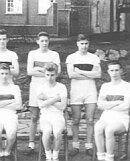 Bishop Vesey's Grammar School
Old boys recall slipperings at this secondary school near Birmingham, which is fine and normal, but also "vigorous face-slapping", which seems very reprehensible to me. Not only dangerous but far more humiliating than a whacking on the backside. I'm quite surprised: I myself went to exactly this kind of school (old-established, traditional, selective boys' grammar school) in the 1960s, and there, while there was plenty of proper CP, it would have been unthinkable for a master to hit a boy in the face.
Hitchin Boys' School Old Boys' Association Newsletter, February 2001
Passing mention of caning at this Hertfordshire school.
Plimsoll or Slipper?
The plimsoll, dap, gymshoe, pump or tennis shoe (UK current: "trainer"; US: "sneaker"), when used to inflict pain, was generally referred to in British schools as "the slipper". Punishment with it, usually "unofficial" and always applied to the seat of the offender's trousers, was often called "a slippering". This could give rise to confusion with the domestic, house or "carpet" slipper, a generally less painful instrument. This message board includes, among some extraneous nonsense and obvious fantasy, what purport to be accounts of the use of both types of implement.
The Wetherby Schools Photographic Archive & nostalgia experience
Former pupils of this Yorkshire school recall their canings and slipperings.
First stirrings
Extract from the autobiography of philosopher Colin McGinn. He describes being caned at his "loutish and philistine" secondary-modern school in Blackpool in the 1960s. On one occasion "the PE teacher caned an entire year of boys -- some ninety behinds" (page 4).
Your views on school discipline
A range of views on this BBC page. One contributor says that if the people who have banned CP were made to travel on buses with today's school children they would soon be bringing back the cane.
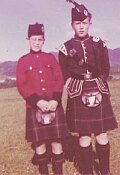 QVS: Crime and Punishment
Recollections of cane, slipper and belt at Queen Victoria School in Dunblane (Scotland), an army boarding school. Continues on this second page.
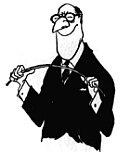 Excerpts from Down With Skool!
A couple of snippets from Ronald Searle and Geoffrey Williams' 1953 classic. Ostensibly kids' humorous fiction, but can be seen as highly subversive satire.
James Hale
Obituary of this literary agent says that at Charterhouse School around 1960 he instigated a successful rebellion against the practice of senior boys caning junior boys.
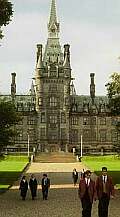 History of Fettes College
Scroll down to the section on 1970-2000 in this account of Scotland's top private boarding school. It mentions Anthony Chenevix-Trench's period as Headmaster (1971-79) but doesn't allude explicitly to his enthusiasm for corporal punishment, saying only "his regime was a highly personal one". The only mention of CP is to say that by the late 1980s it had been abolished.
For more on Fettes, see feature article The cane and the tawse in Scottish schools and, on caning there in the Trench era, this September 2001 news item. And see also the following item ....
He could talk his way out of things
A mate of Tony Blair's who was at Fettes College with him around 1970 tells us a bit more about the different sorts of caning there. A 'school beating' involved being caned by all 12 prefects in turn, and "by tradition you were allowed a day in the sanatorium afterwards".
The abolition of caning
The former School Clerk at a Sheffield primary school remembers sending out a letter to all parents asking them to vote on abolishing caning. Only five parents out of 260 replied yes, she says, but the school abolished it anyway. So much for democracy!
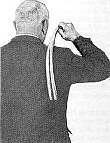 The School Belt Past and Present
The True History of the Lochgelly Tawse
Lochgelly Tawse Scrapbook
Where Can I Buy a Lochgelly Tawse?
Description of the Lochgelly Tawse
A website created by the daughter of legendary Scottish strap manufacturer John J Dick. You can now once again buy a real Lochgelly Tawse -- but prices start at £100!
For more about the Scottish tawse, see this article.
Now it's like looking through a window
A former student of a girls' secondary school in Wolverhampton recalls canings in front of the whole school in the 1940s.
Mr Reg Woolford (1924-1929)
Reminiscences from The King's School, Gloucester.
Punishment and discipline at Old Radnor School
Extracts from 1880s punishment books in Wales.
Punishment Book
Quotes from the punishment book of a junior school in the early 20th century.
Mick Jagger: My best teacher
Rolling Stone (now Sir) Mick Jagger, revisiting his old grammar school in Kent in 2000 for the first time in 40 years, remembered that headmaster's canings were a daily occurrence.
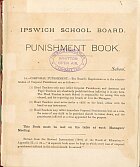 Thomas Wolsey School -- Punishment Book
Photographs of pages from this Ipswich school's punishment book in 1930 and 1931.
School Daze
Recollections of a grammar school in Wales. The author says these remarks were originally posted on Friends Reunited but got deleted, so he made his own web page for them. Grove Park Grammar School for Boys in Wrexham took the prize for sheer volume of physical punishment, he says.
Why we are all losers in the crime game
Humorous columnist in The Observer (2002) is overcome with nostalgia for the Britain of "red telephone boxes, free cough mixture for all and corporal punishment in schools".
Elmbridge School: Crime and Punishment
Elmbridge School: Things we did, good and bad
Elmbridge School: Roger Francis Remembers
Elmbridge School: some reminiscences by Garth Allmand
Memories of one of Essex County Council's unusual out-of-county state boarding schools.
School history: Purley County Grammar School
Story of the school that later became Purley High School for Boys (now closed). In the 1950s and 1960s the headmaster was the splendidly named Dr Birchall, who once caned 30 sixth-formers on the last day of term. Of Mr Derek Akers, who maintained a high media profile in defence of caning, the authors say "Much can be said about the last head of the school -- but alas due to the laws of libel must remain unpublished until after his death". Whatever can they mean? For more on Purley in the 1970s and 1980s, see this feature article.
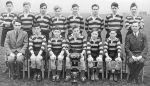 No caning for Brimrod boys
Recollection of Brimrod School's (Rochdale) winning rugby league team in 1952. Headmaster Mr Wilmot told one boy, 14-year-old Harry Tonge, during the match that if he didn't tackle harder he would be caned afterwards. "We ended up winning the game and the whole tournament", says Harry now.
Committee on Rights of Child concludes thirty-first session
This UN body noted in October 2002 that, at least in theory, CP had still not been abolished in private schools in Northern Ireland. (But it has now -- see this June 2003 news item.)
School discipline -- what's to be done?
BBC News Online "Talking Point" debate from 2001. As always, some contributors insist that the return of CP is a key part of the answer, while others completely disagree.
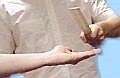 Should corporal punishment return to the classroom?
Another BBC News "Talking Point" (2000). Includes this posed picture of a teen student being rulered on the hand.
Sects, power and miracles in the Bible belt of Essex
The oracle of Essex
American-style fundamentalist Christianity comes to the English home counties, with tales of lawsuits over paddlings in Bible schools. Articles from 2000.
The Making of Them, extract page 8
The Making of Them, extract page 9
From the "Boarding School Survivors" website, a description of ceremonial prefects' canings at prep school.
A Tale of Two Countries: Child Rearing in Northern Ireland and Norway
An American pacifist discusses her witnessing of CP whilst teaching at a mixed school in Northern Ireland.
A great deal of caning, 1879
Extracts from the log book of a school in rural Wales.
Reflections 1954-1961
Second Form 1968-69 [DOC]
Pages from the Sternians Association for old boys of Lord Wandsworth College, a boarding school in Hampshire. "The cane or the slipper ruled" in the 1950s, and in the late 1960s misbehaving boys were given a "cosy tail". See also this picture of a housemaster's caning at the school.
History of Miller Academy and Memories for the Millennium
Strapping anecdotes from a school in the far north of Scotland.
Advertisement for George Pocock's Academy
George Pocock ran a school in Bristol in the early 19th century and invented a machine for spanking unruly boys, according to this. Unfortunately the machine is not featured in the picture, as far as I can see.
Transgression and Correction
Essay calling for an end to "polarised debates" on subjects like corporal punishment -- amen to that -- and asking: why not let the child choose the form of punishment?
Ultimate Deterrents: Punishment and Control in English and American Schools
Essay from 1966 comparing discipline policies on both sides of the Atlantic.
The Elitist and the Popular Ideal: Prefects and Monitors in English and American Secondary Schools
Companion piece to the above. Academic view of the prefectorial system: in past times school prefects could impose punishments on other pupils, including (in some schools) corporal punishment, a situation apparently unknown in the US.
"The Art of Slashing": Victorian Representations of Corporal Punishment
Introduction to an academic essay notes that 19th-century educators succeeded in resisting all attempts to do away with caning and birching or even in many cases to tone it down. "Spectacular forms of bodily punishment" were crucial in forming the middle-class subject, it says. The title, by the way, is taken from a description of Mr Creakle in Charles Dickens's David Copperfield.
Dr Arnold
A chapter from Lytton Strachey's Eminent Victorians (1918). Dr Arnold, headmaster of Rugby School around 1830, celebrated in fictional form in "Tom Brown's Schooldays", is claimed to have single-handedly changed the whole ethos of English private education, not least in the matter of corporal punishment. In place of the indiscriminate, casual, knockabout flagellation which had characterised most schools thitherto, he introduced the idea of solemn, ritualistic floggings as a piece of grave ceremonial theatre with almost spiritual overtones.
No caning at Nantddu
Sarah gets a worse punishment
Part of a local history series for kids on "Victorian school days" in Wales. Shows extracts from school log books in 1878 and 1893.
Brookhead Revisited
Quotes Cheshire Education Committee's 1951 rules on corporal punishment. Click on the picture of the punishment book to see some entries from it.
Abolishing corporal punishment: lessons learnt in British classrooms
Overview (in a South African document) of the abolition process in the UK, with particular reference to the role of the European Convention on Human Rights. Points out that the alternatives to CP are costly and time-consuming -- or, in the case of exclusion, ironically self-defeating.
Early parting
Article from The Guardian (London) (1999) on schools in Northern Ireland, still largely divided on religious lines (Protestant or Catholic). At a Catholic school in Derry, the writer recalls, corporal punishment was not a last resort but the first and only resort.
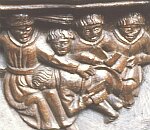 Misericords and Choir Stall Carvings: Education Imagery and Satire in Medieval Choirs
Discusses, with illustrations, the numerous appearances in church choir stalls of carvings of boys having their bottoms birched.
School Punishment Book 1954-60
A primary school on the edge of London reproduces some extracts from its punishment book in the middle 1950s (all canings of boys on the hand).
 Sparing the Rod: Schools, Discipline and Children's Rights
Advertisement for a book, published July 1999, which I have not seen: it claims to be the first book to trace the history of corporal punishment in schools, which certainly isn't true.
Archives of the Society of Teachers Opposed to Physical Punishment, 1968-1989
You can consult STOPP's records (108 boxes of them, it says) at the Institute of Education in London.
Retiring Headmaster
Transcript of a radio interview: a retiring headmaster recounts an amusing anecdote about a caned 16-year-old boy and his complaining mother.
Muggeridge: The Biography
Chapter One of Richard Ingrams's book on the writer Malcolm Muggeridge, who attended a grammar school in Croydon at the time of the First World War. The headmaster was keen on caning boys, and on one occasion Muggeridge supposedly seized the cane and broke it.
Punishment at Spring Hill School
Quotes an extract from the logbook of a Lancashire primary school, recording the caning of some girls in 1902.
 Brian Jones
According to this page from "Rock and Roll Heaven", Brian Jones of the Rolling Stones (the vaguely handsome one of the group, who died at age 27) was frequently caned at school in the 1950s.
The Jewish Way of Child Abuse
This distressingly screwed-up chap is talking about emotional abuse by his parents at his middle-class north London home in the 1950s, but in passing he also mentions canings at junior school (Hendon) and grammar school (Edgware).
Should corporal punishment be reintroduced into the school system? (Alternative link)
Essay by a schoolboy who says he would not like to be caned.



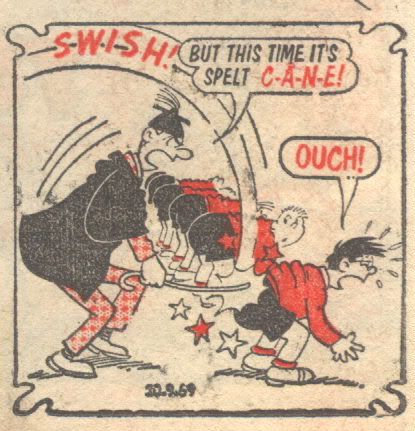
 Web links: School CP: Other countries
 UNITED KINGDOM