Notes:
(1) Most external links on this page are to documents in PDF format, so this is no longer indicated separately for each document.
(2) Where paddling statistics are cited, they come from the US Department of Education's Office for Civil Rights online database, unless otherwise stated.
LOUISIANA: private and charter schools
Beekman Charter School, Bastrop
It is no longer the case here that there is no parental opt-out from CP: Parents may now request exemption, but must do so in writing annually. "Paddling of the student's buttocks is the only corporal punishment that shall be administered."
D'Arbonne Woods Charter School, Farmerville
At this K-12 school, "Parents who object to the use of corporal punishment are advised to remove their child from DWCS and place them in a school that does not implement corporal punishment." The only CP allowed is "paddling of the student's buttocks".
Stats: No CP was recorded in 2015/16. During 2017/18, 10 boys and 7 girls received spankings.
Family Worship Christian Academy, Opelousas
"A wooden paddle will be used. Swats will not be administered with the hand." There is a maximum of five swats per occasion (or two, for students under seven).
First Baptist Christian School, Slidell
At this school for grades 1 through 12, CP is a discipline procedure for Class II violations such as disrespect for authority, cell phone misuse, failing to turn in disciplinary assignments, reckless driving of a vehicle on campus, and skipping detention. See pages 8 and 9 of the handbook. "The school administrator will administer a paddle to the buttocks in the presence of a staff witness." There is a maximum of four swats. Parental approval is required. The parent may choose to come to the school and deliver the swats him- or herself, with an administrator as witness.
Kingston Christian Academy, Shreveport
The paddle used at this K-12 school is kept in the principal's office. Its dimensions are no longer specified (previously 24" by 5" by ⅜"). There is a maximum of three swats, applied to the student's buttocks.
Northside Christian School, Crowley
Parents must sign their consent to "corporal correction" upon enrollment.

Oak Forest Academy students have all signed a statement agreeing to be paddled if necessary.
Oak Forest Academy, Amite
At this Christian school, student and parent must both sign a statement (page 1 of the handbook) agreeing that "corporal punishment may be used". Also, "A reasonable paddling may be administered upon parent request". In grades 7 through 12, CP is a consequence for category 1 and 2 offenses but not category 3 (the most serious).
Ouachita Christian School, Monroe
At the Middle and High School, "Corporal discipline may be administered by the OCS administration and/or staff when deemed appropriate and necessary." It may be used for a first offense of lying, cursing or disrespect to an adult.
See also the Application for Admission, where the student as well as a parent must sign that they accept that disciplinary action includes corporal punishment.
Riverfield Academy, Rayville
"The Riverfield Academy Board of Directors shall allow reasonable corporal punishment of unruly pupils [...] Refusal of corporal punishment may result in the student being suspended."
Slidell Christian Academy
This handbook includes a form which parents must sign "giving consent for this policy (including corporal punishment/spanking". If a spanking is necessary, "the parent will be informed of this and expected to carry out the spanking at home after school for the first two such offenses. The third and subsequent offenses will require that the parent (normally the Father) be called to come in IMMEDIATELY to SCA to administer the spanking". Parents are also told they must "exercise proper Biblical discipline procedures including spanking" at home.
Open Door Christian Academy (formerly Southland Christian Academy), Denham Springs
At this K-12 school, "Corporal correction" may be applied to students who earn "excessive detentions".
These Louisiana private schools also state that they use corporal punishment, but give few or no details:
Bowling Green School, Franklinton
Lafayette Christian Academy
Silliman Institute, Clinton
Tallulah Academy
Westminster Christian Academy, Opelousas
LOUISIANA: public schools
Beauregard Parish School Board (covers DeRidder, Longville, Merryville, Singer)
Corporal punishment "shall consist of two licks with a paddle", administered to the student's buttocks by the principal or designee. It is no longer specified that it should be a "last resort". Parents "may" (but not "shall") be notified. CP is also specifically mentioned for a second school bus disturbance.
Stats: There were 85 paddlings in Beauregard Parish in 2013, falling to 28 in 2014/15 and 34 in 2015/16, according to this Dec 2016 news report, which also says that students may be given a choice between a paddling and either ISS or detention.
Central Community School System (covers parts of Baton Rouge, Central, Greenwell Springs)
There is a maximum of three swats, to be applied to the student's buttocks. Only the principal or assistant principal may administer it. Parents may sign a form to opt out. The paddle is 20 in. long, 4 in. wide and not more than half an inch thick. "A log will be kept on all paddlings".
Claiborne Parish School Board, Homer
"Corporal punishment shall be limited to punishing or correcting a student by striking the student a maximum of four (4) times on the posterior anatomy in an area below the waist with a standard paddle supplied by Claiborne Parish School Board."
Iberia Parish School Board (covers Delcambre, Jeanerette, Loreauville, New Iberia)
Corporal punishment must be administered with a paddle to the student's buttocks only.
Jackson Parish School Board (covers Jonesboro, Quitman)
"Each school should have dedicated personnel that are authorized to paddle students."
Monroe City Schools
Parents are given the opportunity to deny permission for paddling (see form near beginning of handbook). Otherwise, it may be used when other remedies, short of suspension, have been tried without success. A student "may not receive more than three (3) applications of the paddle at any single session" and "may not receive a paddling more than once in any single school day". "Each school has designated people/person authorized to paddle students."
Morehouse Parish Schools (covers Bastrop, Mer Rouge)
Corporal punishment may be given by any teacher, but not by bus drivers. The teacher may spank with his or her hand (it is unusual for this to be specified in official rules), or else use a paddle 20" long, 4" wide and half an inch thick, with a maximum of 3 swats on the "buttocks area". The principal must give permission and there must be a witness. Documentation required includes information as to the race of the student punished. "Mandatory suspension" is the automatic penalty for refusal to submit to a spanking. On a second suspension for this reason (among others), the student may be expelled.
Parents may fill out a form requesting that their son or daughter not be spanked.
Stats: In the past, Morehouse has been the public school district with the highest rate of corporal punishment in Louisiana (8.6% of all students were paddled in 2011/12).
Natchitoches Parish School District
"Corporal punishment shall be administered on the buttocks only. A paddle made of wood with no holes or splinters shall be used in administering corporal punishment, and the paddle is not to exceed twenty (20) inches in length, one fourth (1/4) inch in thickness and at least three (3) inches in width, with rounded edges and corners." There is a maximum of four strokes.
See also this April 2015 news item.
Pointe Coupee Parish Schools, New Roads [DOC]
Here, CP may be administered only by a principal or assistant principal, using a standardized paddle furnished by the central office. There is a maximum of three licks in grades K through 6, and five licks in grades 7 through 12. Paddling may be administered in lieu of short-term suspension for a long list of offenses including insubordination, skipping class, smoking, disrupting the lunch room, and excessive tardiness.
Richland Parish School Board (covers Archibald, Delhi, Holly Ridge, Mangham, Rayville, Start)
Here, "reasonable corporal punishment of unruly pupils" is allowed "by paddling the buttocks only". Unusually, dimensions for two different paddles are given: max. half an inch thick for the senior high schools (grades 9 through 12) and max. a quarter of an inch thick for all others. In both cases the paddle must be from 4 to 6 inches wide, and from 15 to 18 inches long.
Stats: In this district there were 84 paddlings in 2015/16, mostly at the elementary schools.
Sabine Parish School Board (covers Converse, Florien, Many, Negreet, Noble, Pleasant Hill, Zwolle)
Corporal punishment must take the form of paddling (max. 5 swats) "in" [sic] the buttocks, with the permission of the principal and in the presence of another staff member. CP may also be offered as an alternative to short-term suspension. It may not be used if parents have submitted a form to that effect. Bus drivers are forbidden to spank.
Vermillion Parish Public Schools (covers Abbeville, Erath, Gueydan, Kaplan, Maurice, Rayne)
See p.15. Paddles used here must be 14 to 15 inches long, 6 inches wide, and half an inch thick. The paddle must be applied to the student's posterior, with a maximum of five strokes.
History: See this Nov 2011 news item.
Webster Parish School Board (covers Cotton Valley, Doyline, Dubberly, Minden, Sarepta, Shongaloo, Sibley, Springhill)
"Corporal punishment (spanking)" is permitted for "unruly pupils". Parents may exempt, in which case they must be prepared to come to the school to pick up the student during the school day. A female staff member must be present when girls are spanked. Only the buttocks may be paddled. The paddle is 15 inches long, 6 inches wide and half an inch thick. There is a maximum of five licks. This is the handbook for the four high schools (grades 9 through 12), but the CP language applies across the district.
These Louisiana public schools also state that they use corporal punishment, but give few or no details:
Allen Parish School Board, Oberlin
-- Kinder High School
Avoyelles Parish School Board, Marksville (grades K-6 only)
-- Stats: 145 paddlings in 2013/14, according to this Dec 2016 news item.
Bossier Parish Schools (covers Benton, Bossier City, Elm Grove, Haughton, Plain Dealing, Princeton)
-- History: See this March 2009 news item, which says that 40 students were paddled here in 2008, and this Oct 2014 report.
Concordia Parish School Board (covers Ferriday, Monterey, Ridgecrest, Vidalia)
Evangeline Parish School Board, Ville Platte
-- History: See this March 2008 news item and this Nov 2011 report.
LaSalle Parish Schools, Jena
Ouachita Parish School Board (covers Calhoun, Monroe, Sterlington, Swartz, West Monroe)
-- History: See this Oct 2013 news item and this video clip showing two actual paddlings under way in 2013 at Richwood Middle School in West Monroe.
Vernon Parish School Board, Leesville
-- Stats: There were 275 paddlings here in 2013/14, according to this Dec 2016 news item.
MARYLAND: private schools
St. Stephen's Classical Christian Academy, Eldersburg
-- Parent Questionnaire
"Defiant and rebellious behavior warrants paddling." The questionnaire asks parents: "Do you hereby delegate to the Headmaster and Rector the authority to apply corporal punishment (spanking) to your children in accordance with the guideline outlines in the Parent Student Handbook? Yes/No."
MICHIGAN: private schools
Northern Michigan Christian Academy, Burt Lake
"I understand that the school has full discretion in the classroom discipline of my child(ren), which includes corporal punishment (spanking). I understand my right to discipline my child personally at the school rather than it come directly from an administrator."
MISSISSIPPI: private schools
Amite School Center, Liberty
"Violation of rules may result in corporal punishment or whatever the Headmaster deems appropriate." It must be administered by the headmaster or assistant headmaster. A consent form must be signed by parents.
Benton Academy
Teenagers at this private Christian school who display "disrespectfulness to adults" may receive an immediate spanking. Corporal punishment is the first type of discipline listed for the adolescents in the "Types of Disciplinary Action Used by Secondary Administration."
Brookhaven Academy
In grades 7 through 12, CP comes second in the discipline ladder after detention. Also, the third detention in a 9-week period "will result in corporal punishment". Additionally, "Corporal punishment may be used as a choice for other disciplinary sanctions (with parental/guardian approval)."
Canton Academy
CP is a "viable disciplinary option". It is to be administered by the Head of Schools or the Elementary Principal or designee, with parental consent. Suspension may be an alternative.
Carroll Academy, Carrollton
"Carroll Academy has full discretion in the discipline of students while at the school, including paddling."
Columbia Academy
At this K-12 school, staff "shall have the right to administer corporal punishment to any student for a violation of any rule or regulation". Parental acceptance of paddling "is assumed by the signing of the handbook signature sheet and/or continued enrollment in Columbia Academy".
Copiah Academy, Gallman
Discipline with the paddle is offered in grades 3 through 12. It is the school's policy "to administer corporal punishment at the discretion and at the direction of the Headmaster". Parents are contacted beforehand. Student and parents are given a choice of up to 3 licks or up to 5 days' suspension. "When possible men will administer punishment to boys and women will administer punishment to girls."
Deer Creek School, Arcola
In grades 7 through 12, "The school reserves the right to administer discipline to the extent deemed necessary including corporal punishment". Paddling is the only method to be used. There is a maximum of three licks.
Friendship Christian Academy, Victoria
Corporal punishment is one of the "more serious consequences" for misbehavior. Property damage brings "automatic paddling (3 licks)". CP is also automatic in cases of inflicting harm on another person, disrespecting the staff, and "three occurrences of the same problem". Parents who have "opted out" must come to the school office immediately and administer the paddling themselves.
Grace Christian School, Louisville (Mississippi)
"Spanking will not be the only means of discipline; however, neither will it be a 'last resort'." It is preferred that the parents perform this task at home, but "parents agree to allow school personnel to administer corporal punishment (spanking) as necessary".
Heritage Christian Academy, Holly Springs [DOC]
CP is available for repeated Level I violations and first instances of Level II or Level III violations.
Heritage Academy High School, Columbus (Mississippi)
This document, for the junior and senior high school, includes a corporal punishment agreement form which the student as well as the parent must sign. "If corporal punishment is refused as a disciplinary measure, then two days of out-of-school suspension (OSS) is a mandatory requirement."
Hillcrest Christian School, Jackson
CP is mentioned as a method of discipline at both the Lower School and the Upper School. "In the event that corporal punishment is warranted", the Dean will call the parents to discuss it. The Principal is authorized to administer CP, with parental permission.
Kirk Academy, Grenada
Corporal punishment is "used in cases deemed necessary" (see page 19). In particular, boys who wear their hair too long or who are unshaven for a third time "will receive internal suspension or corporal punishment" (see page 28).
Leake Academy, Madden
"Corporal Punishment (Paddling)" comes first in a list of "forms of disciplinary action" at this K-12 school. The document stresses (in capital letters) that all teachers may paddle all students.
Madison-Ridgeland Academy, Madison
"Spankings will be administered" in grades 6 through 12.
North Delta School, Batesville
At this K-12 Christian school, "there are times when the school administration will deem corporal punishment to be a necessary punishment". "Parents will be given the option of 'licks' or a one-day in-school suspension for their child's unacceptable behavior."
North Sunflower Academy, Drew
Parents must agree to the use of CP (without parental notice) when they sign up for this K-12 Christian school. The offenses for which "licks" may be provided include talking in class, inappropriate attitudes, fighting, and failure to turn in homework. Unusually, the staff members empowered to paddle are listed by name. Female students are punished by the "Headmaster" [sic] or the High School Supervisor, who are currently both female. The spanking of boys and young men is handled by the (male) Athletic Director.
Oak Hill Academy, West Point
"Corporal punishment may be used as a sanction for misconduct at Oak Hill Academy. ... Parents will be required to sign corporal punishment form."
Presbyterian Day School, Kosciusko
"The vast majority of discipline problems are to be dealt with at the classroom level and may include spanking by the teacher or spanking by the parent in the presence of the teacher."
Sylva-Bay Academy, Bay Springs
"Parents will sign an enrollment contract which states corporal punishment may be used." There is a maximum of 3 licks, administered to the buttocks with a wooden paddle, "in the privacy of an office".
Simpson County Academy, Mendenhall
"All students who attend Simpson Academy are subject to corporal punishment, or paddling." This covers grades K through 12. Parents are required to sign a form approving the use of CP, which is mentioned in particular for "when a student wilfully disobeys school rules or is a repeat offender" and where "circumstances indicate the need for strong measures".
Tri County Academy, Flora
"Corporal punishment is an integral part of a good disciplinary program."
See also this Feb 2014 news item and this June 2014 follow-up.
Wilkinson County Christian Academy, Woodville
Corporal punishment is available for nearly all offenses, including possession of tobacco, cutting class, public display of affection, cell phone misuse, and "acting in a manner that brings shame or embarrassment to the school reputation."
Winona Christian School, Winona
"Corporal punishment will be administered as needed by WCS." It is particularly mentioned as a penalty for a first tobacco offense and now also for a fourth and fifth tardy per nine-week period.
These Mississippi private schools also state that they use corporal punishment, but give few or no details:
Bayou Academy, Cleveland (Mississippi)
Hebron Christian School, Pheba
Humphreys Academy, Belzoni
Marshall Academy, Holly Springs
Oxford Christian Academy
Park Place Christian Academy, Pearl
Parklane Academy, McComb
Russell Christian Academy, Meridian
Tunica Academy
Winston Academy, Louisville (Mississippi)
MISSISSIPPI: public schools
Alcorn School District (covers Corinth, Glen, Rienzi)
Corporal punishment (maximum now reduced from five to three licks) is permitted as a disciplinary measure for a wide variety of specified offenses including disruption, loitering in the halls, and defiance. For being tardy to school, CP is now available at the first offense, instead of only from the third offense as in previous versions. "Licks will not be given for failing to do assignments or for a failing grade." An unusual provision is that "No coach will paddle at a practice. The student(s) will be taken to the principal the next morning to receive punishment". Also, "The Alcorn Career Center will make all paddles for the district".
Stats: There were an estimated 80 paddlings at the three senior high schools in 2009.
Attala County School District
At p.54 is a form on which parents state whether they consent to CP or not. If not, they should "speak to the principal about other options in cases of misbehavior".
History: See this April 2013 news report, which stated that paddlings were frequent in Attala County.
Baldwyn School District
Corporal punishment is specifically mentioned for profanity, gambling, trespassing, theft, and misconduct in ISS.
Choctaw Tribal Schools
This group of schools for Native Americans is operated by the Mississippi Band of Choctaw Indians and has nothing to do with Choctaw County Schools (see following item).
CP "is limited to the striking of a student on the buttocks with a paddle" by the principal or assistant principal. The witness must be a tribal member. The student's classroom teacher should NOT be a witness. If paddling is refused, suspension is mandatory. Parents must sign a form indicating whether or not they wish CP to be used.
Choctaw County School District, Ackerman
CP is not mentioned for any specific offenses at the elementary level, but may be substituted for ISD at the discretion of the administration.
From 7th through 12th grade, "CP or 2 days ISD" is the specified penalty for a large number of crimes at the first or subsequent offenses, including being in an unauthorized area, "misbehavior with substitute teacher", cutting class, cheating, no hall pass, loitering after school, "inappropriate romantic display of affection", profanity, misuse of computers, etc. and for a second or third offense of possessing over-the-counter medicines. However, "Corporal punishment will not be offered for students who are tardy to school" (this was new in 2022). There is a maximum of three licks per paddling, which shall be delivered to the student's buttocks.
Stats: Some 135 students were paddled at Ackerman High School in 2009 (95 boys and 40 girls), about 32% of the student roll.
Coffeeville School District
In general, corporal punishment (or detention) appears at step two of the Discipline Ladder, and for a second office referral for misbehavior on the bus. However, the principal has the right to use CP "in any situation when deemed necessary". Also, CP or ISS is the penalty for a fourth tardy to school.
Parents may submit a written request for exemption. Action in lieu of or in addition to CP may include requiring the parent to attend classes with the student.
Stats: School year 2009 saw some 140 paddlings at Coffeeville High School.
DeSoto County Schools (covers Hernando, Horn Lake, Lake Cormorant, Olive Branch, Southaven, Walls)
[Site is geo-blocked -- Needs VPN to access from outside USA]
Although it is in Mississippi, DeSoto County is de facto a suburb of Memphis TN. It is a huge school district. Spanking consists of up to three licks "with an appropriate instrument" on the buttocks per incident.
CP "may be administered to students of all ages, but it is suggested that students in grades 6-12 be given a choice of other punishment instead of corporal punishment". Parental permission is not required, but individual students may be exempted at the parent's request.
History: See this Jan 2006 news item and this Feb 2006 follow-up (both with video clips) about a mass paddling of boys by the football coach at Olive Branch Middle School, and this further follow-up of April 2006 giving paddling statistics for the district and revising downward the number of boys said to have been spanked in the incident from around 20 to 10.
See also this April 2006 report on paddling as an alternative to suspension for dress code violations at Horn Lake Middle School, and this Oct 2009 news item revealing that 2,505 parents in the district have sent letters asking for exemption from CP -- only about 8% of the total.
Stats: This Sep 2010 news report says that 3,140 DeSoto County students (10.5% of the total -- about average for Mississippi) received CP in the then latest school year, in 4,993 spankings.
East Jasper Consolidated Schools, Heidelberg
Paddling is used for Level 3 infractions, with written authorization by parents. There is a maximum of "three strikes to the buttocks".
Stats: Heidelberg High School introduced paddling by the 2011/12 school year, having previously recorded zero instances of CP since 2000/01. During 2015/16, 11 of the 127 boys, and 26 of the 161 girls, received swats -- a very rare case of significantly more girls than boys being spanked.
East Tallahatchie School District
"One day ISS or corporal punishment, with parent contact" is the consequence here for a first dress-code violation. The same applies to a second or third referral for having a backpack in the hall or for any other minor offense. ISS or a paddling at the principal's discretion is also meted out for a fourth and subsequent tardy to school.
If a student refuses a paddling or a parent objects to it, a three-day suspension is substituted. "The three-day suspension is for refusal to take the punishment by either the student or by the objections of the parent and in no way limits the principal from suspending a student for a period of time greater than three (3) days." CP is "used for disciplinary reasons only and not for academic purposes".
This is the handbook for Charleston High School; the middle and elementary schools have similar policies.
Enterprise School District (Mississippi)
"Corporal punishment will be administered by the teacher or administrator if the student deserves such punishment." Students violating the bus rules for a second or third time will be suspended from the bus "or receive three paddle licks from the principal". It is now required that the spanking be administered "only to the student's buttocks in such a way that there will be no permanent damage". Parents "who DO NOT wish for their children to be paddled MUST meet with the principal at the beginning of each year on the school campus, sign a form refusing permission, and agree to remove their children IMMEDIATELY from the campus when called. Refusal by a student to receive corporal punishment may result in suspension."
In grades K through 4, CP may be administered for a third and fourth office visit. In grades 5 through 12 it may be used on any office visit from the second through the fourth.
Forrest County School District, Hattiesburg
All teachers may administer CP. Paddles must be approved and initialed by the building principal. "Suspension is mandatory in cases where corporal punishment is refused." There is no reference to parental consultation or consent. Parents are informed afterwards.
History: See this Jan 2007 news item, reporting that CP was used regularly here at that time.
George County School District, Lucedale
See Policy JKA on page J-68. CP is to be given by the principal or designee, with a wooden paddle of normal size, solid with no holes. "Licks must be administered to the buttocks only." If the student "refuses to take punishment" the issue must not be forced; instead the student will be sent home for three unexcused days, or until such time as he or she returns with a parent. When a teacher sends a student to the principal's office to be disciplined, the decision on how to deal with it rests with the administration, and the teacher must not tell the student that he/she is going to be paddled or suspended.
Greenwood Leflore Consolidated School District, Greenwood
This district defines CP as "punishing or correcting a student by striking the student on the buttocks with a paddle", and lays down a maximum of five swats per paddling. It is administered by the principal or assistant principal, and must not be used for academic lapses.
Grenada School District (Mississippi)
The Board of Education "views corporal punishment as a form of discipline" but if a parent "chooses not to participate" [sic] in it, the form at page 60 must be signed, and "an alternative means of discipline will be used".
"All corporal punishment must be administered to the buttocks only" with an approved paddle. It is a "possible corrective strategy" for violations at Level 2 and Level 3, but not Level 1 (the least serious). This is the handbook for the High School (grades 9-12); other schools in the district use similar language.
Harrison County School District (covers part of Biloxi, Christian, D'Iberville, Gulfport, Saucier)
The principal or assistant principal must be present at all spankings. Parental permission must be given beforehand. CP must be administered "to the buttocks only" and must not be excessive, though no maximum number of swats is stipulated. Every paddle used must be approved and initialed by the building principal; it must be kept in the office. A form, recording the number of licks administered, is to be taken home by the punished student and given to his or her parents.
Stats: This district did not formerly make heavy use of the paddle by Mississippi standards: 980 spankings in 2004/05, or only 7% of the student roll. But this Oct 2009 news item says that figure had risen to 1,702 by 2008/09.
Hazlehurst City School District
Corporal punishment, to be delivered by an administrator only, is listed as a consequence for a long list of widely varying offenses, according to the somewhat confusing Discipline Ladder. The CP consent form must be signed by the student as well as the parent.
Itawamba County School District
All students here are subject to corporal punishment, and no teacher may be sued for using it. Parents do not have any right to object to the use of CP for their students, a previous provision giving them an opt-out on written request having been withdrawn in 2005.
At the four high schools, CP (2 swats) is an alternative to 2 half-hour detentions at step 1 of the discipline ladder. At step 2, it is 3 detentions or 3 swats.
History: See this Oct 2005 news item.
Kosciusko School District
At both elementary and secondary levels, corporal punishment is available for defiance, insubordination and electronic device violations.
Lauderdale County Schools (covers Collinsville, Meridian)
CP is indicated at Step 2 of the Discipline Ladder. It must be administered in the principal's office. Parents are informed, and may "deny corporal punishment to their child" by making a written request.
Lee County Schools (covers Belden, Guntown, Mooreville, Plantersville, Saltillo, Shannon, Tupelo, Verona)
CP is a means of enforcing the rules when other methods fail. It is indicated for a first or second offense of "unacceptable behavior", but not for a third such offense, at which point the student is suspended.
History: See this May 2010 news item about a paddling at Saltillo Elementary School.
Stats: There were about 1,000 paddlings here in school year 2004/05. This Oct 2009 news item says that figure had risen to 1,707 paddlings by 2008/09.
Louisville Municipal School District (Mississippi)
Step 2 of the Discipline Ladder here is "Corporal punishment or in-school suspension". In grades 3 through 12, a student whose parents have submitted a written no-CP request, "or who refuses to be paddled", will serve up to three days' OSS. "Upon refusal of corporal punishment, the student will automatically be added to the No Paddle list."
CP is also specifically mentioned as a consequence for a fourth or subsequent tardy per semester.
Stats: 465 students (332 boys, 133 girls) received a total of 533 spankings in this district as a whole in 2015/16.
Lowndes County School District (covers Caledonia, Columbus)
Certified staff should serve as witnesses to CP. An unusual stipulation is that "The punishment must be terminated if the witness refuses to witness further". CP "shall be administered to the buttocks only". Parents not wishing their students to be spanked must fill out a form.
Corporal punishment is mentioned particularly for a first offense of stealing (grades K-5 only), a first offense of profanity or vulgarity, and a third or subsequent tardy per nine-week period.
Stats: 86 students received spankings in this district in 2013/14, of whom 67 boys.
Madison County School District (covers Camden, Canton, Flora, Germantown, Madison, Ridgeland)
Corporal punishment may be administered for a fourth or subsequent tardy to class (in the case of middle- and high-school students), and is also particularly indicated for taking part in a minor fight, and unauthorized cellphone use, as well as serious offenses in general. All paddles, when not in use, must be stored in the office. Parental requests for non-use of paddling must be made in writing.
See also this Oct 2009 news item, stating that there were 1,104 paddlings in 2008/09, that Madison County students may be spanked for disrespect, and that one of the adults present must be of the same race as the student and another must be of a different race.
And see this Nov 2015 news report, in which a student who was paddled in 9th grade at Ridgeland High School describes the modus operandi (bending over with hands on a desk).
Marion County Schools, Columbia (Mississippi)
There is a maximum of 3 licks with a paddle in all grades (K-12). CP is particularly mentioned for a 5th or 6th tardy per nine-week period, and for first or subsequent offenses in Category II (fireworks, tobacco, gambling) and Category III (defiance, theft, obscenity, leaving school grounds without permission).
McComb School District
CP must be administered by the principal or assistant principal, and only with written parental consent.
See also this July 2012 news item.
Mississippi Achievement School District (formerly Humphreys County School District), Yazoo City
"Corporal punishment includes whipping, spanking, and paddling." It "shall not be administered on any part of the body except the student's buttocks", nor should it "leave any marks or bruises on the skin or flesh", which seems unrealistic when we know that even a moderate paddling can cause (transient, mild and harmless) bruising on some recipients.
Monroe County Schools (covers Aberdeen, Becker, Hamilton, Hatley, Smithville)
In grades 7-12, CP or one day's ISD is the penalty for a third tardy per nine-week period. It may also be used for cell phone and bus offenses. More generally, paddling features at levels 2 and 3 of the Discipline Ladder for grades K-12. "The instrument to be used shall be a paddle and the part of the body to be struck shall be the buttocks."
See also this Apr 2018 news report (with video clip), which quotes the Principal of Smithville High School saying many students choose a spanking over detention because "they would rather just get it over with [...] If a kid here takes a paddling it's because they chose to take one".
New Albany Schools
Paddling is applicable to all students from kindergarten through grade 12. The maximum number of licks is three. These may be administered for a first or repeated Class I or Class II violation, and for a first Class III violation. CP may also be given for a second school bus offense in lieu of five days' suspension from riding the bus, but for some reason this applies only to grades K to 8.
The handbook contains a form on which parents are invited to state whether they do or do not wish corporal punishment to be used.
Stats: This Oct 2009 news item says there were 1,249 paddlings in New Albany Schools in 2008/09.
Newton County Schools
For grades 6 through 12, corporal punishment features at steps 2 and 3 of the discipline ladder. It may also be used for a first, second or third case of misbehavior on the school bus, and for a third dress-code violation. Additionally, paddling or Saturday School is given when a student accumulates five tardies. And, "All cases of cheating will be reported to the principal. The student(s) will be given a zero for the assignment on which the student(s) is working and corporal punishment."
"Three licks on the buttocks shall be the maximum number applied." The instrument is "a flat-surfaced paddle that will cause no more than temporary pain and not inflict permanent damage to the body". Refusal to take CP will result in suspension. Parents may opt out by filling out a form.
Stats: During 2017/18, 63 boys and 49 girls were spanked at Newton County High School. Six boys and two girls received a paddling at the East Central Alternative School.
North Bolivar Consolidated School District, Mound Bayou
A commendably straightforward statement: "The striking of a student on the buttocks with a paddle or strap by a principal or designee is used as necessary to maintain discipline and/or enforce school rules."
See also this Apr 2013 news item, stating that paddling was used frequently at that time.
North Panola School District, Sardis
-- Corporal Punishment Consent Form
CP may be applied for a second minor infraction and a first intermediate infraction. It is also available for misbehavior on the school bus.
Okolona Municipal School District
"Okolona School District uses corporal punishment as a means to correct behavior. Prior to issuing corporal punishment, a phone call will be made to the parent/guardian." Paddling appears to be deemed a less serious matter than previously: it is no longer mentioned as a penalty for bullying or harassment, but it is available for a second minor bus infraction or as an alternative to one day in ISD for a second cell phone violation. "Contact your school for an opt-out form for you to sign if you choose not to have your child paddled."
Pearl Public School District
At the elementary level (page 79), paddling is available only for Category 1 offenses.
At the junior high (page 95), "Corporal punishment may be used at the principal's discretion in lieu of OSS, ISS, or ISD."
And at Pearl High School (grades 9 through 12), students may be spanked for a long list of offenses (starting at page 123) at Levels I through III from tardiness to careless driving. There is a maximum of three licks.
See also this Apr 2013 news item.
Picayune School District
-- Picayune Junior High School
At step 1 of the discipline ladder comes "One - two periods after-school detention, or two licks (corporal punishment)". Step 2 brings three to five detentions, or three licks.
Pontotoc County School District
-- Teacher Handbook
-- Student Handbook
CP may be administered "by or in the presence of" the Principal, Assistant Principal or a teacher.
The Teacher Handbook sets out an "order of disciplinary action": 1. Reprimand, 2. Paddling, 3. Saturday Detention, 4. Suspension, 5. Expulsion. "The student has the right to forgo paddling and accept suspension or other disciplinary action at the discretion of the principal."
From the Student Handbook we learn that CP may be used for a first, second or third offense on the school bus (p.9). In grades 6 through 12, it can be applied for a third or subsequent tardy to class, a first offense of truancy, and for a wide range of other violations including out of place, disrespect, profanity, continuous use of gum, and excessive talking (pages 10 to 13).
"A student or parent may request in writing an alternative type of punishment instead of corporal punishment."
Prentiss County Schools (covers Booneville, Marietta, New Site)
Corporal punishment may be administered for a second school bus offense. More generally, CP may be the consequence for various specified offenses.
Rankin County School District (covers Brandon, Florence, Flowood, Pelahatchie, Puckett, Richland, Sandhill)
CP is generally to be used when other methods have proved ineffective. In addition to taking account, when delivering the spanking, of the student's age, size and condition -- a standard, if probably fairly meaningless, rule -- the "size, strength and temperament of the disciplinarian" is also to be considered. Paddling is specifically mentioned for a first offense of minor misbehavior on the school bus.
Stats: This Oct 2009 news item says there were 742 paddlings in Rankin County in school year 2008/09.
Richton School District
Corporal punishment shall be "applied only to the student's buttocks in such a manner that there will be no permanent effects". If the parent or student refuses the paddling, the only alternative is five days' out-of-school suspension.
For Class I offenses (the less serious, e.g. profanity, 3 or more tardies, parking violations, "unpleasant odor in classroom"), the penalty at the first step is one lick or one day ISI. At step 2 this escalates to 3 licks or 2 days OSS or 2-3 days ISI. For more serious violations (Class II), students get 3 licks on the first as well as subsequent occasions.
This is the High School handbook; the Elementary School has similar language as regards CP.
There is an Alternative School, to which errant students may be assigned for up to 45 days. For offenses committed while there, "they will receive either corporal punishment or OSS as deemed fitting by the Alternative School teacher and the administration".
Stats: 89 students in this district were officially spanked in 2013/14, of which 59 (52 boys, 7 girls) at the High School.
Scott County School District, Forest
-- Bettye Mae Jack Middle School -- Technology Lab [DOC]
"When necessary, reasonable corporal punishment is permitted." It is applied "to the student's buttocks in such a way that there will be no permanent damage". Parents who want to forbid this have to meet with the Principal at the start of each year in person. The student may then be given ISS or OSS instead. Paddling is particularly mentioned as a penalty for a second bus incident.
In the tech lab at BMJ Middle School, students are bluntly told that upon a third instance of misbehavior, "You will be paddled".
Smith County School District, Raleigh (Mississippi)
See p.19. For minor rule violations, the student may be offered a paddling (up to 3 licks) in lieu of other punishment. Students in grades 7 through 12 "may refuse to be paddled", in which case they are suspended for 3 days. CP is specifically mentioned as a penalty for a first offense of profanity (p.11).
Stats: There were an estimated 490 paddlings at this district's three high schools in 2009.
South Delta School District (covers Anguilla, Rolling Fork)
It is stressed that CP may be used only for disciplinary reasons and not for academic failings or failure to turn in assignments. There is a maximum of five licks with the paddle, to be delivered "only to the fleshy part of the buttocks". The elementary paddle is 14 inches long, 2 inches wide and a quarter inch thick. At the middle and high schools the dimensions are 15" x 2" x ⅜". The material is oak or ash wood. Paddles should not be on public display. Parents may fill out a form to request that their son or daughter not be spanked.
South Panola School District, Batesville
A paddling may be administered for any level I or level II offense as an alternative to ISS, as also for a second violation of the electronic devices policy. CP (or one day's ISS) is also used to punish tardies. There is a parental opt-out/opt-in form at page 51, which also states that parents are contacted by phone before the paddling takes place.
Stats: This Oct 2009 news item says there were 2,376 paddlings in South Panola district in the school year 2008/09.
South Tippah School District, Ripley
Corporal punishment is defined as "Student receives a paddling". It comes into play for a first or subsequent violation at Level I, and a first violation at Level II or Level III. This is the handbook for Ripley High School; other schools in the district have identical language.
Sunflower County Consolidated School District, Indianola
This district was previously called Indianola. It no longer features individual handbooks for each school.
CP will not be administered where parents have submitted a written objection to it. Paddlings are administered in the principal's office by the principal or assistant principal. CP is specifically mentioned for various minor rule infractions, as an alternative to ISD.
See also this Nov 2015 news article, in which a sophomore at Gentry High School said he got sent to the detention room for an immediate paddling for "being a few seconds late to class or wearing the wrong belt".
Stats: No CP was recorded at Gentry High School in 2011/12. Two years later, 77 boys and 23 girls received paddlings on at least one occasion.
Tishomingo County School District, Iuka
[Site is geo-blocked -- Needs VPN to access from outside USA]
-- Student handbook
The board policy states that "no student shall receive more than three (3) licks per incident". It is no longer stipulated that "no student shall be paddled more than one time in a day".
According to the student handbook, "Corporal punishment may be administered when deemed appropriate." Parents should be notified, but there does not appear to be any provision for them to object. CP is particularly mentioned as a penalty for fighting.
Tunica County School District
Corporal punishment is administered by the Superintendent, Principals and Assistant Principals. The paddle is to be max. 18 inches long, 6 inches wide and, the document says, one and one-eighth of an inch thick (surely much too thick -- possibly a misprint). It must be "administered to the buttocks only", and a maximum of three licks is "highly recommended". CP must be carried out in private, such as in "the principal's office, lounge, or vacant teacher's room". The discipline form must be signed by the paddled student him- or herself as well as by the paddler and the witness.
An unusual provision is that "If corporal punishment must be administered to one individual more than two (2) times in any school session, a suspension or some other approved form of punishment by the principal may follow".
Union County School District (covers Blue Springs, Myrtle, New Albany)
There is a maximum of three licks per day. Refusal to take a paddling "will result in specific suspension which will constitute an unexcused absence". The student being spanked "will be given a disciplinary referral to take to the parent(s)". School officials "will attempt to comply" with a written parental request for exemption from CP, but have no legal obligation to do so. Paddling is mentioned in particular for a second bus offense, dress code violations, parking-lot violations, and three or more tardies in a semester, among other things.
Local sources report that all high-school teachers have a paddle in their individual classrooms. These paddles are made of Lexan (polycarbonate), thought to be less likely to bruise the student's buttocks than a wooden paddle, all other factors being equal.
Stats: During 2015/16, 136 boys and 23 girls received a total of 368 spankings.
Vicksburg Warren School District
"Appropriately applied corporal punishment" is for level 1 (relatively minor) offenses only. Parents may opt their son or daughter out by writing a letter at the start of the school year, in which case the student will be suspended instead.
Stats: 1,120 students were paddled in this district in 2004/05.
Walthall County Schools, Tylertown
In grades 3 through 12, "one-day suspension or corporal punishment" is the consequence for a third and subsequent tardy. CP is also an option for skipping class, improper driving on campus, tobacco, and improper physical contact, among other things. There is a maximum of five licks.
Stats: At Tylertown High School, 45 boys and 25 girls received one or more paddlings in 2009/10; this increased to 61 boys and 35 girls in 2011/12.
Water Valley Schools
CP is to be administered in the presence of the principal or assistant principal. All paddles must be approved by the principal, and applied to the student's buttocks only. Parents may request exemption by filling out the form on page 93.
Stats: During 2013/14, 25 boys and 10 girls were paddled on at least one occasion at Water Valley High School.
Webster County School District (covers Eupora, Maben, Mathiston)
Parents who wish their son or daughter not to be paddled must go to the school office in person to fill out a form each school year. "Students should inform school personnel that they are on the non-corporal punishment list before receiving punishment." In such a case, the parent will be required to come to the school and take the miscreant home.
At high-school level, CP may be given for sexual behavior, and for a first offense of being out of place, disturbing class, or horseplay. Paddling is also mentioned for dress code infractions.
History: See this Nov 2007 news item and this April 2008 follow-up about an 18-year-old student who was paddled for violating the dress code. A lawsuit against the principal failed. (The age of majority in Mississippi is 21.)
West Tallahatchie School District, Webb
"Corporal punishment will be used as an option for management of student behavior." This applies at both the high school and the elementary school. Below are pictured the parental consent form, and a rather scruffy-looking paddle at the elementary school.
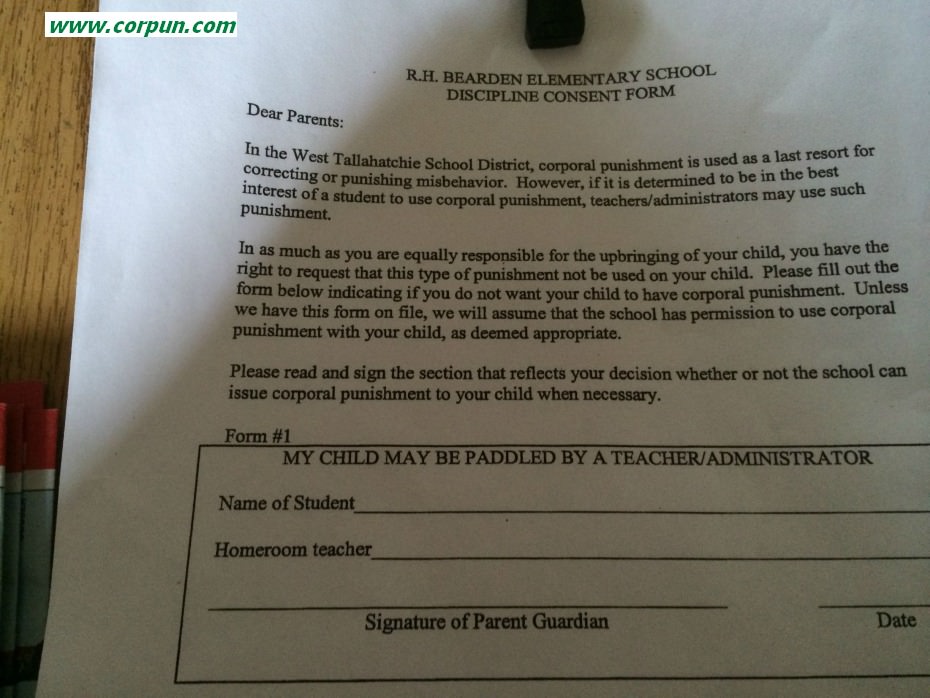
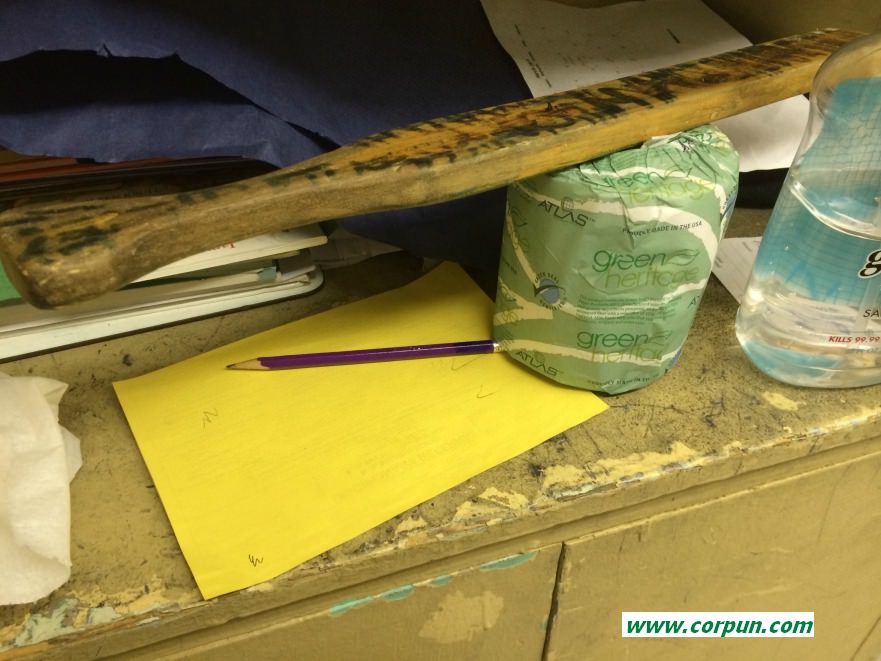
These Mississippi public schools also state that they use corporal punishment, but give few or no details:
Aberdeen School District
-- Employee Handbook
Amory School District
[Site is geo-blocked -- Needs VPN to access from outside USA]
-- History: See this May 2014 news item, stating that the Amory School Board was considering extending the power to paddle to ordinary teachers, rather than by principals only. The Superintendent told the meeting that "not having the ability to paddle students is one of the biggest complaints he gets from teachers".
Booneville Schools, Booneville (Mississippi)
Not to be confused with Booneville in Arkansas, or with Boonville in Missouri.
-- Stats: During 2013/14, 31 boys and 7 girls were paddled on one or more occasions at Booneville High.
Jones County Schools, Ellisville
-- Stats: See this Oct 2009 news item stating that 1,301 students were spanked in this district in 2008/09.
Kemper County School District, DeKalb [DOC]
-- Stats: 35 boys and 5 girls were paddled at Kemper County High School during 2013/14.
North Pike School District, Summit
Quitman County School District, Marks
-- History: See this Nov 2007 news item about a junior-high-school student whose parents claimed his buttocks were "severely bruised" after a paddling here.
Tate County School District (covers Coldwater, Independence)
-- History: See this March 2010 news item about the paddling of a high-school student.
West Bolivar Consolidated School District, Rosedale
-- History: See this Aug 2008 news item.
Western Line School District, Avon
-- Stats: According to this Oct 2009 news item, there were 1,512 paddlings here in 2008/09.
Winona-Montgomery School District, Winona (Mississippi)
Yazoo City Municipal School District
[Site is geo-blocked -- Needs VPN to access from outside USA]
MISSOURI: private schools
Clinton Christian Academy
"The individual administering corporal punishment will either be of the same gender or a female administering the punishment to a male child." Offenses that may be so punished include "Using the Lord's name in vain", swearing, stealing, violence, etc.
Heartland Christian Academy, Bethel [DOC]
Parents must sign their acceptance that their student in grades K through 12 "will receive corporal correction when necessary".
Maranatha Baptist Academy, St. Robert
See pp.30/31. "All parents will be required to give their consent for the use of corporal discipline. Swats will be issued at the discretion of the administration." Offenses that may result in CP include "ongoing behavior problems", lying, fighting, and disrespect to authority. If parents refuse to consent, the student is expelled forthwith.
MISSOURI: public schools
Advance R-IV Public Schools
The handbook no longer states that paddling will be used "only when deemed absolutely necessary". Intriguingly, the maximum number of paddle swats per spanking has been increased to four, from three in earlier versions. This is the high-school handbook; the elementary school has the same wording.
At the High School, 34 different offenses are separately listed as punishable with CP, including some which most schools nowadays regard as too serious a matter for a mere paddling, such as possession of weapons. A spankable offense newly added in 2016 was "gang activity". In most cases CP is available for first and subsequent offenses. Student motorists may be spanked for parking and driving violations at both first and subsequent offenses.
The specification of particular spankable offenses was a change from earlier handbooks; the 2015/16 handbook stated that corporal punishment was available but did not link it to specific offenses. This changed in 2016/17 and was accompanied by a reintroduction of paddling. The 2022/23 High School handbook adds that repeated failure to complete homework will not be tolerated, and a paddling may be administered upon a student's fourth such offense in a quarter.
Stats: No corporal punishment was administered at Advance High School in 2013/14 or 2015/16. Then paddling was reintroduced. Three boys were paddled during 2017/18. Apparently using a paddle had the desired effect on student behavior: ISS assignments dropped from 31 to 20, and out-of-school suspensions dropped from 14 to 1.
Alton R-IV School District
-- Alton Elementary School
-- Alton Junior/Senior High School
Upon a second or third referral to the office for classroom misbehavior at the Elementary School, a student may receive swats, administered by the principal in the presence of a teacher or the counselor. CP is also given for assault, fighting, abuse, tobacco use, and other serious offenses.
Corporal punishment at the High School must be administered by the principal in the presence of a teacher. Students may be given a choice between paddling and suspension for a variety of infractions including tobacco use, fighting, verbal abuse, and a second offense of academic dishonesty in addition to being given no credit for the assignment.
Stats: During 2013/14, 8 boys and 2 girls were paddled on one or more occasions at Alton High School. This increased to 17 boys and 5 girls who received a total of 33 spankings in 2015/16. During 2017/18, 11 paddlings were administered to 5 boys.
Arcadia Valley Schools, Ironton
Parents may request in writing that their youngsters not be paddled, and the student him- or herself also has the right to refuse swats. It is not clear what then happens instead. The paddling must be delivered to the buttocks, in the principal's office. This is the High School handbook; some other schools in the district have similar language.
Bakersfield R-IV Schools [DOC]
At the Middle/High School, "Alternative punishments may be administered by the discretion of the administration, including Corporal Punishment."
Stats: During 2017/18, 11 paddlings were administered to 11 boys at Bakersfield High School.
Bernie R-XIII School District
At the High School, CP is a "Possible Disciplinary Consequence to be assigned at the Principal's discretion", for Level 1 and Level 2 offenses but not levels 3 or 4. It is no longer stated that paddling is "used as the first correction for student misbehavior that affects other students' learning or well-being". Another provision that seems to have disappeared is "A student is not to receive more than one paddling per day. Should there be need for more than one, it is to be postponed until the next day."
Stats: During 2013/14, no CP was recorded at Bernie High School. But 8 boys and 2 girls received a total of 27 spankings in 2015/16. Seven boys were paddled in 2017/18.
Bloomfield R-XIV Schools
-- Bloomfield High School
-- Bloomfield Elementary School
Corporal punishment "is mostly used as the first correction for student misbehavior that affects other student's learning or well-being."
Both the student and his or her parent must sign: "My student and I have read and understand the Discipline Policy, and accept the consequences entailed for the choices my student made. By marking the next box, I agree to the use of CORPORAL PUNISHMENT as a form of discipline for my student."
The High School handbook now also states: "An administrator has the right to inflict reasonable punishment for misconduct by paddling. It must be administered for a salutary purpose to maintain the discipline and efficiency of the school. [...] A student is not to receive more than one paddling per day. Should there be need for more than one, it is to be postponed until the next day."
At the Elementary School, "Students may receive a swatting of the buttocks with a paddle administered by a certified staff member in
the presence of an adult witness".
Stats: 31 boys and 5 girls received spankings at Bloomfield High School during 2015/16.
Bunker R-3 School District
-- Bunker Elementary School
-- Bunker High School
At the Elementary School, CP is administered by the principal when alternative means of discipline have failed. Parents are notified beforehand.
High School students may be spanked by the principal for a third and subsequent tardy to school. Paddling may also be the penalty for a first offense of arson, assault, vehicle misuse, bullying, dishonesty, failure to meet conditions of suspension, fighting, and display of affection, among many other things (in most of these instances it may also be given for a subsequent offense); and for a second or subsequent dress-code violation. All told, the phrase "corporal punishment" occurs no less than 58 times in this handbook.
Stats: During 2011/12, 8 boys were paddled at Bunker High School. This increased to 11 boys and 2 girls in 2013/14.
Campbell R-II Schools
At the discretion of an administrative panel, an out-of-school suspension may be amended to corporal punishment "and/or a combination of ASD, AEP, or Extended AEP."
It is normally thought that parents often try to reduce the discipline their offspring have received from school, but at this high school the 2022/23 student handbook provides, "At the request of parents and with the administration's agreement, punishment may be modified to a more severe punishment."
Corporal punishment is available for a first or second offense of "failure to obey administrative rules and regulations (Includes rules documented in student handbook)." Corporal punishment is specifically mentioned for a first offense (and often for a second offense as well) of fighting; truancy; disrespect to staff members; disturbing or disrupting class; use of vulgar language; smoking; stealing; misbehavior on the bus; disobeying any rules governing night activities, field trips, and after school activities; fireworks; harassment; misbehavior in the cafeteria; and academic dishonesty. For tardiness to class, the first two offenses in a class each quarter result in a verbal reprimand from the teacher. On the third offense, "The office will contact the student for corporal punishment, ASD, AEP".
Stats: During 2017/18, 23 spankings were administered to 16 boys and 2 girls at Campbell High School.
Caruthersville School District
-- Caruthersville High School
The High School handbook gives the standard Missouri wording about swatting the buttocks with a paddle when other methods have failed. The middle and elementary schools use identical language.
Stats: Caruthersville High School (grades 9-12) did not record any corporal punishment from at least the 2011/12 school year through the 2015/16 school year. Like some high schools in other places, notably Texas, it then began to use a paddle. During 2017/18, 31 boys and 6 girls were spanked on 60 occasions.
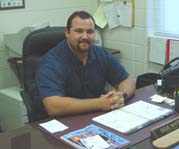
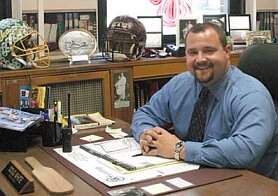
History: A page now removed contained a picture of the elementary school's former assistant principal, Mr Doug White. Could that be the bottom end of a paddle just visible at the front of his desk?
Yes, it could! Here is another picture of Coach White, on a slightly more recent occasion, by this time promoted to assistant principal of the HIGH school, taken from a page also no longer on line:
Cassville R-IV Public Schools
This district attracted wide media publicity in 2022 when it reintroduced paddling after a gap of more than 20 years -- see this separate article (with video clip) for more details.
The 2025/26 high-school student handbook expands the Corporal Punishment Option to include a first tobacco offense, and a first or second truancy violation. Perhaps administrators found it worthwhile to have implemented corporal punishment in 2022/23 and so have decided to make paddling more available. It might also be that some parents asked the school to nip tobacco use in the bud by spanking their teenager the first time he or she is caught with tobacco, and not wait for a second offense.
Chaffee R-II School District
CP at the High School is used when other means have failed, and consists of "1-3 swats on the buttocks, preferably from the administration".
Charleston R-I School District
This is the High School handbook. It contains the word "swat" or "swats" 29 times, specifying the number of swats (1, 2 or 3) to be inflicted as an alternative to detention for a wide range of specific offenses. "Students in grades 7-12 may provide consent for corporal punishment."
Stats: During 2017/18, 17 boys and one girl at Charleston High School chose a spanking instead of detention.
Clarkton C-4 High School
"In the event a paddling is refused by either a student or their parent the only alternative available is suspension. [...] It is important to note when a student is suspended the work they miss will be recorded as a zero and not allowed to be made up." Corporal punishment is specifically mentioned as a possible consequence for some 40 different offenses, from academic dishonesty to bullying to sleeping in class to possession of tobacco.
The high school also has a Cell Phone Form (adopted in 2018 and not currently on line) that all students and their parents sign, and which uses the phrase "corporal punishment" five times: "Signing this form indicates that you and your child have discussed the consequences involved with cell phone usage at school and that you are stating that you and your child understand the cell phone policy."
Stats: In recent years, Clarkton High School has increasingly relied on using the paddle to maintain student discipline, particularly for boys. In 2013/14, 6 boys and 2 girls received swats; during 2015/16 this increased to 11 boys and 2 girls; and during 2017/18, 15 boys and 2 girls were paddled on 21 occasions. Use of out-of-school suspension declined from 10 students in 2015/16 to only two students in 2017/18. Local sources suggest that if a student commits separate offenses, administrators may assign the student to receive a spanking the next morning as well as to begin his or her ISS assignment.
Clearwater R-I Schools, Piedmont
-- Clearwater High School
-- Clearwater Middle School
At the High School, CP may be used for both minor and major discipline infractions. Among other misbehavior, swats may be given to couples who engage in "consensual hugging, fondling, kissing, handholding and other activities," after a warning on a first offense. The 2016/17 handbook (no longer on line) provided, "Refusing corporal punishment will result in ISS." The 2022/23 handbook tightens the school's policy of discouraging student refusal of a paddling by providing, "Refusing corporal punishment will result in OSS."
At the Middle School, corporal punishment is defined as "paddling or swats to seat of pants", and "may be substituted for in-school suspension as determined by the principal."
Stats: Three boys at Clearwater High School were officially spanked in 2017/18.
Cole County R-I Schools, Russelville
At secondary level, corporal punishment "can be used any time during the discipline procedure," administered "by the principal in the presence of a teacher."
Cooter R-4 School District
CP may be administered for a first offense of truancy, horseplay in the classroom, disrespect, disruption, and insubordination. For a first offense of fighting, gambling, sexual harassment or bullying, the penalty is either CP or some other punishment such as OSS or Saturday Detention. The paddle may also be brought out for a sixth or subsequent tardy, and for a second offense of littering, public display of affection, or improper attire. No student may receive more than one paddling per day, and "it is the teacher's responsibility to check to see if the student has been paddled by someone else that day". The student is also to be asked whether there is any medical or other physical reason why he or she should not receive a paddling.
Delta C-7 Schools, Deering
-- Delta C-7 Elementary School
-- Delta C-7 Junior-Senior High School
The Elementary School handbook says CP must occur soon after the behavior being punished. The school's "Administrative Policy on Corporal Punishment" says the person administering the paddling "must maintain his/her composure and not administer the punishment in a malicious and vindictive manner." [...] "The child is to be received back into the classroom without malice since he/she has paid for his/her misconduct."
At the High School, corporal punishment is for misconduct at levels I, II and III but not IV (the most serious). There is a maximum of three swats per offense. Paddling may also be used by the principal for a first or third "bus incident". Students who are truant for the first time may receive corporal punishment, and if they refuse to be spanked they "will not be readmitted to school until such discipline is completed". For tardies, the punishment at the third offense is two swats or two detentions; at the fourth, it is three swats or Saturday school. A similar policy applies to public display of affection. It is not clear whether it is the student who gets to make the choice. CP may also be used for a first or subsequent tobacco offense.
Stats: During 2015/16, 9 boys and 4 girls were paddled at Delta C-7 High School. During 2017/18, 16 of the high school's boys, but none of the girls, received swats. During 2015/16, 14 boys were paddled at Delta C-7 Elementary School. During 2017/18, this increased to 25 boys.
History: See this Nov 2005 news item about Delta High School.
Delta R-V Schools, Delta
This High School handbook refers to corporal punishment 44 times.
Stats: During 2013/14, 14 boys and 2 girls were paddled on one or more occasions at Delta High School. This increased to 25 boys and 2 girls spanked in 2015/16. During 2017/18, no CP was recorded.
Dent-Phelps R-III School, Salem
This K-8 school introduced corporal punishment in July 2017. It may be administered for any offense, however major or minor -- everything from arson to dropping litter: no fewer than 63 offenses are separately listed in the handbook as liable to incur either "corporal punishment" or "and/or corporal punishment".
Dexter R-XI Schools
-- Dexter High School
At Dexter High School, corporal punishment may be administered for a wide range of offenses.
Doniphan R-I School District
-- Doniphan Middle School
-- Doniphan High School
At the High School (grades 9-12), "the student and parent" may request a spanking in lieu of suspension. There is an unusually high maximum of six swats to the buttocks "for any one event", which must be delivered by the principal. Students who refuse to be paddled may be suspended.
The Middle School (grades 6-8) mentions misbehavior on the school bus or in the classroom, and cheating, as offenses worthy of "swats", to be administered to the buttocks by the principal. In the 2009/10 version, there was a maximum of six swats, to be spread across two consecutive days, but in the 2022/23 edition of the middle-school book the maximum number of swats was reduced to three.
Dora R-III School District
CP is to be administered by the principal, and involves "swatting the buttocks with a paddle". There is a high level of detail on specific penalties for particular offenses. Thus, for many offenses, such as tobacco use, vandalism or fighting, "1-3 swats" may be delivered at the first offense and "3 swats" at the second. In other cases, e.g. cheating, dress-code violation or public display of affection, it is 1-3 swats for the second offense and 3 swats on the third and fourth occasions. All told, the word "swats" appears 38 times in this handbook.
East Carter R-II School District, Ellsinore
Corporal punishment (the phrase occurs 50 times in this handbook) is listed as an option for a large number of offenses, and also for failure to turn up to after-school detention. The student as well as the parent must sign the acknowledgement form on the last page, which says "I/We also understand that by signing we are agreeing that the student will be complying with the discipline code which includes swats as a form of punishment".
This is the handbook for the High School; the Middle and Elementary handbooks have similar provisions.
Stats: In recent years, this district has decided to use a paddle to discipline its adolescent students much more than it had done before, while refraining from using corporal punishment on younger pupils.
During 2013/14, two boys and two girls were paddled at East Carter High School (grades 9-12), and two boys in 2015/16. Administrators then greatly increased their use of the paddle. In 2017/18, 60 of the high-school boys, and 9 of the girls, received swats. Similarly, during 2015/16, no students at East Carter Middle School (grades 6-8) were paddled, but during 2017/18, 83 of these young teenagers were spanked (57 boys and 26 girls) There was no spanking at all at the Elementary School.
This illustrates a new belief of some school administrators in southern states: giving a spanking can be appropriate when disciplining an older student (e.g., ages 13-19), but non-physical forms of discipline should be tried with youngsters (e.g., ages 5-12).
East Prairie R-2 School District
Corporal punishment may be administered for, among other things, a first offense of arson, assault, automobile misuse, bullying, violating cafeteria manners, fighting, demeaning language, disrespect/ disruption, tobacco, dishonesty, theft, public display of affection, threats or verbal assault, sexual harassment, technology misconduct, truancy and vandalism; and for a second or subsequent offense of disturbing class. This is the High School handbook, which contains 37 occurrences of the phrase "corporal punishment"; the Middle School handbook has broadly similar provisions.
Eminence R-I Schools
Corporal punishment is available for many offenses. For example, students who are not in their classrooms when the tardy bell rings are tardy to class; tardies are tabulated throughout the quarter and may be from any class. On the fourth and fifth tardies a student serves two days of after-school detention or receives "3 Corporal Punishments". Mostly, CP is an alternative to other forms of discipline. However, a student who is truant may have to serve in-school suspension or Saturday School but also receive a paddling.
Local anecdotal sources indicate that Eminence High School generally administers spankings at the beginning of the school day.
Stats: At Eminence High School, during 2015/16, 16 boys and 5 girls received swats. Use of the paddle tripled two years later: in 2017/18, spankings were administered to 45 boys and 17 girls.
Exeter R-VI School District
"Swats may be an option for some offenses", to be administered by the Principal with parental consent. "Only those students with corporal punishment consent slips on file may have the option of swats."
Gainesville R-V School District
-- Gainesville Junior High/High school
The handbook suggests minimum and maximum consequences for various offenses, but notes that these guidelines "will not supersede the administration's prerogative of suspension, expulsion, or corporal punishment".
Gideon School District 37 [DOC]
-- Gideon Elementary School [DOC]
-- Gideon High School [DOC]
The first of these three documents is the Employee Handbook for the whole district. Teachers are urged not to threaten to send students to the office to be paddled, as "this will be the principal's decision only". However, the document is out of date: it says that parents have no say, but since 2022, Missouri law requires parent consent.
At the elementary school, CP is specifically mentioned as a punishment for a second or subsequent offense of misbehavior on the school bus.
At the high school, CP is not listed as a standard penalty but may be substituted for ISS or OSS at the principal's discretion. It is not clear whether this occurs only if requested by the student or parent.
Stats: Gideon High School used corporal punishment during 2000/01, but then put the paddle away from the 2009/10 through the 2015/16 school years. It has since been restored to use: in 2017/18, four boys were given spankings at the high school.
Greenville R-2 School District
-- Greenville High School
Regulation JG-R1 in the pan-district policies listing provides for corporal punishment for a first offense of assault or fighting, a first drugs/alcohol or tobacco or weapons offense, and a first or subsequent offense of disrespectful or disruptive conduct, theft or vandalism.
This separate page stipulates that the parent must have given written permission before the paddling can take place.
The High School handbook particularly mentions corporal punishment in respect of drugs, alcohol and tobacco violations, indeed CP is the only form of discipline applicable in grades 9 through 12 for a first tobacco offense. Also at the High School, a student placed in lunch detention who fails to comply with the strict lunch detention rules "will be assigned corporal punishment, ISS or OSS in conjunction with fulfilling their lunch detention assignment(s)".
Stats: During 2013/14, 20 boys and 2 girls were spanked at Greenville Elementary School, but no students were paddled at either Greenville High School (grades 9-12) or Greenville Junior High School (grades 7-8). But two years later it was decided to include teenage students among those thought suitable for discipline with a paddle. At Greenville High School, during 2015/16, 9 boys received a total of 12 paddlings. Apparently administrators were pleased with the results, as during 2017/18 they gave 35 spankings to 25 students (24 boys, 1 girl). At Greenville Junior High School in 2015/16, 20 boys received 29 paddlings, and 22 boys received 34 paddlings during 2017/18. By contrast, reflecting a trend we have seen elsewhere (notably in Texas) towards paddling older students more than younger ones, at Greenville Elementary School only five boys and three girls received a spanking during 2017/18. (During 2015/16, 15 elementary boys and 2 girls had received a total of 26 spankings.)
Halfway R-III School District
-- Halfway Junior/Senior High School, Half Way
-- Halfway Elementary School
Standard Missouri language about swatting the buttocks with a paddle.
The elementary handbook provides a form on which parents may state whether they wish CP to be used.
Stats: During 2017/18, two boys were paddled at Halfway High School and one girl at Halfway Elementary School.
Howell Valley R-1 School, West Plains
This K-8 school "reserves the right to use corporal punishment at any consequence step (with signed parental consent)".
See also this Dec 2016 news item.
Jasper R-5 School District
In the High School, corporal punishment "is allowed when other options have failed"; parents are contacted. At the elementary level, the consequences of a second visit to the principal's office include "ISS/OSS or Swats"; on a third visit, "ISD, OSS, ASD or Swats".
History: See, in respect of Jasper Elementary School, this Nov 2005 news item.
Junction Hill C-12 School, West Plains
This K-8 school has some unusual detail. CP must be administered in the principal's office, and before the paddling, there must be "a check to see if there are items in the pockets where the swats will be given" -- common sense, but it is rarely spelled out as a printed instruction. Also, the student is to be shown "the proper stance" and informed of "things that can happen if the student does not stay in the position requested".
In the upper school (grades 5 through 8), "swats" may be given for four or more demerits. A paddling may also be requested in lieu of ISS if the parent has given permission. CP is particularly mentioned for a second or third offense of failing to turn in assignments.
Hayti R-II School District
-- Hayti High School
-- Hayti Elementary School
Corporal punishment ("swatting the buttocks with a paddle") shall be delivered by a district administrator. The high-school handbook lists myriad offenses for which "swats" may be given (the word "swat" or "swats" appears 28 times) but no longer specifies how many in each case. Student motorists may be spanked for careless driving and for parking violations.
At the Elementary School, "It is our policy to give students days OSS/out-of-school suspension when the STUDENT refuses swats. If you do not wish for your child to refuse swats, you must work that out with the child AT HOME. Once a child has been assigned to OSS and leaves school for the day after refusing swats, the suspension will not be lifted. Such would be unfair to the other students." Also, "Students who choose out-of-school suspension rather than swats or ISS or those who misbehave enough to receive out-of-school suspension will lose their ball game privileges for the entire school year".
Kennett School District No. 39
-- Kennett High School
-- Kennett Middle School
This district believes in the use of corporal punishment "at all grade levels" in order to provide "for the health, safety and general welfare of students, staff members, parents and patrons." At the High School, paddling is a possible consequence for a first offense of assault or physical or sexual harassment, a first or subsequent offense of disrespect, disruption, extortion, false alarms, fighting, public display of affection, theft, possession of tobacco, or truancy, and a first or second (but not third or subsequent) offense of verbal sexual harassment. Also, spanking (with AEP assignment as an alternative) is the penalty for the third, fourth and fifth tardy to class or to school per quarter.
The Middle School handbook -- in which the phrase "corporal punishment" occurs 41 times -- declares: "It is hereby stated with emphasis that a student will always be given a choice of attending the Alternative Education Program (AEP) in lieu of receiving Corporal Punishment." (Bolding in original). Conversely, "In the event the assignment to AEP is three (3) days or less, the student will be given a choice of receiving Corporal Punishment in lieu of the assignment to the AEP."
History: See this Jan 2006 news item, announcing a clampdown on latecomers: paddling was thenceforth to be the punishment, with AEP (alternative education program) as an option, for every unexcused tardy from the third one in each quarter onwards.
This May 2006 news item suggests that CP was frequent at the High School at the time, and confirms that students there normally got a choice between a paddling and time in the AEP. However, more recent local sources indicate that for serious offenses the high school administration sometimes assigns a student to AEP and also gives him or her a spanking.
Stats: At the High School, 68 boys and 20 girls received paddlings on at least one occasion in 2011/12. Two years later these figures had increased to 85 boys and 31 girls. In 2015/16, 100 boys and 14 girls at Kennett High School received a total of 130 paddlings. During 2017/18, the high school spanked 70 boys and 18 girls.
Lesterville R-IV School District
At the High School, corporal punishment may be used upon a sixth or subsequent referral to the office, on the decision of the principal. It is also specifically mentioned for a first offense of bullying, a fourth or subsequent offense of having unsealed or glass containers, a third or subsequent offense of possessing a cellphone or other device, a fourth offense of horseplay, and a fifth or subsequent tardy to class in a quarter (3 swats).
Lincoln R-2 Schools
Unusual language about witnesses: "All instances of corporal punishment shall be witnessed by a parents [sic] or at least one other adult member of the school staff" -- not necessarily a certificated member of staff, and potentially more than one of them; and most public schools do not allow parents to observe paddlings.
Lonedell R-14 School District
There is a maximum of three swats to the buttocks with a wooden paddle. "The principal requires a signed permission note from parents prior to any student being paddled."
McDonald County R-I School District, Anderson
Corporal punishment, defined as "Application of paddle to the buttocks of the student", is listed in particular as a response to disruption, tobacco, and truancy. However, for some reason "There will be no corporal punishment for tardies". It no longer seems to be mentioned that there is a maximum of three swats.
Stats: During 2017/18, nine paddlings were administered to eight students (seven boys, one girl) at McDonald County High School.
Malden R-I School District
-- Malden Jr/Sr High School
-- Malden Alternative School
The high-school handbook uses the words "swat" or "swats" 36 times, including for public displays of affection, tobacco, rudeness, showing a disrespectful attitude toward staff or visitors, and many other offenses, different numbers of swats being specified for each offense. The normal maximum per incident is three swats.
At the very strict Alternative School, "Students will be placed in isolation, be required to copy work/memorization work, assigned chores, assigned lunch detention, or receive 1-2 swats for minor offenses".
Stats: During 2015/16, 67 boys and 31 girls received a total of 178 paddlings. During 2017/18, 154 paddlings were administered to 74 high-school students (62 boys, 12 girls), or slightly over two spankings per spanked student. (Presumably, many students were only spanked once during the school year, meaning that some students were spanked on three or more occasions.) The high-school administrators'-maintained use of a paddle appears to have helped reduce serious student misbehavior: from 2015/16 to 2017/18 the number of instances of students being suspended out of school declined by 75%, from 40 to only 10.
Marquand-Zion R-VI School District, Marquand
Corporal punishment "shall be administered only by the principal in agreement with or at the request of the parent/guardian. [...] Corporal punishment will be administered only by swatting the buttocks with a paddle for a maximum of three times. Students and parents should be aware that though every precaution will be taken so no serious injury occurs, certainly you could expect pain to be inflicted. The possibility of swelling, redness and bruising are always there anytime [sic] corporal punishment is administered. Corporal punishment can be an option for most offenses but will not take the place of suspension if warranted."
Meadow Heights R-II Schools, Patton
Identical wording to Marquand-Zion (see above).
Stats: During 2017/18, two boys received spankings at Meadow Heights Elementary School, while three boys and two girls were spanked at Meadow Heights High School.
Mountain View - Birch Tree Schools (covers Mountain View, Birch Tree)
-- Liberty High School, Mountain View
-- Liberty Middle School, Mountain View
-- Elementary schools handbook
The pan-district policy document no longer says that a student may be exempted only where a physician's statement is on file that CP would be harmful to the student's physical or emotional health. Rather, "Students shall not be subject to corporal punishment as outlined in this policy without a parent/guardian being notified and providing written permission for the corporal punishment." This is in conformity with new (2022) Missouri legislation that requires parental consent for CP.
The High School handbook states that CP "may be an option" at the discretion of the principal, who is the only person who will administer it. Also, "A written permission form will be sent home the first time this punishment would be used".
The Middle School has similar language to the High School.
The handbook for the two elementary schools gives a list of infractions of varying seriousness. For "level A" offenses (arson, drugs, weapons, threats), the penalty is 2-3 swats or the same number of days' suspension for a first offense, and 3 swats or 3-5 days off for a second offense. Swats are apparently not an option for a third or subsequent violation at level A. At level B (obscenity, tobacco, cheating) the student receives 1-2 swats or 1-2 days' suspension the first time, 2-3 swats or days the second time, and 3 swats or 3-5 days the third time. For the least serious ("level C") sins, the first offense brings a mere 1 swat or day off, the second 1-2 swats or days, and so on.
Naylor R-II Schools [DOC]
At the High School, "Corporal punishment can be used as a discipline measure in many cases, depending on the severity of the offense and the number of prior offenses [...] Parents are notified in writing or by telephone when corporal punishment is administered. Parents and non-certified staff will not be allowed to witness corporal punishment."
Stats: No paddlings were recorded at Naylor High School during 2013/14. During 2015/16, six students (four boys, two girls) received swats. This increased to eleven boys and two girls in 2017/18.
Neelyville R-IV School District
Unusual wording here -- CP "is defined as paddling with a board on the buttocks". Paddles have often been called boards colloquially (as in the old quip about applying the board of education to the seat of learning), but I have not previously seen the word used officially. There is now a maximum of three swats.
"When deemed acceptable, pupils may choose to be paddled in lieu of suspension and/or other disciplinary procedures". Parents, too, may "request it as a first alternative rather than using other forms of discipline".
Otherwise, the "board" may be applied for a wide range of offenses, including using cellphones, misuse of the gym, disruption, false alarms, inappropriate behavior, public displays of affection (including "holding hands, embracing, kissing, fondling, arms around waist, etc."), littering (second or subsequent offense), tobacco, threats, truancy, failing to complete assignments, and vandalism, among other things. For assault and fighting, paddling may be used only at elementary level; for all the other offenses mentioned, no age limits are specified.
Stats: During 2013/14, Neelyville High School did not report any use of corporal punishment. However, according to local sources, the "board" was in use. The school then decided to report its use of corporal punishment: ten boys and four girls received paddlings during 2015/16. In 2017/18, five boys received swats.
Newburg R-II Schools
"Students who fail to comply with these standards shall be subject to reprimand, and/or loss of privileges, and/or spanking, and/or temporary or permanent dismissal from school." There is a maximum of three swats. "The student shall be required to either place his hands on a desk or on his knees while receiving a paddling."
North Pemiscot R-1 School District, Wardell
-- North Pemiscot Junior High & High School
-- Ross Elementary School
CP consists of "swatting the buttocks with a paddle".
At the High School, students "are not allowed the choice of suspension in lieu of receiving corporal punishment". A student who refuses a determined punishment will not be allowed to return to school until the parents have a conference with the principal and the student agrees to accept the previously assigned punishment. "The choice of punishment is the decision of the teacher, administrator or school board, not the student."
CP may be administered (by a teacher or the principal) for a wide range of offenses, including a first offense of threats/harassment, pornography, or fighting; a first or second offense of misbehavior during an after-school activity or assembly; a second offense of tardiness to school, abuse of textbooks, running in the hallway, disobedience or being off-limits; and a third offense of eating/drinking or chewing gum, disrespect or disruption, or minor misbehavior on the school bus. In most of these cases, paddling is an alternative to Saturday School.
At Ross Elementary, CP (or noon detention, or one day of Saturday School) is the penalty for a second tardy, as well as for a list of offenses broadly similar to that at the High School. In many cases (unlike at the High School), paddling is the only outcome available; there are 46 mentions of "corporal punishment" in the document. It may be administered by teachers as well as the principal. There is the same wording as at the High School about students not being offered a choice of punishment. This is one of the most uncompromisingly pro-CP US school handbooks I have seen in the public sector for a while.
North Shelby School District, Shelbyville
"Paddling may be administered by any teacher or administrator ... A paddle must be used (open hand is not permissible)".
History: See this Sep 2008 news item, which said CP was rare in the district at that time.
Norwood R-I Schools
"Corporal punishment can be defined as the physical punishment of a child for failure to obey the student code of conduct required by the school board. Physical punishment may include swats with a paddle (these must be witnessed). Corporal punishment should always be administered in a manner that is fair, non-abusive, and that will not cause permanent physical damage. Occasional bruises occur and are not indicative of abuse or that unnecessary force was used by the teacher or administrators as bruising potential varies from person to person. Parents must sign a consent form giving permission for corporal punishment in lieu of other discipline."
At the Middle School, "Students may receive one day of out-of-school suspension or in-school suspension for each swat called for in student handbook for their offense."
Stats: During 2017/18, nine paddlings were administered to five students (four boys, one girl) at Norwood High School.
Oregon-Howell R-III School District, Koshkonong
-- Koshkonong High School
The 2022/23 high-school handbook provides for the use of corporal punishment "for enforcement of rules", but not for violent or serious offenses. It says parents are notified after the paddling has been administered. Parents may opt out, but must take the initiative of putting in a request for the relevant form in order to do so. These provisions are not consistent with the latest Missouri law, but the district's updated policy correctly states that a parent must supply written permission before CP can be administered.
Osage County R-I School, Chamois
The secondary-school handbook states, "Defined as the administration of bodily infliction by the use of a paddle or facsimile on the buttocks. Corporal punishment is an appropriate means of achieving desirable student behavior when administered properly with discretion.... The parent/guardian will be contacted by the administrator prior to the punishment and given the option to witness the punishment."
Poplar Bluff R-I School District
-- Poplar Bluff Junior High School
At the Junior High School, if parents have authorized corporal punishment and administrators decide to impose it, the young adolescent is expected accept his or her spanking. "In grades 7-8, if a pupil should refuse to submit to corporal punishment, he or she will be suspended up to ten (10) days." This is significantly stricter than previously: the 2019/20 handbook provided for up to a five-day suspension for any student who refused to be spanked.
History: This March 2005 news item reported that 680 paddlings were provided to the district's students over a two-year period.
Portageville School District
-- Portageville Middle School and High School
-- Portageville Elementary School
"A student is not to receive more than one paddling per day. Should there be a need for more than one it is to be postponed until the next day. It is the administrator's responsibility to check to see if the student has been paddled by someone else that day." CP is particularly mentioned for a first offense of classroom disruption, fighting, extortion, false alarm, hazing, public display of affection, sexual harassment, drugs or alcohol, disrespect, smoking, etc. and a first or second offense of bullying.
The elementary handbook has a new section titled, "PROCEDURE CHANGE WITH DISCIPLINE for the 2022-2023 school year." It provides: "Every year, we contact a parent/guardian when corporal punishment will be administered and ask for permission. Now, in addition to calling, the state requires all public schools to have written permission from parents to administer corporal punishment each year. Please fill out the information below with your preference."
Stats: 34 boys and 18 girls at Portageville High School received spankings on at least one occasion in 2013/14. During 2015/16, 35 boys and 10 girls were given a total of 54 paddlings, while in 2017/18, the high school spanked 34 boys and 13 girls.
Puxico R-VIII Schools
"Please note that Puxico R-VIII Schools maintains a policy allowing corporal punishment. Any parent that does not wish for their child to receive corporal punishment due to medical or psychological reasons should contact the office in writing with your request." Its Code of Student Conduct allows the high-school students to be paddled for Level I offenses (tardiness, failing to report for detention, insubordination and public display of affection) and Level II offenses (cheating, driving offenses).
Ripley County R-III Schools, Gatewood
"Corporal Punishment/spanking" is administered by the assistant principal or school superintendent. It consists of "no more than three (3) swats with a paddle on the buttocks [...] Parents may choose for their child to be given suspension instead of corporal punishment."
Ripley County R-IV Schools, Doniphan
A first, second and third offense of academic dishonesty here incurs in-school suspension, corporal punishment and no credit for the work. For certain other violations the student will receive counseling "and in addition may receive corporal punishment". A spanking is also particularly mentioned as an option for the first through fourth offenses of public display of affection, a first offense of truancy, and for arson, assault, bullying, disrespect, failure to work in class, and much else. "Refusal of corporal punishment will result in out of school suspension for the remainder of the day and additional days." Parents are not permitted to witness the paddlings.
Scott City R-I School District
Disciplinary actions for minor misconduct include detentions and corporal punishment. The latter consists of a 3-swat paddling. This is the document for the high school; the elementary school has similar wording.
History: See this Nov 2005 news item.
Scott County R-IV Schools, Benton
The Thomas W. Kelly High School student handbook provides: "Corporal punishment, defined as paddling with a paddle, may be used in the discipline process". It is mentioned in particular as a consequence for a first or second cell-phone offense, as an alternative to ISS.
South Iron R-I School District, Annapolis
At the High School, many offenses specify corporal punishment with no alternative offered (such as detention, ISS or OSS). Students will be spanked for a first or second offense of academic dishonesty (2 swats and 3 swats); arguing (2-3 swats); use or possession of cell phones (2-3 swats); classroom disruption, data security violations, cutting class, defacing school property (first offense, 2 swats, second offense, 3 swats); extortion (first offense, 2-3 swats); public display of affection (second offense, 2 swats, third offense, 3 swats).
But for certain offenses the principal may deploy either the paddle or OSS. For instance, a second offense of disrespectful or obscene language incurs "3 swats or 3-180 days OSS"; for a first offense of false report, accusation or alarm: "2-3 swats, 1-180 days OSS, or expulsion"; for a first offense of insubordination: "2 swats or 1-5 days OSS"; for a second offense of insubordination: "3 swats or 3-10 days OSS"; and so on.
There is a maximum of three swats, "administered on the buttocks". The paddling will not cause permanent physical damage, but "occasional bruises occur and are not indicative of abuse". Students who refuse to be spanked will receive one day's suspension for each swat refused.
The elementary school has a similar policy.
Stats: As implied by the handbook's detailed disciplinary provisions, South Iron High School administers corporal punishment frequently to students who misbehave. During 2017/18, administrators gave 205 spankings to 40 students (26 boys, 14 girls).
Southland C-9 Public Schools
The Junior and Senior High School Student Handbook provides, "In cases where corporal punishment (paddling/swats) is deemed a reasonable punishment for an offense, such punishment will be administered, but only after parent consent. In most cases it will be used only after alternative methods of punishment have been tried. Corporal punishment is permitted as a punishment for "general misbehavior". Any student who refuses a paddling will be placed in the Alternative Learning Center where they will be able to stay caught up with their work, but if out-of-school suspension is needed, the student will not be allowed to make up their work.
The Discipline Matrix states: "In order to protect all parties involved, the principal will administer all corporal punishment [...] It will be administered in a reasonable manner depending on the student's age, weight, and physical condition.
New in 2022, punishment for fighting may include a paddling, and for failing to abide by bus riding rules (such as by throwing objects, having food or soda, or Loud Boisterous Behavior), "A second offense will result in Corporal Punishment".
Stats: During 2013/14, no students were paddled at Southland High School. The school then decided to re-introduce the paddle, with 21 boys and 5 girls receiving spankings on 47 occasions during 2015/16.
South Pemiscot County R-V Schools, Steeleville
"An administrator may administer three swats. The person administering corporal punishment will use only one hand on the paddle and will ask the student if there is any physical reason why they can't take a paddling and if they have had a paddling that day. If the student answers yes to either question, then the paddling will be postponed." The phrase "or 2 swats" appears 29 times. However, for a first offense of menacing, harassing, threatening or "instigating trouble" the punishment is 1-3 days' ISS or 2-3 swats, and for a third offense of violating the dress code or public displays of affection (including hand-holding, hugging or kissing) the boy and girl will similarly receive either 2-3 days of ISS or 2-3 swats.
Stats: No students were paddled at South Pemiscot High School during 2011/12. Subsequently the high school reintroduced paddling, which had been used in 2006/07, when 10 boys received swats. With the reintroduction of paddling, ISS assignments were cut in half; only 30 boys had to serve ISS in 2013/14, but 67 boys and 17 girls received paddlings. During 2015/16, 31 boys and 8 girls were spanked on a total of 66 occasions at South Pemiscot High, while during 2017/18, 22 students (19 boys, 3 girls) were paddled.
Southwest R-V School District, Washburn
-- Southwest High School
-- Southwest Elementary School
At the High School, "corporal punishment can be administered by the principal when a parent/legal guardian requests. When a student's consequences for inappropriate actions results [sic] in ASD or OSS, a parent may authorize, by written permission, for a student to receive corporal punishment in place of the original consequences."
The Elementary School document has similar language, but also specifically mentions that the consequence for a third or subsequent cell phone offense is "corporal punishment with parent consent".
Success R-VI School District
Paddling (once abolished but reintroduced here in 2008) is an option for misconduct at Levels I, II and III at this K-8 school. Parent permission is sought beforehand.
Stats: No corporal punishment was recorded in 2011/12 or 2013/14. During 2015/16, four boys were paddled. During 2017/18, seven paddlings were administered to three boys.
Summersville R-II School District
-- Summersville Elementary School
-- Summersville High School
At the High School, refusal to submit to a paddling will result in OSS for the remainder of the day and one additional day. A student assigned to detention who fails to show up for it "will" (not "may") "receive corporal punishment". An unusual provision is that parents are explicitly forbidden to witness the punishment.
Offenses for which CP is specifically indicated include cheating (first or second offense), bag violations (fourth offense), bullying (first offense), cafeteria misbehavior (first or second offense), destruction of property (first or second offense), "sitting idly, sleeping, or otherwise failing to participate in class" (first, second or third offense), tardiness for a second time, tobacco (first through third offense), truancy (second offense), and more. In some cases there is no alternative to a paddling. For instance, for a third graffiti offense, the consequence is "Repair/clean graffiti and corporal punishment" (note "and", not "or" or "and/or").
A spanking is also the consequence for misconduct on the school bus (second or third offense), not as an alternative to, but as well as, being suspended from riding the bus. But CP for parking and driving violations is no longer mentioned.
The elementary school document contains similar provisions.
Stats: During 2013/14, 35 boys were paddled on one or more occasion at Summersville High School. This decreased to 24 boys in 2015/16, but spanking was extended to the girls, 10 of whom received swats that year; the 34 students were spanked on a total of 40 occasions. During 2017/18, 22 paddlings were administered to 10 students (9 boys, 1 girl) at the high school.
Van-Far R-1 School District, Vandalia
-- Van-Far Junior/Senior High School
Here, "the parent or guardian may choose corporal punishment in lieu of a more serious consequence". Most remarkably for a public school, a parent "must be present during the administration of corporal punishment" as well as a staff witness, and "must sign a release form prior to the administration of the swats". Another most unusual (and refreshingly frank) provision is that "Parents and guardians must recognize that for corporal punishment to be affective [sic] it must be administered with enough vigor to inflict a certain amount of pain to the student's backside. Students with injuries close to the area of application, other medical issues, or those that are susceptible to bruising easily will not be administered corporal punishment."
There is also an elementary school, but its handbook makes no mention of CP.
Webb City R-7 School District (covers Carterville, Webb City)
-- Webb City High School
-- Webb City Junior High School
The pan-district policy lists (starting at page 35) a wide range of offenses for which CP is a possible penalty.
At the (senior) High School, students may choose 3 swats with a paddle instead of three hours' detention, but only if they have their parents' consent (surely unnecessary at that age). An earlier version specified that "students may not receive swats more than TWO times in any semester", but this is now changed to "a limited number of times, determined by an administrator". It remains the case that "students may not receive swats for anything less than a 3-hour detention".
At the Junior High School, corporal punishment is available in general but is no longer specified as a consequence for missing detentions. Parents' approval for CP is now required; in a previous version, they were merely to be notified after the event.
History: See this Jan 2005 news item, which says that there were 345 paddlings in 2000, many of them at high-school students' request.
And see this April 2011 news report (with video clip), which described the modus operandi for paddling at Webb City and stated that "there is a line every Tuesday and Thursday at the office for swats". It also says "A man or woman spanks depending on the gender of student", but this is no longer the case at Webb City High because a female Assistant Principal paddles boys as well as girls, according to local information.
Stats: During 2013/14, no use of paddling was recorded at Webb City High School, although the paddle was indeed in use, according to local sources. In 2015/16, the high school reported that 64 boys and 46 girls received a total of 111 spankings.
Winston R-VI Schools
Paddling is one of the punishments that may be administered for "violations of any school regulation, policy, law, classroom rules, or directives issued by a teacher or administrator".
Woodland R-IV School District, Marble Hill
Corporal punishment here takes the form of "swatting the buttocks with a paddle (one to four swats)" -- one swat more than the usual Missouri maximum.
Stats: During 2017/18, six boys were paddled at Woodland High School.
Zalma R-V Schools [DOC]
At the High School, students may receive swats or an ISS assignment for a first offense of fighting, using tobacco or vapping [sic]; a second offense of stealing or of disrespecting or disobeying staff members; a second or third offense of misbehavior in the cafeteria or other common areas; a third offense of misconduct in the classroom or gambling; and for any "general misconduct".
These Missouri public schools or school districts also state that they use corporal punishment, but give few or no details other than, in many cases, the standard Missouri wording about privacy, witnesses, and "swatting the buttocks with a paddle":
Adair County R-I Schools, Novinger
Adair County R-II Schools, Brashear
Appleton City R-II Schools
Bell City R-II Schools
-- Stats: During 2013/14, 18 boys and 4 girls were paddled at Bell City High School. This increased to 34 boys and 2 girls in 2015/16. During 2017/18, paddlings were administered to 20 boys and 1 girl at the high school.
Bronaugh R-VII Schools
Buchanan R-IV Schools, Dekalb
Callao C-8 Schools
Central R-III Schools, Park Hills
Chadwick School District
-- History: See this Jan 2005 news item.
Clark County Schools Kahoka
-- History: See this Sep 2008 news item and this Apr 2014 one.
Clever R-V Schools
Elsberry R-II Schools
Fairview R-XI School District, West Plains
Glenwood R-8 School District, West Plains
Green City R-I School District
Holcomb R-III School District
-- Stats: During 2017/18, 23 paddlings were administered to 17 boys and 1 girl at Holcomb High School.
Hollister School District
Hudson R-IX School District, Appleton City
Leesville R-IX Schools, Clinton
Madison C-3 Schools
Marion County R-II Schools, Philadelphia, Missouri
Marshfield R-I Schools
Meadville R-IV School District
Milan C-2 Schools
Nell Holcomb R-IV Schools, Cape Giradeau
Norborne R-VIII School District
North Callaway Schools, Kingdom City
North Nodaway R-VI Schools, Hopkins
Oak Ridge R-VI Schools, Oakridge
-- Stats: Six boys received paddlings at Oak Ridge High School during 2017/18. The paddle had not been used during 2013/14 or 2015/16.
Oran R-III Schools
-- Stats: During 2015/16, 7 boys were spanked at Oran High School. This doubled to 14 boys who received swats on 20 occasions in 2017/18.
Richwoods R-VII School District
Risco R-II School District
-- Stats: During 2011/12, 2013/14 and 2015/16, no corporal punishment was recorded at Risco High School. During 2017/18, two paddlings were administered but the statistics do not reveal whether the beneficiaries were boys or girls.
Sheldon R-VIII School District
Southern Reynolds County R-II School District, Ellington
-- Stats: During 2017/18, eight paddlings were administered to four boys at Ellington High School. No high-school student had been paddled during 2015.
Stanberry R-II School District (at the high school, but apparently not at the elementary school)
Strafford R-VI Schools
Swedeborg R-III School, Richland
Tina-Avalon R-II School District, Tina
Union Star R-II School District
Weaubleau R-III Schools
Wellsville-Middletown R-II Schools, Wellsville
West (St. Francois) County R-IV Schools, Leadwood
Westview C-6 Schools, Neosho
Wheatland R-II Schools



The school handbook links are spread over nine pages: