Corpun file 22080 at www.corpun.com
The Democrat, Senatobia, Mississippi, 2 March 2010
Fed suit seeks state paddling ban
By Melissa Turner
News Editor
A 16-year-old Tate County student not only wants his school to stop corporal punishment - he wants the whole state to do so.
William Cody Childress, a student at Independence High School, filed a federal lawsuit earlier this month, alleging that a paddling he received in September of last year violated his civil rights.
According to court records, Childress was in a class taught by a substitute teacher last fall when, about 10 minutes before the final bell would ring, he was sent to the office of Principal Corey Blaylock for looking at photos on a digital camera brought to school by a female student.
The female student, according to the lawsuit, was not punished for violating school policy by bringing the camera to class.
Once there, the lawsuit says, Childress was instructed by Blaylock to sign a paper and then he was paddled. The lawsuit alleges that Blaylock used "excessive force" in administering the punishment.
The lawsuit further states that when Childress returned home, his stepmother took him to North Oak Regional Medical Center in Senatobia for an examination of his injuries. She also called the Tate County Sheriff's Department, which dispatched a deputy who took a photograph. Mrs. Childress was also advised that she could file charges against Blaylock in Tate County Justice Court, which, according to the lawsuit, she has done.
According to the lawsuit, the photographs were reviewed by Tate County Schools Superintendent Gary Walker, Sheriff Brad Lance, and Youth Court Officer Judy Black, who found no evidence of wrongdoing.
The lawsuit names Blaylock, Walker, and the Tate County School District as defendants.
According to court documents, the record does not reflect that the defendants have been served with notice of this lawsuit, other than the certification of the plaintiff's attorney.
In addition to seeking monetary damages from the defendants, the lawsuit asks the court to declare corporal punishment unconstitutional.
According to the lawsuit, corporal punishment is unfairly administered in the state with regards to gender and race.
Childress' attorney, Joseph Robert Murray, III, said that this case was not only about what happened to his plaintiff, but about "corporal punishment at large."
"We ask people to remember as this case moves forward that we have a real human being involved, who has suffered pain and embarrassment," he said.
Murray added that his client is asserting that corporal punishment is unconstitutional because "it is dispensed in a discriminatory fashion, and because the evolving standard of decency is moving away from corporal punishment."
The lawsuit also seeks a temporary restraining order to prevent the district from administering corporal punishment while the case winds its way through the courts, but records show that request was denied by Judge Allen Pepper on February 23.
In denying the restraining order, Judge Pepper said that the U.S. Supreme Court has ruled that Eighth Amendment to the United States Constitution, a prohibition of cruel and unusual punishment cited in the lawsuit, did not apply to corporal punishment. Judge Pepper also ruled that the plaintiff failed to show that he was in imminent danger of another paddling.
Sheriff Lance declined to comment on his knowledge of the case, citing the criminal charges pending against Blaylock.
School Board Attorney John Lamar also declined to comment on the case.
The papers filed represent only one side of the case.
© The Democrat 2010
 Follow-up: 7 July 2010 - Court refuses to stop paddlings in Mississippi
Corpun file 22089 at www.corpun.com

Fox16.com (Fox TV News), Little Rock, Arkansas, 4 March 2010
Teachers in Fountain Lake want corporal punishment
 By Sandra Kirk
Teachers want to reinstate corporal punishment in the Fountain Lake school district. Forty teachers signed a petition to bring back spanking and went to the school board to take action.
One parent FOX16 spoke with is for corporal punishment.
"Because kids don't respect teachers and they need respect."
Another parent said she is against it. "No one will punish my child but me...period," Lisa Hayes said.
Forty Fountain Lake teachers, most from the elementary school, signed a petition to reinstate corporal punishment. The school board president says this started after teachers visited an elementary school in Hamburg that administers corporal punishment on its students.
The issue went to the board last month but action wasn't taken. Before making a decision, the board will call for a special work session to research and evaluate the current disciplinary policy and decide from there whether to whether to change the policy.
Copyright 2010 Newport Television LLC All rights reserved.
RELATED VIDEO CLIP
Fox TV news report (1 minute 40 seconds), 4 March 2010, of which the above is an abbreviated text version. Two parents with contrasting views are briefly interviewed.
HERE IS THE CLIP:
This video clip is not currently available.
IMPORTANT: Copyright in this video material rests with the original copyright holders. This brief excerpt is reproduced under the "fair use" doctrine  for private, non-profit, historical research and education purposes only. It must not be redistributed or republished in any commercial context.
Corpun file 22137 at www.corpun.com
Gaston Gazette, North Carolina, 10 March 2010
To spank or not: Gaston one of few school districts still using the paddle
By Angela Memrick
Children who misbehave in Gaston County Schools could get paddled rather than put in time out with corporal punishment still in effect.
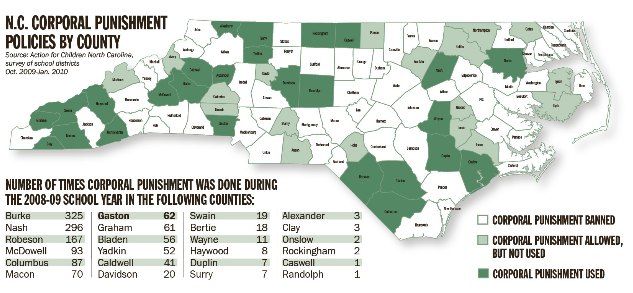
Gaston County Schools is one of 46 school districts that allow corporal punishment, according to an Action for Children North Carolina survey released Wednesday.
Of the 115 school districts in the state, 69 ban corporal punishment, 20 permit corporal punishment but did not hit students last school year and 26 local districts permit corporal punishment and used that measure to discipline students last school year, according to the report.
Why and how it's used
From the first day of school in August through Tuesday Gaston County Schools administered corporal punishment 27 times, said spokeswoman Bonnie Reidy.
Gaston County Schools Superintendent Reeves McGlohon said that the system surveyed administrators two years ago to find out their opinions on corporal punishment.
"They felt it was something that helped maintain discipline," McGlohon said.
Individual principals make decisions on what offenses merit corporal punishment, he said. McGlohon has not received any complaints about it in the four years he's been superintendent.
Rankin Elementary does not use paddling, but Principal Ron Foulk said that procedures are in place to protect a child.
Foulk said he would look at corporal punishment as a last alternative after talking with parents and trying to come up with other choices. He hasn't had a problem that came to the point where paddling might be an option, he said.
"It can't be done off the cuff," Foulk said.
Frequency of use
Gaston County Schools reported using corporal punishment 49 times last year.
The State Board of Education does not have policies or collect data about corporal punishment, according to the report.
Tom Vitaglione, senior fellow with Action for Children, said his group sent a survey to all school districts asking for three things -- how many times corporal punishment was used during the 2008-09 school year, the name of the person sending in the information and the person's title.
Burke County reported the most incidents with corporal punishment used 325 times last year, according to the report. Caswell and Randolph counties each reported one incidence of using corporal punishment last school year, the least among counties that use the measure.
Neighbors say no
Cleveland County Schools banned corporal punishment last year, said spokeswoman Donna Carpenter.
"Our superintendent Dr. Boyles is not a proponent of it and believes, as a majority of our administrators do, that there are other ways. There are better ways," Carpenter said. "It was used very little anyway."
Charlotte-Mecklenburg Schools halted corporal punishment in 1991.
"Research has shown it's not productive. If anything, it causes detrimental effects for the child and family," said spokeswoman Cynthia Shah-Khan. "It's not something that our district supports."
Lincoln County Schools allows corporal punishment, but did not use it last school year, according to Action for Children North Carolina.
"Although not encouraged, corporal punishment may be administered at all levels," states the Lincoln County Board of Education policy. "However, it is not generally recommended for older pupils."
Local schools decide
UNC Charlotte educational leadership professor James Lyons said he can't condemn a school board for using corporal punishment when it's allowed by the state.
Lyons said the Legislature opted to allow local freedom rather than having an across the board policy. If local communities don't want corporal punishment, they can bring that up to the school board, he said. Communities that support corporal punishment can keep it an option.
But Lyons does not personally recommend paddling.
"There's not a lot of research that I can find over the years that says it is effective," Lyons said. "It may be effective with some, but not necessarily for all of them."
Using corporal punishment also places a burden on educators to determine what level of punishment is appropriate, Lyons said.
Lyons said he would recommend that the Legislature ban corporal punishment from North Carolina schools all together.
"If it's inappropriate for supervisors and guards in the Department of Correction to administer it on prisoners, then why should we use it on students?" Lyons asked.
Gaston County Schools corporal punishment policy
The Gaston County Board of Education policy allows a principal, assistant principal or teacher to use corporal punishment, which must be done in front of a second school official.
Students must be told of the types of behavior that could result in corporal punishment and warned in advance with a second school official present before they are punished that way, according to policy. The punishment should not be done in front of other students. Corporal punishment can't be used if a child doesn't complete class assignments or homework.
A paddle is used to spank a child's buttocks when corporal punishment is used, according to the policy. Educators can't slap or hit a student on the face, shake them or hit their hands with a ruler.
Parents would be notified when corporal punishment is used on their child. A parent can request the school official to provide a written explanation of the reasons and the name of the other school official who watched the punishment.
Source: Gaston County Board of Education Policy Manual
© Copyright 2010 Freedom Communications. All Rights Reserved.
RELATED VIDEO CLIP
News report (2 minutes 40 secs), "Burke schools rank #1 in number of students paddled", from WBTV, Charlotte, 11 March 2010. Another view of the situation in North Carolina takes a look at Burke County, which, as the above item notes, reported the largest number of paddlings of any district in the state. However, it also has one of the lowest rates of violent incidents. A paddling principal is interviewed.
HERE IS THE CLIP:
This video clip is not currently available.
IMPORTANT: Copyright in this video material rests with the original copyright holders. This brief excerpt is reproduced under the "fair use" doctrine for private, non-profit, historical research and education purposes only. It must not be redistributed or republished in any commercial context.
Corpun file 22132 at www.corpun.com

wwaytv3.com (WWAY-TV News Channel 3), Wilmington, N. Carolina, 15 March 2010
Columbus County Schools: Spanking and the drop-out rate
By Hailey Winslow

Columbus County school teachers still paddle their students, and they have one of the highest spanking-rates in the state. On the other hand, the system has one of the state's lowest dropout rates.
Daniel Mitchell says he's been paddled twice at school. "Kindergarten and seventh grade," says Mitchell.
Paddling students may sound like something teachers did in the "olden days", but they did it in Columbus County 87 times last year.
"Probably one is too many but in the scheme of things, with over 19 schools, average or whatever, that's not many," says Columbus County Schools Superintendent Dr. Dan Strickland. That puts them at number five out of 26 school systems in the state that still use corporal punishment.
Dr. Strickland says it's only used as a last resort. "What we do in Columbus County under our policy, is it is done under the administration of a principal or a teacher with a witness. But a parent can opt out of corporal punishment any time with a statement or letter in the child's file, and many parents do that."
Contrast that with Columbus county's dropout rate, the third lowest in the region. "When kids are 16 years old they can drop out of school without parent permission, and I think that's an eye-opener for a lot of parents," says Keith Jefferys of Columbus County Schools.
The dropout rate decreased by nearly 30 percent, compared to last year, and 10 percent more kids graduated.
Dr. Strickland doesn't think paddling directly relates to fewer dropouts. Still, even though parents can opt out, some don't think spanking is being pro-active at all. "I do not think any teacher has any right to spank any child. It's left up to the parent," says Levada Potter. Mitchell agrees, "I believe that it could have been handled by my parents."
Dr. Strickland says administrators also practice what's called "Positive Behavior Support", which rewards students for good behavior.
Copyright © 2010 WWAY-TV, LLC & Morris Network Inc., All rights reserved.
RELATED VIDEO CLIP
TV news item (1½ minutes) from WWAY-TV Wilmington (15 March 2010) of which the above is an approximate text version.
HERE IS THE CLIP:
This video clip is not currently available.
IMPORTANT: Copyright in this video material rests with the original copyright holders. This brief excerpt is reproduced under the "fair use" doctrine for private, non-profit, historical research and education purposes only. It must not be redistributed or republished in any commercial context.