In this article:
Introduction
Statistics
Modus operandi
Where and by whom
Who gets paddled
Age restrictions
Racial disparities
Rules and regulations
The gender issue
Offenses so punished
Time of day
A matter of choice
Effects on the student
Private schools
History
College and university
Documents
External links
Many people, even within the USA, think corporal punishment ("CP") has long disappeared from all American public schools. This is not entirely true.
The US Supreme Court ruled in 1977 that the spanking or paddling of students by school officials or teachers is lawful, where it has not been explicitly outlawed by local authorities. That decision still stands.
The use of CP has declined sharply in recent years, but only 33 states (plus D.C. and Puerto Rico) have abolished it in public schools, either de facto or de jure. CP is still permitted in the other 17 states, and it remains a fairly widespread practice in three of them, all in the South: Alabama, Arkansas and Mississippi.
It is also routine, but only in certain (mostly rural or small-town) districts, in six more states: Georgia, Louisiana, Missouri, Oklahoma, Tennessee and Texas.
In the other eight paddling states, the incidence of CP is nowadays nil or negligible, as a proportion of school enrollment: Arizona, Florida, Indiana, Kansas, Kentucky, North Carolina, South Carolina and Wyoming.
The latest states to abolish were Ohio, in 2009; New Mexico, in 2011; Idaho, in 2023; and Colorado, also in 2023. The number of paddlings had already fallen to a low level in these states.
On the other hand, efforts to ban school CP by legislation failed in 2003 in Wyoming and repeatedly in Missouri, and also in North Carolina in 2007, Louisiana in 2009 and again in 2017, Texas in 2011, Colorado in 2017, Kentucky in 2017 and again in 2018, and Mississippi in 2020.
Legislative attempts to reintroduce CP in California (1996), Montana (1997), Iowa (1998), Oregon (1999) and Delaware (2006), were all defeated. Also rejected were a 2007 bill to make it easier to spank students in Kansas and a 2013 bill in Oklahoma to restore CP rights to individual class teachers (as opposed to school principals or administrators, for whom it remains lawful).
A US Supreme Court ruling in 1975 (Baker vs Owen) held that schools could spank students against the wishes of their parents, subject to various conditions being met.
But in 2011, laws were introduced in both Texas and North Carolina giving parents the right to exempt their sons or daughters from any CP provisions, typically by filling out a form provided. It is not clear what effect, if any, these new laws had on the incidence of paddling in Texas: many school districts had already adopted that policy anyway. In North Carolina the number of districts retaining CP was already very small, according to this July 2011 news report.
Since then, the last district in NC still permitting CP has abolished it, amounting to de facto abolition in that state: see this Oct 2018 news item. The same is apparently now true of Kentucky.
Another possibly significant legal change of the past few years is that some states have decreed that students with certain disabilities should not be paddled. For instance, in 2019 a new law in Arkansas stipulated that teachers and administrators are not immune from civil liability if they use corporal punishment on an intellectually disabled or autistic student. At least one Arkansas school district has used this as a pretext for doing away with CP altogether, citing the alleged difficulty of defining "intellectually disabled". Four more states -- Louisiana, Mississippi, Oklahoma and Tennessee -- have recently (2017-2019) legislated to outlaw the corporal punishment of students with disabilities whether physical or mental.
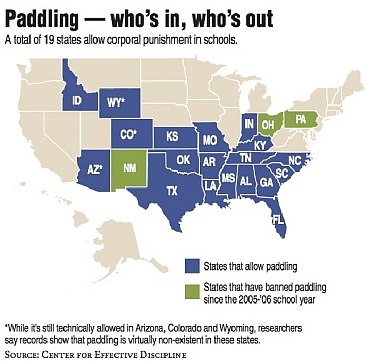
This map appeared in the Chattanooga Times Free Press in October 2013 (read the whole article here).
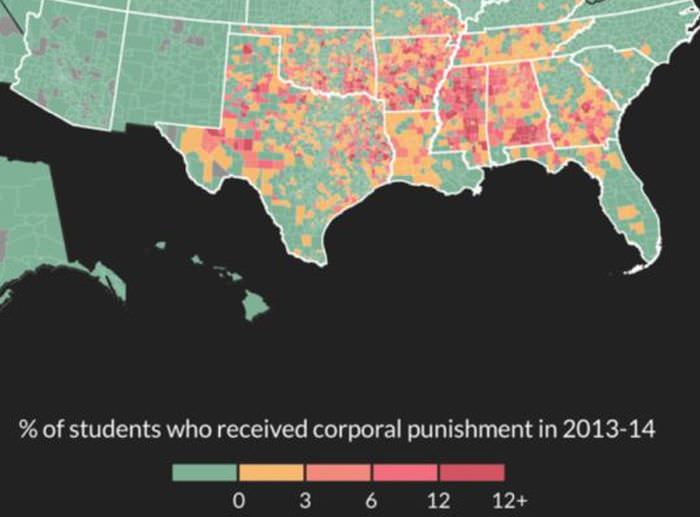
The above map of the southern States shows paddling "hotspots" by county. (NPR Stateimpact)
In November 2016 the outgoing US Secretary of Education, John King Jr., called upon schools across the nation to abolish CP. It is not obvious why he waited to say this until only a couple of months before the inauguration of a new President, and sure enough King was replaced shortly afterwards. King's remarks were not well received in Texas, where one district superintendent noted that decisions in this matter are taken based on local beliefs: "Rarely does Keene ISD take the advice of Washington politicians when deciding what's best for our kids".
Note that all the above refers only to public schools. Paddling in private schools has until recently been lawful in all but two states -- Iowa and New Jersey -- to which may now be added Illinois (2024), Maryland (2023) and New York (2023). It remains quite prevalent in some (mostly Christian) private schools in the South. The use of CP in private schools is not reported in public statistics.
Statistics. According to estimates from the federal Department of Education (Office of Civil Rights), about 69,000 students were paddled in US public schools in the 2017/18 school year -- sharply down from 92,000 two years previously, continuing a decades-long decline.
The following table gives estimates by state for 2017/18:
| State |
Number of students receiving CP |
Percentage of total students |
| Alabama |
9,164 |
1.3% |
| Arkansas |
8,932 |
1.8% |
| Georgia |
3,697 |
0.2% |
| Louisiana |
1,301 |
0.2% |
| Mississippi |
20,309 |
4.3% |
| Missouri |
2,461 |
0.3% |
| Oklahoma |
3,968 |
0.5% |
| Tennessee |
3,765 |
0.4% |
| Texas |
13,892 |
0.3% |
Source: US Department of Education -- Office for Civil Rights.

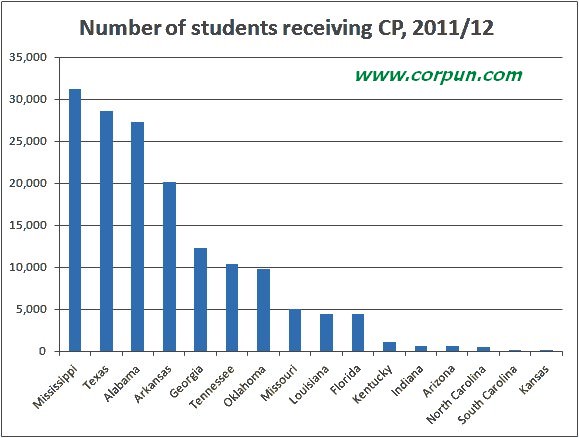
Numbers of students receiving CP, by state, 2011/12 -- Click to enlarge |
The figures for Arizona, North and South Carolina, Colorado, Kansas, Kentucky, Idaho, Indiana and Wyoming were too small to measure in percentage terms.
Note that these are numbers of students paddled, not numbers of paddling events. The total number of paddlings will have been higher, since some students get spanked on more than one occasion in a school year.
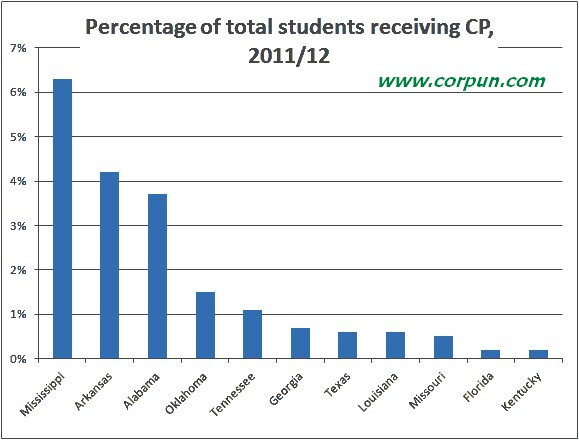
In percentage terms the heaviest-paddling states in 2017/18 were still Mississippi (4.3 per cent of students paddled during the year) followed by Arkansas (1.8%). Alabama comes third with 1.3%. In all other states, the percentage was under 1%.

Percentage of students receiving CP, by state, 2011/12 -- Click to enlarge
|
Mississippi is the "world capital of paddling" in both percentage and absolute terms, having pulled ahead of Texas, which not long ago had the largest number of students spanked -- though not such a high percentage figure; this is simply because Texas, with some 5 million school students, is so big.
The figures for Texas mask sharp differences between different areas. The state has over 1,000 public school districts. Many of these are very small by the standards of the rest of the world, often consisting of just one high school, one middle school and one or two elementary schools. These are generally found in rural or small-town settlements (of which Texas has a vast number), where community and parental support for spanking still tends to be part of the local culture.
At the other end of the scale, most major urban areas in Texas have abolished CP, including all the big cities, such as Fort Worth (in 1999), Houston (2001), and Dallas (2005), as well as Austin, El Paso, and San Antonio. As a result, although around 80% of districts use the paddle, these account for only 40% of the students. To put it another way, some 60% of Texas students attend schools in the 20% of districts where it is banned.(1)
(1) S. Phillips, The demographics of corporal punishment in Texas, University of North Texas, May 2012.
 For more detail on school paddling in Texas, see this separate article.

The paddle at Holmes County High School in Bonifay, Florida, in 2012. It is made of ash wood and is 16 inches long. (stateimpact.npr.org) |
All the federal Department of Education figures should be treated as estimates at best; formerly they were extrapolated from only a proportion of districts. But they should have become more accurate over time, as the DOE from 2011/12 allegedly began surveying all schools, rather than just a sample.
Note also that some observers suspect that all such data understate the real incidence of CP, citing anecdotal evidence that some, maybe many, punishments go unrecorded, though this may be less true than it once was.
There is a steady stream of news items about individual school districts within paddling states deciding to abandon CP. Against the overall declining trend, though, there are some reports of districts which had abandoned the paddle deciding to bring it back. Both phenomena can be seen in these examples from July 2013.
An interesting case is Mathis school district in Texas, one of several in that state to have brought back the paddle or increased its use in the past few years. According to this Nov 2015 news report, a particular reason in the Mathis case was that high-school students were transferring to neighboring school districts that had not abandoned CP, because behavior was better there.
This Aug 2017 news article about high-school football in Texas quotes a coach as saying that "the pendulum is swinging back toward corporal punishment". Likewise, this Feb 2019 item in a Texas local newspaper says "CP is making a comeback". These claims are not borne out by the statistics for the state as a whole, but they might have been true of some of the more rural or small-town areas.
Modus operandi. Corporal punishment in US schools is almost invariably applied with a paddle across the student's clothed posterior, after removing anything found in the back pockets. Paddles come in many shapes and sizes -- see these pictures, usually made of wood. Very occasionally the implement may be of a composite plastic material, such as perspex (Plexiglass) or polycarbonate (Lexan), sometimes wrongly described as "fiberglass". For an early instance of this, see this Dec 1987 news item about a Texas school district adopting Plexiglass paddles for its elementary schools but wooden ones (maple) at secondary level. Oak and ash also seem to be popular woods for paddles, which are often made in a school's own shop class.
A typical punishment nowadays consists of two or three strokes, usually referred to as "swats" or "licks", or occasionally "pops" or "cracks". In American English the procedure is often described as "spanking", even though an implement is nearly always used. (In this article, the terms "paddling" and "spanking" are used interchangeably.)
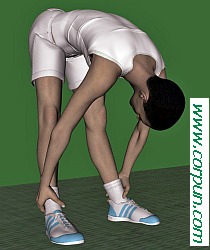 In the past it was the norm in some schools to require the culprit to present his bottom for discipline by standing clear of any furniture and bending down as low as possible, often with feet placed well apart for stability: "Grab your ankles" was a familiar command (pictured left). By all accounts, this stance has gone out of fashion.
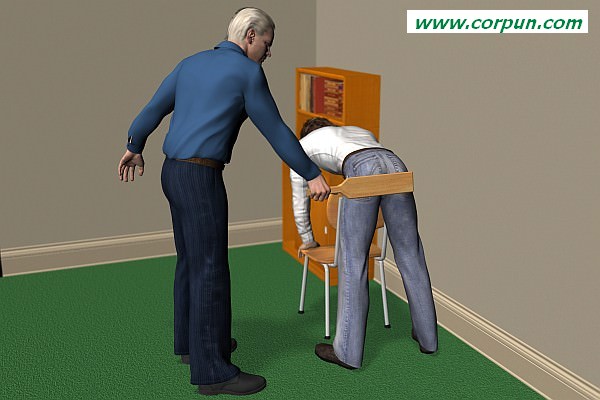
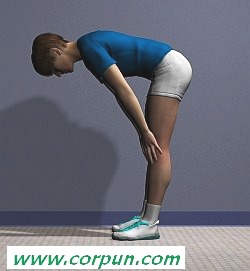 Even the "hands on knees" position (pictured right), rather less undignified, is perhaps less favored than it once was. A slightly different version of this is shown in the posed picture at the top of this page.
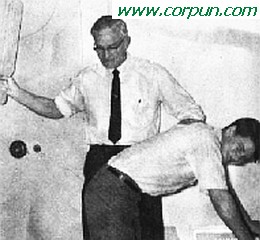 Nowadays, according to informed sources, it is more usual for the offender to be asked to bend over a chair or bench (pictured left).
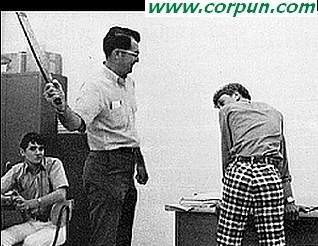 Probably more often still, he may be required merely to put his hands on the desk, leaning forward only a few degrees from the vertical (pictured right) even though, and particularly with today's fashion for loose clothing, this is clearly less effective in terms of pulling the fabric taut across the student's seat. This is not a particularly recent phenomenon -- the command "Put your hands on the desk" is heard in the Butler, PA documentary from 1978.
 "Hands on the wall" is another possible method, as illustrated at left, a variant of which is seen in real life in this 1970s photograph from Texas, and this 2014 video clip from Louisiana.
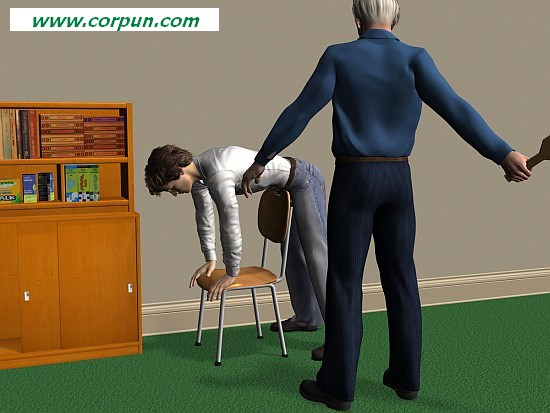
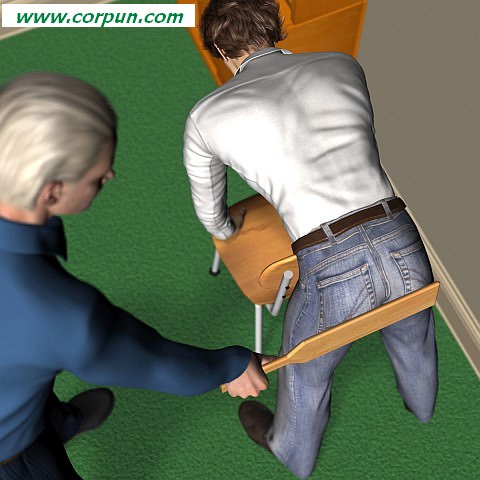
Having the student bend over the BACK of a chair, with feet apart and holding on to its front for stability, is a different and more formal technique, mentioned by the principal of Booneville H.S. in Arkansas. It is perhaps especially suitable for taller and more senior students: the following artist's impressions show from three different angles a twelfth-grader being disciplined in the principal's office:
Where and by whom. Until recent years, CP was often administered in the classroom, or in the hallway outside it. It was also an American tradition for sports coaches to do a lot of on-the-spot paddling, typically in the locker-room or even out on the field. While all those things still happen in a few places -- see this 2013 video clip from Louisiana -- it is much more common now for the punishment to be delivered privately in an office, often by the principal or assistant principal or at least in his or her presence. It is less likely nowadays to be done on the spur of the moment, and more likely to require formal bureaucratic procedures and specific documentation. This affords greater legal certainty, and guards against the danger of angry teachers resorting to random violence.
The question whether ordinary classroom teachers should have the right to paddle, or only administrators, may be partly related to another issue: is CP a suitable response to low-level classroom disruption, or should it be reserved for more specific violations that may have nothing to do with classroom management, like smoking and truancy? In Dec 1976 it was reported that a local teachers' union in Florida believed that "the paddle more properly belongs in the hands of classroom teachers" because it was they who, at that time in that place, were said to be directly responsible for maintaining order. There may still be some school districts where that line is taken, but it is probably now a minority view. It certainly is in Texas and Oklahoma, where many school districts spell out that administering the paddle is a task reserved for the administration -- typically the Principal or Vice-Principal.

Ratio of boys to girls paddled, by state -- Click to enlarge |
Who gets paddled. In some areas in the past, it was made explicit that only boys could be chastised, as in Cincinnati (Ohio) in 1898. Nowadays, in most places, female as well as male students may receive CP, or, at least, modern American notions about sexual equality require that they be given the opportunity to receive it wherever boys may do so. For a relatively early mention see this Oct 1952 news item about four teenage girls paddled in Pennsylvania. An example of the trend gathering steam can be found in this 1988 news item from Ohio about high-school girls demanding the right to be paddled. They thought it unfair that boys were offered a choice between a spanking and detention, while girls had no option but to serve the detention. Since then, this kind of explicit sex-discrimination has largely disappeared, in public schools at least (some private schools do still make a distinction between the sexes in this matter).
A late convert to the cause of sexual equality was Sulphur Springs High School in Texas, where it was not until 2013 that a student survey asked, "Should girls be allowed to get swats?" The replies were positive, and female students began choosing to receive corporal discipline at the start of 2014, according to local sources.
In practice, though, statistics consistently show that around 75% to 85% of paddlings are still of male students. That is, roughly three boys are spanked for every girl. This might be, in part, because boys (and their parents) are more likely than girls to opt for CP, if given the choice. But we should bear in mind that, according to official figures, boys much more often receive any kind of punishment than girls. Males and females are different: over 90% of the prison population is male. Boys just are on average worse-behaved than girls, though this does appear to be a little less true that it once was.
Age restrictions. In general, statistics show that the most typical recipients of corporal punishment in the USA are boys aged 13 through 17 -- much as in pretty well all other cultures since the dawn of time. But in the majority of American school districts, there are no explicit age limits: the recipient may be any age from 4 through 19. Twelfth-graders, who might have been driving an automobile for three or four years, or having legal sex for two years, can be and are spanked in some high schools. In certain places, such as Alvarado ISD in Texas (which does not use CP at the elementary level at all), it has been reported that most of the district's frequent paddlings take place in grades 9 through 12. Some anecdotal accounts suggest that these students, especially if male, can expect to be paddled a lot harder, stroke for stroke, than younger recipients: "It does hurt pretty bad," says an Alvarado twelfth-grader in this video clip about visiting the office to bend over the chair for three "pops" in lieu of suspension.
Other Texas school districts which make clear that CP is used only at the secondary level include Bandera ISD, Denver City ISD, Dodd City ISD, Joaquin ISD, Lazbuddie ISD, Salado ISD and Springtown ISD. There are several others which do not say so but for which it can be inferred from the official statistics that the same policy applies.
We don't usually have statistics broken down by age or grade within a particular school, but we do for school year 2013/14 in the case of Reagan County High School in Texas:
-- 9th grade (age c.15) -- 26 students received 37 paddlings
-- 10th grade (age c.16) -- 34 students received 50 paddlings
-- 11th grade (age c.17) -- 24 students received 40 paddlings
-- 12th grade (age c.18) -- 30 students received 40 paddlings.
We might note in passing that the minimum school leaving age in Texas was increased to 18 in 1997. Remarkably, with effect from 2015 it has been further increased to 19. In most of the other paddling states, it is still 16 or 17.
 Varsity football at Ozen High School. Players are subject to paddling by Coach. (Beaumont Enterprise) Varsity football at Ozen High School. Players are subject to paddling by Coach. (Beaumont Enterprise)
|
Corporal discipline seems to be particularly prevalent in the case of 16-, 17- and 18-year-old high-school "athletes" (members of sports teams) in small-town Texas, where there is a tradition of sports coaches wielding the paddle on behalf of the school, even when the offense is not sports-related (such as for failing grades), as reported in this May 2012 illustrated news item about a 17-year-old footballer paddled at Ozen High School in Beaumont ISD.
Indeed, some school districts in Texas -- where high-school sports are a really big deal, often dominating the headlines of local newspapers -- produce an "Athletic handbook", separate from the main student handbook. This often states not only that sports coaches may administer CP to team members, but also that "athletes" are held to a stricter standard of behavior than other students. They are thus more likely to be spanked than their non-athlete peers if they break the general school rules, let alone the extra rules especially laid down for their team.
The legal position relating to students who have reached the age of majority (18 in most states, though it is 21 in Mississippi) seems to be a bit of a gray area. Does the school cease at that point to be in loco parentis? Common sense would suggest that it should then be for the student him- or herself to accept or refuse a paddling, without reference to the parents.(2)
(2) Cordell High School, Oklahoma, is one of very few schools whose handbook explicitly covers this point: "Corporal punishment may only be given when authorized by the student's parent/guardian or authorized by a student that is 18 years or older".
But that is not how the judges saw it in this 2005 Texas case. Jessica Serafin was 18 years old when she was paddled for a summer school rule violation at the School of Excellence in Education, a public charter school in San Antonio. Her hand "suffered minor, temporary injuries" when she improperly failed to keep her hands away from her bottom while being disciplined. Ms. Serafin sued. The three federal judges ruled unanimously in October 2007 that "having voluntarily chosen to attend classes after her eighteenth birthday and remain enrolled, she was not free to disregard school rules". They added that "the Texas statute governing the use of corporal punishment in schools makes no differentiation between adults and minors, stating that all students are eligible to receive corporal punishment". In 2008 the US Supreme Court declined to hear an appeal against this decision.
Accordingly, at least in Texas, by continuing in school after becoming legal adults, 18-year-olds make themselves "eligible" to be spanked, even if they would prefer ISS or another form of discipline. Once he or she turns 18, can the student sign a form opting him- or herself out of paddling? Texas law says "parents" can sign the opt-out, so the answer is probably not. Conversely, what if a parent of a high-school student signs a form exempting the student from paddling but then the student turns 18 and would prefer swats to ISS; do the young adult's wishes override those of his or her parents? They surely ought to do in logic, but it is unclear.
But such questions arise only very rarely. Informed sources report that the age of majority makes no difference in practice: 18-year-old students in Texas, legally adult, are just as likely as 16- or 17-year-olds to opt for a spanking in preference to some other penalty; it happens quite frequently at some senior Texas high schools and is clearly accepted as normal by the students concerned as well as by the local community. And in such a case their parents, if they get involved at all, hardly seem likely to protest.
It is not clear to what extent this applies in other, less well documented paddling states. It may do in Mississippi, where in any case the age of majority is 21. In Louisiana and Tennessee one gets the subjective impression that school CP is more often thought of as appropriate mainly for younger students, but further research is needed into this topic.
Racial disparities. Opponents often claim that corporal punishment is racially discriminatory because statistics show that black students are more likely to be spanked than white ones, pro rata to the population as a whole. In fact, though, the same applies to suspensions and other kinds of punishment, so while there may be a "racial problem" in school discipline overall, it is not specifically a "corporal punishment problem". A long Apr 2014 article in The Nation discusses this point, with particular reference to Mississippi, where about 50% of all public school students are black, but black students account for 64% of those paddled. The article notes that many black people strongly support CP, and some view it as a valued part of their cultural heritage.
But on closer inspection it turns out that Mississippi is the only really dramatic example of this phenomenon. In some other states, notably Texas and Alabama and Tennessee, the official statistics show that black students are slightly less likely than white ones to get a paddling.(3) So anti-CP campaigners have been dishonestly manipulating the figures on this issue, and should not keep repeating the mantra that school spanking is intrinsically racially discriminatory, unless they make clear that they are talking almost entirely about Mississippi specifically (and to a very much smaller extent, Arkansas, Georgia and Louisiana).
(3) "Schools, black children, and corporal punishment", Brookings Institution, January 2016.
Rules and regulations. Many US school districts (as well as some private schools) nowadays lay down more or less detailed rules for the administration of CP and publish them in their school handbooks or, in some cases, in a separate "Code of conduct". (For a very early example, see this May 1950 news item.) These often specify such things as the offenses for which a paddling may be meted out, the permissible dimensions of the paddle, the part of the body to be targeted (usually "the buttocks" but sometimes "the buttocks area", "the lower posterior" or "the seat of the pants"), who can administer it and where and in whose presence, what "due process" is required (e.g. formally stating in the presence of the witness what the student is being disciplined for, and inviting the student to state his or her case), whether prior parental consent is necessary, and what happens if the student refuses to submit to the punishment.
Handbooks in some school districts also stipulate the maximum number of swats/licks that may be delivered. Nowadays it is most often three, sometimes only two, occasionally four (but five or six in some Louisiana and Mississippi districts). This is normally taken to mean "swats per paddling incident", but a few school districts lay down a separate maximum per student per day.
An occasional variation on this is to prescribe a larger number of swats divided into multiple spanking sessions spread over consecutive days, such as at Jim Ned High School in Tuscola, Texas, where students who reach step 5 of the "discipline ladder" receive no fewer than "9 swats (3 per day for 3 days) or 3 days of ISS".
Similarly, in 2014 Eldorado High School in Schleicher County, Texas, increased its penalty for a sixth tardy per semester from six to no less than 10 swats, to be delivered at the rate of two swats per day for 5 days. Getting paddled every day for five consecutive days can hardly fail to provide the student with a bright red and very sore posterior, but then it is the student who chooses that option instead of five days in ISS.
Flippin High School in Arkansas offers students incurring a third office referral the choice of 100 minutes' detention or "ten swats with a paddle", with the proviso that "Any total of more than five swats will be spread over two days". Anecdotal evidence suggests that there are at least a few other high schools that operate such a policy without saying so in the handbook.
Many school handbooks also lay down specific penalties for particular offenses, with different numbers of swats applicable according to how seriously each offense is regarded.
The gender issue. It has become quite common, though it is still not universal, for the rules to stipulate that the paddling must be delivered -- or, failing that, witnessed -- by a staff member of the same sex as the student, especially at high-school level. This probably reflects unease in some quarters about the idea of men spanking teenage girls.
For example, in 2011 the Texas Association of School Boards (TASB) inserted a new provision in its model school policy: "Corporal punishment shall be administered only by an employee who is the same sex as the student". Many school districts adopted the revised policy without paying any attention to the new provision. This ended up embarrassing Springtown ISD when a male administrator at Springtown High School, following time-honored practice and unaware that the rules had changed, spanked two girls in September 2012: see these illustrated news reports (with video clips).

The girls' mothers complained, and a widely publicized brouhaha ensued. This included a lively public meeting of the school board at which other young ladies who had been disciplined at the high school with the male vice-principal's paddle stood up and defended the practice: "I've had swats from him before, and they hurt, but that's why we have parental consent", declared Ms Bartee. Springfield ISD then rescinded the policy change so that a male administrator could again paddle a female student, provided a female staff member was present as a witness.
When it became clear that the new TASB model text was merely a suggestion and not a legal requirement, quite a few other school districts followed suit, perhaps because in a small district there might not be enough administrators of both sexes to make a same-sex requirement practical. Thus, the Hemphill, Mineola and O'Donnell ISDs adopted the "same sex" language in 2011, but all three districts removed it in 2014. Other districts have since done the same, including Big Spring ISD in Oct 2016. We are unaware of any Texas ISD that since 2014 has imposed a "same sex" restriction if it was not already included in the local policy. By contrast, many ISDs have removed such restrictions that prior boards had adopted. To this extent, there has been a reversal in Texas of the general national trend towards having a same-sex requirement for paddling.

In the "tardy room" at Waxahachie High School in Texas, the table is strewn with tardy slips -- and a paddle (March 2013). Repeatedly arriving late for school or for class is a spanking offense in many districts.
Offenses. The range of offenses that can be punished with a paddling varies very widely from one place to another. Some handbooks spell them out in great detail, while others leave the matter vague. It can be difficult to see why certain violations merit a spanking and others do not, especially when different school districts sometimes adopt almost diametrically opposite policies. Often, CP is deemed appropriate for intermediate "crimes", those that are neither very trivial nor very serious; but some schools say it is appropriate only for relatively minor lapses, while a few make clear that, to the contrary, it is regarded as a severe punishment for serious offenses only. Either way, it is almost never "a last resort", despite that tired phrase still being trotted out here and there.
In general, though, it is common to find CP specified for fighting, tardiness, dress-code and grooming(4) violations, misbehavior on the school bus, defiance, smoking, public display of affection, parking/driving offenses, profanity, and bullying, among many others. A few schools operate a system whereby specific offenses attract a stated number of demerits, and a paddling is automatic upon accumulating a certain quota of demerits in a semester.
(4) "Grooming" usually refers to things like hair length and style, and forbidden piercing or jewelry. In the case of boys, it can also include the offense of coming to school unshaven, a paddling matter in some high schools. See also this Aug 2005 news item about 28 male students paddled at an Alabama high school for failing to get a haircut when so instructed.
In addition, CP is used by many schools to enforce student compliance with other forms of discipline. Examples include paddling for missing detention, skipping Saturday school, or violating the detention or in-school suspension rules. Again, see the school handbooks pages for details in various different districts.
In the modern era, in public schools at any rate, corporal punishment is usually regarded as inappropriate for poor work or academic inadequacy as opposed to behavioral or "moral" lapses. A significant exception to this, particularly in Texas, is where sports coaches are empowered to spank athletes for failing grades, when lack of effort at school work can mean losing their hard-won place on the team.
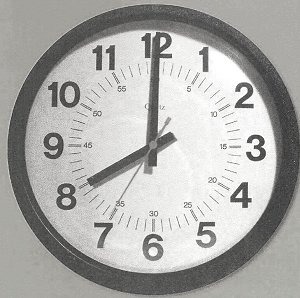
Paddling time -- for some |
Time of day. There appears to be a growing tendency for high schools to carry out all paddlings at the start of the first school day following the offense. For example, Alabama's Sylacauga High School reintroduced paddling a few years ago, and its handbook now provides: "Corporal punishment will be administered at a pre-determined time and location before each school day". At Mildred High and Junior High School in Texas, the form sent to parents reads, "Your child has chosen to break the student code of conduct [...] Your child has asked to receive Corporal Punishment (swats) in lieu of ISS (In school Suspension). With your permission I will administer corporal punishment in the morning at 8:00 a.m.".
In school systems (probably a minority) like Mildred ISD that require parents to approve each CP instance individually in advance, this entails the student taking the discipline slip home at night for parental signature. The student presents the signed slip on arrival at school the following morning and then receives his or her spanking.
Whether parental approval is required separately for each punishment or not, delaying the paddling overnight in this manner might be thought to give the student time to think about what is coming and resolve to change his or her behavior. It may also have the advantage of ensuring that all CP is given in a detached and calm manner, and doing it before lessons begin means that the student wastes no further time in the office when he or she should be in class.
A matter of choice. To a much greater extent than in the past, paddling has become in many schools an option for either the student or the parent, or both. Very likely, CP would not survive in as many places as it does, were this not so. Older teens, especially, may be offered a choice between a spanking and, say, detention or ISS. Some school handbooks, particularly at high-school level, lay down precise equivalences (either in general or for specific offenses), such as "three paddle swats or four days' after-school detention".

After being repeatedly tardy to class, "Shorty" opted to bend over the chair in the principal's office for a three-swat paddling at Booneville H.S. because he needed to keep his Saturday free. |
Much anecdotal evidence suggests that, in these circumstances, most teens, and certainly most young men, opt for the spanking, preferring to endure a "short sharp shock" of severe physical pain for a relatively brief duration, followed by a sore backside for a day or two, rather than long, tedious hours of unhealthy incarceration. In effect, students in these places may be seen to have been given "a right to be paddled" as well as "a right not to be paddled".
For an illustration of this policy being put into practice in 2008 at Booneville High School in Arkansas, where the choice was between taking three paddle swats and attending Saturday school, see these video clips.
Some schools explicitly state that no student will receive corporal punishment against his or her own wish. A few restrict the number of times per semester that a student may choose a spanking.
Many schools offer parents the opportunity to register in writing their desire that their son or daughter not be paddled; in Texas and North Carolina, they now have to do so by law. But they often stress that, in that case, the only alternative is suspension, so that the student loses learning time and, typically, gets a zero grade on work missed. Where the alternative to a paddling is after-school detention, some schools discourage opting out of CP by making life difficult for the parents, for instance by spelling out that no transportation is provided for the "detainees". Some make stipulations such as requiring the parent to agree come to the school to pick up the student within 30 minutes of being called in a discipline situation that would otherwise have been dealt with by a spanking (Alpine ISD, Texas). Some others make the actual process of opting out inconvenient, e.g. by requiring the parent to attend at the school and meet an administrator in person in order to hand over the no-CP letter (Dumas ISD, Texas).
Likewise, Biloxi Public Schools in Mississippi stipulates that parents who choose to forbid paddling may have to attend "parenting sessions", or even attend classes with the student.
Note also that some Texas high schools' athletic policies strongly discourage, or in a few cases even downright forbid, parents from opting their student athletes out of CP, in order not to encroach on playing and training time by requiring attendance at ISS or detention. One district (Newton ISD) goes so far as to write in its Athletic Handbook, "If student or parent/guardian does not agree with any of the above disciplinary actions, students should not be involved in athletics". Another (Mineola ISD), pointing out that "Athletes are required to be administered corporal punishment as needed", stated until recently: "if the Campus Principal gives an athlete the option of swats instead of another form of punishment, the athlete MUST take the swats, or the Athletic Director reserves the right to administer swats along with the punishment the campus principal assigned".

In the locker room of an East Texas high school, a 17-year-old, 6ft 2in. athlete, who has just been expertly paddled by the head football coach, lowers his jeans to show the effects to a friend's camera (March 2013). This school's athletic handbook says coaches may administer swats -- no maximum number specified -- for "violation of team rules", independently of the normal code of conduct. Note the skill and accuracy with which all the swats (three?) have been placed neatly over the lower half of the young man's posterior, so that he will experience a sharp reminder each time he sits down, for a day or so at least. (Screen grab from a YouTube clip that is no longer on line) |
As noted, some school districts, rather than allowing parents to "opt out", require them to explicitly "opt in" before the paddle can be used, but in most places the convention is still that a student may be spanked unless there is a parental opt-out notice already on file in the office.
Effects on the student. The effects of a paddling can vary a lot, depending on how forcefully it is applied and also, to a degree, on the student's size, build and physical resilience. Paddled students tend to say that it hurts like crazy at the time, but that the pain often does not last very long. There may be yelps and tears and red faces, as attested by numerous anecdotal eyewitness and first-person accounts. But even a paddling of four or five hard swats will, if administered accurately, only leave the buttocks sore and red or, at worst, harmlessly bruised for several days; it does not cause injury or bleeding. A few school districts, such as South Iron and Winona, both in Missouri, spell out in their handbooks that the paddle may cause bruises and that this does not constitute abuse (contrary to what overprotective mothers sometimes claim).
Private and charter schools. Private schools are less constrained than public ones in matters of punishment. Often, part of their appeal to parents is that they can boast much better-behaved pupils than public schools because they are freer to impose strict discipline. This can involve some private schools in frequent applications of CP -- especially, but not only, Christian (generally Protestant, e.g. Presbyterian, Baptist, fundamentalist or "born-again") schools, who are able to invoke biblical justifications for it. Some boarding schools, too, have been noted for making extensive use of the paddle, particularly "historically black" ones, or those with a military emphasis.
Charter schools are publicly funded but not subject to local school district rules, so that for instance in Memphis TN, where the local school board has banned the paddle in ordinary schools, public charter schools make a selling point of their ability to secure better student behavior through spanking.
Note too that there are many states -- including Alaska, California, Illinois, Michigan, Nevada, New York, Utah and Washington State -- where paddles are deployed in some private schools, even though they are banned in public ones. There are only two states where CP in private schools is prohibited by law: Iowa and New Jersey.
History. Much research remains to be done on the history of corporal punishment in American education. Presumably the early settlers brought their own existing practices with them from Europe. Whipping with a switch is much mentioned in literature in, especially, the 19th century, often making use of branches or twigs collected right outside the schoolroom.
In some districts, such as Alameda in California in 1893, regulations specified the use of a leather strap on the palm of the hand, as in Scotland and Canada, but this does not seem to have been widespread in the USA. A strap is also mentioned (no target area specified) in this 1880 case in New York State.
It is far from clear why, how, or exactly when the wooden paddle (originally, it is often alleged, an implement associated with slavery) became almost universally adopted. The paddle has also long been a feature of American college fraternity life -- but which came first? At all events, anecdotal evidence suggests that paddling had become the norm for school CP in most districts by the 1930s if not the 1920s.
An early mention of the word "paddle" comes in this 1887 news item about an allegedly excessive school punishment in Iowa. In that instance, the implement is described as "a hickory club or 'paddle', three feet long, one-half inch thick and one and one-half inches wide".
A newspaper editorial in 1908 opined that the paddle seemed "almost divinely appointed" for the purpose of punishing a boy, and explained why it was so suited to application to his rear end: "That area of the body which it most aptly fits is not very susceptible to mortal wounds ... the bones which it contains are so abundantly swathed about with muscular tissue that there is no danger of breaking them".
Some commentators have surmised anecdotally that the paddle may have come to be favored over the switch because of its weight and solidity, so that, if used properly, it can be effective even through fairly thick clothing, such as denim jeans (invented in the 1870s) with their patch pockets over the seat.
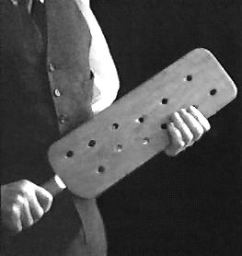 In the past, some paddles had holes drilled in them, to reduce air resistance, as in this picture from a fictional film (right). This supposedly increases the effectiveness of the punishment, but is nowadays rare, and explicitly disallowed by some school district regulations, probably because of fears that it could increase the propensity for bruising.
There were one or two places where the rattan cane was the official instrument, notably the Boston public schools until the 1960s. Even odder in American terms, the Boston rattan was applied to the student's hand (see J. Kozol, "Death at an Early Age", The Atlantic, September 1967). Massachusetts abolished school CP in 1972.
The rattan was also used in St Louis, Missouri, until it was abolished in 1981.
Also a special case is New Jersey, which abolished school CP in 1867, more than a century before any other state.(5) An attempt to reintroduce it in Newark NJ, with parental consent only, was rejected in 1894. The press coverage implies that the implement used was to have been the rattan, had the legislation passed.
(5) But at least one New Jersey school got round this by requiring parents to come and spank their unruly offspring -- see this Oct 1900 news item.
Another non-standard implement once used in a few areas was a length of rubber hose, as in this 1912 case in New Mexico and this 1919 case in Vermont and this 1924 case in New York and this 1960 case in Ohio.
Some big-city school districts, especially in the urban north, abolished CP long before the states in which they are situated. Thus, New York City first banned it in public schools in 1870, while in New York State as a whole it was not discontinued until 1985.
College and university. It is surprising to discover that college students and university freshmen could at one time be paddled in some places. See these 1922 rules for the spanking of students by campus police at Northwestern University in Chicago, and these Sep 1919 news items about punishments at the University of Missouri carried out by senior students with official approval, in a tradition said to have been started in 1905 and upheld in a vote of the student body in 1920.
At the University of Washington in Seattle, spanking was supposedly banned in 1914.
One could regard some of this as analogous with canings by prefects in English schools. It seems to have been something quite different from fraternity paddling, a private unofficial activity that has more to do with hazing than punishment. Meanwhile at Texas A & M University, paddling with an ax handle has been described by one informed source as "the traditional method of discipline at the university" until as recently as the mid-1980s -- see this picture.
DOCUMENTS:
A Legal Analysis of Ingraham v. Wright
Part of the paddled boys' testimony in the landmark 1977 Supreme Court case which upheld school corporal punishment as constitutional. (For more on this case, see "External Links" below.)
Court: School official not abuser
Report (Oct 2006) of a case in Arkansas, in which the state Court of Appeals held that bruising alone cannot be used as a test for abuse. A boy's three-swat school paddling, in which his buttocks were bruised, did not constitute abuse; and the assistant principal who administered it should not have been put on the child abuse registry, the court found.
State Laws on school corporal punishment
Extracts from legislation in those states which still allow paddling in schools, and one or two of those that do not.
Past regulations of school districts - 1963
Paddling regulations from Oakland (California) and Broward County (Florida) in 1963.
Past regulations of school districts - 1981
Regulations from Los Angeles in 1981, and a copy of the corporal punishment report form to be filed by the school -- all splendidly bureaucratic!
See also: Current handbooks of schools where CP is used
See also: Video clips
See also: Pictures of paddles
See also: Paddling in US schools in Topics A to Z
EXTERNAL LINKS: (these will open in a new window)
Corporal punishment incidence checklist
From the Louisiana Department of Education, a form on which schools are asked to fill out the details of every instance of CP. There is space for the names of three witnesses, but oddly no mention of the number of licks.
The Advantages of Corporal Punishment in Schools
Article on a parenting website (2017) briefly sets out some arguments in favor of retaining the school paddle. In particular, it is cheap and quick.
Counterpoint: The Benefits of Corporal Punishment
Abstract of an article (2016). The article itself is not on line but it can be accessed via certain libraries.
Schools, black children, and corporal punishment
Statistical analysis by the Brookings Institution (2016) shows that the racial disparity "problem" is very marked in relation to student suspensions but has been overstated as far as CP is concerned. In Texas for instance there is no difference at all between black and white students spanked pro rata to their population numbers (although it would have been interesting to know how Hispanics fit into this, since they now make up about 40% of the Texas population).
Mississippi School Districts Corporal Punishment Incidents: 2009-2010 to 2010-2011 School Years
Out of date, but still maybe of some interest, this is a nice colored map of the USA's top paddling state showing for each school district whether the incidence of CP was going up or down at the time.
Discipline by Teachers in Loco Parentis
This 1957 document from Cleveland-Marshall Law School in Ohio is a short academic thesis by a second-year law student. Now, more than 60 years later, the common-law doctrine of in loco parentis remains the legal basis for school CP, though it has become rather a theoretical one in an era when many parents don't spank their children and especially not in a formal ceremony with a wooden paddle. Perhaps partly as a result of this, much has changed since 1957, notably the extent to which parents are often allowed de facto (and now in the case of Texas de jure) to exempt their offspring from CP on the understanding that the student will be suspended instead.
Trends in Discipline and the Decline in Use of Corporal Punishment [DOC]
Information note (2011) from the Florida Department of Education gives some statistics. Students receiving CP in Florida declined from 13,900 in 1994/95 to 3,661 in 2009/10. The number of districts using the paddle had fallen to 30 (out of 67). Figures for individual districts are given for 2009/10. The winner was Jackson, with 480 spankings recorded. Analysis of the figures reveals that all the paddling districts were in the Florida panhandle and the inland part of the peninsula: corporal punishment had disappeared entirely from the east and west peninsular coasts.
The document notes that, as paddlings went down in the 1990s, suspensions rose sharply by a much larger amount, though they fell back somewhat in the latest five years. In other words, the increased suspensions were not merely replacements for CP. One might infer from this a general collapse in discipline due at least in part, perhaps, to the loss of the deterrent effect of the paddle in those districts that have abandoned it.
Correlation between high rates of corporal punishment in public schools and social pathologies
This so-called "research study" takes CP figures from the top ten paddling states and attempts to match them to data about such diverse matters as the murder rate, reading proficiency levels, and unmarried mothers. The paper then grudgingly concedes that a statistical correlation does not prove a causal relationship, and lamely attempts to meet this point by quoting various other documents. Some of these are purely anecdotal and others are "studies", such as those by Dr Murray Straus, which had nothing to do with school paddling but looked at the spanking of toddlers by their mothers, an entirely different subject.
Quite aside from any other considerations, several of the "top ten" paddling states in fact have very low percentages of students paddled. In Texas, for example, the figure looks large in absolute terms, but represents less than 1% of students. How likely is it that something directly affecting such a small proportion of a given population is going to have, of itself, a measurable effect on the wider society in the whole of that area? The paper concludes with the bald assertion that "corporal punishment in public schools clearly has disastrous effects on children and communities", having in fact wholly failed to demonstrate any such thing.
For my own explanation as to why statistical juggling exercises of this sort are invariably a waste of time, see this article on my Questions and Answers page.
Holloman v Harland and Allred and Walker County Board of Education
[Site is geo-blocked -- Needs VPN to access from outside USA]
Full judgment of the US Court of Appeals (2004) in a case about Michael Holloman, a schoolboy in Alabama who was paddled in 2000, aged 18, for raising his fist in protest during the Pledge of Allegiance. The court held that the school had violated his First Amendment rights to free speech. Michael chose a spanking (3 licks by the principal in his office) in preference to three days' detention, which would have prevented him from graduating. The nature of the punishment is incidental to the legal issues raised, which did not concern CP as such; but from our point of view the interesting paragraphs in the document are 10, 11, 39, 45, 48, 159, 161, 162, 164.
See also this June 2001 news item and this June 2002 follow-up for earlier stages of the case.
Fee and Fee v Herndon et al.
[Site is geo-blocked -- Needs VPN to access from outside USA]
US Court of Appeals ruling (1990) about a sixth-grade student paddled at school in Texas. The boy's mother had given permission for this, although from a strict legal point of view parental permission was not required in any case. The court threw the case out on a series of technicalities.
Doe And Others v. Heck And Others
This is the US Court of Appeals full ruling (2003) in the Greendale Baptist Academy case. It held that Wisconsin social workers, who had entered the school without a warrant and questioned students about CP, had violated the constitution. The court upheld the parents' rights and those of the paddling school. See also this April 2003 news item.
NRS 392.4633 Corporal punishment prohibited
[Site is geo-blocked -- Needs VPN to access from outside USA]
Current legislation outlawing CP in public schools in Nevada.
Minutes of the Senate Committee on Human Resources and Facilities
[Site is geo-blocked -- Needs VPN to access from outside USA]
Debate (April 1993) on Senate Bill 354 in Nevada (see previous item).
Duncan Ex Rel. v Chamblee and Leake County School District
Mississippi case from 1999. A schoolboy claimed to have been "violently paddled" on two successive days. As far as I can understand it, the State Supreme Court rules here (though with three judges dissenting) that his case against the school fails on a complex assortment of legal technicalities.
Sponsor Statement for HB14
Summary of a failed 1997 legislative attempt to reintroduce "corporal correction of students" in Alaska. The actual wording of the Bill can be read here [PDF].
A Shock to the Conscience: The Due Process Clause and Corporal Punishment
Article (2001) in American School Board Journal about whether the constitution places any limits on the severity of school CP.
Legitimated Violence in Schools: The Power Behind the Paddle
This "academic" essay, written in tendentious sociological jargon and published in the "Advancing Women in Leadership Journal", attacks CP from a hardline feminist and "children's rights" ideological perspective. There is a lot about "hegemonic masculinity", wherein even Desmond Morris's ancient pseudo-anthropological fantasies about the "bent-over submissive posture" and CP as a "form of ritual copulation" are trotted out once more.
Few readers of either sex will, I suspect, be inclined to take any of this stuff seriously, but the document does include a plausible vignette of a day at a southern elementary school, including eyewitness accounts of paddlings of a girl and a boy.
The paper is mistaken, incidentally, in stating that the UN Convention on the Rights of the Child "calls for a worldwide ban on corporal punishment". The Convention does nothing of the sort. The words "corporal punishment" do not appear anywhere in it, and nor does it contain any references to paddling, spanking, or any similar wording. What it does call for is the protection of children from "mental and physical violence". When countries signed up to the Convention (which, in any case, the USA has not done), they cannot reasonably have supposed that it prohibited ordinary, moderate spanking or paddling which causes no injury.
Another error is the assertion that "every industrialized nation in the world, except the U.S., has abolished corporal punishment in schools". Singapore is certainly an industrialized country, to name but one where school CP is entirely legal and in widespread use.
Sanctions for Breaches of Rules
Summary of various court cases relevant to school discipline (extract from a law textbook).
Education Law: Historic Supreme Court Cases
Includes summaries of Goss v. Lopez (1975) and Ingraham v. Wright (1977).
Education Law in North Carolina, Chapter 18: Student conduct issues [PDF]
See items 1813 to 1816 inclusive.
California Education Code 49000-49001
Text of 1986 legislation making corporal punishment illegal in public (but not private) schools in California.
Mississippi Senate Bill 2651
Would have required the state to adopt rules governing corporal punishment in schools. Died in committee (2000).
Ingraham et al v. Wright et al
Legal argumentation in the famous Supreme Court case.
Ingraham v. Wright: The Return of Old Jack Seaver
1978 article from "Inequality in Education" analyses this landmark case at length.
Ingraham v Wright dissenting judgment
Long statement by the four judges who were in the minority. Among other things, they thought the Eighth Amendment should apply to schoolchildren as well as criminals.
Moyer v. Commonwealth
1999 judgment in the Virginia Court of Appeals. Moyer, a teacher accused of the sexual abuse of minors, had (among other things) paddled some teenage cadets on their bare buttocks, raising the issue whether or not buttocks are "sexual parts"; the higher court held that they are not. In a dissenting judgment, some of the paddlings are described. See also news item of 29 August 1997, Cadet testifies about nudity, secret rituals with teacher, in The Archive.
Lesson 5: Student/Youth Due Process Middle
Exercise for, presumably, student teachers to learn about the constitutional case law applying to school corporal punishment. Considers the Tinker, Goss and Ingraham cases.
Robert L. Daily v Board of Education
Case in the Nebraska Supreme Court (February 1999) about a public school board's decision to suspend a teacher for using corporal punishment, contrary to that State's 1988 law. At issue was whether bopping a student on the head to get his attention, in the middle of a fracas, constituted corporal punishment; the lower court thought it didn't, but the higher court held that it did.
Saylor v Board of Education of Harlan County
[Site is geo-blocked -- Needs VPN to access from outside USA]
Report of case (July 1997) in US Court of Appeals. A paddled 5-foot-10-inch 14-year-old (5 licks for fighting; buttocks bruised) claimed his due process rights had been violated. The appeal court disagreed. Lots of interesting detail about the paddling (which took place in Kentucky in 1990) and the discipline situation in the school in question, and a great deal of legal analysis with references to other school paddling cases. Astute readers will find a witty joke buried in the text.
Commonwealth of Pennsylvania v David Douglass
1991 court case about a paddling in a fundamentalist Christian school.
Testimony of Shelly Gaspersohn, October 1984
Evidence to the US Senate Subcommittee on Juvenile Justice by a woman who had been paddled three years earlier at age 17 at Dunn High School, North Carolina. She had agreed to the punishment as an alternative to suspension but found it too severe for her taste. See also this October 1984 illustrated news item.
Reading the Law Monograph Series No 48
From the Education Law Association, an abstract of a book describing the constitutional situation and analyzing the statutes in different States.
Michigan: Nonpublic and Home Schools [PDF]
Makes clear (p.17) that the ban on school corporal punishment in Michigan does not apply to private schools.
Iowa Senate File 2062
Failed 1998 proposal for legislation to reintroduce corporal punishment to Iowa schools.
Corporal punishment in public schools: the legal and political battle continues
Academic legal discussion (1994) of the state of the law re paddling in US schools.
Corporal Punishment in Private Schools
Rules from the Alaska Administrative Code for private schools using corporal punishment, including a requirement for parental consent.
Outlaw Corporal Punishment
Doomed 1991 attempt in US congress to ban school corporal punishment at federal level.
Harris v Tate County School District
A Mississippi court holds (April 1995) that a boy's school paddling did not violate his due process rights.
Orville Harris v. Commonwealth of Pennsylvania Secretary of Education
Report of a court case (not to be confused with the Mississippi corporal punishment case also called Harris). This Harris was a teacher who used corporal punishment in Philadelphia, contrary to that school district's rules.



 UNITED STATES: School CP