
www.corpun.com

| www.corpun.com : Archive : 2011 : US Schools May 2011 |
Corpun file 23281 at www.corpun.com
myfoxdfw.com (KDFW Fox4 TV), Dallas/Fort Worth, Texas, 5 May 2011
House Bill Addresses Spanking in Schools
By Brandon Todd
Fox 4 NewsALVARADO, Texas -- School districts across the state handle corporal punishment differently. But a new bill up for vote will try to maintain some consistency.
Larger school districts around the state like Dallas, Fort Worth and Arlington have done away with spanking students. The Alvarado Independent School District is one of the few districts in the state that actively does.
AISD's policy states parents have to give permission for their child to receive the corporal punishment. And that's what the bill, headed to the state House floor on Friday, will require in every district across the state. No spanking unless parents give the green light first.
In Alvarado students are spanked for many reasons. Thirteen-year-old Dillon Berry found himself on the receiving end of a paddle in school just a couple of months ago.
"They ask you, 'What did you do wrong?' You tell them what you did wrong. They go, 'Was that right?' You say your answer and then they bend you over on a chair and they pop you twice," he said.
Berry said it hurt a little, but it was better than the alternatives.
"It's a last resort that's used and we always call the parents before we use it. And more times than not it's the students who want to do that and pleads with their parents to let the school use that form of discipline rather than putting them in SAC," said Superintendent Chester Juroska.
That's the school alternative classroom and it can cause students to miss class or even miss out on sports practice.
Some parents said the new bill is a lot better than an earlier one in the House that would have banned corporal punishment altogether. That bill died in committee.
"I think that a parent should be able to say yes or no. And you know, if they want to be the ones to even do the paddling sometimes that's even done," said Cris Ratliff.
TM and © 2011 Fox Television Stations, Inc., and its related entities. All rights reserved.
RELATED VIDEO CLIP
News report (2 mins 30 secs) from KDFW-TV Fox 4 Dallas/Fort Worth, 5 May 2011, of which the above report is an abbreviated version. Proposed Texas legislation would require parental consent. A recently punished student describes his spanking, which he chose in preference to "alternative classroom". It hurt "a little", he says. CP statistics are quoted for Alvarado ISD (where it was already policy to get parent permission first) showing that most of the paddling takes place at the senior high school. The school district's superintendent, interviewed, says he would rather not use CP but parents insist on it, often under pressure from the students themselves. A parent briefly speaks in support of the new bill on "parental rights" grounds.
HERE IS THE CLIP:
IMPORTANT: Copyright in this video material rests with the original copyright holders. This brief excerpt is reproduced under the "fair use" doctrine
for private, non-profit, historical research and education purposes only. It must not be redistributed or republished in any commercial context.
Corpun file 23283 at www.corpun.com
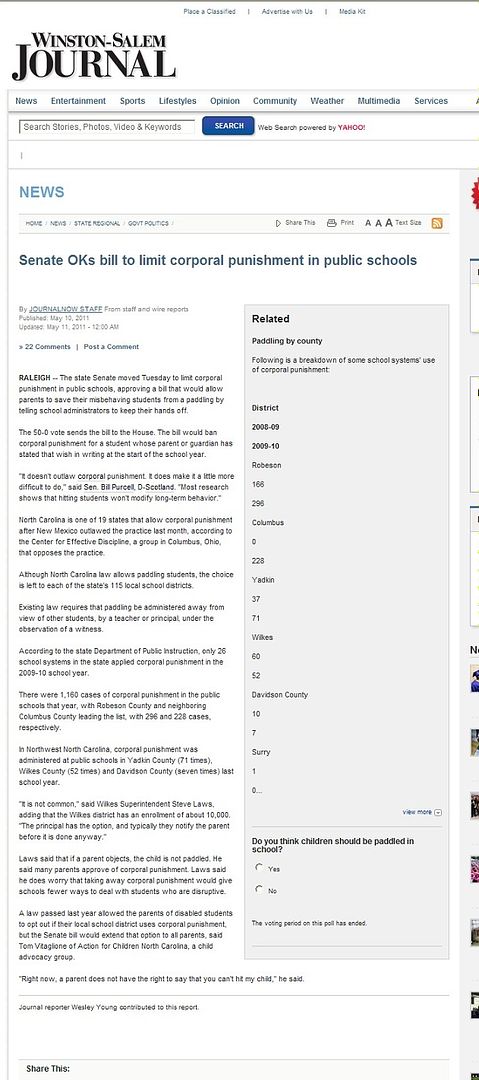
Winston-Salem Journal, North Carolina, 11 May 2011
Senate OKs bill to limit corporal punishment in public schools
By JournalNow Staff
From staff and wire reports
RALEIGH -- The state Senate moved Tuesday to limit corporal punishment in public schools, approving a bill that would allow parents to save their misbehaving students from a paddling by telling school administrators to keep their hands off.
The 50-0 vote sends the bill to the House. The bill would ban corporal punishment for a student whose parent or guardian has stated that wish in writing at the start of the school year.
"It doesn't outlaw corporal punishment. It does make it a little more difficult to do," said Sen. Bill Purcell, D-Scotland. "Most research shows that hitting students won't modify long-term behavior."
North Carolina is one of 19 states that allow corporal punishment after New Mexico outlawed the practice last month, according to the Center for Effective Discipline, a group in Columbus, Ohio, that opposes the practice.
Although North Carolina law allows paddling students, the choice is left to each of the state's 115 local school districts.
Existing law requires that paddling be administered away from view of other students, by a teacher or principal, under the observation of a witness.
According to the state Department of Public Instruction, only 26 school systems in the state applied corporal punishment in the 2009-10 school year.
There were 1,160 cases of corporal punishment in the public schools that year, with Robeson County and neighboring Columbus County leading the list, with 296 and 228 cases, respectively.
In Northwest North Carolina, corporal punishment was administered at public schools in Yadkin County (71 times), Wilkes County (52 times) and Davidson County (seven times) last school year.
"It is not common," said Wilkes Superintendent Steve Laws, adding that the Wilkes district has an enrollment of about 10,000. "The principal has the option, and typically they notify the parent before it is done anyway."
Laws said that if a parent objects, the child is not paddled. He said many parents approve of corporal punishment. Laws said he does worry that taking away corporal punishment would give schools fewer ways to deal with students who are disruptive.
A law passed last year allowed the parents of disabled students to opt out if their local school district uses corporal punishment, but the Senate bill would extend that option to all parents, said Tom Vitaglione of Action for Children North Carolina, a child advocacy group.
"Right now, a parent does not have the right to say that you can't hit my child," he said.
Journal reporter Wesley Young contributed to this report.
Related
Paddling by county
Following is a breakdown of some school systems' use of corporal punishment:
District 2008-09 2009-10
Robeson 166 296
Columbus 0 228
Yadkin 37 71
Wilkes 60 52
Davidson Co. 10 7
Surry 1 0
Corpun file 23285 at www.corpun.com
Gaston Gazette, North Carolina, 11 May 2011
Gaston schools still wield the paddle
By Amanda Memrick
Gaston County Schools paddled students 13 times this school year.
"Corporal punishment is generally by parental request or the administrator seeks permission first," said Gaston County Schools spokeswoman Bonnie Reidy.
Notifying parents ahead of time could become the law after the state Senate voted 50-0 Tuesday to require schools to give parents the choice to allow or forbid corporal punishment. Parents would be given a form at the first of the school year or when their child enrolls in the school that either gives permission for paddling or prohibits that form of discipline from being used. Corporal punishment can be used if the parent does not return the form.
North Carolina is one of 19 states that allow corporal punishment, according to Action for Children North Carolina. Of the state's 115 school districts, 18 local school districts still use corporal punishment.
The state Department of Public Instruction reported nearly 1,200 cases of corporal punishment statewide last school year.
According to Gaston County Schools data, corporal punishment was used on kindergartners the most with paddling used seven times this year. Second-graders received the paddle three times, first-graders were paddled twice and one third-grader was paddled through March 30.
"Corporal punishment is used as a last alternative of discipline," Reidy said.
The district follows the state law and has procedures in place that must be followed when using corporal punishment, Reidy said.
Only a principal, assistant principal or teacher may administer corporal punishment, according to board policy. A second school official must witness the punishment and it can't be done in front of other students.
Students must be warned that certain types of misbehavior could result in corporal punishment and must be forewarned before they are disciplined that way, according to policy. Students are told in front of a witnessing school official the reason they are being paddled. Corporal punishment can't be used for failing to complete class assignments or homework.
Corporal punishment must be used on the buttocks and the paddle can't be of a size or material that would cause injury, according to the policy. Slapping, striking a student about the face, shaking a student, or striking a student's hand with a ruler isn't allowed.
Once a student is paddled, parents are notified. A parent can request a written explanation of the reason for the punishment.
School officials must be sure they know how using that form of punishment would affect a child before it's administered, according to policy. They have to have used other forms of control and the school official must know enough about the student's home relationships, personality, and physical condition to determine that corporal punishment is appropriate, the policy states.
"They must have used every other form of discipline," Reidy said.
© Copyright 2010 Freedom Communications. All Rights Reserved.
Corpun file 23312 at www.corpun.com
The Williamson Daily News, West Virginia, 11 May 2011
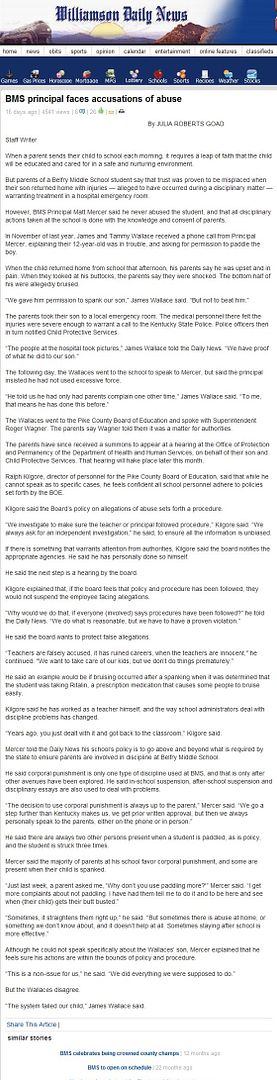
BMS principal faces accusations of abuse
By Julia Roberts Goad
Staff Writer
When a parent sends their child to school each morning, it requires a leap of faith that the child will be educated and cared for in a safe and nurturing environment.
But parents of a Belfry Middle School [in Kentucky] student say that trust was proven to be misplaced when their son returned home with injuries -- alleged to have occurred during a disciplinary matter -- warranting treatment in a hospital emergency room.
However, BMS Principal Matt Mercer said he never abused the student, and that all disciplinary actions taken at the school is done with the knowledge and consent of parents.
In November of last year, James and Tammy Wallace received a phone call from Principal Mercer, explaining their 12-year-old was in trouble, and asking for permission to paddle the boy.When the child returned home from school that afternoon, his parents say he was upset and in pain. When they looked at his buttocks, the parents say they were shocked. The bottom half of his were allegedly bruised.
"We gave him permission to spank our son," James Wallace said. "But not to beat him."
The parents took their son to a local emergency room. The medical personnel there felt the injuries were severe enough to warrant a call to the Kentucky State Police. Police officers then in turn notified Child Protective Services.
"The people at the hospital took pictures," James Wallace told the Daily News. "We have proof of what he did to our son."The following day, the Wallaces went to the school to speak to Mercer, but said the principal insisted he had not used excessive force.
"He told us he had only had parents complain one other time," James Wallace said. "To me, that means he has done this before."
The Wallaces went to the Pike County Board of Education and spoke with Superintendent Roger Wagner. The parents say Wagner told them it was a matter for authorities.
The parents have since received a summons to appear at a hearing at the Office of Protection and Permanency of the Department of Health and Human Services, on behalf of their son and Child Protective Services. That hearing will hake place later this month.
Ralph Kilgore, director of personnel for the Pike County Board of Education, said that while he cannot speak as to specific cases, he feels confident all school personnel adhere to policies set forth by the BOE.
Kilgore said the Board's policy on allegations of abuse sets forth a procedure.
"We investigate to make sure the teacher or principal followed procedure," Kilgore said. "We always ask for an independent investigation," he said, to ensure all the information is unbiased.If there is something that warrants attention from authorities, Kilgore said the board notifies the appropriate agencies. He said he has personally done so himself.
He said the next step is a hearing by the board.
Kilgore explained that, if the board feels that policy and procedure has been followed, they would not suspend the employee facing allegations.
"Why would we do that, if everyone (involved) says procedures have been followed?" he told the Daily News. "We do what is reasonable, but we have to have a proven violation."
He said the board wants to protect false allegations.
"Teachers are falsely accused, it has ruined careers, when the teachers are innocent," he continued. "We want to take care of our kids, but we don't do things prematurely."
He said an example would be if bruising occurred after a spanking when it was determined that the student was taking Ritalin, a prescription medication that causes some people to bruise easily.
Kilgore said he has worked as a teacher himself, and the way school administrators deal with discipline problems has changed.
"Years ago, you just dealt with it and got back to the classroom," Kilgore said.
Mercer told the Daily News his school's policy is to go above and beyond what is required by the state to ensure parents are involved in discipline at Belfry Middle School.He said corporal punishment is only one type of discipline used at BMS, and that is only after other avenues have been explored. He said in-school suspension, after-school suspension and disciplinary essays are also used to deal with problems.
"The decision to use corporal punishment is always up to the parent," Mercer said. "We go a step further than Kentucky makes us, we get prior written approval, but then we always personally speak to the parents, either on the phone or in person."
He said there are always two other persons present when a student is paddled, as is policy, and the student is struck three times.
Mercer said the majority of parents at his school favor corporal punishment, and some are present when their child is spanked.
"Just last week, a parent asked me, 'Why don't you use paddling more?'" Mercer said. "I get more complaints about not paddling. I have had them tell me to do it and to be here and see when (their child) gets their butt busted."
"Sometimes, it straightens them right up," he said. "But sometimes there is abuse at home, or something we don't know about, and it doesn't help at all. Sometimes staying after school is more effective."
Although he could not speak specifically about the Wallaces' son, Mercer explained that he feels sure his actions are within the bounds of policy and procedure.
"This is a non-issue for us," he said. "We did everything we were supposed to do."
But the Wallaces disagree.
"The system failed our child," James Wallace said.Copyright 2011 The Williamson Daily News. All rights reserved.
Corpun file 23294 at www.corpun.com
Houston Chronicle, Texas, 13 May 2011, p.1
The 82nd Legislature
A tender subject: school spankings
House passes but splits on bill giving parents say in punishment
By Gary Sharrer
Austin Bureau
AUSTIN -- Parents would get a voice in whether school officials can spank their children under a bill approved Thursday by the Texas House that split some lawmakers between local control and parental rights.
The legislation, which requires Senate approval, would allow parents to opt out their children from paddling or spanking by teachers or administrators in school districts that impose corporal punishment. HB 359 would not apply in rural school districts.
Rep. Alma Allen, D-Houston, has been trying to ban corporal punishment in schools altogether since the retired school teacher and principal arrived in the Legislature six years ago.
"This is a real start," she said a day after her colleagues initially rejected the legislation. She and her co-authors convinced at least 12 members to flip their votes and passed a watered down version of the bill by a vote of 87-56.
Lawmakers opposing any ban on corporal punishment complained that it would infringe on local control and limited government principles. Some legislators credited school spankings in their youth for putting them on life's proper path.
"What we're doing is taking away the ability of teachers to maintain discipline in the classroom," Rep. Bill Zedler, R-Arlington, said.
Rep. Scott Hochberg, D-Houston, countered that parents should have a say when it comes to spankings of their children.
"That is not too much of a right to give to a parent," Hochberg said.
Allen accepted an amendment that would exempt school districts in counties with populations of 50,000 or less to mollify rural lawmakers -- many of whom still voted against the measure.
Smaller communities do not need the state guiding them on school discipline, Rep. Warren Chisum, R-Pampa, said.
"We're OK with the system we have right now," he said. "We know our parents. We know who's in the schools. We know how to handle our discipline."
'Big government intrusion'
Current law allows school districts to use corporal punishment with or without a parent's consent, Allen said, adding that many larger districts do not allow spanking because of lawsuit costs.
Some conservative lawmakers protested any change in the law. They suggested that shaping discipline policy for school districts violated their local control rights and represented "big government intrusion."
Rep. Phil King, R-Weatherford, and two other Republican lawmakers talked about the lickings they took as students. King said they "made a difference in my life."
Zedler remembered vowing not to skip classes -- in between his second and third swat.
"We conservatives believe in local control and limited government," King said.
Rep. Mike Villarreal, D-San Antonio, chided his conservative colleagues by pointing out they would give locally elected officials control of physical punishment of children instead of the children's parents.
"This is the most hypocritical (local-control argument) I have ever seen you make," Villarreal said.
Two of Allen's co-authors -- Arlington Republicans Diane Patrick and Barbara Nash -- also defended the bill. Both are former school board members.
"Local control is very, very important. However, parental rights are central to our conservative values," Nash said.
In the end, however, Nash voted against the measure.
The bill also includes a provision that would prohibit campus police from issuing Class C misdemeanor citations to students in grades six and under for non-violent, non-sexual, non-harassment type incidents -- something Supreme Court Chief Justice Wallace Jefferson has been promoting.
"That is a pipeline to the prison system," Allen said.
CORPORAL PUNISHMENT
According to the Houston Independent School District code of student conduct:
Although abolished from board policy, a school may obtain a waiver from the Superintendent of Schools, granting the school permission to use corporal punishment to discipline students. This action is "limited to spanking or paddling the student ... and is limited to a maximum of three "pops."
-- Cleveland: Allowed; limited to spanking or paddling by the principal or a designee
-- Conroe: Prohibited; students shall not be spanked or paddled
-- Cy-Fair: Prohibited; students shall not be spanked, paddled or otherwise physically disciplined
-- Fort Bend: Prohibited; students shall not be spanked, paddled or otherwise physically disciplined
-- Galveston: Prohibited; students shall not be spanked, paddled or otherwise physically disciplined
-- Katy: Prohibited; students shall not be spanked, paddled or otherwise physically disciplined
-- Liberty: Allowed; limited to spanking or paddling by the principal or a designee
-- North Forest: Allowed; limited to spanking or paddling by the principal or a designee
-- Pasadena: Allowed; limited to spanking or paddling by the principal or a designee
-- Pearland: Prohibited; students shall not be spanked, paddled or otherwise physically disciplined
-- Spring: Prohibited; students shall not be spanked, paddled or otherwise physically disciplined
-- Spring Branch: Prohibited; students shall not be spanked, paddled or otherwise physically disciplined
Sources: School board policy manuals
Copyright 2011 The Houston Chronicle
Corpun file 23292 at www.corpun.com
valleycentral.com (KGBT Action 4 News TV), Harlingen, Texas, 16 May 2011
Bill gives parents more power to say no to corporal punishment
By Erika Flores
Texas schools are still allowed to spank school children, but there's a bill in the legislature that says no spanking over parents wishes.
The bill wouldn't outlaw the paddle, but it would regulate corporal punishment in schools giving more power to parents to just say no.
It's existed since pre-colonial times.
"When a kid did something they weren't supposed to, if they weren't attentive, the monitors popped them with that cane," said Jerry Lowe, with the department of education leadership at University of Texas-Pan American.
It's a swat to discipline students when they get out of line.
"Now a days, it sounds kind of harsh," said Lowe.
It's still legal in some states and still on the books in districts across Texas.
"We've been doing it for forever in our country," he said.
State law does not provide guidelines for corporal punishment policies.
Each district decides whether to allow it as an option for disciplining students, but that could change.
House Bill 359 would prohibit corporal punishment for those students whose parents oppose paddling.
"That's not a good way for schools to discipline kids," said 19-year-old Omar Barbosa. "Discipline should be something between a parent and child."
The McAllen school district did away with corporal punishment in the 90's.
Barbosa went to McAllen High and said he's thankful there was no paddling done there.
"Students would not respect school officials if they were hit by them," said Barbosa.
Many parents agree.
They said schools shouldn't be allowed to paddle their kids.
"Just discipline in another way," said mother Sylvia Gonzales.
Gonzales said she'd rather schools put her 14 year old in suspension or have him pick up garbage than swat him with a paddle, and she said she's glad the bill will allow parents to voice their wishes when it comes to swatting their kid.
There are a few districts in Rio Grande Valley that have corporal punishment still on the books, but they don't all enforce it.
[...]
© Copyright 2011 Barrington Broadcasting Group, LLC
Two-minute news segment from local TV station KGBT Harlingen (16 May 2011) of which the above report is an abbreviated version. Harlingen, almost on the Mexican border, is 72% Hispanic, and this report leaves the impression that more or less everyone there is opposed to CP. Clearly, if that is so, the area is quite untypical of Texas in that respect. Whether this ethnic group is in general more anti-spanking than the Texas mainstream majority, and if so why, might be an interesting question, but this report does not address it. The only student interviewed in the piece went to a school that didn't use CP anyway, so the purpose of his contribution is not very evident. The only parent quoted is against paddling altogether -- but the whole point of the bill supposedly being reported on here is that it would give parents the right to say no, so again one wonders what her problem is.
HERE IS THE CLIP:
This video clip is not currently available.
IMPORTANT: Copyright in this video material rests with the original copyright holders. This brief excerpt is reproduced under the "fair use" doctrine
Corpun file 23293 at www.corpun.com
www2.wrbl.com (WRBL News 3 TV), Columbus, Georgia, 16 May 2011
Corporal punishment in schools: Muscogee County to renew its policy
Georgia is one of the roughly dozen and a half states to hang on to its discipline policy. News 3 takes a look at Muscogee County's discipline policy.
By Alison Flowers
COLUMBUS, Ga. -- Every year the Muscogee County School District revisits its corporal punishment policy, among other discipline policies. Voting on the new discipline manual has been shelved for a month, but the recommendation on the table is to renew the existing corporal punishment policy.
Georgia is one of the roughly dozen and half states to hang on to striking children with a paddle as a form of discipline. Principals or designated staff may administer corporal punishment with other adults in the room.
For parents who don't want their children to experience this kind of punishment, they may opt out when they enroll their kids in school -- only if they have a signed statement from a medical doctor, attesting to the potential damage it would cause their children.
To Chief of Student Services Melvin Blackwell, a former principal and practitioner of corporal punishment, it is a good way to keep kids in the classroom by avoiding suspension.
"I don't think it's outdated," Blackwell said. "I think it should stay where it is, and once again, we must understand that we're not advocating for it, but we do want to have another step before the child is out of the classroom."
The U.S. Department of Education keeps some books on the number of times corporal punishment is used. The last count was in 2006. Baker Middle School, Eddy, Davis, Martin Luther King Jr. and South Columbus Elementary Schools had the highest incidence of using corporal punishment.
In a News 3 On Your Side Web poll, 63 percent of readers agreed with the district's policy, while 37 percent disagreed.
"Sometimes you just have to get a child's attention," said Tony Thomas, the grandparent of a Muscogee County student.
Board members say corporal punishment is used infrequently. Federal statistics show the district used it more than 600 times in 2006. The majority of those receiving the punishment were African-American boys. Boys are three times as likely to be the recipients of corporal punishment, according to a 2008 study. African-American girls are twice as likely to receive corporal punishment in schools than white girls, according to the same study.
Two-minute news segment from local TV station WRBL News 3, Columbus, Georgia (16 May 2011) of which the above report is a modified version. (Columbus is the capital of Muscogee County.) The dimensions of the paddle are described. Officials and parents are interviewed. There are no dissenting voices. A viewers' online poll is quoted, suggesting most people in this area approve of the local paddling policy.
HERE IS THE CLIP:
This video clip is not currently available.
IMPORTANT: Copyright in this video material rests with the original copyright holders. This brief excerpt is reproduced under the "fair use" doctrine
Corpun file 23306 at www.corpun.com
Lexington Herald-Leader, Kentucky, 21 May 2011
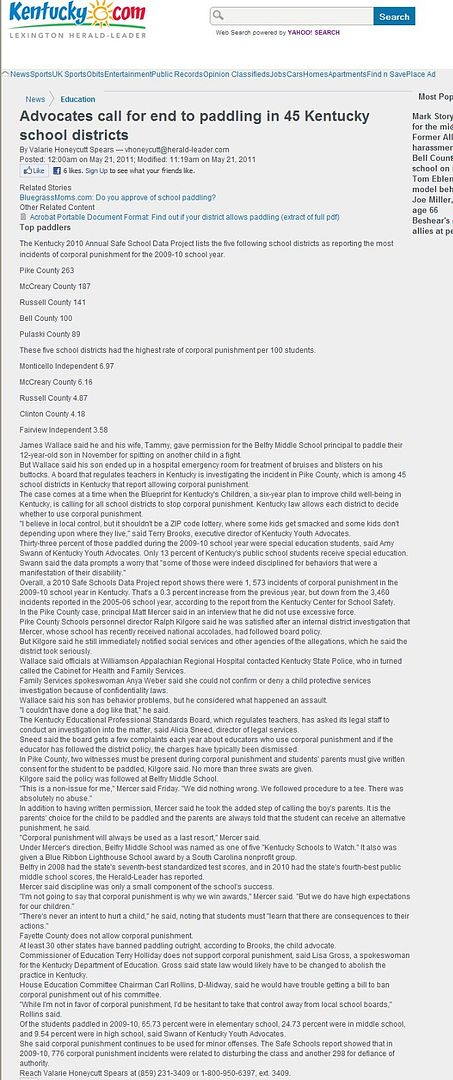
Advocates call for end to paddling in 45 Kentucky school districts
By Valarie Honecutt Spears
Top paddlers
The Kentucky 2010 Annual Safe School Data Project lists the five following school districts as reporting the most incidents of corporal punishment for the 2009-10 school year.
Pike County 263
McCreary County 187
Russell County 141
Bell County 100
Pulaski County 89These five school districts had the highest rate of corporal punishment per 100 students.
Monticello Independent 6.97
McCreary County 6.16
Russell County 4.87
Clinton County 4.18
Fairview Independent 3.58
James Wallace said he and his wife, Tammy, gave permission for the Belfry Middle School principal to paddle their 12-year-old son in November for spitting on another child in a fight.
But Wallace said his son ended up in a hospital emergency room for treatment of bruises and blisters on his buttocks. A board that regulates teachers in Kentucky is investigating the incident in Pike County, which is among 45 school districts in Kentucky that report allowing corporal punishment.
The case comes at a time when the Blueprint for Kentucky's Children, a six-year plan to improve child well-being in Kentucky, is calling for all school districts to stop corporal punishment. Kentucky law allows each district to decide whether to use corporal punishment.
"I believe in local control, but it shouldn't be a ZIP code lottery, where some kids get smacked and some kids don't depending upon where they live," said Terry Brooks, executive director of Kentucky Youth Advocates.
Thirty-three percent of those paddled during the 2009-10 school year were special education students, said Amy Swann of Kentucky Youth Advocates. Only 13 percent of Kentucky's public school students receive special education.
Swann said the data prompts a worry that "some of those were indeed disciplined for behaviors that were a manifestation of their disability."
Overall, a 2010 Safe Schools Data Project report shows there were 1,573 incidents of corporal punishment in the 2009-10 school year in Kentucky. That's a 0.3 percent increase from the previous year, but down from the 3,460 incidents reported in the 2005-06 school year, according to the report from the Kentucky Center for School Safety.
In the Pike County case, principal Matt Mercer said in an interview that he did not use excessive force.
Pike County Schools personnel director Ralph Kilgore said he was satisfied after an internal district investigation that Mercer, whose school has recently received national accolades, had followed board policy.
But Kilgore said he still immediately notified social services and other agencies of the allegations, which he said the district took seriously.
Wallace said officials at Williamson Appalachian Regional Hospital contacted Kentucky State Police, who in turned called the Cabinet for Health and Family Services.
Family Services spokeswoman Anya Weber said she could not confirm or deny a child protective services investigation because of confidentiality laws.
Wallace said his son has behavior problems, but he considered what happened an assault.
"I couldn't have done a dog like that," he said.
The Kentucky Educational Professional Standards Board, which regulates teachers, has asked its legal staff to conduct an investigation into the matter, said Alicia Sneed, director of legal services.
Sneed said the board gets a few complaints each year about educators who use corporal punishment and if the educator has followed the district policy, the charges have typically been dismissed.
In Pike County, two witnesses must be present during corporal punishment and students' parents must give written consent for the student to be paddled, Kilgore said. No more than three swats are given.
Kilgore said the policy was followed at Belfry Middle School.
"This is a non-issue for me," Mercer said Friday. "We did nothing wrong. We followed procedure to a tee. There was absolutely no abuse."
In addition to having written permission, Mercer said he took the added step of calling the boy's parents. It is the parents' choice for the child to be paddled and the parents are always told that the student can receive an alternative punishment, he said.
"Corporal punishment will always be used as a last resort," Mercer said.
Under Mercer's direction, Belfry Middle School was named as one of five "Kentucky Schools to Watch." It also was given a Blue Ribbon Lighthouse School award by a South Carolina nonprofit group.
Belfry in 2008 had the state's seventh-best standardized test scores, and in 2010 had the state's fourth-best public middle school scores, the Herald-Leader has reported.
Mercer said discipline was only a small component of the school's success.
"I'm not going to say that corporal punishment is why we win awards," Mercer said. "But we do have high expectations for our children."
"There's never an intent to hurt a child," he said, noting that students must "learn that there are consequences to their actions."
Fayette County does not allow corporal punishment.
At least 30 other states have banned paddling outright, according to Brooks, the child advocate.
Commissioner of Education Terry Holliday does not support corporal punishment, said Lisa Gross, a spokeswoman for the Kentucky Department of Education. Gross said state law would likely have to be changed to abolish the practice in Kentucky.
House Education Committee Chairman Carl Rollins, D-Midway, said he would have trouble getting a bill to ban corporal punishment out of his committee.
"While I'm not in favor of corporal punishment, I'd be hesitant to take that control away from local school boards," Rollins said.
Of the students paddled in 2009-10, 65.73 percent were in elementary school, 24.73 percent were in middle school, and 9.54 percent were in high school, said Swann of Kentucky Youth Advocates.
She said corporal punishment continues to be used for minor offenses. The Safe Schools report showed that in 2009-10, 776 corporal punishment incidents were related to disturbing the class and another 298 for defiance of authority.
© www.kentucky.com and wire service sources. All Rights Reserved.
Corpun file 23361 at www.corpun.com
Press-Register Blog, Mobile, Alabama, 22 May 2011
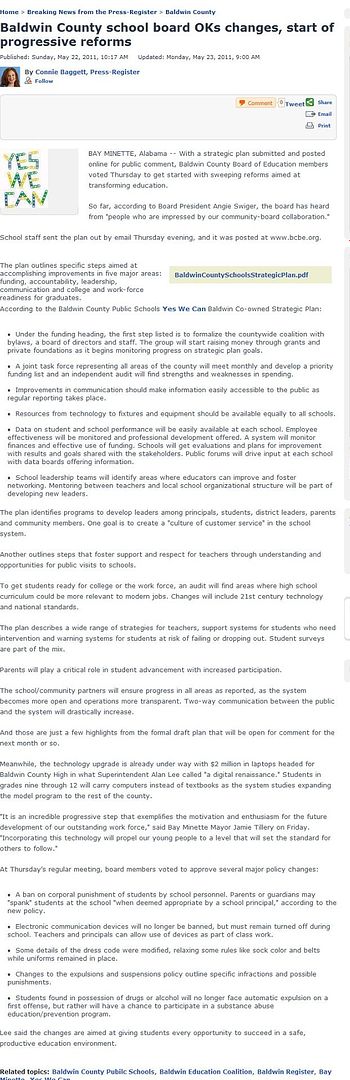
Baldwin County school board OKs changes, start of progressive reforms
By Connie Baggett, Press-Register
(extracts)
BAY MINETTE, Alabama -- With a strategic plan submitted and posted online for public comment, Baldwin County Board of Education members voted Thursday to get started with sweeping reforms aimed at transforming education.
[...]
At Thursday's regular meeting, board members voted to approve several major policy changes:
A ban on corporal punishment of students by school personnel. Parents or guardians may "spank" students at the school "when deemed appropriate by a school principal," according to the new policy.
[...]
Mobile Press-Register © 2011 Alabama Live LLC. All Rights Reserved.
Corpun file 23307 at www.corpun.com
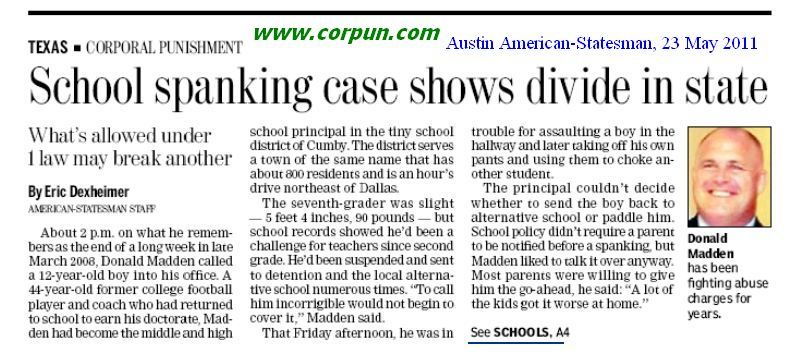
Austin American-Statesman, Texas, 23 May 2011, p.A1
Texas: Corporal punishment
School spanking case shows divide in state
What's allowed under 1 law may break another
By Eric Dexheimer
American-Statesman Staff
Donald Madden has been fighting abuse charges for years.
About 2 p.m. on what he remembers as the end of a long week in late March 2008, Donald Madden called a 12-year-old boy into his office. A 44-year-old former college football player and coach who had returned to school to earn his doctorate, Madden had become the middle and high school principal in the tiny school district of Cumby. The district serves a town of the same name that has about 800 residents and is an hour's drive northeast of Dallas.
The seventh-grader was slight -- 5 feet 4 inches, 90 pounds -- but school records showed he'd been a challenge for teachers since second grade. He'd been suspended and sent to detention and the local alternative school numerous times. "To call him incorrigible would not begin to cover it," Madden said.
That Friday afternoon, he was in trouble for assaulting a boy in the hallway and later taking off his own pants and using them to choke another student.
The principal couldn't decide whether to send the boy back to alternative school or paddle him. School policy didn't require a parent to be notified before a spanking, but Madden liked to talk it over anyway. Most parents were willing to give him the go-ahead, he said: "A lot of the kids got it worse at home."
And when Madden had brought up the subject with the seventh-grader's father earlier, the man was clear. "Light him up," he'd said.
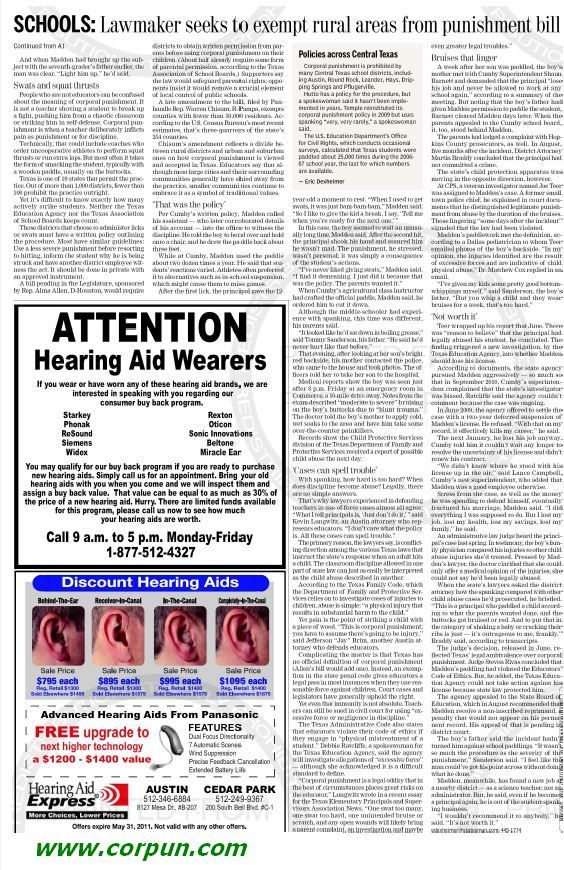
Swats and squat thrusts
People who are not educators can be confused about the meaning of corporal punishment. It is not a teacher shoving a student to break up a fight, pushing him from a chaotic classroom or striking him in self-defense. Corporal punishment is when a teacher deliberately inflicts pain as punishment or for discipline.
Technically, that could include coaches who order uncooperative athletes to perform squat thrusts or run extra laps. But most often it takes the form of smacking the student, typically with a wooden paddle, usually on the buttocks.
Texas is one of 19 states that permit the practice. Out of more than 1,000 districts, fewer than 100 prohibit the practice outright.
Yet it's difficult to know exactly how many actively strike students. Neither the Texas Education Agency nor the Texas Association of School Boards keeps count.
Those districts that choose to administer licks or swats must have a written policy outlining the procedure. Most have similar guidelines: Use a less severe punishment before resorting to hitting, inform the student why he is being struck and have another district employee witness the act. It should be done in private with an approved instrument.
A bill pending in the Legislature, sponsored by Rep. Alma Allen, D-Houston, would require districts to obtain written permission from parents before using corporal punishment on their children. (About half already require some form of parental permission, according to the Texas Association of School Boards.) Supporters say the law would safeguard parental rights; opponents insist it would remove a crucial element of local control of public schools.
A late amendment to the bill, filed by Panhandle Rep. Warren Chisum, R-Pampa, exempts counties with fewer than 50,000 residents. According to the U.S. Census Bureau's most recent estimates, that's three-quarters of the state's 254 counties.
Chisum's amendment reflects a divide between rural districts and urban and suburban ones on how corporal punishment is viewed and accepted in Texas. Educators say that although most large cities and their surrounding communities generally have shied away from the practice, smaller communities continue to embrace it as a symbol of traditional values.
'That was the policy'
Per Cumby's written policy, Madden called his assistant -- who later corroborated details of his account -- into the office to witness the discipline. He told the boy to bend over and hold onto a chair, and he drew the paddle back about three feet.
While at Cumby, Madden used the paddle about two dozen times a year. He said that students' reactions varied. Athletes often preferred it to alternatives such as in-school suspension, which might cause them to miss games.
After the first lick, the principal gave the 12-year-old a moment to rest. "When I used to get swats, it was just bam-bam-bam," Madden said. "So I like to give the kid a break. I say, 'Tell me when you're ready for the next one.'"
In this case, the boy seemed to wait an unusually long time, Madden said. After the second hit, the principal shook his hand and assured him he wasn't mad. The punishment, he stressed, wasn't personal; it was simply a consequence of the student's actions.
"I've never liked giving swats," Madden said. "I find it demeaning. I just did it because that was the policy. The parents wanted it."
When Cumby's agricultural class instructor had crafted the official paddle, Madden said, he ordered him to cut it down.
Although the middle-schooler had experience with spanking, this time was different, his parents said.
"It looked like he'd sat down in boiling grease," said Tommy Sanderson, his father. "He said he'd never hurt like that before."
That evening, after looking at her son's bright red backside, his mother contacted the police, who came to the house and took photos. The officers told her to take her son to the hospital.
Medical reports show the boy was seen just after 8 p.m. Friday at an emergency room in Commerce, a 10-mile drive away. Notes from the exam described "moderate to severe" bruising on the boy's buttocks due to "blunt trauma." The doctor told the boy's mother to apply cold, wet soaks to the area and have him take some over-the-counter painkillers.
Records show the Child Protective Services division of the Texas Department of Family and Protective Services received a report of possible child abuse the next day.
'Cases can spell trouble'
With spanking, how hard is too hard? When does discipline become abuse? Legally, there are no simple answers.
That's why lawyers experienced in defending teachers in use-of-force cases almost all agree: "What I tell principals is, 'Just don't do it,'" said Kevin Lungwitz, an Austin attorney who represents educators. "I don't care what the policy is. All these cases can spell trouble."
The primary reason, the lawyers say, is conflicting direction among the various Texas laws that instruct the state's response when an adult hits a child. The classroom discipline allowed in one part of state law can just as easily be interpreted as the child abuse described in another.
According to the Texas Family Code, which the Department of Family and Protective Services relies on to investigate cases of injuries to children, abuse is simple: "a physical injury that results in substantial harm to the child."
Yet pain is the point of striking a child with a piece of wood. "This is corporal punishment; you have to assume there's going to be injury," said Jefferson "Jay" Brim, another Austin attorney who defends educators.
Complicating the matter is that Texas has no official definition of corporal punishment (Allen's bill would add one). Instead, an exemption in the state penal code gives educators a legal pass in most instances when they use reasonable force against children. Court cases and legislators have generally upheld the right.
Yet even that immunity is not absolute. Teachers can still be sued in civil court for using "excessive force or negligence in discipline."
The Texas Administrative Code also states that educators violate their code of ethics if they engage in "physical mistreatment of a student." Debbie Ratcliffe, a spokeswoman for the Texas Education Agency, said the agency will investigate allegations of "excessive force" -- although she acknowledged it is a difficult standard to define.
"Corporal punishment is a legal oddity that in the best of circumstances places great risks on the educator," Lungwitz wrote in a recent essay for the Texas Elementary Principals and Supervisors Association News. "One swat too many, one swat too hard, one unintended bruise or scratch, and any open wounds will likely bring a parent complaint, an investigation and maybe even greater legal troubles."
Bruises that linger
A week after her son was paddled, the boy's mother met with Cumby Superintendent Shaun Barnett and demanded that the principal "lose his job and never be allowed to work at any school again," according to a summary of the meeting. But noting that the boy's father had given Madden permission to paddle the student, Barnett cleared Madden days later. When the parents appealed to the Cumby school board, it, too, stood behind Madden.
The parents had lodged a complaint with Hopkins County prosecutors, as well. In August, five months after the incident, District Attorney Martin Braddy concluded that the principal had not committed a crime.
The state's child protection apparatus was moving in the opposite direction, however.
At CPS, a veteran investigator named Joe Teer was assigned to Madden's case. A former small town police chief, he explained in court documents that he distinguished legitimate punishment from abuse by the duration of the bruises. Those lingering "some days after the incident" signaled that the law had been violated.
Madden's paddlework met the definition, according to a Dallas pediatrician to whom Teer emailed photos of the boy's backside. "In my opinion, the injuries identified are the result of excessive forces and are indicative of child physical abuse," Dr. Matthew Cox replied in an email.
"I've given my kids some pretty good bottom-whippings myself," said Sanderson, the boy's father. "But you whip a child and they wear bruises for a week, that's too hard."
'Not worth it'
Teer wrapped up his report that June. There was "reason to believe" that the principal had legally abused his student, he concluded. The finding triggered a new investigation, by the Texas Education Agency, into whether Madden should lose his license.
According to documents, the state agency pursued Madden aggressively -- so much so that in September 2010, Cumby's superintendent complained that the state's investigator was biased. Ratcliffe said the agency couldn't comment because the case was ongoing.
In June 2009, the agency offered to settle the case with a two-year deferred suspension of Madden's license. He refused. "With that on my record, it effectively kills my career," he said.
The next January, he lost his job anyway. Cumby told him it couldn't wait any longer to resolve the uncertainty of his license and didn't renew his contract.
"We didn't know where he stood with his license up in the air," said Lance Campbell, Cumby's new superintendent, who added that Madden was a good employee otherwise.
Stress from the case, as well as the money he was spending to defend himself, eventually fractured his marriage, Madden said. "I did everything I was supposed to do. But I lost my job, lost my health, lost my savings, lost my family," he said.
An administrative law judge heard the principal's case last spring. In testimony, the boy's family physician compared his injuries to other child abuse injuries she'd treated. Pressed by Madden's lawyer, the doctor clarified that she could only offer a medical opinion of the injuries; she could not say he'd been legally abused.
When the state's lawyers asked the district attorney how the spanking compared with other child abuse cases he'd prosecuted, he bristled. "This is a principal who paddled a child according to what the parents wanted done, and the buttocks got bruised or red. And to put that in the category of shaking a baby or cracking their ribs is just -- it's outrageous to me, frankly," Braddy said, according to transcripts.
The judge's decision, released in June, reflected Texas' legal ambivalence over corporal punishment. Judge Steven Rivas concluded that Madden's paddling had violated the Educators' Code of Ethics. But, he added, the Texas Education Agency could not take action against his license because state law protected him.
The agency appealed to the State Board of Education, which in August recommended that Madden receive a non-inscribed reprimand, a penalty that would not appear on his permanent record. His appeal of that is pending in district court.
The boy's father said the incident hadn't turned him against school paddlings. "It wasn't so much the procedure as the severity of the punishment," Sanderson said. "I feel like the man could've got his point across without doing what he done."
Madden, meanwhile, has found a new job at a nearby district -- as a science teacher, not an administrator. But, he said, even if he becomes a principal again, he is out of the student-spanking business.
"I wouldn't recommend it to anybody," he said. "It's not worth it."
Policies around Central Texas
Corporal punishment is prohibited by many Central Texas school districts, including Austin, Round Rock, Leander, Hays, Dripping Springs and Pflugerville.
Hutto has a policy for the procedure, but a spokeswoman said it hasn't been implemented in years. Temple reinstituted its corporal punishment policy in 2009 but uses spanking "very, very rarely," a spokeswoman said.
The U.S. Education Department's Office for Civil Rights, which conducts occasional surveys, calculated that Texas students were paddled about 25,000 times during the 2006-07 school year, the last for which numbers are available.
Eric Dexheimer
Corpun file 23401 at www.corpun.com
The New York Times Student Journalism Institute, 23 May 2011
At St. Augustine, Some Want the Paddle Back a Year After Ban
By Briana Barner
St. Augustine principal Don Boucree on the school's decision to continue paddling students: "Our perspective is that it is the will of the parents, and we want that wish to continue." Trevor James | NYT Institute>
Kendra Every has seen a change in her son Don over the school year, and she doesn't like what she sees.
She chose to send Don to St. Augustine High School because of its tradition of tough discipline, including paddling. Now -- for the first time in Augustine's 60-year history -- paddling is no longer allowed. Every said she wants paddling back.
"He's a little lax because of the absence of the paddle," Every said. "It wasn't a great year with my son. He hasn't been dedicated, hasn't been turning in homework, hasn't been shining his shoes."
One year after the Archdiocese of New Orleans banned paddling from St. Augustine, the decision is still causing controversy across New Orleans. The archdiocese issued the ban on the eve of the 2010-11 school year, despite complaints from the administration, parents, alumni and students. The Center for Effective Discipline still lists St. Augustine on its website as the only Catholic high school in the country that administers corporal punishment. The practice is banned in many Catholic schools, but it is still legal in several states, including Louisiana.
Since February, a growing debate between Archbishop Joseph Aymond and members of the St. Augustine community has included an hours long town hall meeting between the two, Aymond's controversial video blog, a community march and protest, and subsequent meetings to discuss an unreleased report compiled by a consultant Aymond hired. The report is what Aymond is said to have used to support the ban.
Sarah McDonald, a spokeswoman for the archbishop, said the diocese is not at liberty to comment. Principal Don Boucree said the two groups are still talking.
St. Augustine students cleaning out their lockers at the end of the year. Some parents want paddling, banned a year ago, to resume at the school. Trevor James | NYT Institute
Supporters of corporal punishment at the school, which is predominantly black, have said it aligns with African-American traditions of discipline and should remain because it is a part of the school's culture. Opponents of paddling have linked corporal punishment to increased violence and called the practice antiquated.
Boucree, an alumnus and former St. Augustine teacher, stressed that paddling wasn't the only form of discipline at the school. Other measures include detention and suspension.
Nevertheless, Boucree said a year without paddling has led to more behavioral problems.
"Paddling deters minor infractions," he said, listing chewing gum and screaming in the hallways as examples. "It cuts away the silly things."
Now, problems that would have been handled with the swat of a paddle have to be handled in Saturday detention, he said.
Boucree said he had to paddle a student only once as a teacher, and he didn't want an image to persist of "faculty and staff running around the school using the paddle every two minutes."
When paddling was allowed, not everyone was permitted to do so. In the end, only one staffer administered discipline.
Some in the community don't agree with the principal, and some do.
Marcia Lasandor, whose son Joel graduated from St. Augustine in 2007, said she agreed with the ban and opposed paddling.
"I don't think that a child should be hit with a piece of wood," she said.
She said that her son did not have behavioral problems before he came to the school, so it didn't add or subtract anything from who he was. "Discipline, yes. Strict discipline, yes. Paddling -- no," Lasandor said.
Joel Bertrand, Lasandor's son, supported paddling but acknowledged flaws with the policy.
"After a while," Bertrand said, the punishment "becomes obsolete because you're used to it." Nevertheless, the paddle had served its purpose, he said.
Lasandor said the practice of paddling has a lot to do with the history and tradition of the school -- an ideal that does not hold the same weight in her eyes.
Terry Simon offered a story that shows how St. Augustine's paddling policy instilled character into his son Brian.
One day, Simon said, he planned to take his son to the doctor before school. No problem with being late, Simon thought. He'd just write a note of explanation, and Brian could go about his day. But Brian didn't see it that way.
Simon said his son pleaded with him to get to school on time because he was responsible for being punctual. A note would not suffice, Simon was told, and Brian would be paddled. This need for punctuality followed Brian into his life after graduation.
Briston Hines, a 2010 graduate, said an explanation was always given before or after a paddling occurred.
"Each time, you learned a different lesson," Hines said. "I wouldn't be as in line as I am now."
Hines said that "St. Aug" taught him to be wise, respectful, intelligent and diligent.
Simon said, "One of the things about the paddle -- it's an immediate consequence. They speak about the paddle like an old girlfriend. There was love there."
It all comes down to the bottom line for Simon.
"You can have discipline without the paddle," Simon said, "but will it be as effective?"
Copyright 2011, The New York Times Student Journalism Institute
Corpun file 23325 at www.corpun.com
The Des Moines Register, Iowa, 27 May 2011
Birthday spankings at eastern Iowa school spark complaints, probe
By Staci Hupp
This is the modified hockey stick that Terry Eisenbarth has used to give birthday 'whammies' to his students in Mount Vernon./ SPECIAL TO THE REGISTER
A Mount Vernon elementary school principal used a padded hockey stick to deliver birthday spankings to his students, according to complaints that Linn County authorities are investigating.
Complaints about Principal Terry Eisenbarth's birthday "whammies" at Washington Elementary School are also under review by school board members, who met behind closed doors Wednesday night. About 70 people waited outside the meeting, parents said.
"I do not spank my kids at home on their birthdays,"said Steve Wernimont, 44, who has three children. "That is not a celebration. It's being subservient to a dominating figure."Wernimont and his husband, Ric Turnquist, said their three children, ages 9, 8 and 7, received birthday whammies last fall. The children didn't acknowledge the spankings until this month, when Wernimont said he heard about the practice and asked them about it.
The older children didn't seem to mind, but the 7-year-old boy, who has post-traumatic stress disorder and other emotional problems, "did not like it one bit," Wernimont said.
The couple said they complained to police and the school board only after Superintendent Pamela Ewell did not respond to an email for several days.Ewell and Eisenbarth did not return telephone calls Thursday.
In a letter to parents, Eisenbarth described the "pat on the backside" as a birthday tradition. He celebrated each child's birthday with an announcement on the school intercom, followed by an invitation to the principal's office.
Eisenbarth gave students pencils and calculators, sang "Happy Birthday" and spanked them once for each year of their lives, the letter said.
School employees or parents often participated, and no children were injured, the letter said.
Eisenbarth, 38, said he stopped the birthday spankings after someone complained that they "created an uncomfortable situation," the letter said.
"I am very sorry that I have caused discomfort to some by celebrating birthdays in this manner," Eisenbarth wrote.
The hockey stick was wrapped in plastic foam, Mount Vernon police said.
Police initially ruled that a complaint from parents was unfounded. Then they forwarded the investigation to Linn County sheriff's officials to avoid allegations of a conflict of interest.Sheriff Brian Gardner said police "work closely" with school officials in Mount Vernon, a district of about 1,300 students.
"We're probably going to review the reports, see if there may be any holes, perhaps interview a witness and make a determination as to whether there has been a criminal offense," Gardner said.
Carol Greta, an attorney at the Iowa Department of Education, said birthday spankings don't appear to violate a state ban on corporal punishment, "which is defined as intentional physical punishment."But school boards and state officials who oversee educator licensing can take action against employees who act inappropriately, she said.
Wernimont said the issue has divided residents of Mount Vernon.
"I've gotten calls from people who've said, 'You're ruining the image of our town,'" he said.
Other parents blame Eisenbarth, who is wrapping up his first year as elementary principal in Mount Vernon.
Kim Benesh wrote in a letter to the local newspaper that "the important lesson the elementary school tirelessly tries to instill of, 'Your body is your own and no one has the right to touch you,' has been devastatingly thrown out the window."Bob Penn, the school board's vice president, would not discuss the board's next move. Penn called it a personnel issue that he can't discuss publicly.
"Our mission is always to try to make decisions that are in the best interests of the kids in the district," he said. "That's what we're about."Copyright © 2011 www.DesMoinesRegister.com. All rights reserved.
About this website
Search this site
Illustrated article: American school paddling
Other external links: US school CP
Archive 2010: USA
Archive 2011: USA
Video clips
Picture index
Previous month
Following month
www.corpun.com Main menu page
Copyright © C. Farrell 2011, 2013
Page updated January 2013