
www.corpun.com

| www.corpun.com : Archive : Up to 1975 : UK Schools Jan 1935 |
British Medical Journal, London, 5 January 1935, p.38
Correspondence
Corporal Punishment for Girls
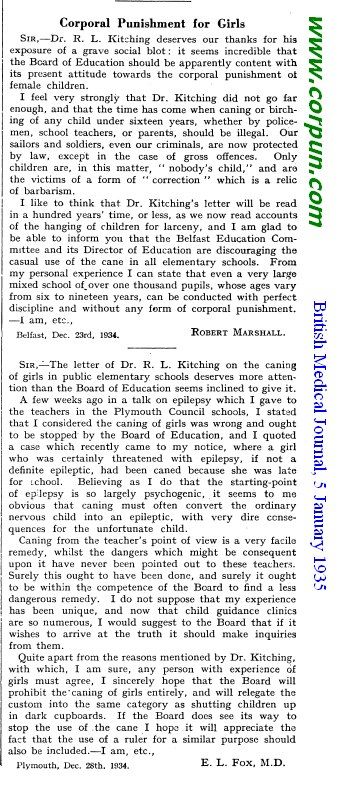
SIR, -- Dr. R. L. Kitching deserves our thanks for his exposure of a grave social blot: it seems incredible that the Board of Education should be apparently content with its present attitude towards the corporal punishment of female children.
I feel very strongly that Dr. Kitching did not go far enough, and that the time has come when caning or birching of any child under sixteen years, whether by policemen, school teachers, or parents, should be illegal. Our sailors and soldiers, even our criminals, are now protected by law, except in the case of gross offences. Only children are, in this matter, "nobody's child," and are the victims of a form of "correction" which is a relic of barbarism.
I like to think that Dr. Kitching's letter will be read in a hundred years' time, or less, as we now read accounts of the hanging of children for larceny, and I am glad to be able to inform you that the Belfast Education Committee and its Director of Education are discouraging the casual use of the cane in all elementary schools. From my personal experience I can state that even a very large mixed school of over one thousand pupils, whose ages vary from six to nineteen years, can be conducted with perfect discipline and without any form of corporal punishment.
-- I am, etc.,
ROBERT MARSHALL.
Belfast, Dec. 23rd, 1934.__________________
SIR, -- The letter of Dr. R. L. Kitching on the caning of girls in public elementary schools deserves more attention than the Board of Education seems inclined to give it. A few weeks ago in a talk on epilepsy which I gave to the teachers in the Plymouth Council schools, I stated that I considered the caning of girls was wrong and ought to be stopped by the Board of Education, and I quoted a case which recently came to my notice, where a girl who was certainly threatened with epilepsy, if not a definite epileptic, had been caned because she was late for school.
Believing as I do that the starting-point of epilepsy is so largely psychogenic, it seems to me obvious that caning must often convert the ordinary nervous child into an epileptic, with very dire consequences for the unfortunate child.
Caning from the teacher's point of view is a very facile remedy, whilst the dangers which might be consequent upon it have never been pointed out to these teachers. Surely this ought to have been done, and surely it ought to be within the competence of the Board to find a less dangerous remedy. I do not suppose that my experience has been unique, and now that child guidance clinics are so numerous, I would suggest to the Board that if it wishes to arrive at the truth it should make inquiries from them.
Quite apart from the reasons mentioned by Dr. Kitching, with which, I am sure, any person with experience of girls must agree, I sincerely hope that the Board will prohibit the caning of girls entirely, and will relegate the custom into the same category as shutting children up in dark cupboards. If the Board does see its way to stop the use of the cane I hope it will appreciate the fact that the use of a ruler for a similar purpose should also be included.
-- I am, etc.,
E. L. Fox, M.D.
Plymouth, Dec. 28th. 1934.
British Medical Journal, London, 5 January 1935, p.39
Correspondence
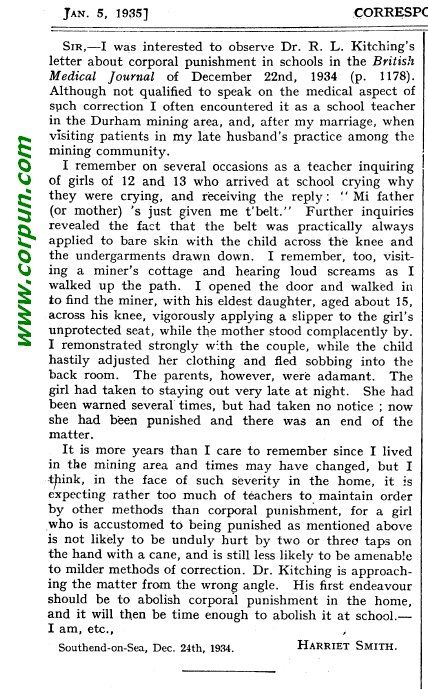
SIR, -- I was interested to observe Dr. R. L. Kitching's letter about corporal punishment in schools in the British Medical Journal of December 22nd, 1934 (p. 1178). Although not qualified to speak on the medical aspect of such correction I often encountered it as a school teacher in the Durham mining area, and, after my marriage, when visiting patients in my late husband's practice among the mining community.
I remember on several occasions as a teacher inquiring of girls of 12 and 13 who arrived at school crying why they were crying, and receiving the reply: "Mi father (or mother)'s just given me t'belt." Further inquiries revealed the fact that the belt was practically always applied to bare skin with the child across the knee and the undergarments drawn down. I remember, too, visiting a miner's cottage and hearing loud screams as I walked up the path. I opened the door and walked in to find the miner, with his eldest daughter, aged about 15, across his knee, vigorously applying a slipper to the girl's unprotected seat, while the mother stood complacently by.I remonstrated strongly with the couple, while the child hastily adjusted her clothing and fled sobbing into the back room. The parents, however, were adamant. The girl had taken to staying out very late at night. She had been warned several times, but had taken no notice; now she had been punished and there was an end of the matter.
It is more years than I care to remember since I lived in the mining area and times may have changed, but I think, in the face of such severity in the home, it is expecting rather too much of teachers to maintain order by other methods than corporal punishment, for a girl who is accustomed to being punished as mentioned above is not likely to be unduly hurt by two or three taps on the hand with a cane, and is still less likely to be amenable to milder methods of correction. Dr. Kitching is approaching the matter from the wrong angle. His first endeavour should be to abolish corporal punishment in the home, and it will then be time enough to abolish it at school.
I am, etc.,
HARRIET SMITH.
Southend-on-Sea, Dec. 24th, 1934.
British Medical Journal, London, 12 January 1935, p.85
Correspondence
Corporal Punishment for Girls
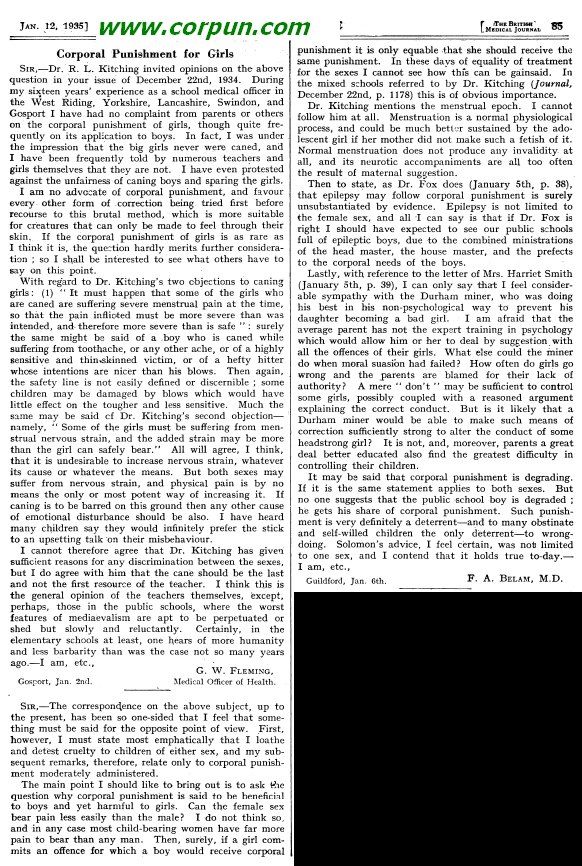
SIR, -- Dr. R. L. Kitching invited opinions on the above question in your issue of December 22nd, 1934. During my sixteen years' experience as a school medical officer in the West Riding, Yorkshire, Lancashire, Swindon, and Gosport I have had no complaint from parents or others on the corporal punishment of girls, though quite frequently on its application to boys. In fact, I was under the impression that the big girls never were caned, and I have been frequently told by numerous teachers and girls themselves that they are not. I have even protested against the unfairness of caning boys and sparing the girls.
I am no advocate of corporal punishment, and favour every other form of correction being tried first before recourse to this brutal method, which is more suitable for creatures that can only be made to feel through their skin. If the corporal punishment of girls is as rare as I think it is, the question hardly merits further consideration; so I shall be interested to see what others have to say on this point.
With regard to Dr. Kitching's two objections to caning girls: (1) "It must happen that some of the girls who are caned are suffering severe menstrual pain at the time, so that the pain inflicted must be more severe than was intended, and therefore more severe than is safe": surely the same might be said of a boy who is caned while suffering from toothache, or any other ache, or of a highly sensitive and thin-skinned victim, or of a hefty hitter whose intentions are nicer than his blows. Then again, the safety line is not easily defined or discernible; some children may be damaged by blows which would have little effect on the tougher and less sensitive.Much the same may be said of Dr. Kitching's second objection -- namely, "Some of the girls must be suffering from menstrual nervous strain, and the added strain may be more than the girl can safely bear." All will agree, I think, that it is undesirable to increase nervous strain, whatever its cause or whatever the means. But both sexes may suffer from nervous strain, and physical pain is by no means the only or most potent way of increasing it. If caning is to be barred on this ground then any other cause of emotional disturbance should be also. I have heard many children say they would infinitely prefer the stick to an upsetting talk on their misbehaviour.
I cannot therefore agree that Dr. Kitching has given sufficient reasons for any discrimination between the sexes, but I do agree with him that the cane should be the last and not the first resource of the teacher. I think this is the general opinion of the teachers themselves, except, perhaps, those in the public schools, where the worst features of mediaevalism are apt to be perpetuated or shed but slowly and reluctantly. Certainly, in the elementary schools at least, one hears of more humanity and less barbarity than was the case not so many years ago.
-- I am, etc.,
G. W. FLEMING,
Medical Officer of Health.
Gosport, Jan. 2nd.___________________
SIR, -- The correspondence on the above subject, up to the present, has been so one-sided that I feel that something must be said for the opposite point of view. First, however, I must state most emphatically that I loathe and detest cruelty to children of either sex, and my subsequent remarks, therefore, relate only to corporal punishment moderately administered.
The main point I should like to bring out is to ask the question why corporal punishment is said to be beneficial to boys and yet harmful to girls. Can the female sex bear pain less easily than the male? I do not think so, and in any case most child-bearing women have far more pain to bear than any man. Then, surely, if a girl commits an offence for which a boy would receive corporal punishment it is only equable that she should receive the same punishment. In these days of equality of treatment for the sexes I cannot see how this can be gainsaid. In the mixed schools referred to by Dr. Kitching (Journal, December 22nd, p. 1178) this is of obvious importance.
Dr. Kitching mentions the menstrual epoch. I cannot follow him at all. Menstruation is a normal physiological process, and could be much better sustained by the adolescent girl if her mother did not make such a fetish of it. Normal menstruation does not produce any invalidity at all, and its neurotic accompaniments are all too often the result of maternal suggestion.
Then to state, as Dr. Fox does (January 5th, p. 38), that epilepsy may follow corporal punishment is surely unsubstantiated by evidence. Epilepsy is not limited to the female sex, and all I can say is that if Dr. Fox is right I should have expected to see our public schools full of epileptic boys, due to the combined ministrations of the head master, the house master, and the prefects to the corporal needs of the boys.
Lastly, with reference to the letter of Mrs. Harriet Smith (January 5th, p. 39), I can only say that I feel considerable sympathy with the Durham miner, who was doing his best in his non-psychological way to prevent his daughter becoming a bad girl. I am afraid that the average parent has not the expert training in psychology which would allow him or her to deal by suggestion with all the offences of their girls. What else could the miner do when moral suasion had failed? How often do girls go wrong and the parents are blamed for their lack of authority? A mere "don't" may be sufficient to control some girls, possibly coupled with a reasoned argument explaining the correct conduct. But is it likely that a Durham miner would be able to make such means of correction sufficiently strong to alter the conduct of some headstrong girl? It is not, and, moreover, parents a great deal better educated also find the greatest difficulty in controlling their children.
It may be said that corporal punishment is degrading. If it is the same statement applies to both sexes. But no one suggests that the public school boy is degraded; he gets his share of corporal punishment. Such punishment is very definitely a deterrent -- and to many obstinate and self-willed children the only deterrent -- to wrongdoing. Solomon's advice, I feel certain, was not limited to one sex, and I contend that it holds true to-day.
I am, etc.,
F. A. BELAM, M.D.
Guildford, Jan. 6th.
British Medical Journal, London, 19 January 1935, p.130
Correspondence
Corporal Punishment for Girls
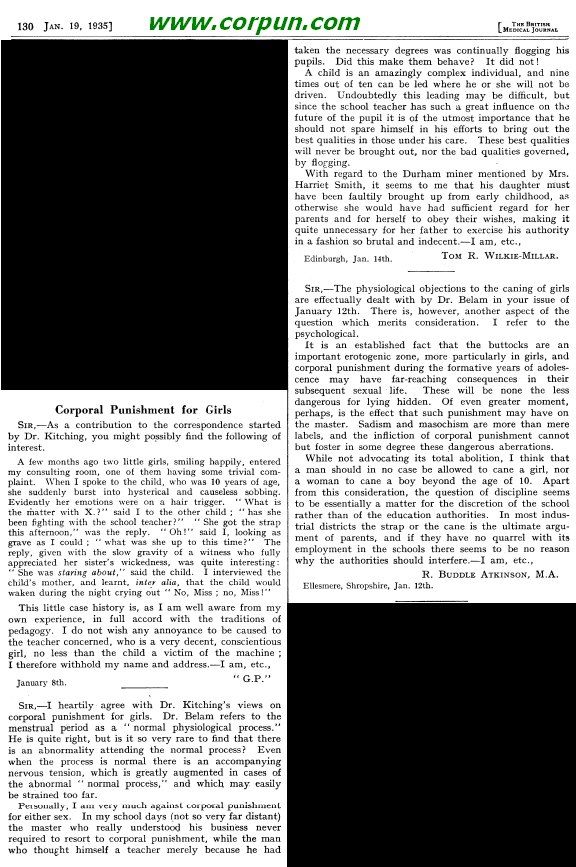
SIR,- As a contribution to the correspondence started by Dr. Kitching, you might possibly find the following of interest.
A few months ago two little girls, smiling happily, entered my consulting room, one of them having some trivial complaint. When I spoke to the child, who was 10 years of age, she suddenly burst into hysterical and causeless sobbing. Evidently her emotions were on a hair trigger. "What is the matter with X.?" said I to the other child; "has she been fighting with the school teacher?" "She got the strap this afternoon," was the reply. "Oh!" said I, looking as grave as I could; "what was she up to this time?" The reply, given with the slow gravity of a witness who fully appreciated her sister's wickedness, was quite interesting: "She was staring about," said the child. I interviewed the child's mother, and learnt, inter alia, that the child would waken during the night crying out "No, Miss; no, Miss!"
This little case history is, as I am well aware from my own experience, in full accord with the traditions of pedagogy. I do not wish any annoyance to be caused to the teacher concerned, who is a very decent, conscientious girl, no less than the child a victim of the machine; I therefore withhold my name and address.
-- I am, etc.,
"G.P."
January 8th.___________________
SIR,- I heartily agree with Dr. Kitching's views on corporal punishment for girls. Dr. Belam refers to the menstrual period as a "normal physiological process." He is quite right, but is it so very rare to find that there is an abnormality attending the normal process? Even when the process is normal there is an accompanying nervous tension, which is greatly augmented in cases of the abnormal "normal process," and which may easily be strained too far.
Personally, I am very much against corporal punishment for either sex. In my school days (not so very far distant) the master who really understood his business never required to resort to corporal punishment, while the man who thought himself a teacher merely because he had taken the necessary degrees was continually flogging his pupils. Did this make them behave? It did not!
A child is an amazingly complex individual, and nine times out of ten can be led where he or she will not be driven. Undoubtedly this leading may be difficult, but since the school teacher has such a great influence on the future of the pupil it is of the utmost importance that he should not spare himself in his efforts to bring out the best qualities in those under his care. These best qualities will never be brought out, nor the bad qualities governed, by flogging.
With regard to the Durham miner mentioned by Mrs. Harriet Smith, it seems to me that his daughter must have been faultily brought up from early childhood, as otherwise she would have had sufficient regard for her parents and for herself to obey their wishes, making it quite unnecessary for her father to exercise his authority in a fashion so brutal and indecent.
-- I am, etc.,
TOM R. WILKIE-MILLAR.
Edinburgh, Jan. 14th.___________________
SIR,- The physiological objections to the caning of girls are effectually dealt with by Dr. Belam in your issue of January 12th. There is, however, another aspect of the question which merits consideration. I refer to the psychological.
It is an established fact that the buttocks are an important erotogenic zone, more particularly in girls, and corporal punishment during the formative years of adolescence may have far-reaching consequences in their subsequent sexual life. These will be none the less dangerous for lying hidden. Of even greater moment, perhaps, is the effect that such punishment may have on the master. Sadism and masochism are more than mere labels, and the infliction of corporal punishment cannot but foster in some degree these dangerous aberrations.
While not advocating its total abolition, I think that a man should in no case be allowed to cane a girl, nor a woman to cane a boy beyond the age of 10. Apart from this consideration, the question of discipline seems to be essentially a matter for the discretion of the school rather than of the education authorities. In most industrial districts the strap or the cane is the ultimate argument of parents, and if they have no quarrel with its employment in the schools there seems to be no reason why the authorities should interfere.
-- I am, etc.,
R. BUDDLE ATKINSON, M.A.
Ellesmere, Shropshire, Jan. 12th.
Follow-up: 16 February 1935 - Correspondence: The Caning of Girls
About this website
Search this site
Article: School corporal punishment in Britain
Other external links: UK school CP
Archive up to 1975: UK
Video clips
Picture index
www.corpun.com Main menu page
Copyright © C. Farrell 2011
Page created May 2011