Corpun file 22760
Evening Post, Wellington, 12 December 1929
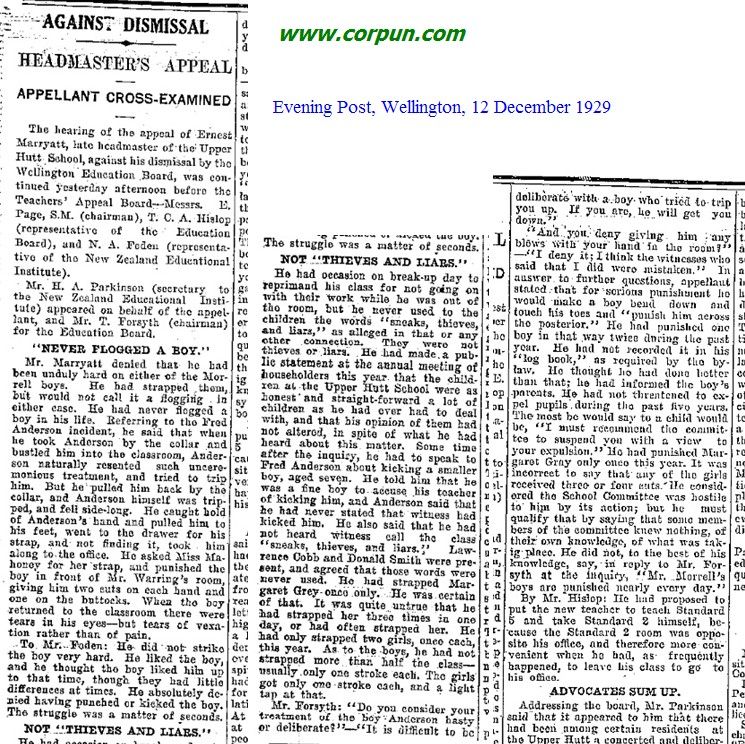
Against Dismissal
Headmaster's Appeal
Appellant Cross-examined
The hearing of the appeal of Ernest Marryatt, late headmaster of the Upper Hutt School, against his dismissal by the Wellington Education Board, was continued yesterday afternoon before the Teachers' Appeal Board -- Messrs. E. Page, S.M. (chairman), T. C. A. Hislop (representative of the Education Board), and N. A. Foden (representative of the New Zealand Educational Institute).
Mr. H. A. Parkinson (secretary to the New Zealand Educational Institute) appeared on behalf of the appellant, and Mr. T. Forsyth (chairman) for the Education Board.
"Never Flogged a Boy."
Mr. Marryatt denied that he had been unduly hard on either of the Morrell boys. He had strapped them, but would not call it a flogging in either case. He had never flogged a boy in his life.
Referring to the Fred Anderson incident, he said that when he took Anderson by the collar and bustled him into the classroom, Anderson naturally resented such unceremonious treatment, and tried to trip him. But he pulled him back by the collar, and Anderson himself was tripped, and fell side-long. He caught hold of Anderson's hand and pulled him to his feet, went to the drawer for his strap, and not finding it, took him along to the office. He asked Miss Mahoney for her strap, and punished the boy in front of Mr. Warring's room, giving him two cuts on each hand and one on the buttocks. When the boy returned to the classroom there were tears in his eyes -- but tears of vexation rather than of pain.
To Mr. Foden: He did not strike the boy very hard. He liked the boy, and he thought the boy liked him up to that time, though, they had little differences at times. He absolutely denied having punched or kicked the boy. The struggle was a matter of seconds.
Not "Thieves and Liars."
He had occasion on break-up day to reprimand his class for not going on with their work while he was out of the room, but he never used to the children the words "sneaks, thieves, and liars," as alleged in that or any other connection. They were not thieves or liars. He had made a public statement at the annual meeting of householders this year that the children at the Upper Hutt School were as honest and straight-forward a lot of children as he had ever had to deal with, and that his opinion of them had not altered, in spite of what he had heard about this matter.
Some time after the inquiry, he had to speak to Fred Anderson about kicking a smaller boy, aged seven. He told him that he was a fine boy to accuse his teacher of kicking him, and Anderson said that he had never stated that witness had kicked him. He also said that he had not heard witness call the class "sneaks, thieves, and liars." Lawrence Cobb and Donald Smith were present, and agreed that those words were never used.
He had strapped Margaret Grey once only. He was certain of that. It was quite untrue that he had strapped her three times in one day, or had often strapped her. He had only strapped two girls, once each, this year. As to the boys, he had not strapped more than half the class -- usually only one stroke each. The girls got only one stroke each, and a light tap at that.
Mr. Forsyth: "Do you consider your treatment of the boy Anderson hasty or deliberate?" -- "It is difficult to be deliberate with a boy who tried to trip you up. If you are, he will get you down."
And you deny giving him any blows with your hand in the room?" -- "I deny it; I think the witnesses who said that I did were mistaken." In answer to further questions, appellant stated that for serious punishment he would make a boy bend down and touch his toes and "punish him across the posterior." He had punished one boy in that way twice during the past year. He had not recorded it in his "log book," as required by the by-law. He thought he had done better than that; he had informed the boy's parents.
He had not threatened to expel pupils during the past five years. The most he would say to a child would be, "I must recommend the committee to suspend you with a view to your expulsion." He had punished Margaret Gray only once this year. It was incorrect to say that any of the girls received three or four cuts. He considered the School Committee was hostile to him by its action; but he must qualify that by saying that some members of the committee knew nothing, of their own knowledge, of what was taking place. He did not, to the best of his knowledge, say, in reply to Mr. Forsyth at the inquiry, "Mr. Morrell's boys are punished nearly every day."
By Mr. Hislop: He had proposed to put the new teacher to teach Standard 5 and take Standard 2 himself, because the Standard 2 room was opposite his office, and therefore more convenient when he had, as frequently happened, to leave his class to go to his office.
Advocates Sum Up.
Addressing the board, Mr. Parkinson said that it appeared to him that there had been among certain residents at the Upper Hutt a concerted and deliberate attempt to get rid of Mr. Marryatt from the school; and that that was the real source of the trouble. He had a letter from the Mayor of the borough highly commending Mr. Marryatt, and a letter signed by a number of residents at the Upper Hutt, expressing every confidence in Mr. Marryatt, in spite of the present charges. Incidents had been gathered up over a long period for the purpose of establishing a cumulative effect against the headmaster.
At the annual meeting of householders at the end of April last only forty people were present; showing that there was no trouble in the district at that time. When there was trouble there would always be a big attendance. But at that meeting a new committee was elected and after that the trouble began.
Summary dismissal, or dismissal with less than three months' notice, was only justifiable on the grounds of "immorality or gross misbehaviour." He had obtained a memorandum from the Education Department showing that during the past four years approximately thirteen teachers had been peremptorily dismissed under Section 82 of "The Education Act, 1914," and their certificates had been cancelled. The following table showed the nature of the offences constituting either immoral or gross misbehaviour in each case: Theft 2, immorality 5, misappropriation of trust funds 1, sedition 1, drunkenness 4. That was the choice company the board had put Mr. Marryatt in, without justification.
Even if all the allegations against him had been proved, they would not amount to such an enormity as would justify summary dismissal. He did not think that the board seriously held Mr. Marryatt guilty of "gross misbehaviour." That charge, he felt, was an after-thought to justify the action of the board in dismissing him at one month's notice. It was a serious matter to a man of Mr. Marryatt's position and reputation; it had meant a monetary loss to him and his leaving a district in which he had lived some seven years.
Mr. Forsyth contended that corporal punishment of both boys and girls had been fully proved by his witnesses and borne out to some extent by the appellant's own witnesses. He held that the use of the words "sneaks, thieves, and liars" had also been proved. The statement by the inspectors as to the appellant's inefficiency were borne out by the examples of the pupils' work handed in to the Appeal Board.
He denied that gross misbehaviour should be bracketed with immorality. The Education Board made no suggestion whatever of that kind. "Gross misbehaviour" must be considered relatively; and in a school conduct might constitute gross misbehaviour which would not be considered as such in other surroundings and under other circumstances. The dismissal was technical only. There was no intention at all to throw Mr. Marryatt out on the street. The intention was only to reduce him a grade, and the month's notice was given in the interests of Mr. Marryatt himself. It was the intention of the board to keep him in employment. In the meantime, he had the right to apply for employment even in a grade 6 school, in any other district.
The board reserved its decision, Mr. Page stating that it would be delivered in writing in the Courtroom at a quarter to eleven on Saturday morning next.