
www.corpun.com

| www.corpun.com : Archive : 2010 : US Schools Jul 2010 |
The Augusta Chronicle, Georgia, 5 July 2010
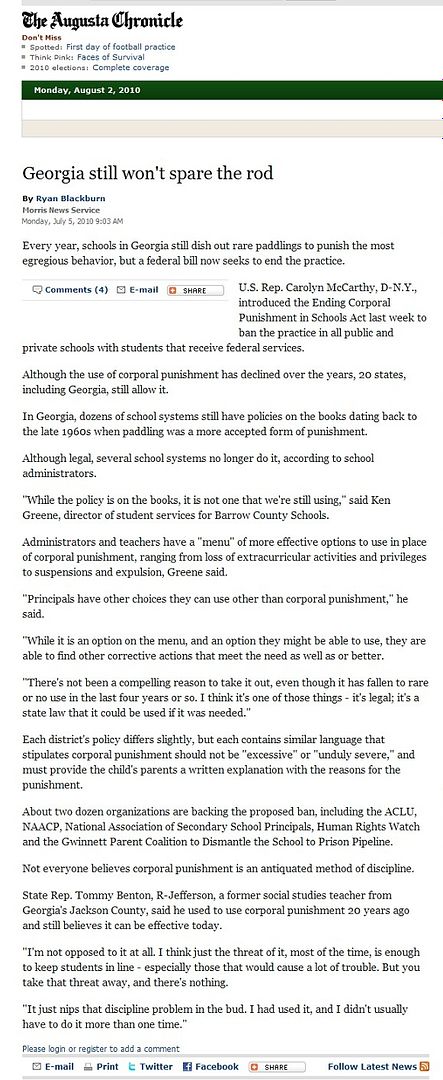
Georgia still won't spare the rod
By Ryan Blackburn
Morris News Service
Every year, schools in Georgia still dish out rare paddlings to punish the most egregious behavior, but a federal bill now seeks to end the practice.
U.S. Rep. Carolyn McCarthy, D-N.Y., introduced the Ending Corporal Punishment in Schools Act last week to ban the practice in all public and private schools with students that receive federal services.
Although the use of corporal punishment has declined over the years, 20 states, including Georgia, still allow it.
In Georgia, dozens of school systems still have policies on the books dating back to the late 1960s when paddling was a more accepted form of punishment.
Although legal, several school systems no longer do it, according to school administrators.
"While the policy is on the books, it is not one that we're still using," said Ken Greene, director of student services for Barrow County Schools.
Administrators and teachers have a "menu" of more effective options to use in place of corporal punishment, ranging from loss of extracurricular activities and privileges to suspensions and expulsion, Greene said.
"Principals have other choices they can use other than corporal punishment," he said.
"While it is an option on the menu, and an option they might be able to use, they are able to find other corrective actions that meet the need as well as or better.
"There's not been a compelling reason to take it out, even though it has fallen to rare or no use in the last four years or so. I think it's one of those things - it's legal; it's a state law that it could be used if it was needed."
Each district's policy differs slightly, but each contains similar language that stipulates corporal punishment should not be "excessive" or "unduly severe," and must provide the child's parents a written explanation with the reasons for the punishment.
About two dozen organizations are backing the proposed ban, including the ACLU, NAACP, National Association of Secondary School Principals, Human Rights Watch and the Gwinnett Parent Coalition to Dismantle the School to Prison Pipeline.
Not everyone believes corporal punishment is an antiquated method of discipline.
State Rep. Tommy Benton, R-Jefferson, a former social studies teacher from Georgia's Jackson County, said he used to use corporal punishment 20 years ago and still believes it can be effective today.
"I'm not opposed to it at all. I think just the threat of it, most of the time, is enough to keep students in line - especially those that would cause a lot of trouble. But you take that threat away, and there's nothing.
"It just nips that discipline problem in the bud. I had used it, and I didn't usually have to do it more than one time."
The Clarion-Ledger, Jackson, Mississippi, 7 July 2010
Court refuses to stop paddlings in Mississippi
The Associated Press
A federal appeals court has turned down a Tate County high school student's motion for a temporary injunction against paddling Mississippi students.
William Cody Childress sought the injunction while a U.S. District Court in Mississippi considers a permanent ban on the punishment.
Childress, a 16-year-old Independence High School student, filed a lawsuit Feb. 18 in U.S. District Court claiming he was paddled "with excessive force."
The lawsuit, which also claims boys are improperly paddled more based on gender, asked for a temporary injunction while the lawsuit was pending.
U.S. District Judge W. Allen Pepper in Greenville denied the request Feb. 23.
On Wednesday, a three-judge panel of the 5th U.S. Circuit Court of Appeals in New Orleans also denied the request.
The Commercial Appeal, Memphis, Tennessee, 12 July 2010
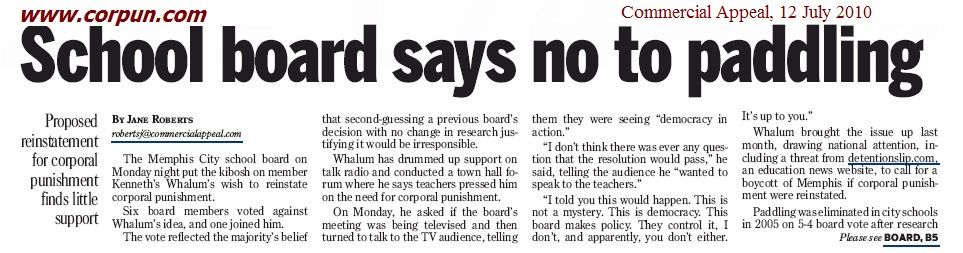
School board says no to paddling
Proposed reinstatement for corporal punishment finds little support
By Jane Roberts
The Memphis City school board on Monday night put the kibosh on member Kenneth Whalum's wish to reinstate corporal punishment.
Six board members voted against Whalum's idea, and one joined him.
The vote reflected the majority's belief that second-guessing a previous board's decision with no change in research justifying it would be irresponsible.
Whalum has drummed up support on talk radio and conducted a town hall forum where he says teachers pressed him on the need for corporal punishment.
On Monday, he asked if the board's meeting was being televised and then turned to talk to the TV audience, telling them they were seeing "democracy in action."
"I don't think there was ever any question that the resolution would pass," he said, telling the audience he "wanted to speak to the teachers."
"I told you this would happen. This is not a mystery. This is democracy. This board makes policy. They control it, I don't, and apparently, you don't either. It's up to you."
Whalum brought the issue up last month, drawing national attention, including a threat from detentionslip.com, an education news website, to call for a boycott of Memphis if corporal punishment were reinstated.
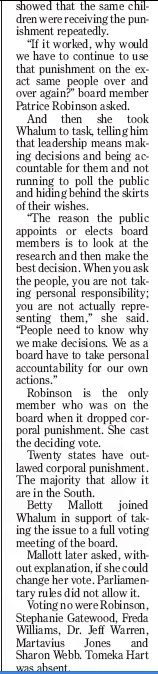
Paddling was eliminated in city schools in 2005 on 5-4 board vote after research showed that the same children were receiving the punishment repeatedly.
"If it worked, why would we have to continue to use that punishment on the exact same people over and over again?" board member Patrice Robinson asked.
And then she took Whalum to task, telling him that leadership means making decisions and being accountable for them and not running to poll the public and hiding behind the skirts of their wishes.
"The reason the public appoints or elects board members is to look at the research and then make the best decision. When you ask the people, you are not taking personal responsibility; you are not actually representing them," she said. "People need to know why we make decisions. We as a board have to take personal accountability for our own actions."
Robinson is the only member who was on the board when it dropped corporal punishment. She cast the deciding vote.
Twenty states have outlawed corporal punishment. The majority that allow it are in the South.
Betty Mallott joined Whalum in support of taking the issue to a full voting meeting of the board.
Mallott later asked, without explanation, if she could change her vote. Parliamentary rules did not allow it.
Voting no were Robinson, Stephanie Gatewood, Freda Williams, Dr. Jeff Warren, Martavius Jones and Sharon Webb. Tomeka Hart was absent.
© 2010 Scripps Newspaper Group Online
Tahlequah Daily Press, Oklahoma, 20 July 2010
TPS staffer fired for chronic absenteeism
By Sean Kennedy
Press Special Writer(extract)
TAHLEQUAH -- Tahlequah I-35 Board of Education members voted to fire a special care paraprofessional for excessive absenteeism despite pleas of medical reasoning on Monday night.
[...]
In other action, the board approved a new discipline policy that eliminates the use of corporal punishment in the district.
[...]
About this website
Search this site
Article: American school paddling
Other external links: US school CP
Archive 2010: USA
Video clips
Picture index
Previous month
Following month
www.corpun.com Main menu page
Copyright © C. Farrell 2010
Page created November 2010