
www.corpun.com

| www.corpun.com : Archive : 2009 : MY Judicial Aug 2009 |
itn.co.uk (Independent Television News), London, 24 August 2009
Beer drinking Muslim model asks for public caning
Human rights group Amnesty International has denounced plans by Malaysian authorities to cane a Muslim model for drinking beer.
Kartika Sari Dewi Shukarno will be the first Malaysian woman to be caned under Islamic laws applicable to the country's Muslims, who account for 60 percent of the 27-million population.
Kartika was arrested in a raid for drinking alcohol at a hotel lounge last year and sentenced to caning by a Shariah court in July in what was considered a warning to other Muslims to abide by religious laws.
She says her 20-month legal ordeal has been stressful, but she respects the law.
In fact, she is defiantly asking that the punishment, six strokes of the cane, be carried out in public, something the authorities are reluctant to allow.
Opinions are divided about the punishment Kartika faces under Islamic laws, which some say are too severe and selectively enforced.© Independent Television News Limited 2009. All rights reserved.
RELATED VIDEO CLIP
ITN news report, 22 August 2009 (1 minute 28 seconds) from Malaysia, of which the above is a text summary.
HERE IS THE CLIP:
This video clip is not currently available.
IMPORTANT: Copyright in this video material rests with the original copyright holders. This brief excerpt is reproduced under the "fair use" doctrine
for private, non-profit, historical research and education purposes only. It must not be redistributed or republished in any commercial context.
The Straits Times, Singapore, 26 August 2009
Pahang puts caning on hold
Sentence seen as too harsh, says KL minister
By Carolyn Hong
Malaysia Bureau Chief
KUALA LUMPUR: An Islamic court yesterday suspended indefinitely the caning of a Muslim woman found guilty of drinking beer, as senior government officials spoke up against the harsh punishment that has grabbed international attention.
The chief judge of the Pahang Syariah Court ordered the punishment of Kartika Sari Dewi Shukarno to be deferred, the Minister for Women, Family and Community Development Shahrizat Abdul Jalil said."The overriding view was that the sentence meted out was too harsh and was not commensurate with the offence," she told reporters.
Home Minister Hishammuddin Hussein said that the caning could not go ahead until the prisons department had the expertise to carry it out according to syariah laws.
Prime Minister Najib Razak earlier yesterday said Kartika should appeal and not just resign herself to the punishment.Speaking at a women's day event later, Datuk Seri Najib urged Islamic authorities to mete out physical punishment only as a last resort.
"Islam is about compassion and mercy, physical punishment should be the last resort," he said, without referring to the Kartika case directly.
Kartika, 32, was arrested by Islamic morality police for drinking beer at a beach resort in Pahang in December 2007. She was sentenced to six strokes of the cane and fined RM5,000 (S$2,050), which she has already paid.
The deadline for filing an appeal with the Pahang Syariah High Court has lapsed, but she was urged by Mr Najib to file for a judicial review.
The government's belated intervention suggests that it may not allow the woman to be caned. The sentence was to have been carried out this week but was unexpectedly postponed on Monday until the fasting month of Ramadan ended.
The court's caning order has caused serious damage to Malaysia's international image as a moderate Muslim nation.
The mother of two young children would have been the first woman in Malaysia to be caned for an Islamic offence.
The case reignited a longstanding debate in Malaysia over the extent to which private religious infringements should be punished by the state.
Although this is the most dramatic case by far, Malaysia has faced similar controversies when religious officials arrested Muslims for offences such as close proximity.
The issue is a political minefield. But while the Barisan Nasional government has moved cautiously in its approach, the opposition Parti Islam SeMalaysia (PAS) made its position clear.
Its youth chief Nasrudin Hassan was quoted by a news website as saying yesterday: "We do not want the syariah courts to be seen as inconsistent or powerless."
Public opinion is deeply divided. Liberal Muslims have spoken out strongly against the caning, with campaigns launched to ban the whipping of women. The Malaysian Bar, an organization of lawyers, has also joined it. A group of women's non-governmental organizations said yesterday the sentence was totally inappropriate."She was, after all, a first-time offender who showed remorse and pleaded guilty," said Mrs Mariah Chin Abdullah, executive director of the Selangor Community Awareness Society.
News report by Aljazeera English TV, 23 August 2009 (3 mins 7 secs). Harry Fawcett in Kuala Lumpur fills in the background on the Kartika case just a couple of days before the above decision to put her caning on hold. Kartika herself is interviewed, along with activists who are opposing the punishment.
HERE IS THE CLIP:
IMPORTANT: Copyright in this video material rests with the original copyright holders. This brief excerpt is reproduced under the "fair use" doctrine
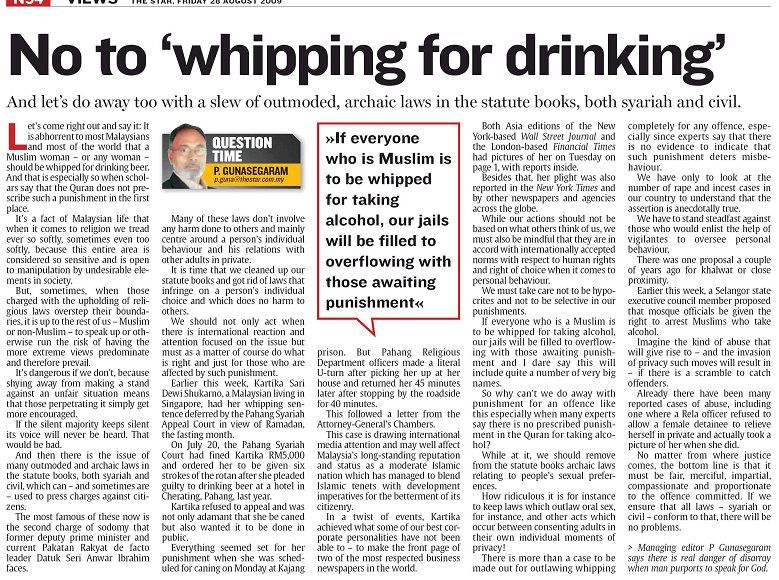
The Star, Kuala Lumpur, 28 August 2009
Question Time
No to 'whipping for drinking'
And let's do away too with a slew of outmoded, archaic laws in the statute books, both syariah and civil.
By P. Gunasegaram
Let's come right out and say it: It is abhorrent to most Malaysians and most of the world that a Muslim woman -- or any woman -- should be whipped for drinking beer. And that is especially so when scholars say that the Quran does not prescribe such a punishment in the first place.
It's a fact of Malaysian life that when it comes to religion we tread ever so softly, sometimes even too softly, because this entire area is considered so sensitive and is open to manipulation by undesirable elements in society.
But, sometimes, when those charged with the upholding of religious laws overstep their boundaries, it is up to the rest of us -- Muslim or non-Muslim -- to speak up or otherwise run the risk of having the more extreme views predominate and therefore prevail.
It's dangerous if we don't, because shying away from making a stand against an unfair situation means that those perpetrating it simply get more encouraged.
If the silent majority keeps silent its voice will never be heard. That would be bad.
And then there is the issue of many outmoded and archaic laws in the statute books, both syariah and civil, which can -- and sometimes are -- used to press charges against citizens.
The most famous of these now is the second charge of sodomy that former deputy prime minister and current Pakatan Rakyat de facto leader Datuk Seri Anwar Ibrahim faces.
Many of these laws don't involve any harm done to others and mainly centre around a person's individual behaviour and his relations with other adults in private.
It is time that we cleaned up our statute books and got rid of laws that infringe on a person's individual choice and which does no harm to others.
We should not only act when there is international reaction and attention focused on the issue but must as a matter of course do what is right and just for those who are affected by such punishment.
Earlier this week, Kartika Sari Dewi Shukarno, a Malaysian living in Singapore, had her whipping sentence deferred by the Pahang Syariah Appeal Court in view of Ramadan, the fasting month.
On July 20, the Pahang Syariah Court had fined Kartika RM5,000 and ordered her to be given six strokes of the rotan after she pleaded guilty to drinking beer at a hotel in Cherating, Pahang, last year.
Kartika refused to appeal and was not only adamant that she be caned but also wanted it to be done in public.
Everything seemed set for her punishment when she was scheduled for caning on Monday at Kajang prison. But Pahang Religious Department officers made a literal U-turn after picking her up at her house and returned her 45 minutes later after stopping by the roadside for 40 minutes.
This followed a letter from the Attorney-General's Chambers.
This case is drawing international media attention and may well affect Malaysia's long-standing reputation and status as a moderate Islamic nation which has managed to blend Islamic tenets with development imperatives for the betterment of its citizenry.
In a twist of events, Kartika achieved what some of our best corporate personalities have not been able to -- to make the front page of two of the most respected business newspapers in the world.
Both Asia editions of the New York-based Wall Street Journal and the London-based Financial Times had pictures of her on Tuesday on page 1, with reports inside.
Besides that, her plight was also reported in the New York Times and by other newspapers and agencies across the globe.
While our actions should not be based on what others think of us, we must also be mindful that they are in accord with internationally accepted norms with respect to human rights and right of choice when it comes to personal behaviour.
We must take care not to be hypocrites and not to be selective in our punishments.
If everyone who is a Muslim is to be whipped for taking alcohol, our jails will be filled to overflowing with those awaiting punishment and I dare say this will include quite a number of very big names.
So why can't we do away with punishment for an offence like this especially when many experts say there is no prescribed punishment in the Quran for taking alcohol?
While at it, we should remove from the statute books archaic laws relating to people's sexual preferences.
How ridiculous it is for instance to keep laws which outlaw oral sex, for instance, and other acts which occur between consenting adults in their own individual moments of privacy!
There is more than a case to be made out for outlawing whipping completely for any offence, especially since experts say that there is no evidence to indicate that such punishment deters misbehaviour.
We have only to look at the number of rape and incest cases in our country to understand that the assertion is anecdotally true.
We have to stand steadfast against those who would enlist the help of vigilantes to oversee personal behaviour.
There was one proposal a couple of years ago for khalwat or close proximity.
Earlier this week, a Selangor state executive council member proposed that mosque officials be given the right to arrest Muslims who take alcohol.
Imagine the kind of abuse that will give rise to -- and the invasion of privacy such moves will result in -- if there is a scramble to catch offenders.
Already there have been many reported cases of abuse, including one where a Rela officer refused to allow a female detainee to relieve herself in private and actually took a picture of her when she did.
No matter from where justice comes, the bottom line is that it must be fair, merciful, impartial, compassionate and proportionate to the offence committed. If we ensure that all laws -- syariah or civil -- conform to that, there will be no problems.
About this website
Search this site
Country files: CP in Malaysia
Article: Judicial caning in Malaysia
JCP pictures: Malaysia
Archive 2009: Malaysia
Video clips
Picture index
Topics A to Z: Caning in Malaysia
Previous month
Following month
www.corpun.com Main menu page
Copyright © C. Farrell 2009, 2010
Page updated January 2010