
www.corpun.com

| www.corpun.com : Archive : 1976 to 1995 : UK Schools Nov 1984 |
The Standard [temporary name for the London Evening Standard], London, 21 November 1984
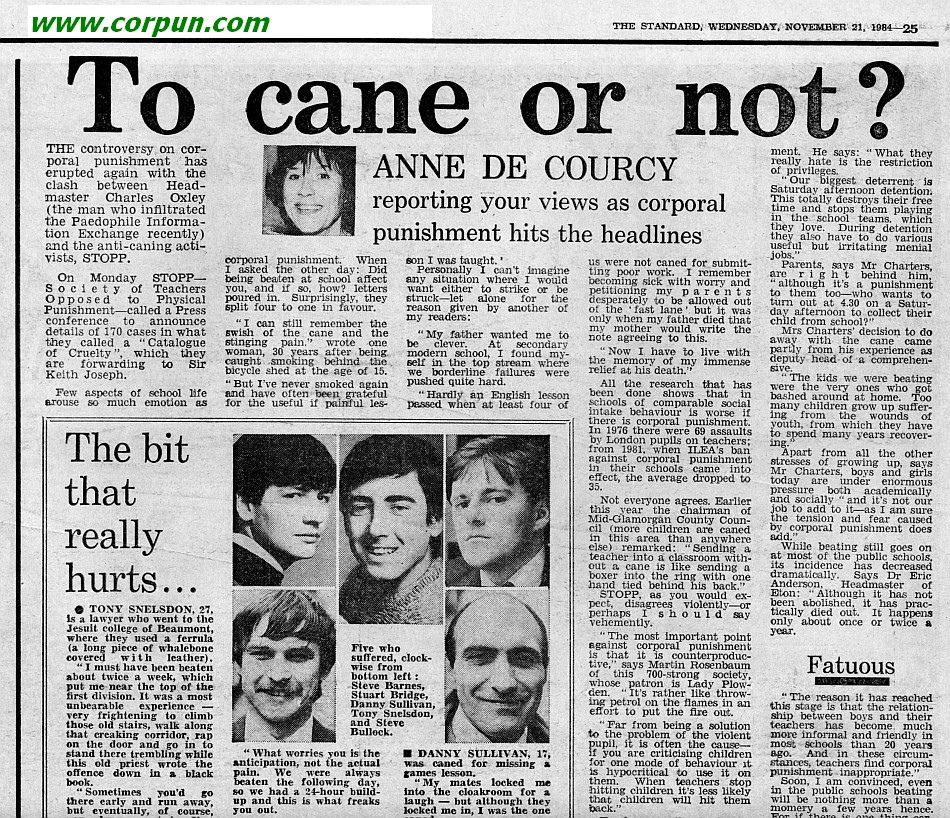
To cane or not?
Anne de Courcy reporting your views as corporal punishment hits the headlines
The controversy on corporal punishment has hit the headlines again with the clash between headmaster Charles Oxley (the man who infiltrated the Paedophile Information Exchange recently) and the anti-caning activists, STOPP.
On Monday STOPP -- Society of Teachers Opposed to Physical Punishment -- called a press conference to announce details of 170 cases in what they called a "Catalogue of Cruelty", which they are forwarding to Sir Keith Joseph.Few aspects of school life arouse so much emotion as corporal punishment. When I asked the other day: Did being beaten at school affect you, and if so, how? letters poured in. Surprisingly, they split four to one in favour.
"I can still remember the swish of the cane and the stinging pain," wrote one woman, 30 years after being caught smoking behind the bicycle shed at the age of 15.
"But I've never smoked again and have often been grateful for the useful if painful lesson I was taught."Personally I can't imagine any situation where I would want either to strike or be struck -- let alone for the reason given by another of my readers:
"My father wanted me to be clever. At secondary modern school, I found myself in the top stream where borderline failures were pushed quite hard.
"Hardly an English lesson passed when at least four of us were not caned for submitting poor work. I remember becoming sick with worry and petitioning my parents desperately to be allowed out of the 'fast lane' but it was only when my father died that my mother would write a note agreeing to this.
"Now I have to live with the memory of my immense relief at his death."All the research that has been done shows that in schools of comparable social intake behaviour is worse if there is corporal punishment. In 1976 there were 69 assaults by London pupils on teachers; from 1981, when ILEA's ban against corporal punishment in their schools came into effect, the average dropped to 35.
Not everyone agrees. Earlier this year the chairman of Mid-Glamorgan County Council (more children are caned in this area than anywhere else) remarked: "Sending a teacher into a classroom without a cane is like sending a boxer into the ring with one hand tied behind his back."
STOPP, as you would expect, disagrees violently -- or perhaps I should say vehemently."The most important point against corporal punishment is that it is counterproductive," says Martin Rosenbaum of the 700-strong society, whose patron is Lady Plowden. "It's rather like throwing petrol on the flames in an effort to put the fire out.
"Far from being a solution to the problem of the violent pupil, it is often the cause -- if you are criticising children for one mode of behaviour it is hypocritical to use it on them. When teachers stop hitting children it's less likely that children will hit them back."
Teacher-pupil confrontations, however, almost always happen in open class or some part of the school where there is not only help but witnesses.
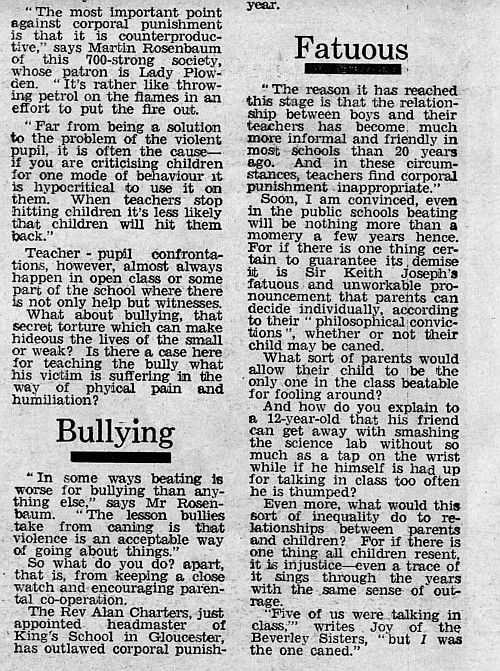
What about bullying, that secret torture which can make hideous the lives of the small or weak? Is there a case here for teaching the bully what his victim is suffering in the way of physical pain and humiliation?Bullying
"In some ways beating for bullying is worse than anything else," says Mr Rosenbaum. "The lesson bullies take from caning is that violence is an acceptable way of going about things."
So what do you do? apart, that is, from keeping a close watch and encouraging parental co-operation.
The Rev Alan Charters, just appointed headmaster of King's School in Gloucester, has outlawed corporal punishment. He says: "What they really hate is the restriction of privileges.
"Our biggest deterrent is Saturday afternoon detention. This totally destroys their free time and stops them playing in the school teams, which they love. During detention they also have to do various useful but irritating menial jobs."
Parents, says Mr Charters, are right behind him, "although it is a punishment for them too -- who wants turn out at 4.30 on a Saturday afternoon to collect their child from school?"
Mr Charters' decision to do away with the cane came partly from his experience as deputy head of a comprehensive.
"The kids we were beating were the very ones who got bashed around at home. Too many children grow up suffering from the wounds of youth, from which they have to spend many years recovering."Apart from all the other stresses of growing up, says Mr Charters, boys and girls today are under enormous pressure both academically and socially "and it's not our job to add to it -- as I am sure the tension and fear caused by corporal punishment does add."
While beating still goes on at most of the public schools, its incidence has decreased dramatically. Says Dr Eric Anderson, headmaster of Eton: "Although it has not been abolished, it has practically died out. It happens only once or twice a year.Fatuous
"The reason it has reached this stage is that the relationship between boys and their teachers has become much more informal and friendly in most schools than 20 years ago. And in these circumstances, teachers find corporal punishment inappropriate."
Soon, I am convinced, even in public schools beating will be nothing more than a memory a few years hence. For if there is one thing certain to guarantee its demise it is Sir Keith Joseph's fatuous and unworkable pronouncement that parents can decide individually, according to their "philosophical convictions", whether or not their children may be caned.
What sort of parents would allow their child to be the only one in the class beatable for fooling around?
And how do you explain to a 12-year-old that his friend can get away with smashing the science lab without so much as a tap on the wrist while if he himself is had up for talking in class too often he is thumped?
Even more, what would this sort of inequality do to relationships between parents and children? For if there is one thing all children resent, it is injustice -- even a trace of it sings through the years with the same sense of outrage.
"Five of us were talking in class," writes Joy of the Beverley Sisters, "but I was the one caned."Just a few of your letters . . .
WHEN I was at school virtually all children who were naughty expected and received physical punishment from teachers and parents.
Our teacher kept a large gym slipper in the cupboard and any misbehaving child was called out in front of the class and bent over the teacher's desk. Boys usually received three or four whacks and girls two.
At home we were a happy family but if we were naughty Mother would slap the backs of our legs. On rare occasions Father would smack us. But I can't say I resented any of the punishments I received -- although they didn't make me good they probably stopped me doing anything really bad. -- Pamela Evans (Mrs),
Croydon.I WAS hit with a ruler for talking to a friend in class when I was about eight. I can still feel the shock I felt then, looking at a smear of blood on the back of my hand.
I was terribly frightened of being hurt again but the punishment didn't make me more attentive, far less respect the teacher who hit me.
Being hit and frightened by adults taught me to question authority (what right do these people have to set themselves above other people?) and to detest all abuse of power. --Janet Wright, London, SW9.I WAS smacked by my mother -- if she hadn't she would have had a tyrant on her hands. I'm so glad she chastised me when I got out of hand. I believe early discipline is very necessary. --Mrs Wyman, Weybridge.
I AM 86 and can still remember being caned and my name being put in the dreaded punishment book for eating sweets in the classroom while knowing they were forbidden.
When my dear Dad heard about it I was given another whack for misbehaving in school. You can be sure that was the only "crime" I committed in my schooldays.
I can truly say I felt no resentment. -- Emily Platt (Mrs), Polegate.I WAS only thrashed once and it was richly deserved. I was 15 and with a group of schoolfriends went shop-lifting.
I was the only one caught and the shopkeeper called my father to collect me. After much discussion, the shopkeeper agreed not to call the police on receiving my father's assurance that he would give me a good hiding.
I waited a long time in my room, shivering with disgrace and apprehension. Eventually my father came up -- I have never seen him looking so grim and determined. I received six strokes and the pain was terrible.
I have never stolen again. N. Gloyne (Mrs), London, SE9.I WAS caned on three occasions at my junior school in England some 30-odd years ago.
It was neither enduringly painful, embarrassing, degrading nor offensive.
Once, however, I was punished by being made to stand in a corner for the last half-hour of class. Being there for so long with 30 seated pairs of eyes alternately looking at the blackboard and smirking at me, was most humiliating.
I resolved never again to upset teacher. So I say, forget corporal punishment -- it is no more than revenge. The best remedy for juvenile misdemeanor is belittlement. -- David Hilton, Carshalton.CANING for me was disastrous and turned my life into a desert. It is both monstrous and petty; an act of sexual violence committed without consent against children and young people. -- R. Brandon, London. W14.
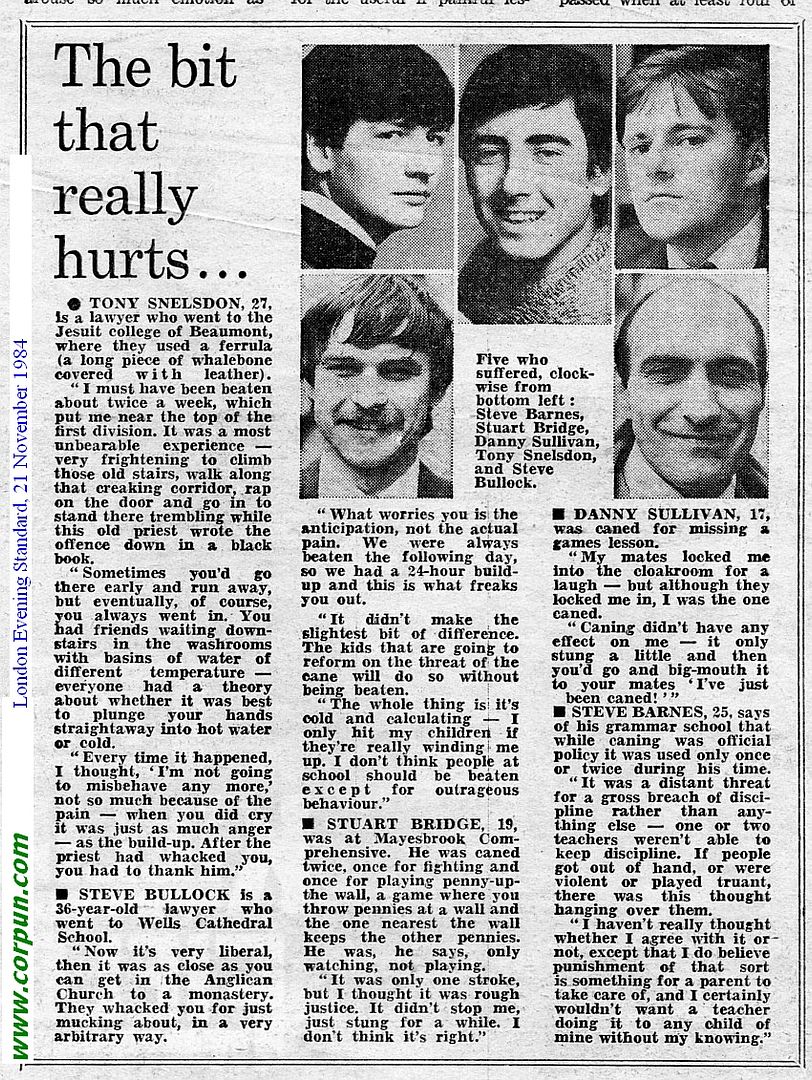
The bit that really hurts . . .
Five who suffered, clockwise from bottom left: Steve Barnes, Stuart Bridge, Danny Sullivan, Tony Snelsdon, and Steve Bullock.
-- TONY SNELSDON, 27, is a lawyer who went to the Jesuit college of Beaumont, where they used a ferrula, (a long piece of whalebone covered with leather).
"I must have been beaten about twice a week, which put me near the top of the first division. It was a most unbearable experience -- very frightening to climb those old stairs, walk along that creaking corridor, rap on the door and go in to stand there trembling while this old priest wrote the offence down in a black book.
"Sometimes you'd go there early and run away, but eventually, of course, you always went in. You had friends waiting downstairs in the washrooms with basins of water of different temperature -- everyone had a theory about whether it was best to plunge your hands straightaway into hot water or cold.
"Every time it happened, I thought, 'I'm not going to misbehave anymore,' not so much because of the pain -- when you did cry it was just as much anger -- as the build-up. After the priest had whacked you, you had to thank him."
-- STEVE BULLOCK is a 36-year-old lawyer who went to Wells Cathedral School.
"Now it's very liberal, then it was as close as you can get in the Anglican Church to a monastery. They whacked you for just mucking about, in a very arbitrary way.
"What worries you is the anticipation, not the actual pain. We were always beaten the following day, so we had a 24-hour build-up and this is what freaks you out.
"It didn't make the slightest bit of difference. The kids that are going to reform on the threat of the cane will do so without being beaten.
"The whole thing is it's cold and calculating -- I only hit my children if they're really winding me up. I don't think people at school should be beaten except for outrageous behaviour."
-- STUART BRIDGE, 19, was at Mayesbrook Comprehensive. He was caned twice, once for fighting and once for playing penny-up-the wall, a game where you throw pennies at a wall and the one nearest the wall keeps the other pennies. He was, he says, only watching, not playing.
"It was only one stroke, but I thought it was rough justice. It didn't stop me, just stung for a while. I don't think it's right."
-- DANNY SULLIVAN, 17, was caned for missing a games lesson.
"My mates locked me into the cloakroom for a laugh -- but although they locked me in, I was the one caned.
"Caning didn't have any effect on me -- it only stung a little and then you'd go and big-mouth it to your mates 'I've just been caned!'"
-- STEVE BARNES, 25, says of his grammar school that while caning was official policy it was used only once or twice during his time.
"It was a distant threat for a gross breach of discipline rather than anything else -- one or two teachers weren't able to keep discipline. If people got out of hand, or were violent or played truant, there was this thought hanging over them.
"I haven't really thought whether I agree with it or not, except that I do believe punishment of that sort is something for a parent to take care of, and I certainly wouldn't want a teacher doing it to any child of mine without my knowing."
About this website
Search this site
Article: School corporal punishment in Britain
Other external links: UK school CP
Archive 1976 to 1995: United Kingdom
Video clips
Picture index
www.corpun.com Main menu page
Copyright © C. Farrell 2011
Page created June 2011