


| www.corpun.com : Archive : 1976 to 1995 : US Schools Feb 1979 |
|
The Tampa Tribune, Florida, 3 February 1979Police Probe Paddling Of Tampa 7th GraderBy Kevin Kalwary and Sherry Howard Prosecutors and police Friday were investigating a complaint that a school dean caused blistering welts when he paddled a seventh-grade student accused of fighting at Blake Junior high school three days ago. David Stephen Duffek came the home from school Wednesday afternoon with large, red, blistered welts that covered his buttocks, officials said. David showed his father, Robert, the results of his punishment. Robert Duffek, a detective in the Hillsborough County Sheriff's office, immediately called the school, but the staff had already gone home, officials said. Duffek did meet with the school's principal, Calvin Bexley, on Thursday. Duffek has refused to comment, saying, "because of the nature of my job, I really think it prohibits me. I would prefer it if you'd talk to my attorney." The dean accused of using excessive force, Neil Tutison, said he paddled David for starting fights with two students during a disagreement on the school paddleball courts at lunchtime on Wednesday. Tutison said David punched one of the students in the nose after scuffling with the other. David was paddled in the dean's office in the presence of secretary Shirley Chalmers, who said she was usually a witness to paddling. Both said that paddling was not excessive. Tustison said the paddle -- not more than 13 inches long, one half inch thick and four inches wide -- was a regulation board used throughout the school system. School board policy allow deans to paddle students, but the policy forbids punishment that is "unduly severe." The prosecutor in charge of the case, Assistant Hillsborough State Attorney Mike Giordano, said his office is looking into the complaint, but would not comment further. Duffek's attorney, Dennis Alvarez, said, "We are waiting to see what the state attorney's investigation shows. "Then we'll proceed from there -- a civil suit possibly," Alvarez said. "I've seen the boy and I don't think this paddling meets the Florida statute term of 'moderate'." One person involved in the case, who asked not to be identified, said Duffek didn't see his son's buttocks until about two hours after the paddling. "The first thing he did was to find out what happened. "Next," he said, "he took pictures. And those pictures, which ended up being taken about four hours after the paddling, still showed everything as if it had just happened. "That boy was hit so hard," he said, "the rivets in the blue jeans actually caused scratches on his skin. "His father took him to Tampa General (Hospital's) emergency room the next day just so he could make sure his son was all right and make sure he could get a doctor to verify that it took more than any "moderate" paddling to leave such welts."
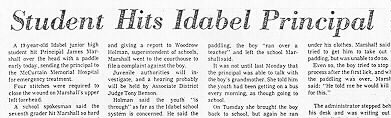
Chicago Tribune, 11 February 1979Paddle swats are commonSpare the rod? Not in Indiana(extract)By Mary Elson A PADDLE MAY be the oldest instrument of discipline in American public schools, but the big board is not considered the least bit old-fashioned in Indiana, a new survey shows. At least 10,962 Indiana junior and senior high school students were physically punished for disciplinary offenses in 1976, according to research by an Indiana University professor. Offenses ranged from chewing gum to assaulting teachers, and the most common form of punishment was the time-honored swat on the behind. A PADDLE WAS used 92 per cent of the time, but hands, yardsticks, rulers, and at least one tennis shoe also were employed. In some schools, corporal punishment was administered to as many as 10 per cent of the students. Dr. William T. Elrod, the secondary education professor who conducted the survey, said researchers have not determined whether the use of corporal punishment is increasing or decreasing, but he thinks it is being used too much today. "We are continuing to rely upon traditional methods of punishment where the problems are no longer traditional," he said. A WHACK WITH a paddle -- while it might cause short-term discomfort -- is not the solution for youths with discipline problems stemming from broken homes, child abuse, or the use of alcohol and drugs, Elrod said. Data for the study were taken from questionnaires sent to all of Indiana's junior and senior high school principals. Eighty per cent - - or about 400 -- replied. Elrod found that corporal punishment was used in 83 per cent of the schools -- 97 per cent of rural schools where parents are more likely to approve, and 70 per cent of suburban schools. Urban schools fell in the middle. Ninety-eight per cent of junior high schools used physical punishment, compared with 76 per cent of the high schools. "THE THING THAT bothers me the most," Elrod said, "was that they're using that much [corporal punishment] at the high school level, where you are dealing with young adults. "It's a degrading kind of experience for someone 16 or 17 years old. You're talking about a mature young lady or a strapping young man." He said generally, however, that "girls get off easy". He estimated that less than 10 per cent of the paddlings are administered to females. Women's liberation notwithstanding, he said school administrators still feel girls may be physically harmed more easily than boys, particularly during menstrual periods. The study also reveals that 45 law suits resulted from discipline or corporal punishment cases in 1976. Elrod said he did not know the verdict in those cases but the most common complaints were that punishment had been excessive or harmed the student in some way. ONLY A FEW suits were filed on the philosophical grounds that corporal punishment itself was inappropriate. The total number of corporal punishment cases recorded in the study -- 10,962 -- probably is much lower than the actual number, Elrod said. That figure represents only first offenders. Repeat offenders, which account for 50 to 75 per cent of all discipline cases, were counted only once. [Six to 10 per cent of all students received corporal punishment at least once.] The 10,962 figure also includes only those spankings administered in the office of the principal or vice principal. While such punishment most often takes place there, many other paddlings are carried out by teachers in the hallways, Elrod said. The study showed that a witness was required in 93 per cent of the junior high schools but in only 55 per cent of the high schools. THE MOST COMMON causes of discipline problems, according to the study, were lack of interest in school work, lack of involvement in school activities, problems at home, and disaffection with community values. Some schools reported using corporal punishment for all 19 offenses listed on the questionnaire. Among them were chewing gum, talking in class, tardiness, vandalism, using drugs, and assaulting a teacher. [...] Corpun file 3684 at www.corpun.com Daily Gazette, Idabel, Oklahoma, 15 February 1979Student Hits Idabel PrincipalA 13-year-old Idabel junior high student hit Principal James Marshall over the head with a paddle early today, sending the principal to the McCurtain Memorial Hospital for emergency treatment. Four stitches were required to close the wound on Marshall's upper left forehead. A school spokesman said the seventh grader hit Marshall so hard that it broke the paddle, a "dressed down" 1 by 4 board.
He was turned over to police and taken from the school. After returning from the hospital and giving a report to Woodrow Holman, superintendent of schools, Marshall went to the courthouse to file a complaint against the boy. Juvenile authorities will investigate, and a hearing probably will be held by Associate District Judge Tony Benson. Holman said the youth "is through" as far as the Idabel school system is concerned. He said the school will not tolerate students who attack teachers or administrators. Marshall said the boy grabbed up the board and hit him after being given a paddling. He said the episode started on Tuesday, Feb. 6, when the boy was brought to his office for causing a disturbance in a classroom. Told that he would be given a paddling, the boy "ran over a teacher" and left the school, Marshall said. It was not until last Monday that the principal was able to talk with the boy's grandmother. She told him the youth had been getting on a bus every morning, as though going to school. On Tuesday she brought the boy back to school, but again he ran away rather than take the 3-lick paddling. "He told his grandmother he wouldn't take a paddling and he wasn't going to school," Marshall said. When the boy returned to school early today, apparently willing to take the paddling and be readmitted to classes, he had padding under his clothes. Marshall said he tried to get him to take out the padding, but was unable to do so. Even so, the boy tried to stop the process after the first lick, and when the paddling was over, Marshall said: "He told me he would kill me for this." The administrator stepped behind his desk and was writing out an "admit slip" when he saw the youth grab up the paddle. Marshall said he stood up and was trying to hold the boy pinned to the wall when he was struck. The Idabel school policy provides that students who are expelled from classes, normally for three days, must take a paddling before being allowed to return. |
Article: American school paddling |
www.corpun.com Main menu page


 The youth, whose name was withheld because he is a juvenile, was quickly subdued by Marshall and men teachers at Gray Junior High.