
www.corpun.com

| www.corpun.com : Feature articles : UK Royal Navy boys 1 |
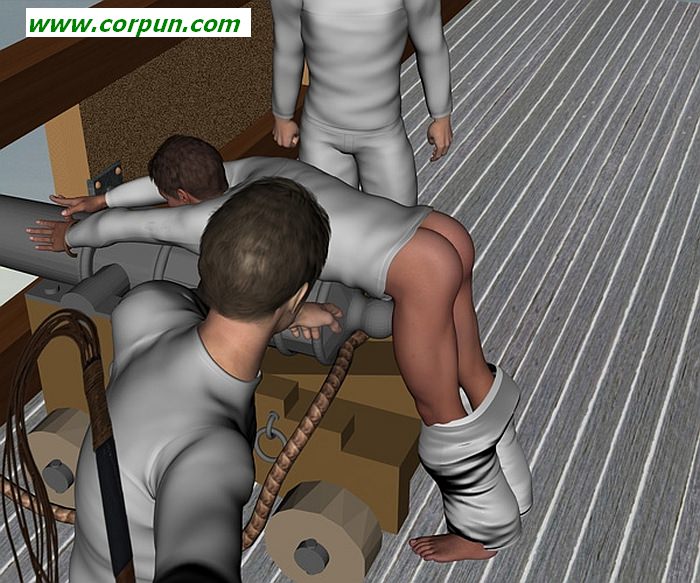
"Kissing the Gunner's Daughter" was naval slang for corporal punishment administered to a young seaman over a gun as imagined in this artist's impression. See also the same scene from other angles.
In the eighteenth century the Royal Navy encouraged boys as young as nine to enlist as 'servants' (the lower age limit was raised to 13 in 1794). They acted as cabin boys to officers and senior seamen, but they were also apprentice seamen, 'learning the ropes' (literally) as they underwent sail training on the rigging. During battles they were made to carry water and gunpowder, earning them the nickname "powder monkeys".
Class divisions were not so rigid as in later Victorian times, and boys from humble backgrounds went aboard with the sons of gentlemen and of existing officers and seamen. Sometimes older boys of good physique were press-ganged but the majority were volunteers, attracted by the romance of the sea and (from 1794 onwards) the relatively good pay. Some boys were already sufficiently educated to become midshipmen (boy officers) after a few months of training. It was a harsh life
, even by the standards of the day, and the romance was quickly eclipsed by rotten food
In defence of the majority of flogging captains of Navy ships, the existing spartan conditions made it difficult to create effective sanctions for misbehaviour. Boys daily scurried about the decks barefoot, climbed the rigging in all climatic conditions and were deliberately toughened up to cope with a life at sea. Food, recreation time and conversation were sacrosanct to them, and reduced diets, extra drill, denial of free time and solitary confinement in the ships' cells were resented by boys, and awkward to supervise, even if effective.
Working-class boys had little or no schooling at that time and hence little experience of formal (still less bare) posterior chastisement. A crude wallop from an irate mother or belting from a father was the limit of it. Stephen Humphries in his book on working-class childhood in a later period, "Hooligans or Rebels?", raises some interesting aspects. He points out that bare-posterior punishment was familiar to and accepted by middle- or upper-class boys who attended so-called "public" (i.e. private) schools, but tended to be resisted by the less well-educated, not just the boys themselves but sometimes also their parents:
[...] the most determined resistance to particular punishments that teachers attempted to impose occurred when boys refused to remove their trousers to be beaten on their bare bottoms .... although these ritual humiliations were for many years an integral part of public school life, teachers from such a background often discovered that working-class parents and children were resolute in their resistance to this type of punishment. Boys ... would stoically endure traditional punishments of the sort that their parents might inflict but refused to submit to the more degrading disciplinary measures favoured by some middle-class schoolteachers.
[S. Humphries, Hooligans or Rebels?: An oral history of working-class childhood and youth 1889-1939, Blackwell, Oxford, 1981]
Nevertheless, boys of all backgrounds were liable to bare-bottom discipline as soon as they joined the Navy. It is not clear just how far back this tradition goes. There were ships' boys in the 16th century and they certainly received corporal punishment. A document in the Harleian Collection of Manuscripts (British Museum) tells something of seaboard life at that period:
[...] As for all petty pillferings and commissiones of that kinde, those were generallie punished with the whippe, the offender beinge to that purpose bounde faste to the capstan; and the waggerie and idleness of ship boys paid by the boatswayne with a rodde, and commonlie this execution is done upon Mondaye morninges, and is soe frequentlie in use, that some meere seamen and saylers doe believe in good earnest that they shall never have a faire winde until the poor boyes be duly brought to the chest; that is, whipped every Mondaye morninge.
["Punishment of Seamen in the reign of Queen Elizabeth", reproduced in The Log Book; or, Nautical Miscellany, pub. Robins, London, 1830]
By the 18th century we have reliable accounts of the punishment of midshipmen. These were trainee officers in their teens, usually better educated (or at least better connected) than ordinary seamen, and always referred to as "young gentlemen" rather than boys. One such, Jeffrey Raigersfeld (later Rear-Admiral), described life on the "Mediator" under Captain Collingwood in the 1780s:
[...] midshipmen were ... always open to the caprice of their commanding officers, punishments awarded to them during their apprenticeship, such as mast-heading, disrating, being turned before the mast, being flogged, and in fact being turned out of the service altogether, all of which are severe punishments; still I am of the opinion, they are ultimately for advantage to the individual, and equally for the benefit of the naval service of the country.
Youth often runs wild and riotous, and requires a tight hand to keep it within bounds. On board the Mediator, all these punishments were inflicted at various times; and one morning after breakfast, while at anchor in St John's Road, Antigua, all the midshipmen were sent for into the Captain's cabin, and four of us were tied up one after the other to the breech of one of the guns, and flogged upon our bare bottoms with a cat-o'-nine-tails, by the boatswain of the ship; some received six lashes, some seven, and myself three. No doubt we all deserved it, and were thankful that we were punished in the cabin instead of upon deck, which was not uncommon in other ships of the fleet.
[Jeffrey Baron de Raigersfeld, The Life of a Sea Officer, c.1830, reprinted in the "Seafarers' Library", Cassell, London, 1929.]
One "young gentleman" who was rather less nonchalant about being flogged was George Duval, a 16-year-old midshipman on "HMS Trent" in 1801. The ship's log merely records:
Sunday 23 August 1801
Punished Geo. Duval, Midshipman, with 21 Lashes.
(PRO - ADM 51/1352)
This provoked the boy's father to write an anguished letter to the Captain, Sir Edward Hamilton, complaining of ill-treatment. Not only had the boy been cruelly treated by being "flogged ... in a most Public and unmerciful Manner" but, the father claimed, he had then been unceremoniously landed on the Island of Jersey without money and without friends, "suffering extreme bodily pain from the punishment" and having to make his own way home to Teignmouth, Devon.
The Captain replied that he had caught the boy in the act of watching through his (the Captain's) cabin window, where he had neglected to draw the curtains, while the Captain was "going to embrace a Lady". He had had the Boatswain inflict the lashes "in the usual way". (PRO - ADM 1/4499)
Dissatisfied with the Captain's reply, Mr Duval senior then wrote to the Admiralty, but was given short shrift: their Lordships pointed out that if Captain Hamilton had brought the boy to a Court Martial ("which he might have done"), the punishment would have been much more severe. However, they assured him that the incident would not be held against the lad in "his future prospects in the Service". (PRO - ADM 12/91)
During the late 18th and early 19th centuries, matters of naval discipline were gradually more standardized. As far as boys were concerned, there were three levels of corporal punishment, in ascending order of severity: on-the-spot caning, summary ceremonial flogging, and flogging by Court Martial, and this three-pronged system remained essentially in place all through the Navy's Victorian heyday until 1906.
-- On-the-spot caning: All boys under 19 could be instantly punished with a cane on the spot for minor offences; no record was kept of these punishments, which could be dished out by any officer or the boatswain. Six strokes of the cane applied to the hands was authorised but, because it impaired a boy's ability to climb the rigging, most captains preferred posterior chastisement. Cabin boys and midshipmen were regularly caned for minor offences or slackness.
-- Summary flogging: For more serious offences, boys could be ceremonially flogged with the 'reduced cat' (sometimes referred to as the 'boy's cat' or 'pussy'), consisting of five tails of smooth whipcord. This was at a time when sea captains still had the summary power -- i.e. without reference to any higher authority -- to have adult sailors flogged with the cat-o'-nine-tails. Such floggings normally took place in the morning on the upper deck in front of the assembled crew, and had to be mentioned in the captain's daily log. Many 19th-century logbooks have survived and can be consulted in the National Archives (formerly Public Record Office) at Kew.
Read sample extracts from ships' logbooks
-- Flogging by Court Martial: Courts Martial were held only for very serious offences. It was rare for boys to be taken before a Court Martial but, when they were, they could be ordered to be flogged with the adult "cat". One such event occurred in 1813, when 17-year-old Valentine Woods was formally sentenced to receive 60 lashes with the cat of nine tails "on his bare Posteriors" for stabbing a crewmate.
In another Court Martial, on board HMS Albion at Portsmouth Harbour on 11 November 1822, Private Marine William Osborne was accused of having sex with a 14-year-old boy, William Webber, on board their sloop, "Shamrock". The evidence records that Osborne seduced Webber late at night in an empty cabin, where they were found in the morning "in a very indecent and unclean attitude", although the prosecution conceded there was no evidence of actual sodomy (a capital offence). The Court Martial sentenced "the said William Osborne to receive fifty Lashes on his bare back with a Cat O'nine Tails and the said William Webber to receive thirty six Lashes in the usual Way of punishing boys, on board His Majesty's said Sloop Shamroc [sic]" and both to be mulcted of all wages due and to be dismissed the service. (ADM 1/5465)
The punishments took place three days later:
Ship's log Shamrock, Thursday 14 November 1822:
9.30 a.m. Punished Wm Osborne (Marine) with Fifty lashes in pursuance of the Sentence of the Court Martial on the 11th inst. also Wm Webber (Boy) with thirty six lashes on his posteriors, after which they were both discharged from the Service. (ADM 53/1294)
- - - -
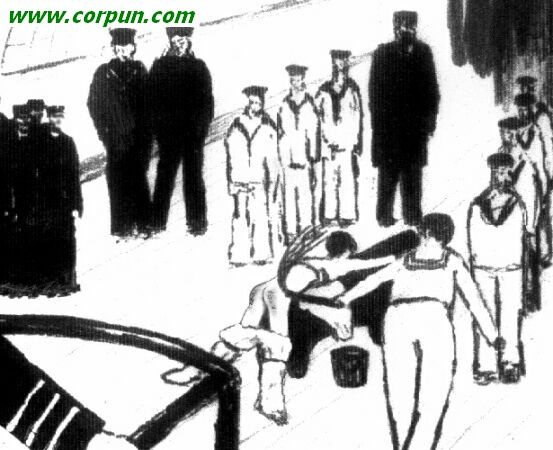
A boy sentenced to be flogged was often required to make his own cat, binding the whipcord lengths to the handle. It was applied across the naked buttocks with a pause of 10 or 15 seconds between lashes to ensure that the boy fully experienced the pain, and also because the tails could become entwined and required separating. The flogging of a boy with 48 lashes (the maximum) would probably take 12 minutes. The ship's doctor was usually present and all boys mustered to 'witness punishment'. The spectacle was intended to serve as a deterrent, but given boys' well-known curiosity about watching chastisements there may also have been some eagerness to see the suffering of a miscreant.
The boy was usually tied in a bending position to a field gun, his body lengthways along the barrel. His abdomen rested on a folded hammock or mattress. The posture was referred to as 'kissing the gunner's daughter'; the term possibly has sexual connotations. It was reported by an officer on HMS "North Star" that on his previous ship HMS "Phaeton" the boys:
'- play on the main deck with a cane, taking turns to kiss the gunner's daughter and enact punishment. This they do sometimes with their trousers lowered.'
(PRO: ADM 1/4748)
Artist's impression of punishment on board ship with the "boy's pussy"
A boy undergoing a flogging was permitted to bite on a piece of hide or wrapped cloth and was given water to drink after each dozen lashes, perhaps more to enhance the ritual than for genuine medical reasons. Bleeding of more than a superficial form rarely occurred. A flogging of 48 lashes was considered severe probably because of its duration more than the intensity of pain inflicted.
Admiralty instructions stated that when a boy was flogged the upper deck was to be cleared of adult seamen, but this was rarely enforced. There are reports of seamen climbing the rigging to watch boys being flogged.
When adult men were generally flogged across the shoulders, why were boys invariably punished on their bottoms? One reason may be that the naval authorities did not want boys to become cocky after taking a "man's punishment". One captain wrote in 1864:
[Seagoing] ships are now only allowed First Class boys, and they being awarded the same punishments, for offences committed, as men, are very apt to consider themselves such before they are rated, and consequently become hardened and bad characters while still at a comparatively young age. I should, at the same time and for the same reason, recommend that the privilege of smoking should not be extended to boys of any age. I am convinced that such a regulation would go far to keep boys in their proper positions.
(Ryder Report on Naval Discipline, 1866) (National Maritime Museum)
The formal enlistment of boys with a view to organised training for a career at sea began in earnest with an 1847 Act of Parliament. Voluntary manning had become a problem, and the Navy began to develop a long-term "continuous service" career structure. Previously most men had joined a specific ship, for the length of her commission only (3 to 5 years). In 1852 a Committee on manning endorsed the need for the recruitment of boys for training if an efficient, professional and permanent Navy was to be built up. The minimum age was now fixed at 15. In their 19th year they would be expected to sign on for a 12-year stint as adult ratings. It was estimated that 3,500 boy recruits would be required each year.
Accordingly, in 1854 the first training ship for boys, HMS Illustrious, was inaugurated, soon to be followed by the legendary HMS Ganges, HMS St Vincent, and others. These establishments introduced an institutional tradition that was to last well over a century. The boys were rated Second Class (see glossary) and supplied with uniforms.
From the beginning, the training ships were just as imbued with Naval rites, rules and customs as seagoing ships, and this naturally included the punishment system. The main difference was that, whereas on a typical seagoing ship only a small proportion of the crew would be boys, on the training ships they were all boys, so that posterior corporal punishment became far more significant there than in the Navy generally.
However, the training ships did not use the "boys' pussy cat" for corporal punishment. Instead, as explained in Part Two, they adopted the use of the birch from the outset.
Meanwhile, a look at statistics. How frequent were these public floggings of boys? For the 1850s, we can get an idea from the Admiralty's annual punishment reports to Parliament. Here are the first few lines of the report for 1854:
SHIP No. of floggings of boys Offences Total lashes inflicted Agamemnon 2 Drunkenness, smuggling 48 Ajax 8 Theft, indecency 216 Albion 5 Straggling, theft, indecency 204 Aleco 0 Algiers 0 Amphion 4 Theft, drunkenness 144 Arab 5 Theft, skulking 124
Analysis of the figures over several years shows that throughout the 1850s about one-third of all floggings were awarded to boys; this rose to about 50% in 1863/4 as the flogging of adult sailors declined considerably.
The total amount of formal corporal punishment reached a peak in 1856 with 1,397 public floggings, of which 469 were administered to boys. In that year the number of ships reached 279 and the total Navy was about 60,000 sailors, of which getting on for 10,000 were boys:
Year Total floggings Of which, boys Boys % Total lashes Total lashes (boys) Average lashes per flogging (boys) 1853 808 299 37% 24,959 ? ? 1854 1,214 390 32% 35,479 10,587 27.1 1855 1,333 436 33% 42,154 ? ? 1856 1,397 469 34% 44,492 13,789 29.4 1857 1,087 364 33% 35,847 11,095 30.4 1859 951 374 39% ? ? ? 1862 1,012 ? ? 34,692 ? ? 1863 752 382 51% 25,514 11,196 29.3 1864 577 279 48% 19,619 8,252 29.5
We can see from this table, among other things, that the severity of boys' floggings was actually slightly greater in 1864 (29.5 strokes per flogging) than it had been ten years earlier (27.1 strokes per flogging).
The detailed punishment returns show that the most popular amounts of punishments for boys during this period were 24 strokes and 36 strokes. Analysis of a random sample of 150 entries for 1854 reveals that far and away the most frequent reason for punishment was theft, followed by insubordination/insolence, smuggling, drunkenness, leaving the ship, skulking, and "being dirty" (possibly a euphemism for masturbation). Also making an occasional appearance in the 'offences' column are, among others, disgusting language, desertion, neglect of duty, indecency, striking a man, and being asleep at post.
On a typical ship there were perhaps on average two formal floggings of boys per year. An exception was HMS Victory
(Parliamentary Papers Nos 48 of 1857, 12 of 1858, 41 of 1859, 115 of 1864, 27 of 1865, and 47 and 257 of 1866)
Background sources and further reading:
David Phillipson, Band of Brothers: Boy Seamen in the Royal Navy 1800-1956, Sutton Publishing, Stroud, UK, 1996 (ISBN 0 07509 1251 0)
Henry Baynham, Men from the Dreadnoughts, Hutchinson, London, 1976
Tom Robson, Boy Seaman R.N.: The True Story, Darlington, 1996 (ISBN 0 9527749 0 9)
www.corpun.com Main menu page
Copyright © C. Farrell 2003-2020
Page updated January 2020