Corpun file 19689

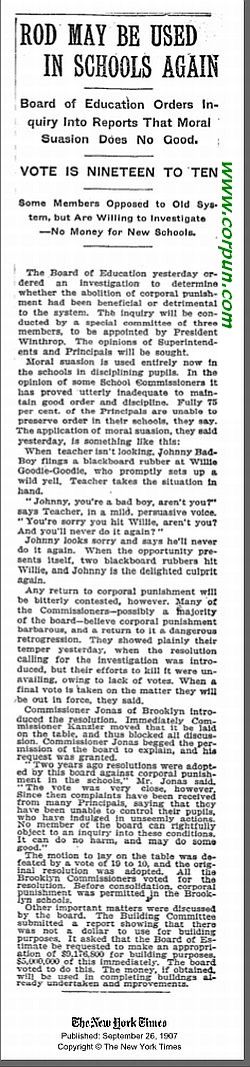
The New York Times, 26 September 1907
Rod May Be Used In Schools Again
Board of Education Orders Inquiry Into Reports That Moral Suasion Does No Good.
Vote Is Nineteen To Ten
Some Members Opposed to Old System, but Are Willing to Investigate -- No Money for New Schools.
The Board of Education yesterday ordered an investigation to determine whether the abolition of corporal punishment had been beneficial or detrimental to the system. The inquiry will be conducted by a special committee of three members, to be appointed by President Winthrop. The opinions of Superintendents and Principals will be sought.
Moral suasion is used entirely now in the schools in disciplining pupils. In the opinion of some School Commissioners it has proved utterly inadequate to maintain good order and discipline. Fully 75 per cent. of the Principals are unable to preserve order in their schools, they say. The application of moral suasion, they said yesterday, is something like this:
When teacher isn't looking, Johnny Bad-Boy flings a blackboard rubber at Willie Goodie-Goodie, who promptly sets up a wild yell. Teacher takes the situation in hand.
"Johnny, you're a bad boy, aren't you?" says Teacher, in a mild, persuasive voice. "You're sorry you hit Willie, aren't you? And you'll never do it again?"
Johnny looks sorry and says he'll never do it again. When the opportunity presents itself, two blackboard rubbers hit Willie, and Johnny is the delighted culprit again.
Any return to corporal punishment will be bitterly contested, however. Many of the Commissioners -- possibly a majority of the board -- believe corporal punishment barbarous, and a return to it a dangerous retrogression. They showed plainly their temper yesterday, when the resolution calling for the investigation was introduced, but their efforts to kill it were unavailing, owing to lack of votes. When a final vote is taken on the matter they will be out in force, they said.
Commissioner Jonas of Brooklyn introduced the resolution. Immediately Commissioner Kanzler moved that it be laid on the table, and thus blocked all discussion. Commissioner Jonas begged the permission of the board to explain, and his request was granted.
"Two years ago resolutions were adopted by this board against corporal punishment in the schools," Mr. Jonas said. "The vote was very close, however. Since then complaints have been received from many Principals, saying that they have been unable to control their pupils, who have indulged in unseemly actions. No member of the board can rightfully object to an inquiry into these conditions. It can do no harm, and may do some good."
The motion to lay on the table was defeated by a vote of 19 to 10, and the original resolution was adopted. All the Brooklyn Commissioners voted for the resolution. Before consolidation, corporal punishment was permitted in the Brooklyn schools.
[...]
Corpun file 19668
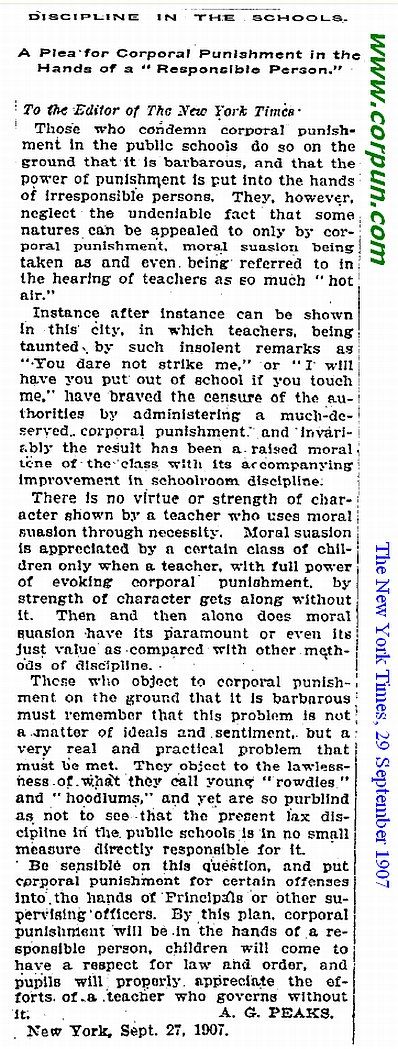
The New York Times, 29 September 1907
Discipline in the Schools.
A Plea for Corporal Punishment in the Hands of a "Responsible Person."
To the Editor of The New York Times
Those who condemn corporal punishment in the public schools do so on the ground that it is barbarous, and that the power of punishment is put into the hands of irresponsible persons. They, however, neglect the undeniable fact that some natures can be appealed to only by corporal punishment, moral suasion being taken as and even being referred to in the hearing of teachers as so much "hot air."
Instance after instance can be shown in this city, in which teachers, being taunted by such insolent remarks as "You dare not strike me," or "I will have you put out of school if you touch me," have braved the censure of the authorities by administering a much-deserved corporal punishment, and invariably the result has been a raised moral tone of the class with its accompanying improvement in schoolroom discipline.
There is no virtue or strength of character shown by a teacher who uses moral suasion through necessity. Moral suasion is appreciated by a certain class of children only when a teacher, with full power of evoking corporal punishment, by strength of character gets along without it. Then and then alone does moral suasion have its paramount or even its just value as compared with other methods of discipline.
Those who object to corporal punishment on the ground that it is barbarous must remember that this problem is not a matter of ideals and sentiment, but a very real and practical problem that must be met. They object to the lawlessness of what they call young "rowdies" and "hoodlums," and yet are so purblind as not to see that the present lax discipline in the public schools is in no small measure directly responsible for it.
Be sensible on this question, and put corporal punishment for certain offenses into the hands of Principals or other supervising officers. By this plan corporal punishment will be in the hands of a responsible person, children will come to have a respect for law and order, and pupils will properly appreciate the efforts of a teacher who governs without it.
A. G. PEAKS.
New York, Sept. 27, 1907.