Corpun file 18973
Port Clinton News-Herald, Ohio, 6 March 2007
'73 vs. '06 -- are we better off?
By Elizabeth Schuett
GIBSONBURG -- The following zipped in on my e-mail the other day and, though I've read it before and nodded my head in silent agreement before zapping the message into computer never-never-land, today it seems imperative to send it along with a huge AMEN!
The title: 1973 vs. 2006
Scenario -- Jack pulls into school parking lot with rifle in gun rack. 1973: Vice principal comes over, takes a look at Jack's rifle, goes to his car and gets his to show Jack. 2006: School goes into lock down, FBI called, Jack hauled off to jail and never sees his truck or gun again. Counselors called in for traumatized students and teachers.
Scenario -- Johnny and Mark get into a fist fight after school. 1973: Crowd gathers. Mark wins. Johnny and Mark shake hands and end up best friends. Nobody goes to jail, nobody arrested, nobody expelled. 2006: Police called, SWAT team arrives, arrests Johnny and Mark. Charges them with assault, both expelled -- even though Johnny started it.
Scenario -- Jeffrey won't be still in class, disrupts other students. 1973: Jeffrey sent to office and given a good paddling by principal. Sits still in class. 2006: Jeffrey given huge doses of Ritalin. Becomes a zombie. School gets extra money from state because Jeffrey has a disability.
Scenario -- Mark gets a headache and takes some headache medicine to school. 1973: Mark shares headache medicine with principal out on the smoking dock. 2006: Police called, Mark expelled from school for drug violations. Car searched for drugs and weapons.
Scenario -- Mary turns up pregnant. 1973: Five high school boys leave town. Mary does her senior year at a special school for expectant mothers. 2006: Middle school counselor calls appropriate authorities and Mary is driven to the next state over and gets an abortion without her parents' consent or knowledge. Mary given condoms and told to be more careful next time. Also brings baby to school for students and teachers to coo over.
Scenario -- Johnny takes leftover firecrackers from the 4th of July, puts them in a model-airplane-paint bottle, blows up a red-ant hill. 1973: Ants die. 2006: ATF, Homeland Security, FBI called. Johnny charged with domestic terrorism, FBI investigates parents, siblings removed from home, computers confiscated, Johnny's dad goes on a terror-watch list and is never allowed to fly again.
Scenario -- Johnny falls while running during recess and scrapes his knee. He is found crying by his teacher, Mary. Mary hugs him to comfort him. 1973: In short time Johnny feels better and goes on playing. 2006: Mary is accused of being a sexual predator and loses her job. She faces three years in state prison.
We could go on forever here. We read the horror stories every day. None of the above scenarios are unique. True story follows:
Scenario -- Recently, my friend's son swatted his 13-year-old daughter on the backside for rude behavior. 1973: The mouthy kid is grounded and her manners improve. 2006: The child calls 911. Police arrive. Father eyed with suspicion and interrogated.
Sometimes I wonder -- don't you? Are we making anything better? Or are we just flailing our arms for show and pretending to fix what ain't broke?
Corpun file 18982
North West Indiana Times, Munster, 8 March 2007
Coach spanked for paddling players
Coach gets probation; school district sued
By Dan Hinkel
CROWN POINT | The former Gary basketball coach who paddled his 13-year-old basketball players for losing a game will serve three years on probation.
The coach, Gary Community School Corp. and Melton Elementary School also face a lawsuit from one player's parent.
Thayer Williamson, 33, of Gary, pleaded guilty to three counts of battery Jan. 24. Judge Salvador Vasquez on Wednesday sentenced Williamson to three years on probation and anger management counseling, according to a news release from Lake County Prosecutor Bernard Carter.
Williamson hit several 13-year-old basketball players with a duct-tape wrapped wooden paddle on Nov. 17, 2004, the day after a loss, according to the probable cause affidavit. Williamson told the boys to shoot free throws and then said he would hit them for the shots they missed, according to the affidavit.
"I am showing them how to be men. I put the paddle to them for losing," Williamson told a player's mother, according to the affidavit.
A school nurse later told police she found bruises, welts or slight swelling on 11 players' buttocks.
Williamson pleaded guilty to paddling three boys, according to Carter's press release.
Williamson was never an employee of Gary schools, said Ragen Hatcher, in-house counsel for the school corporation. Williamson had not met requirements to volunteer for the schools, Hatcher said. He does not volunteer in Gary schools anymore, Hatcher said.
A parent -- Joshua Perry -- filed a suit in November 2006. Neither Perry nor Perry's lawyer could be reached for comment Wednesday night.
The schools are awaiting a ruling on whether Williamson will be treated as a school volunteer even though he was not approved to volunteer by the school corporation, Hatcher said.
The suit is scheduled for a status conference with Judge Jeffrey Dywan on April 2.
Copyright © 2007 nwi.com
Corpun file 18993
News & Observer, Raleigh, N. Carolina, 15 March 2007
Bill would end corporal punishment in schools
Most N.C. districts allow it; ban has support of Democratic lawmakers, state superintendent
By Leah Friedman, Lynn Bonner and Lisa Hoppenjans
Staff Writers
Two out of three school districts in North Carolina let school officials spank students. Chatham, Johnston, Franklin and Harnett counties are among those that allow corporal punishment in their public schools.
"It's very rarely, if ever, used," said Harnett County Superintendent Dan Honeycutt. But Honeycutt didn't know exactly how many times corporal punishment had been administered in his district and said he does not require principals to report it to him.
Now, some state legislators and education leaders say spanking students has no place in the schools and are asking lawmakers to ban the practice.
Rep. Martha Alexander, a Charlotte Democrat, filed a bill Wednesday with the support of several area lawmakers, including Democratic Reps. Jennifer Weiss of Wake, and Larry Hall and Paul Luebke of Durham.
"The children should not be subject to violence in the schools from anybody," Alexander said. "We do know there are better ways, there are other ways, to discipline children."
State Superintendent June Atkinson and Eddie Davis, president of the N.C. Association of Educators, also support a ban.
According to a survey taken this year by the UNC-Chapel Hill School of Social Work, 68 school districts in North Carolina allow corporal punishment, and 47 prohibit it. Wake, Durham and Orange counties prohibit corporal punishment.
In 2002, Alexander said, 4,866 students were subjected to corporal punishment statewide.
Gary Shaffer, an associate professor in the School of Social Work, said use of corporal punishment has declined nationwide since the 1980s and most industrialized nations forbid it. There is little data about corporal punishment in North Carolina's schools, he said, but studies from other states show boys and minorities tend to get spanked the most.
Although corporal punishment might temporarily curb bad behavior, Shaffer said, it can make some children more aggressive over time. "I'm not saying for every child that gets struck it leads to this," he said. "But when you hit a child, you really don't know what their psychological situation is."
Broad state laws let school boards and principals set their own punishment policies, which is a problem, said Brian Lewis, executive director of Covenant with North Carolina's Children, a child advocacy group that helped organize a news conference Wednesday. There are no standards or training for administering corporal punishment, and school personnel often refuse to say how they carry it out, he said. But anecdotally, "it's typically big pieces of wood being slapped against children," he said.
Legal immunity
In September 2005, a child in Robeson County was "beaten black and blue" by a teacher and ended up in an emergency room, said Peggy Dean of Union County, and a member of Parents and Teachers Against Violence in Education. Robeson County prosecutors decided against prosecuting, according to a February 2006 article by The Associated Press. State educators have immunity from criminal conviction unless the corporal punishment caused permanent injury or was done maliciously, AP reported.
At least three years ago, a principal physically punished a student in a Chatham County elementary school, said school board Chairman Norman Clark. Chatham school officials wouldn't describe the punishment Wednesday. The corporal punishment policy on the school system's Web site says parents will be notified, only a school official may administer it, and it must be done in view of a witness. The policy does say what a principal can use to strike the student, such as a wooden paddle.
Chatham County Commissioner George Lucier, whose son goes to a public high school, said he just learned of Chatham's corporal policy. He plans to ask the school board to ban it during the county's budget process, he said. "It's one of those things reminiscent of the early days," he said. "Why not just take it off the books?"
Superintendents from Chatham, Franklin and Johnston counties did not return calls seeking comment.
© Copyright 2007, The News & Observer Publishing Company
Corpun file 19010
News & Observer, Raleigh, N. Carolina, 20 March 2007
Don't spare the rod
By Barry Saunders
Staff Writer
Maybe it was trying to watch 32 basketball games in one weekend that did it. Whatever the reason, I was unable one recent morning to remember important stuff, like my first ex's name.
I did remember my first school spanking, though.
More precisely, I remembered my buddy Ervin's first school spanking, since his came just before mine.
Mrs. Watkins had lined our first-grade selves up for some act of sedition and was mowing down the line with her aerodynamic leather strap. When she got to Ervin, he boldly instructed her: "Don't hit me hard."
Say what?
"Don't hit me hard. My momma told me to tell you not to hit me hard."
Ooooohhhh. What heart. What guts. What a sore bottom he had when she finished. I don't recall if Mrs. Watkins lit into him with extra gusto for his intemperance, but I know she didn't ease up on him.
State Rep. Martha Alexander of Charlotte not only doesn't think teachers should hit students hard; she doesn't think they should hit them at all.
As much as I wish Alexander and her bill had been around when Mrs. Watkins was lighting our pants on fire, I think it is wrong. Well-intentioned, but wrong.
She introduced a bill recently banning school paddlings after, she told me, learning of a case in Robeson County in which a 12-year-old boy "was hit until he was black and blue."
That's deplorable, but couldn't we just ban teachers who don't know the difference between discipline and assault?
Vanessa Jeter, spokeswoman for the state Department of Public Instruction, told me that "other behavior management tools" have proven more effective than paddling.
Hey, kid. Throw another spitball and I've got your behavior management tool -- right here.
It may be impossible to find empirical data proving that a paddling or the fear of one prevents disruptive behavior. Neither, though, do there seem to be data proving that tabling the paddle works.
People with lots of alphabet titles behind their names know more than I do, so maybe they can explain if there is a correlation between the disappearance of paddles and leather straps from schools and the appearance of metal detectors and cops in them.
Nobody is declaring war on schoolkids -- Jeter said paddlings were used in only 24 school districts last year -- so why not allow educators to keep that arrow in their quiver as a last resort?
They should all keep a giant paddle hanging on the wall, like a dangling Sword of Damocles, to remind misbehaving little crumbsnatchers what may await them if, for instance, they pull another chair from under an unsuspecting classmate.
Alexander said her bill doesn't address alternatives to paddling, because alternatives already exist.
She cited a public school program called Positive Behavior Support in which kids are -- get this -- rewarded for positive behavior.
What th' ... Say, shouldn't kids do the right thing because it's the right thing to do and not because they may get a lollipop or a smiley face out of the deal?
© Copyright 2007, The News & Observer Publishing Company
Corpun file 19082
Roxboro Courier-Times, N. Carolina, 21 March 2007
Person schools rarely use corporal punishment authority
By Phyliss Boatwright
C-T Staff Writer
A national advocacy group based in California, calling itself Parents and Teachers Against Violence in Education, wants the option of paddling in North Carolina public schools stopped.
A bill -- HB 853 -- before the N.C. General Assembly is entitled An Act to prohibit the use of corporal punishment in the public schools.
During the 1980s, many states in the north and western portions of the country banned corporal punishment. Today, 29 states have legislation prohibiting the practice. The 21 states that allow paddling, including North Carolina, are predominately in the South and Midwest.
Person County Schools is one of 68 school districts in the Tar Heel State that allow paddling.
Schools Supt. Ronnie G. Bugnar said the incidence of corporal punishment has been low, however, over the course of his 25 years at the head of the district.
In 2000, Helena and Oak Lane Elementary schools reported paddling students. Those incidents, Bugnar said this week, were the last so far as he knows.
The issue of paddling has been a non-issue here for some time, according to Bugnar and school board members. They said this week that corporal punishment was reserved as a "last resort" only and is not in any way encouraged.
In fact, Bugnar said, "I am opposed to it," but the policy allowing paddling has simply not been discussed by a school board in recent years.
The last revision made to the corporal punishment policy code was in 2003.
Jimmy Wilkins, vice chair of the board of education, said it might be time for the current board to take a fresh look and determine whether corporal punishment should be prohibited locally.
Bugnar said the corporal punishment issue had not been brought to his attention since 2000 -- until recent news articles were published concerning the proposed state prohibition.
"I've heard more about it [over the past week] than I have in years," he said Monday.
The Person County policy provides for corporal punishment but only after "other lesser punishments have been tried first." The punishment must be administered by a teacher, principal or assistant principal in an office and in the presence of a second teacher, principal or assistant principal, and a parent of the punished child must be informed by telephone or letter that the punishment was administered. The policy states that corporal punishment "shall not be administered in the presence of other students."
© Copyright 2004 The Roxboro Courier Times
Corpun file 19373

The Charlotte Observer, N. Carolina, 27 March 2007
Young Voices
Last week, a bill was introduced in the legislature to ban corporal punishment in N.C. schools. What do you think? Should corporal punishment be allowed? If not, what punishments for misbehavior do you feel are more appropriate?
Dane Keil, 15, home-schooled, Charlotte: Corporal punishment should not be allowed in any school because it is encouraging physical abuse in an academic setting. The best solution is to have open and frequent communication with the child's parents concerning the problem. It is rather hard to believe that in this day and age, such a malicious form of abuse is still practiced in the greatest nation in the world. A bill against corporal punishment would help protect students from such cruel physical abuse.
Corey Hart, 15, North Stanly High School, New London: Students should be responsible for their actions; if the student did something bad enough to deserve a spanking, then so be it. I think it would cut down on a lot of problems in schools. For some kids, a suspension is just a vacation from school because their parents don't care. The only way to get kids in line is for corporal punishment not to be banned, and even used more in elementary schools.
Chang Sun, 12, Jay M. Robinson Middle, Charlotte: There are other, more effective, punishments. For example, secluding them from their friends would work. Misbehavior could be punished by a lunch detention. Repeated violations could result in seclusion for the entire school day. If the troubles continue, a referral to the principal's office might be the option. There is no need for physical punishment. It would not do any good, for the violating student might even gain support on the grounds of enduring physical punishment.
Lindy Galloway, 19, UNC Greensboro: With the disrespect that is becoming so outrageous in today's youth, there is a lack of discipline. Punishment needs to happen somewhere. Those kids who lack so much respect most likely are not seeing any repercussions to their actions at home. Discipline needs to happen somewhere. Today's rule breakers are becoming tomorrow's felons.
Alexandra Anderson, 15, Myers Park High, Charlotte: Corporal punishment should never be allowed. It's not up to the schools to decide whether or not hitting a child is acceptable, it's up to the parents. Instead of punishing a student with physical force, try other methods that are proven to work better. Younger children learn well from time-outs, while for older children it's good to cut off something fun. For instance if their grade has a field-day or dance planned, don't let that specific student join in.
Ashlee McGee, 12, Grandview Middle, Hickory: Corporal punishment should be allowed in schools because sending students to the office and suspending them just doesn't help much. They just come back to school and do it over and over again. If they got a good whopping every time they did something, they're more likely to not do it again."
Corpun file 19025

The Herald-Sun, Durham, N. Carolina, 27 March 2007
Chatham to review corporal discipline
By Cara McDonough
The Herald-Sun
PITTSBORO -- Kelly Fuller wants the Chatham County school board to follow the lead of 48 other North Carolina school districts and ban corporal punishment at county schools.
The practice, she said, isn't only potentially harmful to students, but studies suggest it may be ineffective.
Fuller spoke about the issue on behalf of the Perry Harrison School PTSA at the Chatham County school board meeting Monday night. She has one child at the school.
"There is no clear evidence that corporal punishment leads to better behavior, enhanced moral character or increased respect for authority figures," Fuller said. "Corporal punishment is easily abused, leads to physical injuries and can cause serious emotional harm to our children."
Fuller cited various studies on corporal punishment -- defined as "paddling, spanking or other forms of physical punishment" -- which suggest the practice can be administered unfairly. Students are more likely to experience corporal punishment if they are poor, male, of ethnic minority status or have a disability, she added.
According to the U.S. Department of Education Office of Civil Rights, black students are disproportionately affected by corporal punishment and are hit at twice the rate of other students.
Gary Shaffer, who teaches at the UNC School of Social Work, told the board Monday that a recent study conducted by his department found that roughly a third of the 67 North Carolina districts that allow corporal punishment have actually used it in the past decade.
Shaffer said the actual use of corporal punishment in Chatham schools is unclear -- some school administrators say it's never used, while some parents say otherwise. Even so, he said, just listing the practice as allowed seems inappropriate, especially when other state institutions, including jails, foster-care homes and detention centers, don't allow it.
"I think we're putting children at risk and taking on a role that's really not appropriate for a state institution like a school," Shaffer said Tuesday. "The school district puts itself at some risk of litigation when they engage in this activity, and the child is put in what I call an 'unknown risk.'"
North Carolina is one of 21 states that allow corporal punishment, but state Rep. Martha Alexander, a Democrat from Charlotte, recently introduced a bill that would ban corporal punishment statewide. But Fuller hopes Chatham acts on the issue sooner rather than later. "I'd really like to see Chatham County do their own ban before the state tells us to," Fuller said.
Board Chairman Norman Clark said Tuesday that the board will definitely be reviewing the policy.
"I think they made some valid points. It appears that corporal punishment is not being widely used, so it might be time to reevaluate whether it is a worthwhile option," he said. "We will definitely be discussing it."
© Copyright 2007. All rights reserved.
Corpun file 19027

KTHV-TV, Little Rock, Arkansas, 29 March 2007
Conway Schools To Reconsider Paddling
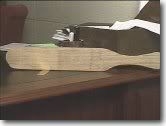
The Conway School Board is to consider a new set of disciplinary options for its students, including a return to corporal punishment.
On April 17, the board will hear a proposal that would allow officials to use paddles to discipline students. The district abolished corporal punishment in March 2006.
School board member Carolyn Lewis says she hasn't decided whether to support the return of paddling, but added that it can be an effective disciplinary tool on the elementary level.
According to statistics from the Arkansas Department of Education, public schools reported 36,439 uses of corporal punishment in the 2005-2006 school year. That's down from 40,517 in 2004-2005 and 47,022 in 2003-2004.
Faulkner County reported more than a thousand uses of corporal punishment in 2005-2006, compared with none in Pulaski County. White County reported more than 3,900 uses, while Craighead County reported 811.
Cindy Thacker, principal at Ida Burns Elementary School in Conway, says discipline problems have increased since the district banned corporal punishment. Thacker says she's seen problems with children being disrespectful and bullying others.
Jeannie Cole, the Arkansas PTA's vice president of legislation, says the national association has supported the abolishment of corporal punishment in schools. Cole says there's a thin line between appropriate punishment and abuse.
Copyright 2007 by The Associated Press. All Rights Reserved.
 RELATED VIDEO CLIP (2 mins 47 secs) from KTHV Little Rock, 29 March 2007.
Extract from local TV news about the above item. Parents, grandparents and experts are interviewed. (Text version follows below.)
HERE IS THE CLIP:
This video clip is not currently available.
IMPORTANT: Copyright in this video material rests with the original copyright holders. This brief excerpt is reproduced under the "fair use" doctrine  for private, non-profit, historical research and education purposes only. It must not be redistributed or republished in any commercial context.
Corpun file 19028
KTHV-TV, Little Rock, Arkansas, 29 March 2007
Paddling Could Come Back To Conway Schools
By Jerod Clark
Reporter
The sign in front of Ida Burns Elementary in Conway says "fairness" and soon the district will debate whether
it's fair to paddle students.
Parent Paula Taylor says, "If they do bad, they may need a spanking."
"Any child psychologist will tell you there's other means of controlling and disciplining a child than spanking," says parent Betty Richie.
Parents at Laurel Park in Conway are split on whether corporal punishment would be a good thing. Grandparents, who saw their own children spanked at school, are split, too.
Mary Rowlett says, "I am really against it. I believe in discipline all the way, but let me know and we'll take care of it at home."
Lois Higgins says, "It's okay provided the parents are notified first and that the child has done something and it's not too severe, too painful."
The Conway School District says it's considering reinstating paddling so educators have more control in the classroom. It something Eliscia Mosley, a teacher in another district, understands.
She says, "I have a few of them I know you probably should paddle and I have a few of them you can't use that form of discipline with them to get them to use self-control in the classroom. It's just not going to work."
Conway wouldn't be the only district in Faulkner County to use corporal punishment. The Arkansas Department of Education says last school year corporal punishment was used more than 1,000 times in the county.
White County had 3,900 uses, Craighead County had 811 and Pulaski County had none.
Regardless of their stance, all the parents on the playground say they better be told first before anyone tries to spank their child.
The school board is expected to take up the issue at its April 17th meeting.