

| www.corpun.com : Archive : 2000 : US Schools Mar 2000 |
|
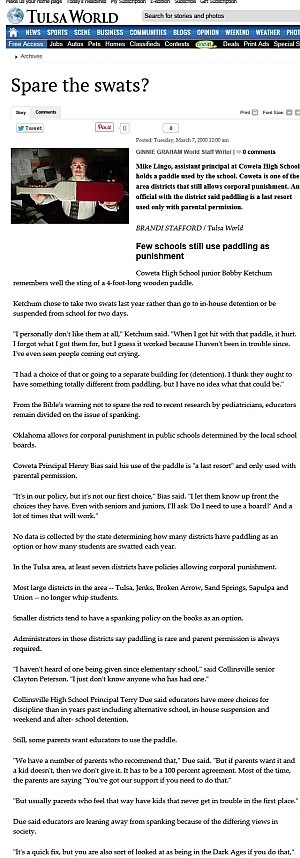
Corpun file 25855 at www.corpun.com Tulsa World, Oklahoma, 7 March 2000Spare the swats?Few schools still us paddling as punishmentBy Ginnie Graham
Coweta High School junior Bobby Ketchum remembers well the sting of a 4-foot-long wooden paddle. Ketchum chose to take two swats last year rather than go to in-house detention or be suspended from school for two days. "I personally don't like them at all," Ketchum said. "When I got hit with that paddle, it hurt. I forgot what I got them for, but I guess it worked because I haven't been in trouble since. I've even seen people coming out crying. "I had a choice of that or going to a separate building for (detention). I think they ought to have something totally different from paddling, but I have no idea what that could be." From the Bible's warning not to spare the rod to recent research by pediatricians, educators remain divided on the issue of spanking. Oklahoma allows for corporal punishment in public schools determined by the local school boards. Coweta Principal Henry Bias said his use of the paddle is "a last resort" and only used with parental permission. "It's in our policy, but it's not our first choice," Bias said. "I let them know up front the choices they have. Even with seniors and juniors, I'll ask 'Do I need to use a board?' And a lot of times that will work." No data is collected by the state determining how many districts have paddling as an option or how many students are swatted each year. In the Tulsa area, at least seven districts have policies allowing corporal punishment. Most large districts in the area -- Tulsa, Jenks, Broken Arrow, Sand Springs, Sapulpa and Union -- no longer whip students. Smaller districts tend to have a spanking policy on the books as an option. Administrators in those districts say paddling is rare and parent permission is always required. "I haven't heard of one being given since elementary school," said Collinsville senior Clayton Peterson. "I just don't know anyone who has had one." Collinsville High School Principal Terry Due said educators have more choices for discipline than in years past including alternative school, in-house suspension and weekend and after-school detention.
Still, some parents want educators to use the paddle. "We have a number of parents who recommend that," Due said. "But if parents want it and a kid doesn't, then we don't give it. It has to be a 100 percent agreement. Most of the time, the parents are saying "You've got our support if you need to do that." "But usually parents who feel that way have kids that never get in trouble in the first place." Due said educators are leaning away from spanking because of the differing views in society. "It's a quick fix, but you are also sort of looked at as being in the Dark Ages if you do that," Due said. "Besides the fact that some people think it's barbaric, it is an odd thing to ask a student to bend over. "There is also no way to know how many have parents who give spankings at home like we did growing up. And there are so many different alternates now for discipline that we did not have before." Sperry High School Principal Dale Cooper said he has swatted three students in about three years. "In my opinion, kids in high school want to be treated like young adults," Cooper said. "So when they make a bad decision, they need to be punished in a way that reflects their age, and that is not necessarily paddling." To get a whipping in school, students are usually repeat offenders of school rules. In Owasso, students typically get a choice of "three licks or three days suspension," said Superintendent Dale Johnson. Owasso is one of the largest school districts in the area, with about 6,500 students, to allow corporal punishment. "We have a lot of parents who want us to keep them in school," Johnson said. "They say to spank them and make them behave. Many times, parents are working and don't want them at home. This is the third time and parents know the student has been acting up in class for some time. "And there might be some 16-year-old with a car getting in trouble to get suspended to get out of school for awhile." The Tulsa law firm of Rosenstein, Fist and Ringold represents about 300 school districts in the state and has guidelines for instituting corporal punishment policies. The suggestions recommend paddling for serious or repeated infractions of school rules and be administered by a certified staff member in front of a witness, also a certified employee. A written report detailing the offense and punishment should be made with the signature of the witness and the employee administering the swats, according to the guidelines. Last week, the Drumright school board voted to not renew the contract of elementary school Principal Gary Cooper for breaking the school policy when paddling a 9-year-old.. Cooper administered the swats against the wishes of his parents, and his parents reported bruises left on the boy's buttocks. Drumright school policy requires written parent permission before a student is disciplined by corporal punishment. In 1997, a U.S. District Court ruled in favor of Spiro schools after a principal swatted a 6-year-old boy, also reportedly leaving bruises according to court documents. Parents of the boy filed a lawsuit, but the court ruling stated that the punishment was not severe enough to constitute a violation of the student's civil rights. Many of the school districts in Oklahoma banned spanking in 1992 after the state Board of Education passed a measure against using corporal punishment. Most of the districts perceived it as a moratorium, but state Superintendent Sandy Garrett said it was more of a "strong suggestion" and not enforceable. Sapulpa was the first in the Tulsa area to hang up its paddles in the late 1980s. Union and Tulsa districts stopped corporal punishment in 1991 with Broken Arrow, Jenks, Sand Springs and Glenpool following suit. Tulsa-area districts with the spanking as an alternative include Owasso, Collinsville, Skiatook, Sperry, Berryhill, Liberty and Coweta. After a rash of high-profile school shootings, an Oklahoma poll taken in 1998 showed that 52.61 percent of citizens believe corporal punishment is very effective in deterring school violence. Another 23.35 percent said it is somewhat effective. The poll has an error margin of plus or minus 3.4 percent and 750 people participated in the survey. Skiatook High School Principal Melvina Prather said paddling is not effective for all students. "Obviously, with people who use corporal punishment at home, it is a viable option at school," Prather said. "Students who fear corporal punishment never get to that point. And for some students, it is not effective and we find other methods. "For a student who is being batted around at home, where there is abuse, obviously (paddling) is not appropriate. What amazes me are parents who have children going on a football field and taking a chance of an injury there and then do not want two swats to the butt." © 2015 BH Media Group Holdings, Inc. Corpun file 5481 at www.corpun.com The Post-Tribune, Gary, Indiana, 12 March 2000Gary teacher charged for paddling studentGARY - A special education pupil at Beveridge School required overnight hospitalization after he was paddled by his teacher, who has been charged with battery. Reginald A. Holmes, 32, of Gary faces up to three years in prison if convicted of the battery charge filed Thursday in Lake Superior Court in Crown Point. Corpun file 6328 at www.corpun.com The Meridian Star, Meridian, Mississippi, 13 March 2000Judge: Accountability for children and parentsBy Marianne Todd Frank Coleman, a Youth Court judge for more than 13 years, believes excessive and frivolous lawsuits, and a lack of parental backing, have contributed to a decline in corporal punishment at school which he says results in a higher number of school discipline problems being brought before his bench. "If a child by the third or fourth grade knows a teacher cannot paddle him because a parent hasn't given permission, that child by high school age is uncontrollable," he said. Coleman recently met with The Meridian Star's editorial board to discuss school discipline policies and their effectiveness in shaping children. When Coleman took office, the juvenile center was merely a "dormitory" designed for the safety of children who might run away before their court dates. Coleman, a former criminal attorney, heard the cases of runaways, simple assault offenders and incorrigible children who refused to obey their parents. Nowadays, he hears the cases of children who carry weapons to school, consume and sell drugs at school and commit violent acts at school. School attendance problems are also on the rise this year. [...] The increasing problems of lack of respect and concern for consequences stems from a lack of discipline, both in school and at home, he said. Parents who refuse to give schools permission to paddle may be setting themselves up for hardships, he said. School teachers and administrators who fail to carry out corporal punishment when given permission, and when needed, are also failing the child. Corporal punishment saw a sharp decline as more and more parents filed lawsuits against school districts for spanking a discipline measure deemed excessive by some parents, he said. "Now everybody wants to sue everybody. We've become a court-oriented world. Just simple registration doesn't give schools authority to use corporal punishment," Coleman said. While school districts are fearful of lawsuits, some parents are fearful of being turned in by their own children. "I want parents to understand that it's going to be a hard case to prove to me that a child is being abused where this is discipline unless it is an improper form of discipline, and I have seen some of that," said Coleman, who has a 16-year-old of his own. "But it all has to work together. If a teacher disciplines a child at school and a parent does not support it at home, it's wasted. When I got whippings I understood why I got them. It seems like nowadays the kids have heard so much about abuse and the welfare department, they use that as a weapon against parents. "I haven't yet gotten as bold as one of my predecessors... he made a parent take a child into his office and take his belt off and wear the child's butt out right there. It sounds like good idea to me, although I haven't reached that point yet." Coleman said he is also mindful that it is harder to shame young people today. "Children were different even 20 years ago because there was some stigma attached to being paddled and being a trouble-maker in school. People didn't want to have anything to do with you. People pushed you aside and wouldn't let you into their groups," he said. "Now everybody wants to be somebody and have some kind of image. They just don't have the same morals and stigmas." Coleman said current punishments, suspension or alternative school, are relatively futile. "Some still paddle, but it's too convenient now to give students in-school suspension, out-of-school suspension and then ship them off to alternative school where they don't have to see them anymore," he said. "Half of them don't show up for in-school suspension which results in out-of-school suspension, and then the kid is running around, doing what he wants." If there is an answer to the problem, Coleman said it will be found in assortment of remedies, all of which must work together for the common goal. "There is no one avenue to take," he said. "How can we go back 30 years and change how society views things? I hope a lot of conservatism comes around in the country in the next 10 years because we need some conservative moral values with a good, common sense approach to things. "We need discipline in schools, and if we're not going to be supported by the parents at home, tell them to find another school, another place. There needs to be parental accountability, but there needs to be a whole lot of accountability for children. We need more preventative programs rather than after-the-fact programs. Some people think prayer in school is a joke. I don't see it as a joke. Coleman said we have a long way to go. "I don't look for it to get better anytime soon. It's going to get worse, actually. I am a realistic person, but I do have optimism. There's always hope that things will get better." Copyright © 2000 Meridian Star Corpun file 5484 at www.corpun.com Mobile Register, Alabama, 25 March 2000Boy's mother pleased with board actionBy Karen Tolkkinen CHATOM - A fifth-grade teacher lost her paddling privileges this week after the Washington County School Board deemed she spanked a child too many times. Tammy Dickey, who has been teaching for eight years, became upset when children in her science class kept talking, said parents who received a notice from her that their children had been disciplined. The students were chattering about an upcoming field trip, said Tammy Holmes, whose 11-year-old son got swatted. Corpun file 6304 at www.corpun.com The Meridian Star, Meridian, Mississippi, 26 March 2000Spank or notBy Marianne Todd Area educators agree there has been a significant decline in the use of corporal punishment over the last few decades. They also agree no matter what the means of punishment, discipline is futile if not backed at home. "I don't know that children have changed that much, but society has changed," said Oakland Heights Elementary School Principal Kim Benton. "When I first started teaching, parents were more supportive. If a teacher said something happened, then it happened, and the parents followed through at home. The change I've seen is that more and more parents are not following through at home." Benton said she considers her staff fortunate that the majority of her parents back her teachers. Roughly 80 percent of her parents have signed the district's required corporal punishment permission slip, allowing supervised spanking in her office only. Another group of parents who initially refused to permit spanking, signed the form after behavior problems got out of control. "There is a time and place for spanking, and it should never be done in anger," said Benton, an educator of 17 years. "It should be the last resort, and it should always be appropriate. A child who forgets his homework doesn't need a spanking." While Benton finds the use of corporal punishment unpleasant, usually one or two paddlings can remedy a behavior problem. If that doesn't work, educators need to look beyond a child's seemingly bad behavior for more serious problems and solutions, she said. Robert Markham, Carver Middle School principal, agrees with Benton. "We'll try on a couple of occasions and 85 to 90 percent of the time it works and the behavior changes," he said. "But there are chronic behavior problems in which no punishment works." Markham, who spent 17 years in teaching before taking his current position 16 years ago, remembers the days when teachers had complete control over paddlings, often pulling students into hallways for a quick swat or paddling right in the classroom. While he notes a sharp decline in the use of corporal punishment, the decrease in paddlings are not singularly to blame for an increasing disrespect among some of today's young generation, he said. "I believe it has a lot to do with the broken family and the single mother who is trying to raise a boy twice her size. Sometimes, mama can't control the situation," he said. Because of this, some parents who initially wouldn't give permission to paddle, decide later to not "spare the rod" after all. Markham said he also considers himself fortunate that roughly 90 percent of his parents are willing to work with his teachers on various forms of disciplines. Office referral problems tend to occur more often with children "who think they can bring mama to the office," or whose parents leave the form of discipline up to the child. "I've seen parents beg kids to take a spanking and stay in school rather than face suspension," Markham said. "And kids are different. It's gone from the spitball type problems to fights and being very disrespectful and disruptive in the classroom. It has caused a lot of teachers to back off, mainly because of lawsuits and the threat of lawsuits." Markham said although his staff members take many steps with children such as detention and team meetings before the use of corporal punishment is employed, the general decrease in the number of paddlings administered has made it harder for educators to control classrooms. "We look at it as a way to keep kids in school," he said. "In order to get kids to do their best in school we need the 'triangular effect.' That is when you have the parents on one side, the teachers on the other and the child in the middle. "About 90 percent of our parents are willing to work with us and that is because I have talked with them, and they know me. We've established that trust, and we have a good success rate because of it." Like Meridian Public School District, Lauderdale County parents also must sign a form if they do not want corporal punishment administered on their child. "If they don't want it the next step is that they are suspended from school, but we're talking about major infractions here," said West Lauderdale Attendance Center principal Charles Williams. "It's a matter of choice. We do not enforce corporal punishment on anyone, but the majority of parents say if necessary, go ahead and paddle." Unlike Meridian High School, West Lauderdale students can face paddling as a means of punishment until high school graduation. Williams, an educator of 30 years who remembers when teachers "laid you across the desk and spanked you in front of the whole classroom," said corporal punishment is an effective means of discipline. "They think a little more about coming back in and getting a paddling," he said. "But what works for some won't work for others. "If they ever do away with corporal punishment, students will be spending more time out of school which will be detrimental. "We can't let students control the schools. If the teachers and administrators don't have control, the educational process can't proceed as it should." Corpun file 6303 at www.corpun.com The Meridian Star, Meridian, Mississippi, 26 March 2000Most schools still paddle but have alternative methodsBy Marianne Todd Some area educators say teens are too old to paddle. Others prefer to adhere to corporal punishment until graduation. "We give them in-school suspension or a day of work details such as raking or cleaning desks," said Kate Griffin Principal Phillip Daniels. "It's very effective. It's embarrassing. The kids don't want to be seen working." While his eighth and ninth graders are too old to paddle, Daniels said corporal punishment was highly effective with younger children at Magnolia Middle School, where he served as assistant principal. Curt Pouncey, principal at Northwest Junior High School, said his eighth and ninth graders still get paddled, but only with the permission of parents. "It's not one of our options on a disciplinary level, but some would rather us do that than suspension," Pouncey said. "In fact, there's quite a number that prefer it. It is a deterrent." Pouncey, who has been an educator for 28 years, said he doesn't keep a paddle in his office. If corporal punishment is called for, a thin ruler is used, he said. "Times have changed a lot. A lot of parents don't agree with it as a method of discipline, so we don't initiate it. They have to sign a paper giving us permission." Like the contrast at area junior high schools, administrators at high schools also have different ideas about corporal punishment. At Meridian High School, students are given verbal reprimands, teacher/parent conferences and suspension for bad behavior, said Principal James Bounds. Students there are never paddled, he said. "You have different needs as far as the ability to gain the attention of the person who will not comply with behavior that is expected," he said. "As a general rule, when students reach the tenth grade their maturity level is such that they pretty much know right from wrong. Their reflection on why they are receiving punishment is usually highly effective, so we approach it from a mental standpoint." Bounds, who began teaching in area schools in 1977, said he found corporal punishment to be highly effective on junior high and middle school children; however, parental involvement is the ultimate key to altering poor behavior. "You start out early on with parent contact and initiating the thought process that corrective behavior needs to take place," Bounds said. "It allows you the flexibility to increase the consequences as you move up the ladder. "A student can't afford to miss large amounts of time from school and still gain credit for classes. If they continue to perform badly they're going to find themselves repeating a course and not gaining credit. That's a pretty severe consequence." Charles Williams, West Lauderdale Attendance School principal, said administrators at his school paddle students until the end of their 12th year. Parents who do not wish their child to be punished by means of a paddle must sign a form letting educators know paddling is out. While the majority of Williams' parents give permission to use corporal punishment, educators exhaust other means of discipline before turning to the paddle, he said. |
Article: American school paddling |
www.corpun.com Main menu page