Corpun file 19688

The New York Times, 10 January 1895
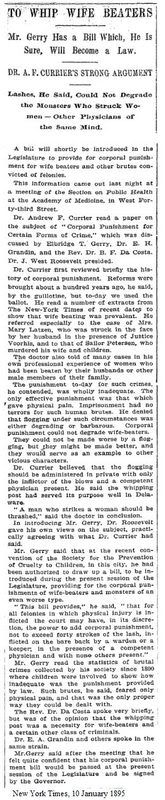 Mr. Gerry Has a Bill Which, He Is Sure, Will Become a Law.
To Whip Wife Beaters
Dr. A.F. Currier's Strong Argument
Lashes, He Said, Could Not Degrade the Monsters Who Struck Women -- Other Physicians of the Same Mind.
A bill will shortly be introduced in the Legislature to provide for corporal punishment for wife beaters and other brutes convicted of felonies.
This information came out last night at a meeting of the Section on Public Health at the Academy of Medicine, in West Forty-third Street.
Dr. Andrew F. Currier read a paper on the subject of "Corporal Punishment for Certain Forms of Crime," which was discussed by Elbridge T. Berry, Dr. E.H. Grandin, and the Rev. Dr. B.F. Da Costa. Dr. J. West Roosevelt presided.
Dr. Currier first reviewed briefly the history of corporal punishment. Reforms were brought about a hundred years ago, he said, by the guillotine, but to-day we used the ballot. He read a number of extracts from The New-York Times of recent dates to show that wife beating was prevalent. He referred especially to the case of Mrs. Mary Latzen, who was struck in the face by her husband in the presence of Justice Voorhis, and to that of Sailor Petersen, who murdered his wife and children.
The doctor also told of many cases in his own professional experience of women who had been beaten by their husbands or other male members of their family.
The punishment to-day for such crimes, he contended, was wholly inadequate. The only effective punishment was that which gave physical pain. Imprisonment had no terrors for such inhuman brutes. He denied that flogging under such circumstances was either degrading or barbarous. Corporal punishment could not degrade wife-beaters.
They could not be made worse by a flogging, but they might be made better, and they would serve as an example to other vicious characters.
Dr. Currier believed that the flogging should be administered in private with only the inflictor of the blows and a competent physician present. He said the whipping post had served its purpose well in Delaware.
"A man who strikes a woman should be thrashed," said the doctor in conclusion.
In introducing Mr. Gerry, Dr. Roosevelt gave his own views on the subject, practically agreeing with what Dr. Currier had said.
Mr. Gerry said that at the recent convention of the Society for the Prevention of Cruelty to Children, in this city, he had been authorized to draw up a bill, to be introduced during the present session of the Legislature, providing for the corporal punishment of wife-beaters and monsters of an even worse type.
"This bill provides," he said, "that for all felonies in which physical injury is inflicted the court may have, in its discretion, the power to add corporal punishment, not to exceed forty strokes of the lash, inflicted on the bare back by a warden or a keeper, in the presence of a competent physician and with none others present."
Mr. Gerry read the statistics of brutal crimes collected by his society since 1890 where children were involved to show how inadequate was the punishment provided by law. Such brutes, he said, feared only physical pain, and that was the only proper way they could be dealt with.
The Rev. Dr. Da Costa spoke very briefly, but was of the opinion that the whipping post was a necessity for wife-beaters and a certain other class of criminals.
Mr. Gerry said after the meeting that he felt quite confident that his corporal punishment bill would be passed at the present session of the Legislature and be signed by the Governor.
 Follow-up: 21 February 1895 - The Whipping-post Bill. To be Reported, with Wife Beaters Exempted from its Provisions.