
www.corpun.com

| www.corpun.com : Archive : Up to 1975 : UK Judicial Nov 1943 |
Corpun file 25191 at www.corpun.com
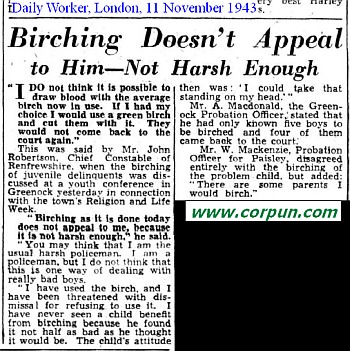
Daily Worker, London, 11 November 1943, p.1
Birching Doesn't Appeal to Him -- Not Harsh Enough
"I do not think it is possible to draw blood with the average birch now in use. If I had my choice I would use a green birch and cut them with it. They would not come back to the court again."
This was said by Mr. John Robertson. Chief Constable of Renfrewshire, when the birching of juvenile delinquents was discussed at a youth conference in Greenock yesterday in connection with the town's Religion and Life Week.
"Birching as it is done today does not appeal to me, because it is not harsh enough," he said."You may think that I am the usual harsh policeman. I am a policeman, but I do not think that this is one way of dealing with really bad boys.
"I have used the birch, and I have been threatened with dismissal for refusing to use it. I have never seen a child benefit from birching because he found it not half as bad as he thought it would be. The child's attitude then was: 'I could take that standing on my head.'"
Mr. Macdonald, the Greenock Probation Officer, stated that he had only known five boys to be birched and four of them came back to the court.
Mr. W. Mackenzie, Probation Officer for Paisley, disagreed entirely with the birching of the problem child, but added: "There are some parents I would birch."
Corpun file 19934 at www.corpun.com
Hereford Times, 13 November 1943
The Birched Boys
Hereford Public Inquiry Lasts Four Days
Great Volume of Evidence
Judge Probes Fact That Police Were Not Notified
(extracts)
The Hereford Public Inquiry, which has created national interest, came to a close at half-past four on Wednesday afternoon. It was opened on Saturday morning in the Assembly Room of the Hereford Town Hall [...]
The inquiry, which was conducted by Lord Justice Goddard, had lasted approximately 24 hours, during which a great volume of evidence was heard, related to the procedure in the Hereford Juvenile Court when three boys were charged with offences for which two of them were ordered to be birched, and placed under the care of the City Education Authority to be boarded-out away from their homes.
An appeal was lodged by the parents of one of the boys, Dennis Craddock, and the King's Bench Divisional Court unanimously quashed the conviction, the Lord Chief Justice (Lord Caldecote) and Lord Justice Charles and Lord Justice Hallett also passing severe strictures on the procedure at the Juvenile Court. Reports of these strictures and comments in the daily Press throughout the country were followed by questions and a motion tabled in the House of Commons, and the Home Secretary (Mr. Herbert Morrison) made a statement, in the course of which he announced that a Public Inquiry would be held. Meanwhile, a writ had been taken out by the parents of the boy Craddock against the three Magistrates who dealt with the case -- Mrs. Bentley-Taylor, Mrs. Ainslie and Mr. W.R. Bufton -- and against Chief Inspector Wheatley.
[...]
On Thursday it was stated in London that Mr. Herbert Morrison intends to publish the report in full at the earliest possible moment.
[...]Chief Inspector Wheatley was the first witness [...] He stated that he was the person who decided that the case should go forward.
The Inspector proceeded to say that there were three magistrates dealing with the case. [...] He detailed the charges and the pleas, and said that in opening the case he remarked at the end: "If ever there was a case which merited the birch on the facts as I knew them, this was a case for the birch."
The witness described what he recalled of the hearing, and said that after the Chairman's statement the boys were to be birched, and Mrs. Craddock was very distressed. The Chairman indicated that the parents could be present at the birching if they so desired.
Inspector Wheatley went on: "We waited a few moments to see whether the parents wanted to come, but apparently they did not. There was a sort of electric atmosphere for a moment, and then I told P.C. Colyer to take them over to the police station for the birching. When we left the Court there could be no doubt that they knew we were going to carry out the birching."
Mrs. Bentley-Taylor had said the birching should be carried out as soon as possible, so that the boys should have in mind that it was for that particular offence, and she asked that the officer in the case (P.C. Colyer) should do the actual birching.
[...]On the point that Mrs. Bentley-Taylor said that the whipping was to be done by P.C. Colyer, and a suggestion that she thought he would "beat him harder," witness said P.C. Colyer had six children of his own. Witness did not touch the boy, but two held his arms and another his legs. Dr. Ward-Smith was present, examined the boys, and said they were fit for birching. Witness did not tell P.C. Colyer to "bring it down with a good hard swish."
[...]"Did not make them bleed"
P.C. Stanley Charles Colyer was next called. After dealing with the events in the Juvenile Court he went on to describe what happened at the birching.
Mr. Platts Mills asked witness: "You made them bleed pretty well, didn't you, and brought up some heavy weals on their bottoms?"
Witness replied: "I did not, sir."
Mr. Platts Mills: "You took your coat and waistcoat off and rolled up your sleeves?"
Witness: I did not take off my coat, and I did not roll up my sleeves. I am the lightest man in the Force.
[...]Former clerk gives evidence
The last witness on Saturday was Mr. J.N. Martin, former Clerk to the City Justices and now a Sub-Lieutenant in the R.N.V.R. [...]
Replying to Mr. Platts Mills, he said, in regard to the order as to the birchings, the words "as soon as practicable" were used; if any other words had been used he would have corrected them. They also directed that the birchings should be in the presence of the parents if the parents desired it but he could not remember that the Chairman asked the parents specifically if they wanted to be present.
Witness further stated that following an interval of about 10 minutes, in which various matters were discussed, Mr. Craddock said he wanted to appeal. There was some discussion on this point, and Mr. Herbert, the School Attendance Officer, was asked to 'phone the police station to hold up the birching.
[...]MONDAY'S SITTING
"Birching Was Done in Humane Manner"
[...] Dr. Herbert Ward Smith was first called. He stated, in answer to Mr Parker, that he was summoned to the Police Station between noon and 1 o'clock, and examined the boys as to their fitness for birching. He did not make any report, but said to Inspector Wheatley, "Carry on." He was present when the boys were birched.
Mr. Parker: Quite generally, was the birching in your view conducted properly or not? -- Perfectly properly conducted.
Did P.C. Colyer take off his coat? -- Yes.
Lord Justice Goddard asked witness whether he was sure and he replied, "To the best of my recollection he did not have his uniform coat on."
Further answering Mr. Parker, Dr Ward Smith said that he did not see any blood drawn.
The Judge: Was the birching done in a humane or a brutal manner? -- In a humane manner.
In answer to Mr. Platts Mills, witness said he did not consider the humanity of this beating from a psychological point of view.
Mr. Platts Mills: Are you aware that the Home Office has taken steps, within the past five years, to end birching by statute? -- That is nothing whatever to do with me, I am afraid.
You said it was humane. Do you know that the Home Office Committee recommended unanimously that birching should cease?
The Judge: What has that got to do with it? I have called this gentleman to tell the tribunal whether the birching was done humanely or not.
Not a psychologist
Mr Platts Mills (to witness): If there was a psychological effect, this birching was likely to mar these boys mentally. Would you know that from your examination of their pulses, or whatever it was? -- I am afraid I am not a psychologist to answer that question.
You cannot tell whether the birching was humane or not, not being a qualified psychologist? -- The birching was done in a perfectly proper manner without violence or undue force.
[...]Solicitor Who Represented One of the Boys
Mr. F. Craze, who represented Craddock, was the next witness. He said he was Clerk to the Magistrates for Dore and Skentrith. Mr. Craddock went to him, he believed it was on the day before the case came before the Juvenile Court, and asked him to represent his boy. He had with him two summonses, and there was a question of damages to furniture. He gave Mr Craddock certain advice, and went to the Court on 12th January.
When he went into the Court entrance he saw the boys and their parents in the corridor, for the Juvenile Court was dealing with another matter. He saw Detective Davies talking to the three boys, and his recollection was that the parents were not sitting with them at the time, but were on the opposite side of the corridor.
"Detective Davies seemed to be taking a great deal of care and trouble with the boys," Mr. Craze added, "to see that they understood exactly what was happening."
[...]Mr. Craze proceeded to deal with what occurred after the decision of the Magistrates, and the birching of the boys. He said Mr. Craddock told him of what had occurred and he wrote to the Under Secretary of State for Home Affairs.
He received a reply to the effect that the circumstances had been inquired into, and it appeared that though it was made clear that the whipping was to be carried out as soon as practicable, and the boys were taken from the Court by the police with a view to the flogging being carried out, the question of an appeal was not raised until some 20 minutes later, and it was then found that the boys had been whipped. In those circumstances, the Under-Secretary of State could take no further action.
[...]Replying to Mr. Platts Mills, Mr. Craze said he did not want to go into matters which occurred when he was not present in Court, but if what Mr. Craddock said about the boys being taken from the Court and whipped before he had had time to consider the question of an appeal, he would presume that it was the Magistrates' Clerk's fault. "If it had been in my Court," Mr. Craze said, "when the decision had been announced, I should have said to the parents, 'Do you wish to appeal?' If they had said 'No' I should have said to the police 'Carry on.'"
Mr O.B. Wallis testifies
After Mr T. Watkins, clerk to the firm of Messrs. E.L. Wallis and Son, solicitors, had stated that on 25th January Mr. and Mrs. Payne came to see if Mr O.B. Wallis would defend their son and Mrs. Payne on certain charges -- adding that no mention of any charge of malicious damage was made.
Mr. Wallis gave evidence that he went to the second hearing of the case with instructions to plead in mitigation of sentence on behalf of the boy Payne. His instructions were that the boy "had pleaded guilty and had been convicted of the two charges of larceny." [...] With regard to the sentence of birching, he at once asked the Paynes if they wished to be present at it, and they said no.
After P.C. Colyer had taken the boys away he (witness) and the parents were in the lobby outside the Court when Mr. Craddock asked him if he could appeal. Witness referred him to the Clerk. He discussed the question of appeal with his clients who decided not to. "I think possibly they were all rather stunned by what had taken place," Mr. Wallis remarked, and after some minutes they were called back into the Court. Mr. Craddock had already come in and was facing the Clerk who had his finger in Stone's Justices' Manual and was saying, "Yes, you have a right to appeal."
[...]Evidence of the Court Chairman
Next to be called was Mrs. Bentley-Taylor; there was a quickening of interest in the hall as she came forward to the witness table.
[...]At the conclusion of his opening statement the Chief Inspector, in making the comment about use of the birch did not refer to any particular boy. It was the second time she had ordered a birching; on the previous occasion, a long time ago, the doctor could not pass the boy as being fit.
She went on to say that after the evidence had been called -- the prosecution's witnesses not being cross-examined as to facts -- it was obvious that the offence was a very serious one; Mr. Jones's evidence was very definite. Mr. Craze addressed the Bench in mitigation, there being no suggestion that Craddock was not guilty nor partly responsible for some of the damage, but she could not remember whether the solicitor made any reference to Craddock's having previously been on probation. As to how and when they reached their decision at the end of the afternoon's hearing, she thought they cleared the Court and discussed privately with their Clerk what was best to be done. Mr. Martin indicated that Richards was too young and undeveloped to have formed any criminal intention and advised that he be dismissed. The case against the others was adjourned for a medical report to be obtained [...]
The birching decision
On the 26th, continued Mrs. Bentley-Taylor, Mr. Herbert handed in the medical report for which they had adjourned the case. Mr. Wallis addressed them in mitigation; the Court was cleared, and they considered what was to be done. The parents were brought back into Court and they announced their decision. [...]
Asked if she knew whether she said anything further specifically to the parents, Mrs. Bentley-Taylor said she asked them if they wished to be present at the birching. She was quite sure that it was to the parents that she mentioned the option of their being present, and not to the children.
[...]Mrs. Craddock was showing signs of distress, and she spoke to her and told her that they had often boarded out children through the Education Authority, and what a very successful way it had proved of getting children out of bad habits and the bad company into which they had fallen. [...] Mrs. Craddock's reply was to the effect that she thought it might be quite a good thing for him to get away, but she did not like the birching. It was just at that time that Mr. Craddock came back and said that he wished to appeal. She knew he was there when Mrs. Craddock said she did not like the birching.
Mr. Craddock, continued witness, asked if he could appeal. She asked the Clerk, who hesitated for a moment, and she thought he said he was not sure there was an appeal from the Juvenile Court. He then began to look it up, and after quite a few minutes -- she thought he looked it up in two reference books -- he said there was a right of appeal. She then asked the Clerk's assistant if he would go across at once to the Police Station and stop the birching as Mr. Craddock wished to appeal.
[...]In answer to Mr. Howard, Mrs. Bentley-Taylor said that no mention was made of appealing when the decision regarding the birching was announced. If it had been given she would not have allowed the birching to go forward.
The Judge: How long do you suppose elapsed between the time you actually pronounced the sentence of birching and anything being said about the appeal which caused you send a messenger across to the police station? -- I should say about 20 minutes.
[...]Mr. Craddock's evidence
Mr. Harold Ernest Craddock, fitter at an R.O.F. factory, whose address since July has been Craig Farm, Pontrilas, was called next. [...] Regarding the hearing on 26th January, Mr. Craddock said that when the Court assembled he believed there was some argument about the charges [...] The Court was cleared for a time, and when they returned Mrs. Bentley-Taylor announced that the boys would be privately whipped with four strokes of the birch rod in the presence of a Police Inspector and in the presence of the boys' parents, if they so desired. Before that she said that the boys would be sent away in the care of the Education Authority.
Mr. Parker: What happened then? -- As soon as the sentence was given the police officer beckoned to the boys to come out of Court. The boys were then in a seat in front of us.
Did you follow? -- I did not. Mrs. Bentley-Taylor went on to say something about payments. I immediately said "I wish to appeal." When I said "I wish to appeal" she turned to the Magistrates' Clerk and said "Has Mr. Craddock the right to appeal?" I said "As a special constable I can tell you if you do not know." By that time the Clerk had looked up the book.
[...] "Mrs. Bentley-Taylor then frantically said 'Run, run. Mr. Craddock is appealing. Send someone at once to the Police Station.' In the meantime while the junior clerk -- he was the one sent -- was away she turned to Mr. Payne, and said "Do you wish to appeal also?' Mr. Payne said 'I cannot afford to appeal.' [...]
[...]Continuing, Mr. Craddock said "At that time the junior clerk came running in very breathlessly, saying 'It is too late. The birching has been carried out.' My wife then frantically ran out of the room. Mr. and Mrs. Payne also followed, I believe. I stood a little while in hesitation and then I went to the Police Station, or partly to the Police Station. I met my wife returning from the Police Station. She said 'The boys have been birched and gone home.'
His lordship: They did not wait for you? -- No. I returned back to the Court room. The Court was still sitting. I said to the Bench -- the Magistrates' Clerk particularly and Mrs. Bentley-Taylor -- that they would hear more of this, they did not know their work, and I informed my solicitor.
What was particularly in your mind? -- I think if the Clerk had said I could have appealed it would never have happened. I was then told to sit down and take things quietly, to sit on a chair. I refused to do so, and put the chair under the table, leaving the Court disgusted.
[...]"The Court was still sitting"
Mr. Craddock was next asked why he did not go with the boys when they were to be birched, he having been given that opportunity. He replied, "Because it was given out 'as soon as possible after this Court.' The Court was still sitting, and when the Court was still sitting, it had not finished, had it? After the Court I expected to go."
[...]Answering his lordship, witness said that he knew P.C. Colyer before he joined the Police Force, and had been on perfectly friendly terms with him.
Witness, answering Mr. Howard, denied that he had any conversation with P.C. Colyer before the proceedings on 26th January, and denied that he asked him who was going to do the birching.
His lordship: You knew the case had been adjourned for a medical report. Was it in the back of your mind that there was the possibility of whipping? -- I did not know what the medical report was really for. I thought it might be whipping. That is why I went to the Court with the full intention of appealing if it came off. [...]
His lordship: How long do you think -- I know it is difficult to remember exactly -- elapsed between the Magistrates saying that the sentence was one of whipping to the time you said you desired to appeal? -- Immediately after, as far as I can recollect. Mrs. Bentley-Taylor was talking, and I did not interrupt her possibly for one or two minutes. Not any more. I should say I then said I wanted to appeal.
[...]Counsels' Submissions to the Judge
Wednesday afternoon was entirely devoted to speeches by counsel, which mainly took the form of discussions with the Judge on various issues in the matter.
[...]Another submission made by counsel was that there should have been no whipping as well as taking away from the home, and that the Court and the police erred in carrying out the whipping immediately. Mr. Platts Mills went on to deal with the question of appeal, and his lordship made this comment, 'I think, myself, that the draftsman of the Act overlooked the question of appeal, and it may be that is a matter which might have to be put right by legislation. It is putting the Courts and police officers in great difficulties. There is nothing worse than for a child to have a whipping hanging over his head for 14 days before it is carried out."
[...]Lord Justice Goddard indicated on rising that he would make his report to the Home Secretary in due course. The inquiry concluded at 4.25 p.m.
Corpun file 19936 at www.corpun.com
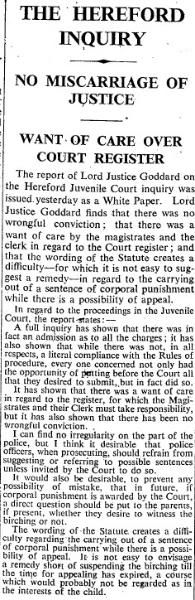
The Times, London, 23 November 1943
The Hereford Inquiry
No Miscarriage of Justice
Want of Care Over Court Register
The report of Lord Justice Goddard on the Hereford Juvenile Court inquiry was issued yesterday as a White Paper. Lord Justice Goddard finds that there was no wrongful conviction; that there was a want of care by the magistrates and the clerk in regard to the Court register; and that the wording of the Statute creates a difficulty -- for which it is not easy to suggest a remedy -- in regard to the carrying out of a sentence of corporal punishment while there is a possibility of appeal.
In regard to the proceedings in the Juvenile Court, the report states:--
A full inquiry has shown that there was in fact an admission as to all the charges; it has also shown that while there was not, in all respects, a literal compliance with the Rules of procedure, every one concerned not only had the opportunity of putting before the Court all that they desired to submit, but in fact did so.
It has shown that there was a want of care in regard to the register, for which the Magistrates and their Clerk must take responsibility, but it has also shown that there has been no wrongful conviction.
I can find no irregularity on the part of the police, but I think it desirable that police officers, when prosecuting, should refrain from suggesting or referring to possible sentences unless invited by the Court to do so.
It would also be desirable, to prevent any possibility of mistake, that in future, if corporal punishment is awarded by the Court, a direct question should be put to the parents, if present, whether they desire to witness the birching or not.
The wording of the Statute creates a difficulty regarding the carrying out of a sentence of corporal punishment while there is a possibility of appeal. It is not easy to envisage a remedy short of suspending the birching till the time for appealing has expired, a course which would probably not be regarded as in the interests of the child.
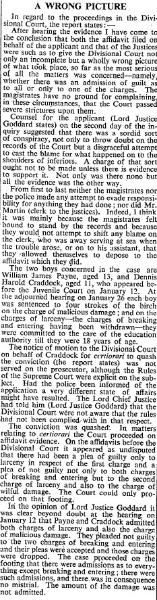
A Wrong Picture
In regard to the proceedings in the Divisional Court, the report states:--
After hearing the evidence I have come to the conclusion that both the affidavit filed on behalf of the applicant and that of the Justices were such as to give the Divisional Court not only an incomplete but a wholly wrong picture of what look place, so far as the most serious of all the matters was concerned -- namely, whether there was an admission of guilt as to all or only to one of the charges. The magistrates have no ground for complaining, in these circumstances, that the Court passed severe strictures upon them.
Counsel for the applicant (Lord Justice Goddard states) on the second day of the inquiry suggested that there was a sordid sort of conspiracy, not only to throw doubt on the records of the Court but a disgraceful attempt to cast the blame for what happened on to the shoulders of inferiors. A charge of that sort ought not to be made unless there is evidence to support it. Not only was there none but all the evidence was the other way.
From first to last neither the magistrates nor the police made any attempt to evade responsibility for anything they had done; nor did Mr. Martin (clerk to the justices). Indeed, I think it was mainly because the magistrates felt bound to stand by the records and because they would not attempt to shift any blame on the clerk, who was away serving at sea when the trouble arose, or on to his assistant, that they allowed themselves to depose to the affidavit which they did.
The two boys concerned in the case are William James Payne, aged 13, and Dennis Harold Craddock, aged 11, who appeared before the Juvenile Court on January 12. At the adjourned hearing on January 26 each boy was sentenced to four strokes of the birch on the charge of malicious damage; and on the charges of larceny -- the charges of breaking and entering having been withdrawn -- they were committed to the care of the education authority till they were 18 years of age.
The notice of motion to the Divisional Court on behalf of Craddock for certiorari to quash the conviction (the report states) was not served on the prosecutor, although the Rules of the Supreme Court were explicit on the subject. Had the police been informed of the application a very different state of affairs might have resulted. The Lord Chief Justice had told him (Lord Justice Goddard) that the Divisional Court were not aware that the rules had not been complied with in that respect.
The conviction was quashed. In matters relating to certiorari the Court proceeded on affidavit evidence. On the affidavits before the Divisional Court it appeared as undisputed that there had been a plea of guilty only to larceny in respect of the first charge and a plea of not guilty not only to both charges of breaking and entering but to the second charge of larceny and also to the charge of wilful damage. The Court could only proceed on that footing.
In the opinion of Lord Justice Goddard it was clear beyond doubt at the hearing on January 12 that Payne and Craddock admitted both charges of larceny and also the charge of malicious damage. They pleaded not guilty to the two charges of breaking and entering and their pleas were accepted and those charges were dropped. The case proceeded on the footing that there were admissions as to everything except breaking and entering; there were such admissions, and there was in consequence no mistrial. The amount of the damage was not admitted.
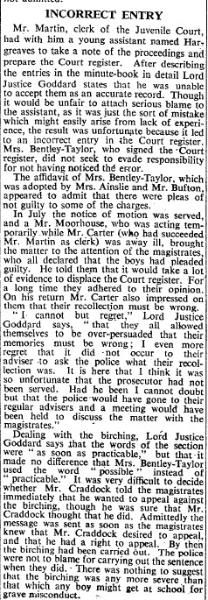
Incorrect Entry
Mr. Martin, clerk of the Juvenile Court, had with him a young assistant named Hargreaves to take a note of the proceedings and prepare the Court register. After describing the entries in the minute-book in detail Lord Justice Goddard states that he was unable to accept them as an accurate record. Though it would be unfair to attach serious blame to the assistant, as it was just the sort of mistake which might easily arise from lack of experience, the result was unfortunate because it led to an incorrect entry in the Court register. Mrs. Bentley-Taylor, who signed the Court register, did not seek to evade responsibility for not having noticed the error.
The affidavit of Mrs. Bentley-Taylor, which was adopted by Mrs. Ainslie and Mr. Bufton, appeared to admit that there were pleas of not guilty to some of the charges.
In July the notice of motion was served, and a Mr. Moorhouse, who was acting temporarily while Mr. Carter (who had succeeded Mr. Martin as clerk) was away ill, brought the matter to the attention of the magistrates, who all declared that the boys had pleaded guilty. He told them that it would take a lot of evidence to displace the Court register. For a long time they adhered to their opinion. On his return Mr. Carter also impressed on them that their recollection must be wrong.
"I cannot but regret," Lord Justice Goddard says, "that they all allowed themselves to be over-persuaded that their memories must be wrong; I even more regret that it did not occur to their adviser to ask the police what their recollection was. It is here that I think it was so unfortunate that the prosecutor had not been served. Had he been I cannot doubt but that the police would have gone to their regular advisers and a meeting would have been held to discuss the matter with the magistrates."
Dealing with the birching, Lord Justice Goddard says that the words of the section were "as soon as practicable," but that it made no difference that Mrs. Bentley-Taylor used the word "possible" instead of "practicable." It was very difficult to decide whether Mr. Craddock told the magistrates immediately that he wanted to appeal against the birching, though he was sure that Mr. Craddock thought that he did. Admittedly the message was sent as soon as the magistrates knew that Mr. Craddock desired to appeal, and that he had a right to appeal. By then the birching had been carried out. The police were not to blame for carrying out the sentence when they did. There was nothing to suggest that the birching was any more severe than that which any boy might get at school for grave misconduct.
Corpun file 19935 at www.corpun.com
The Times, London, 23 November 1943
[Editorial]
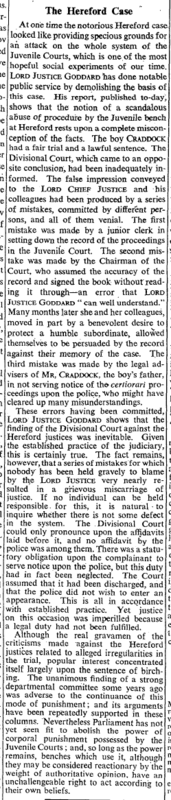
The Hereford Case
At one time the notorious Hereford case looked like providing specious grounds for an attack on the whole system of the Juvenile Courts, which is one of the most hopeful social experiments of our time. LORD JUSTICE GODDARD has done notable public service by demolishing the basis of this case. His report, published to-day, shows that the notion of a scandalous abuse of procedure by the Juvenile bench at Hereford rests upon a complete misconception of the facts. The boy CRADDOCK had a fair trial and a lawful sentence. The Divisional Court, which came to an opposite conclusion, had been inadequately informed. The false impression conveyed to the LORD CHIEF JUSTICE and his colleagues had been produced by a series of mistakes, committed by different persons, and all of them venial. The first mistake was made by a junior clerk in setting down the record of the proceedings in the Juvenile Court. The second mistake was made by the Chairman of the Court, who assumed the accuracy of the record and signed the book without reading it through -- an error that LORD JUSTICE GODDARD "can well understand." Many months later she and her colleagues, moved in part by a benevolent desire to protect a humble subordinate, allowed themselves to be persuaded by the record against their memory of the case. The third mistake was made by the legal advisers of MR. CRADDOCK, the boy's father, in not serving notice of the certiorari proceedings upon the police, who might have cleared up many misunderstandings.
These errors having been committed, LORD JUSTICE GODDARD shows that the finding of the Divisional Court against the Hereford justices was inevitable. Given the established practice of the judiciary, this is certainly true. The fact remains, however, that a series of mistakes for which nobody has been held gravely to blame by the LORD JUSTICE very nearly resulted in a grievous miscarriage of justice. If no individual can be held responsible for this, it is natural to inquire whether there is not some defect in the system. The Divisional Court could only pronounce upon the affidavits laid before it, and no affidavit by the police was among them. There was a statutory obligation upon the complainant to serve notice upon the police, but this duty had in fact been neglected. The court assumed that it had been discharged, and that the police did not wish to enter an appearance. This is all in accordance with established practice. Yet justice on this occasion was imperilled because a legal duty had not been fulfilled.
Although the real gravamen of the criticisms made against the Hereford justices related to alleged irregularities in the trial, popular interest concentrated itself largely upon the sentence of birching. The unanimous finding of a strong departmental committee some years ago was adverse to the continuance of this mode of punishment; and its arguments have been repeatedly supported in these columns. Nevertheless Parliament has not yet seen fit to abolish the power of corporal punishment possessed by the Juvenile Courts; and, so long as the power remains, benches which use it, although they may be considered reactionary by the weight of authoritative opinion, have an unchallengeable right to act according to their own beliefs.
Follow-up: 6 December 1943 - The strange case of Hereford's birching (illustrated)
Corpun file 19938 at www.corpun.com
The Times, London, 25 November 1943
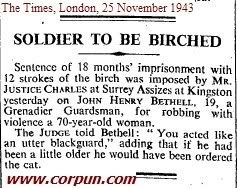
Soldier to be birched
Sentence of 18 months' imprisonment and 12 strokes of the birch was imposed by Mr. Justice Charles at Surrey Assizes at Kingston yesterday on John Henry Bethell, 19, a Grenadier Guardsman, for robbing with violence a 70-year-old woman.
The Judge told Bethell: "You acted like an utter blackguard," adding that if he had been a little older he would have been ordered the cat.
About this website
Search this site
Article: Judicial CP in Britain
JCP pictures: United Kingdom
Archive up to 1975: UK
Other external links for UK JCP
Video clips
Picture index
Following month
www.corpun.com Main menu page
Copyright © C. Farrell 2001, 2008, 2014
Page updated September 2014