


| www.corpun.com : Archive : Up to 1975 : UK Judicial Mar 1900 |
|
Corpun file 18600 at www.corpun.com
The Times, London, 6 March 1900Parliament.House of Lords.[...] Youthful Offenders Bill.LORD JAMES OF HEREFORD moved the second reading of this Bill, the object of which is to substitute whipping for imprisonment as a punishment for children and young persons. Various causes had contributed to reduce the number of convictions for indictable offences in recent years, yet still there was opportunity for doing more to check the supply of habitual offenders, and for that purpose the Bill was designed.
The Bill, which was identical with that which passed the House last Session, provided that a child or young person being a male convicted by indictment or summarily of any offence other than homicide may be adjudged to be privately whipped with a birch rod by a constable in the presence of an inspector, to the extent of six strokes for a child of six, 12 for a boy under 14, and 18 in other cases. A young offender being remanded might, under the 4th clause, instead of being sent to prison, be placed in the custody of any fit person willing to receive him, and should the boy escape he might be arrested without warrant. [...] The 5th clause gave powers to Courts of assize and quarter sessions to commit to an industrial school. EARL CARRINGTON said he was glad to find by Clause 1 of the Bill a child under 12 was not to receive more than 12 strokes with the birch rod. Eighteen strokes was the maximum number which could be inflicted on a boy of any age. That was rather too high, for noble Lords would remember that when they were at school they never received more than 12. (Laughter.) LORD NORTON expressed his gratitude to Lord James for introducing this Bill. His noble friend had hit two or three important points where the law was most defective. Sending children to prison was most cruel. Corporal punishment had a much more deterrent effect. In 99 cases out of every 100 the parents were the really guilty persons. In recent years the State had placed itself far too much in loco parentis towards children, thus relieving parents of their proper responsibility. [...] The EARL of KIMBERLEY said he did not view the Bill with unqualified dissatisfaction. There was a good deal to be said both ways. There was a strong argument in favour of a Bill of this kind from the desire that children should not be sent to prison. He entirely sympathized with that desire; but they must not shut their eyes to the disadvantages of and objections to a system of whipping. His noble friend had told them it would be seldom that a boy who had been whipped once would come back again. He could tell their lordships on excellent authority that, at the school where he was, a boy, not unconnected with that assembly, though not a member of it, came back 18 times. (Laughter.) He knew boys personally who did not care in the slightest degree how often they were whipped, and he could mention a very distinguished person who was not present who did not care a fig about it. (Laughter.) Therefore he did not suppose that whipping was a perfectly efficacious remedy. He somewhat questioned the wisdom of a maximum of 18 strokes, because they were going to entrust the administration of this Bill to every justice throughout the country sitting in petty sessions, and any offence, however small, might be punished by whipping. He did not wish to decry his brother justices, but in so large a body there were men who took a wrong view of punishment, and there might be an outcry against whipping. He welcomed the provision by which boys who were going to reformatories would not be sent to prison, and he hoped the Bill would work well. The BISHOP of WINCHESTER thanked the noble lord for introducing this Bill. Though it was a small measure it might be far-reaching in its consequences. With regard to the remarks of the noble earl as to the danger of entrusting these powers to unwise or over-severe justices, he thought that if in after life a boy would be the worse for a mistaken whipping he would be ten thousand times worse for six months' imprisonment, which was the alternative. [...] He believed that if this Bill became law it would effect an untold amount of good. The Bill was then read a second time. Corpun file 25470 at www.corpun.com
The Times, London, 13 March 1900, p.10House of Lords. Monday, March 12.Youthful Offenders Bill.(extracts)The House went into Committee on this Bill. On Clause 1, [...] The EARL OF ELGIN said there was, in certain quarters, much of the feeling that the punishment of whipping, even with a birch rod, brought with it a certain amount of degradation to a boy. He did not understand that magistrates objected to whipping per se. If it could be inflicted by the parental arm, they would not object, but they objected to its being inflicted by a policeman in the cells. The result was that, in some places in Scotland, they were face to face with the difficulty Lord James had referred to -- that, up to a certain age boys felt themselves practically free from the penalties of the law. The magistrates felt that if they inflict a fine with the alternative of imprisonment the child knew that he would not be sent to prison, and the magistrates being unwilling to order whipping there was no other course open to them. The alternative presented in the fourth clause of the Bill -- namely, that there should be some place of confinement distinct from a prison to which the youthful offender could be committed -- appeared to him to be best suited to meet this difficulty. VISCOUNT CROSS said the punishment of whipping boys in place of imprisoning them had commended itself strongly in many parts of the country. It had been in force ever since the Summary Jurisdiction Act of 1879, which he had the honour of passing through the House of Commons, and he had never heard a complaint against it. It was a great matter to keep children out of prison by inflicting some small punishment. (Hear.) The MARQUIS of SALISBURY. -- I rise to make a slight protest against the idea that flogging these boys inflicts a contamination upon them and that this House is doing it exceptionally to the poor and not to the rich. My impression is that if you will examine the past record of Members of this House (laughter) you will find that it has been very frequently inflicted, and that there is no trace of contamination surviving. (Renewed laughter.) I cannot understand why the arm of a policeman should be more contaminating than the arm of a parent. I am sure that, in the public schools of this country, it would be thought an odd thing if you had to send for a parent from a distant county in order to perform the operation of flogging a pupil. There is a great deal of silly sentimentality on the subject, which is not shared by the vast mass of the people of this country. It is only shown by a narrow section. I quite admit it is possible to carry whipping to a cruel extent, and all cruelty ought to be scrupulously avoided. On the other hand, you must not judge the effect of a flogging by its effect on the boy himself. The great value of flogging is to the people who are not flogged; the great value is the deterrent it offers to others, who see what evil courses lead to. (Hear, hear.) I can only say I should be as anxious as anyone to make no difference in the punishment of the rich and the poor. I only hope you will flog the evildoer as freely and with as little scruple among the classes of the poor as you have for centuries among the classes of the rich. (Hear, hear.) The EARL of KIMBERLEY said that no doubt there was a great deal of force in what the noble marquis had said. In matters of this kind he hoped the noble marquis would agree with him that the punishment to be inflicted should be one which would meet with the approval of the class to which the boys to be punished belonged. In order effectively to carry out the law there must be behind it a state of public opinion which supports the administration of the law; otherwise, what Lord Elgin had referred to was likely to occur. People felt -- he did not say this was a conclusive argument against the Bill, but it is one that deserved careful consideration -- and he knew there existed a prejudice amongst the class to which these boys belonged against this punishment. For some reason they looked upon it in a different light from what noble lords did, and this must be taken into consideration. The problem was, he was aware, a difficult one. It was obvious that they all desired to keep children out of the prisons, but that, on the other hand, there must be some punishment. If it was too severe they would defeat their object. With regard to older boys who had committed grave offences, if they were not sent for trial but dealt with summarily light punishment could not be inflicted. In days when there were no reformatories, in a village near where he resided, a child set fire deliberately to a shed, with disastrous results. The only thing the magistrates (of whom he was one) could do was commit him for trial for arson. Instead of taking this course they decided merely to administer a reprimand. He only hoped the Bill not be pushed too far, but that the law would be administered in such a way as to allay existing prejudice. [...]  Note by C.F.: This Bill would have extended magistrates' birching powers to male offenders aged 15 and 16 and to a wider range of offences, broadly bringing England and Wales into line with the position in Scotland. The Bill completed its passage of the House of Lords but ran out of time in the House of Commons and therefore fell. Note by C.F.: This Bill would have extended magistrates' birching powers to male offenders aged 15 and 16 and to a wider range of offences, broadly bringing England and Wales into line with the position in Scotland. The Bill completed its passage of the House of Lords but ran out of time in the House of Commons and therefore fell.Corpun file 18601 at www.corpun.com
The Times, London, 29 March 1900Corporal Punishment.
In each case the punishment was ordered to be inflicted with the "cat." In 55 cases the offenders were ordered to be whipped once, in nine cases twice, and in one instance three times, the total number of strokes inflicted on each offender ranging from ten to 25. Of the 65 sentences included in the list, 44 were passed at the Central Criminal Court, 35 of these being by the Recorder and nine by the Common Serjeant. Of the remainder 16 were passed at different assizes by Mr. Justice Day, three by Mr. Justice Grantham, one by Mr. Justice Darling, and one by Commissioner Buszard. Note by C.F.: As written, this item is a bit misleading: it evidently refers only to adult floggings ordered by the superior courts and excludes the much more numerous juvenile birchings ordered by local magistrates. |

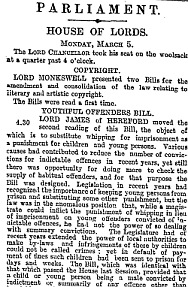 Legislation in recent years had recognized the importance of
keeping young persons from prison and substituting some other
punishment, but the law was in the anomalous position that, while
a magistrate could inflict the punishment of whipping in lieu of
imprisonment on young offenders convicted of indictable offences,
he had not the power of so dealing with summary convictions. The
Legislature had of recent years extended the power of local
authorities to make by-laws and infringements of these by
children could not be called crimes; yet in default of payment of
fines such children had been sent to prison for days and weeks.
Legislation in recent years had recognized the importance of
keeping young persons from prison and substituting some other
punishment, but the law was in the anomalous position that, while
a magistrate could inflict the punishment of whipping in lieu of
imprisonment on young offenders convicted of indictable offences,
he had not the power of so dealing with summary convictions. The
Legislature had of recent years extended the power of local
authorities to make by-laws and infringements of these by
children could not be called crimes; yet in default of payment of
fines such children had been sent to prison for days and weeks.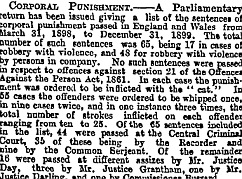 A Parliamentary return has been issued giving a list of the
sentences of corporal punishment passed in England and Wales from
March 31, 1898, to December 31, 1899. The total number of such
sentences was 65, being 17 in cases of robbery with violence, and
48 for robbery with violence by persons in company. No such
sentences were passed in respect to offences against section 21
of the Offences Against the Person Act, 1861.
A Parliamentary return has been issued giving a list of the
sentences of corporal punishment passed in England and Wales from
March 31, 1898, to December 31, 1899. The total number of such
sentences was 65, being 17 in cases of robbery with violence, and
48 for robbery with violence by persons in company. No such
sentences were passed in respect to offences against section 21
of the Offences Against the Person Act, 1861.